For the following questions answer them individually
List-I shows different radioactive decay processes and List-II provides possible emitted particles. Match each entry in List-I with an appropriate entry from List-II, and choose the correct option.
| List-I | List-II | ||
|---|---|---|---|
| (P) | $${}^{238}_{92}U \to {}^{234}_{91}Pa$$ | (1) | one $$\alpha$$ particle and one $$\beta^+$$ particle |
| (Q) | $${}^{214}_{82}Pb \to {}^{210}_{82}Pb$$ | (2) | three $$\beta^-$$ particles and one $$\alpha$$ particle |
| (R) | $${}^{210}_{81}Tl \to {}^{206}_{82}Pb$$ | (3) | two $$\beta^-$$ particles and one $$\alpha$$ particle |
| (S) | $${}^{228}_{91}Pa \to {}^{224}_{88}Ra$$ | (4) | one $$\alpha$$ particle and one $$\beta^-$$ particle |
| (5) | one $$\alpha$$ particle and two $$\beta^+$$ particles | ||
Match the temperature of a black body given in List-I with an appropriate statement in List-II, and choose the correct option.
[Given: Wien's constant as $$2.9 \times 10^{-3}$$ m-K and $$\frac{hc}{e} = 1.24 \times 10^{-6}$$ V-m]
| List-I | List-II | ||
|---|---|---|---|
| (P) | 2000 K | (1) | The radiation at peak wavelength can lead to emission of photoelectrons from a metal of work function 4 eV |
| (Q) | 3000 K | (2) | The radiation at peak wavelength is visible to human eye. |
| (R) | 5000 K | (3) | The radiation at peak emission wavelength will result in the widest central maximum of a single slit diffraction. |
| (S) | 10000 K | (4) | The power emitted per unit area is 1/16 of that emitted by a blackbody at temperature 6000 K. |
| (5) | The radiation at peak emission wavelength can be used to image human bones. | ||
A series LCR circuit is connected to a 45 sin($$\omega t$$) Volt source. The resonant angular frequency of the circuit is $$10^5$$ rad s$$^{-1}$$ and current amplitude at resonance is $$I_0$$. When the angular frequency of the source is $$\omega = 8 \times 10^4$$ rad s$$^{-1}$$, the current amplitude in the circuit is 0.05 $$I_0$$. If $$L = 50$$ mH, match each entry in List-I with an appropriate value from List-II and choose the correct option.
| List-I | List-II | ||
|---|---|---|---|
| (P) | $$I_0$$ in mA | (1) | 44.4 |
| (Q) | The quality factor of the circuit | (2) | 18 |
| (R) | The bandwidth of the circuit in rad s$$^{-1}$$ | (3) | 400 |
| (S) | The peak power dissipated at resonance in Watt | (4) | 2250 |
| (5) | 500 | ||
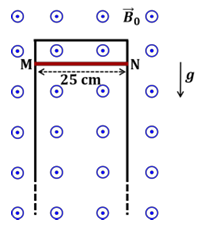
A thin conducting rod MN of mass 20 gm, length 25 cm and resistance 10 $$\Omega$$ is held on frictionless, perfectly conducting vertical rails as shown in the figure. There is a uniform magnetic field $$B_0 = 4$$ T directed perpendicular to the plane of the rod-rail arrangement. The rod is released from rest at time t = 0 and it moves down along the rails. Assume air drag is negligible. Match each quantity in List-I with an appropriate value from List-II, and choose the correct option.
[Given: The acceleration due to gravity $$g = 10$$ ms$$^{-2}$$ and $$e^{-1} = 0.4$$]
| List-I | List-II | ||
|---|---|---|---|
| (P) | At $$t = 0.2$$ s, the magnitude of the induced emf in Volt | (1) | 0.07 |
| (Q) | At $$t = 0.2$$ s, the magnitude of the magnetic force in Newton | (2) | 0.14 |
| (R) | At $$t = 0.2$$ s, the power dissipated as heat in Watt | (3) | 1.20 |
| (S) | The magnitude of terminal velocity of the rod in m s$$^{-1}$$ | (4) | 0.12 |
| (5) | 2.00 | ||
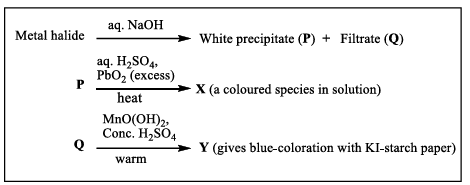
The correct statement(s) related to processes involved in the extraction of metals is(are)
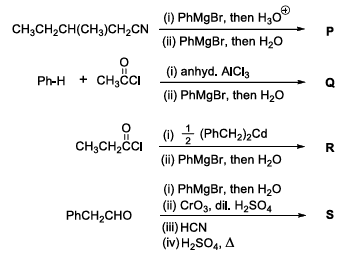
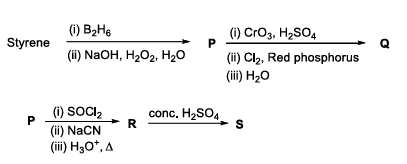
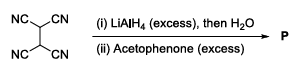
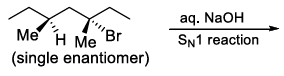
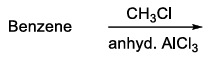
In the following reactions, P, Q, R, and S are the major products.
The correct statement(s) about P, Q, R, and S is(are)
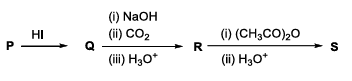
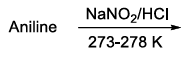
Consider the following reaction scheme and choose the correct option(s) for the major products Q, R and S.
In the scheme given below, X and Y, respectively, are
Plotting $$1/\Lambda_m$$ against $$c\Lambda_m$$ for aqueous solutions of a monobasic weak acid (HX) resulted in a straight line with y-axis intercept of P and slope of S. The ratio P/S is
[$$\Lambda_m$$ = molar conductivity, $$\Lambda_m^\circ$$ = limiting molar conductivity, c = molar concentration, $$K_a$$ = dissociation constant of HX]
On decreasing the pH from 7 to 2, the solubility of a sparingly soluble salt (MX) of a weak acid (HX) increased from $$10^{-4}$$ mol L$$^{-1}$$ to $$10^{-3}$$ mol L$$^{-1}$$. The pK$$_a$$ of HX is: