91- 6303239042


 Preferred Source

 Google Discover
CAT RC Genres 2026
CAT Reading Comprehension (RC) passages can come from a wide range of subjects. You may encounter a passage about philosophy in one set and science, society, history, economics, or literature in another. While the topics can vary, the writing styles, argument structures, and question patterns often follow familiar patterns.
This is where genre-wise CAT RC practice can help.
Instead of solving completely random passages every day, you can practise RCs from different genres and learn how to approach each type of passage. This helps you become more comfortable with unfamiliar topics, identify the author's central argument, understand the tone, and solve inference-based questions more accurately.
In this article, we will cover the major CAT RC genres, how to identify them, how to approach different types of passages, and how to use genre-wise RC practice to improve your CAT VARC preparation.
What Are CAT RC Genres?
CAT RC genres are broad categories used to classify Reading Comprehension passages based on their subject, writing style, and the type of argument being presented.
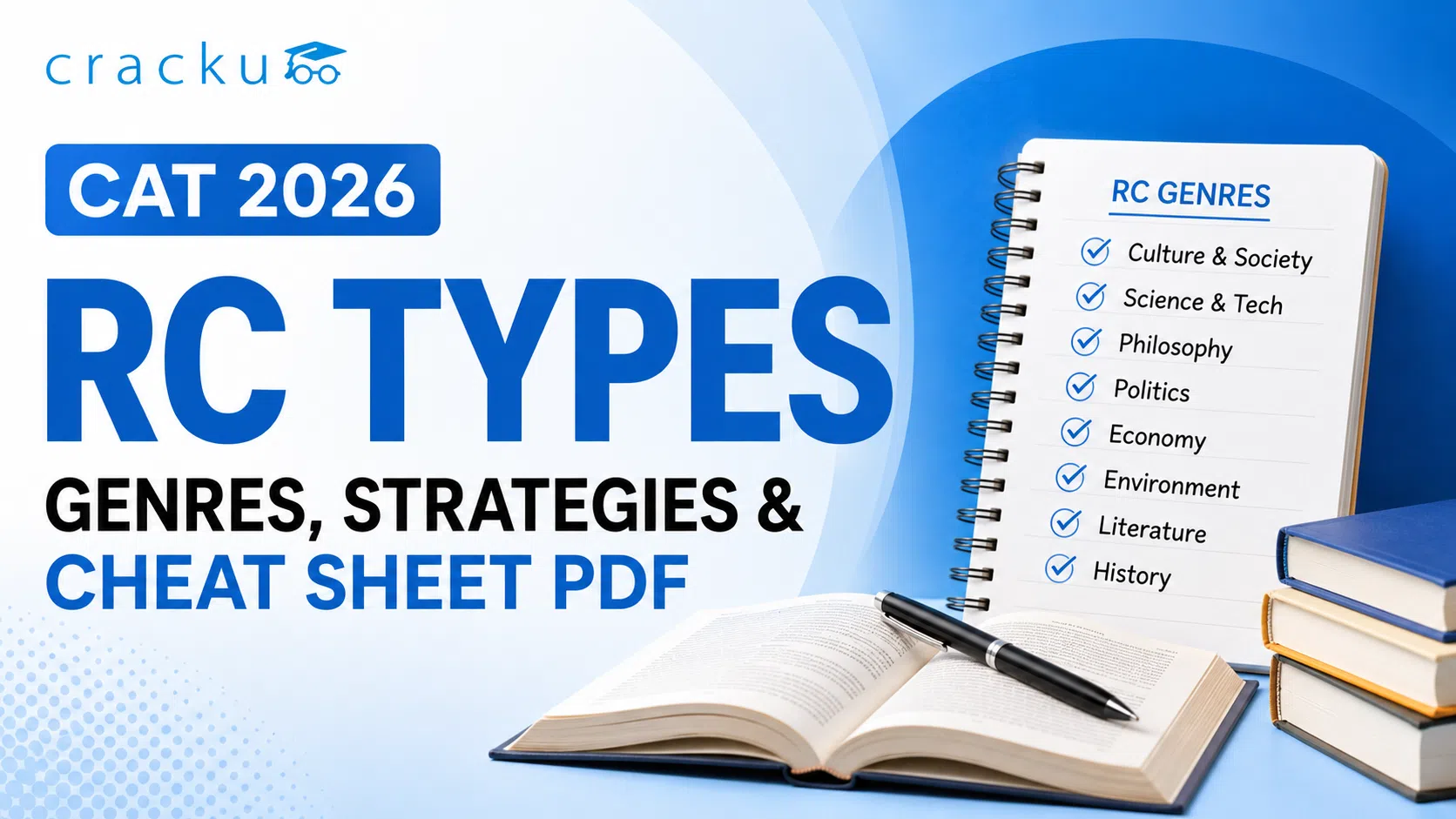
Some common CAT RC genres include:
- Culture and Society
- Science and Technology
- Philosophy
- Psychology
- Politics and Economics
- History
- Art and Literature
- Environment
Knowing the genre is not a shortcut to solving an RC. Instead, it gives you an idea of what to pay attention to while reading.
For example, a philosophy passage may require you to carefully track an abstract argument, while a science passage may require you to understand a concept and the relationship between different ideas.
The actual CAT exam can combine different genres, so your ultimate goal should be to become comfortable reading any type of passage.
Common CAT RC Genres
| CAT RC Genre | Common Topics | What to Focus On |
|---|---|---|
| Culture & Society | Culture, education, language, social change | Author's viewpoint and examples |
| Science & Technology | AI, genetics, space, neuroscience | Concepts, logic and cause-effect |
| Philosophy | Ethics, morality, consciousness | Arguments, assumptions and implications |
| Psychology | Behaviour, cognition, decision-making | Inferences and reasoning |
| Politics & Economics | Democracy, policy, trade, markets | Facts, opinions and conclusions |
| History | Civilisations, historical developments | Sequence, context and argument |
| Art & Literature | Art, literature, criticism | Tone, purpose and central idea |
| Environment | Climate, ecology, conservation | Cause-effect relationships and arguments |
Why Practice CAT RCs Genre-Wise?
Random RC practice is important, but genre-wise practice can be particularly useful when you are still developing your VARC skills.
When you repeatedly read passages from a particular genre, you become familiar with the way ideas are presented. You start recognising whether an author is explaining a concept, challenging an existing belief, comparing two viewpoints, or building an argument.
Develop Pattern Recognition
Different genres often use different styles of writing.
For example, a philosophy passage may introduce an idea, examine an opposing viewpoint, and then develop the author's position. A science passage may introduce a problem, explain a theory, and discuss its implications.
Recognising these structures makes it easier to follow the passage.
Target Your Weak Areas
Let's say you consistently struggle with philosophy passages.
Instead of waiting for a philosophy RC to appear during random practice, you can solve several philosophy passages together and analyse your mistakes.
This allows you to identify whether your problem is:
- Understanding the central idea
- Following the author's argument
- Handling abstract language
- Solving inference questions
- Eliminating answer choices
Improve Your Comfort With Unfamiliar Topics
CAT does not require you to be an expert in the subject of an RC.
However, unfamiliar terminology or abstract ideas can initially slow you down. Regular exposure to different genres makes unfamiliar passages less intimidating.
Improve Reading Efficiency
As you become comfortable with different writing styles, you spend less time trying to understand what the passage is doing and more time focusing on the actual argument.
Make Revision More Systematic
Genre-wise practice also makes it easier to track your preparation.
You can maintain separate accuracy records for:
- Philosophy
- Science
- Psychology
- Culture and Society
- Economics
- History
- Other genres
This helps you identify which areas require more practice.
CAT RC Genre vs CAT RC Question Type
One important distinction to understand is the difference between RC genre and RC question type.
RC Genre
Genre refers to what the passage is about.
Examples:
- Philosophy
- Science
- History
- Politics
- Psychology
- Culture
RC Question Type
Question type refers to what the question asks you to identify or infer from the passage.
Common CAT RC question types include:
- Main Idea
- Central Idea
- Inference
- Author's Tone
- Author's Purpose
- Specific Detail
- Implication
- Application
- Statement-based questions
For example, a philosophy passage can have a main idea question, an inference question, and a tone question.
Therefore, don't prepare only by genre. Use genre-wise practice to improve your reading ability and then practise different question types within those passages.
How to Identify the Genre of a CAT RC
You do not need to identify the exact genre before reading every passage. However, recognising broad signals can help you understand the direction of the passage.
Look for clues such as:
- Society, culture, education or language → Culture & Society
- Research, experiments, technology or scientific concepts → Science & Technology
- Morality, existence, reality or ethics → Philosophy
- Human behaviour, cognition or decision-making → Psychology
- Government, public policy, trade or markets → Politics & Economics
- Historical events or developments → History
- Literature, painting, music or artistic movements → Art & Literature
- Climate, ecology or conservation → Environment
Remember that genre identification should only be used as a reading aid. Do not assume that a particular genre will always be easy or difficult.
A well-written philosophy passage can be easier than a dense science passage, and the reverse can also be true.
How to Approach Different CAT RC Genres
Each genre can require a slightly different reading approach. The objective is not to memorise a fixed strategy but to know what to pay attention to while reading.
Genre 1: Culture, Society and History
Culture and society passages can discuss how people, institutions and cultures evolve. They may explore education, language, social structures, traditions, literature, anthropology or historical developments.
These passages often contain examples, contrasting viewpoints and explanations of how a particular idea developed.
Common Topics:
- Culture
- Society
- Education
- Language
- Anthropology
- Social Change
- Gender Studies
- History
- Institutions
How to Approach These RCs:
Focus on the central argument rather than individual examples.
While reading, ask:
- What is the author trying to establish?
- Why has a particular example been included?
- Is the author supporting or criticising an idea?
- How does the argument develop from one paragraph to another?
Don't spend too much time memorising names, dates or examples unless they are important to the argument.
Common Question Types:
- Main idea
- Author's opinion
- Inference
- Purpose
- Tone
- Specific detail
Genre 2: Science and Technology
Science and technology passages can cover subjects such as artificial intelligence, genetics, neuroscience, evolution, climate science, space research and technological developments.
The terminology may initially appear difficult, but CAT RC questions generally test your ability to understand the passage rather than your prior knowledge of the subject.
Common Topics:
- Artificial Intelligence
- Genetics
- Biotechnology
- Neuroscience
- Evolution
- Space Research
- Climate Science
- Technology
- Environmental Science
How to Approach These RCs:
Don't stop reading every time you encounter an unfamiliar scientific term.
Instead, focus on the relationship between ideas.
Ask:
- What problem is the author discussing?
- What is the main concept?
- What evidence or explanation does the author provide?
- What conclusion does the author reach?
- Why is a particular example or study mentioned?
You don't need to become a scientist to solve a science RC. You need to understand what the author is saying and why.
Common Question Types:
- Main idea
- Inference
- Application
- Specific detail
- Purpose
Genre 3: Philosophy
Philosophy is often considered challenging because the passages can deal with abstract concepts and arguments.
A philosophy RC may discuss morality, ethics, free will, consciousness, reality, knowledge or human existence.
Common Topics:
- Ethics
- Morality
- Free Will
- Consciousness
- Knowledge
- Reality
- Existentialism
- Human Nature
How to Approach Philosophy RCs:
Read these passages carefully and track the argument.
Pay attention to words that indicate a change in the author's reasoning, such as:
- However
- Therefore
- Although
- But
- Thus
- Yet
- Instead
- Consequently
Most importantly, separate what the author is presenting from what the author actually believes.
A passage may introduce an argument only to criticise it later.
Common Question Types:
- Inference
- Assumption
- Implication
- Main idea
- Author's viewpoint
- Purpose
Genre 4: Psychology
Psychology RCs generally focus on human behaviour, cognition, emotions, decision-making and how people respond to different situations.
These passages may overlap with neuroscience, economics or philosophy.
Common Topics:
- Human Behaviour
- Cognitive Biases
- Decision Making
- Memory
- Emotions
- Motivation
- Cognition
- Behavioural Economics
How to Approach Psychology RCs:
Focus on the relationship between behaviour, explanation and conclusion.
Ask:
- What behaviour is being discussed?
- What explanation does the author provide?
- Is the author presenting research or challenging an existing assumption?
- What conclusion follows from the evidence?
Avoid using your personal experience as evidence. The answer must be supported by the passage.
Common Question Types:
- Inference
- Main idea
- Application
- Implication
- Specific detail
Genre 5: Politics and Economics
Politics and economics passages may discuss government policies, democracy, markets, trade, globalisation, capitalism, inequality and public policy.
The subject may sound familiar, but familiarity with the topic should not lead you to rely on outside knowledge.
Common Topics:
- Democracy
- Public Policy
- International Relations
- Globalisation
- Trade
- Capitalism
- Markets
- Inflation
- Governance
- Economic Policy
How to Approach These RCs:
Separate facts, arguments and opinions while reading.
Pay attention when the author:
- Introduces a problem
- Presents an opposing view
- Criticises an existing policy
- Provides evidence
- Draws a conclusion
The author's attitude can be particularly important in these passages.
Common Question Types:
- Author's attitude
- Main idea
- Inference
- Purpose
- Specific detail
Genre 6: Art and Literature
Art and literature passages can discuss writers, artistic movements, literary criticism, aesthetics, visual art or the relationship between art and society.
These passages may be descriptive, analytical or argumentative.
Common Topics:
- Literature
- Poetry
- Painting
- Music
- Art Movements
- Literary Criticism
- Aesthetics
- Creative Expression
How to Approach These RCs:
Don't get distracted by names or references.
Focus on:
- What idea about art or literature is being discussed?
- What position does the author take?
- Why are particular examples used?
- Is the author comparing different perspectives?
Common Question Types:
- Main idea
- Tone
- Purpose
- Inference
- Specific detail
Genre 7: Environment
Environment-related RCs can discuss climate change, conservation, biodiversity, ecology, natural resources and the relationship between humans and the environment.
Common Topics:
- Climate Change
- Biodiversity
- Conservation
- Ecology
- Natural Resources
- Sustainability
- Environmental Policy
How to Approach These RCs:
Pay attention to cause-and-effect relationships.
Identify:
- The environmental problem
- Its causes
- The evidence or explanation
- The consequences
- The author's proposed or implied solution
This can help you build a mental structure while reading.
How to Practice CAT RCs Genre-Wise
Genre-wise practice works best when combined with proper analysis.
Simply solving 20 passages from the same genre will not automatically improve your VARC score.
Use the following process.
Step 1: Choose One Genre
Start with a genre that you find difficult.
For example, if philosophy passages consistently have low accuracy, begin there.
Step 2: Solve 3–5 RCs
Solve the passages under timed conditions.
Don't check the answers immediately after every question.
Step 3: Analyse Every Incorrect Answer
For each wrong answer, determine why you selected it.
Was it because you:
- Misunderstood the passage?
- Missed the author's viewpoint?
- Chose an extreme option?
- Relied on outside knowledge?
- Misread the question?
- Failed to eliminate the options correctly?
Step 4: Track Accuracy
Maintain a simple record of your performance.
For example:
| Genre | RCs Attempted | Questions | Correct | Accuracy |
|---|---|---|---|---|
| Philosophy | 5 | 20 | 14 | 70% |
| Science | 5 | 20 | 17 | 85% |
| Psychology | 5 | 20 | 15 | 75% |
| Culture | 5 | 20 | 18 | 90% |
This makes your weaknesses much easier to identify.
Step 5: Move to Mixed Practice
Once you become comfortable with individual genres, stop practising only genre-wise.
CAT will not tell you what genre the next passage belongs to.
Therefore, eventually move to mixed RC practice to simulate the actual exam environment.
How to Use a Genre-Wise CAT RC PDF
A genre-wise CAT RC PDF can be useful when you want structured practice instead of randomly selecting passages.
A good PDF should ideally include:
- Previous CAT RC passages
- CAT-level practice passages
- Genre-wise organisation
- Detailed solutions
- Question-wise explanations
- Answer elimination logic
- Vocabulary support where required
However, the value comes from how you use the material, not simply from completing the PDF.
Recommended Approach
First: Choose your weakest genre.
Next: Solve 3–5 passages from that genre.
Then: Analyse every incorrect question and understand why the correct option is better.
Finally: Repeat the process with another genre and periodically return to your weaker areas.
Also Read: CAT VARC Cheat Sheet PDF by Sayali Mam, Download Now
Common Mistakes While Preparing CAT RCs
Trying to Memorise the Passage
You don't need to remember every detail.
Focus on the central argument and the role of important examples.
Depending on Prior Knowledge
Even if you know a lot about the topic, the answer must come from the passage.
Your outside knowledge can sometimes make you choose an option that sounds correct but is not supported by the author.
Treating Every Genre the Same Way
Different passages can require different reading approaches.
A dense philosophical argument may need more attention to logic, while a science passage may require you to understand how concepts are connected.
Focusing Too Much on Vocabulary
You don't need to understand every word.
Try to understand the meaning of the sentence and its role in the overall argument.
Ignoring the Analysis
Solving more RCs is useful only when you learn from your mistakes.
Spend enough time analysing incorrect answers.
Practising Only Your Favourite Genre
If you enjoy science passages and consistently avoid philosophy or literature, your preparation remains incomplete.
Practise your strengths, but spend additional time on your weak areas.
Assuming Genre Predicts Difficulty
A particular genre is not automatically easy or difficult.
The author's writing style, argument structure and question choices determine the actual difficulty.
Genre-Wise CAT RC Practice: What Should You Focus On?
| Genre | Primary Focus | Important Skills |
|---|---|---|
| Culture & Society | Viewpoints and examples | Inference, tone |
| Science & Technology | Concepts and relationships | Main idea, application |
| Philosophy | Arguments and assumptions | Inference, implication |
| Psychology | Behaviour and reasoning | Inference, application |
| Politics & Economics | Facts and opinions | Tone, conclusion |
| History | Context and development | Main idea, inference |
| Art & Literature | Interpretation and criticism | Tone, purpose |
| Environment | Causes and consequences | Inference, application |
CAT RC Types: Conclusion
Mastering CAT RC genres is not about becoming an expert in philosophy, science, economics, history or literature. It is about becoming comfortable with different styles of writing, argument structures and ways of presenting ideas. Start by practising RCs genre-wise and identify the areas where your accuracy is lowest. Analyse your mistakes carefully, understand why the correct option works, and gradually increase the variety of passages you solve. Once you are comfortable with individual genres, move to mixed RC practice so that you can handle an unfamiliar passage under CAT-like conditions.
The goal is simple: regardless of whether CAT gives you a passage on philosophy, science, society, economics or literature, you should be able to understand the argument, identify the author's viewpoint and eliminate the wrong options with confidence.