Join WhatsApp Icon JEE WhatsApp Group

NTA JEE Main 3rd April 2016 Offline

For the following questions answer them individually

A student measures the time period of 100 oscillations of a simple pendulum four times. The data set is 90 s, 91 s, 95 s and 92 s. If the minimum division in the measuring clock is 1 s, then the reported mean time should be:

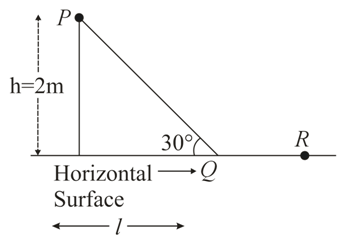
A point particle of mass m, moves along the uniformly rough track PQR as shown in the figure. The coefficient of friction, between the particle and the rough track equals $$\mu$$. The particle is released, from rest, from the point P and it comes to rest at a point R. The energies, lost by the ball, over the parts, PQ and QR, of the track, are equal to each other, and no energy is lost when particle changes direction from PQ to QR. The values of the coefficient of friction $$\mu$$ and the distance x = (QR), are respectively close to:

A person trying to lose weight by burning fat lifts a mass of 10 kg upto a height of 1 m 1000 times. Assume that the potential energy lost each time he lowers the mass is dissipated. How much fat will he use up considering the work done only when the weight is lifted up? Fat supplies $$3.8 \times 10^{7}$$ J of energy per kg which is converted to mechanical energy with a 20% efficiency rate. Take $$g = 9.8$$ ms$$^{-2}$$:

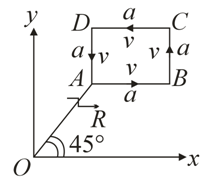
A particle of mass m is moving along the side of a square of side 'a', with a uniform speed v in the x-y plane as shown in the figure:


Which of the following statements is false for the angular momentum $$\vec{L}$$ about the origin?

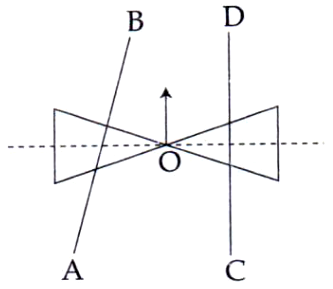
A roller is made by joining together two cones at their vertices O. It is kept on two rails AB and CD which are placed asymmetrically, with its axis perpendicular to CD and its centre O at the centre of line joining AB and CD (see the figure below). It is given a light push so that it starts rolling with its centre O moving parallel to CD in the direction shown. As it moves, the roller will tend to:

A satellite is revolving in a circular orbit at a height $$h$$ from the earth's surface (radius of earth $$R$$; $$h << R$$). The minimum increase in its orbital velocity required, so that the satellite could escape from the earth's gravitational field, is close to (Neglect the effect of atmosphere.)

A pendulum clock loses 12 s a day if the temperature is 40°C and gains 4 s a day if the temperature is 20°C. The temperature at which the clock will show correct time, and the co-efficient of linear expansion ($$\alpha$$) of the metal of the pendulum shaft are respectively:

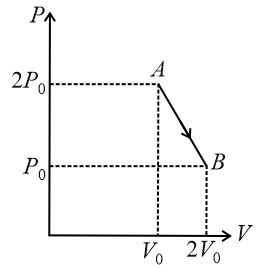
$$n$$ moles of an ideal gas undergoes a process $$A \to B$$ as shown in the figure. The maximum temperature of the gas during the process will be:

An ideal gas undergoes a quasi-static, reversible process in which its molar heat capacity C remains constant. If during this process the relation of pressure P and volume V is given by $$PV^n$$ = constant, then n is given by (Here $$C_P$$ and $$C_V$$ are molar specific heat at constant pressure and constant volume, respectively):

A particle performs simple harmonic motion with amplitude A. Its speed is tripled at the instant that it is at a distance $$\frac{2A}{3}$$ from equilibrium position. The new amplitude of the motion is:

A pipe open at both ends has a fundamental frequency $$f$$ in air. The pipe is dipped vertically in water so that half of it is in water. The fundamental frequency of the air column is now:

A uniform string of length 20 m is suspended from a rigid support. A short wave pulse is introduced at its lowest end. It starts moving up the string. The time taken to reach the support is (Take, $$g = 10$$ m s$$^{-2}$$)

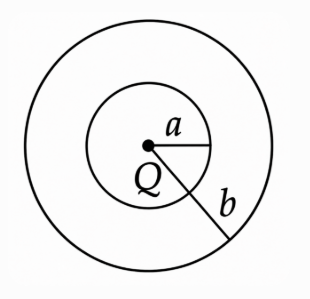
The region between two concentric spheres of radii 'a' and 'b', respectively (see figure), has volume charge density $$\rho = \frac{A}{r}$$, where A is a constant and r is the distance from the centre. At the centre of the spheres is a point charge Q. The value of A such that the electric field in the region between the spheres will be constant, is:

image

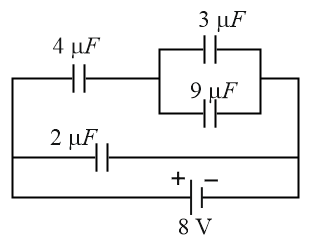
A combination of capacitors is set up as shown in the figure. The magnitude of the electric field, due to a point charge Q (having a charge equal to the sum of the charges on the 4 $$\mu$$F and 9 $$\mu$$F capacitors), at a point distant 30 m from it, would equal:

A galvanometer having a coil resistance of 100 $$\Omega$$ gives a full scale deflection, when a current of 1 mA is passed through it. The value of the resistance, which can convert this galvanometer into ammeter giving a full scale deflection for a current of 10 A, is:

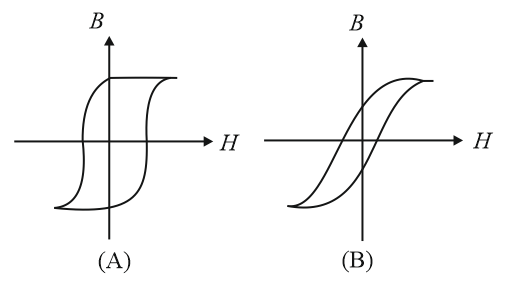
Hysteresis loops for two magnetic materials A and B are given below:


These materials are used to make magnets for electric generators, transformer core and electromagnet core. Then it is proper to use:

Two identical wires A and B, each of length $$l$$, carry the same current $$I$$. Wire A is bent into a circle of radius R and wire B is bent to form a square of side $$a$$. If $$B_A$$ and $$B_B$$ are the values of magnetic field at the centres of the circle and square respectively, then the ratio $$\frac{B_A}{B_B}$$ is

An arc lamp requires a direct current of 10 A at 80 V to function. If it is connected to a 220 V (rms), 50 Hz AC supply, the series inductor needed for it to work is close to:

Arrange the following electromagnetic radiations per quantum in the order of increasing energy:
A: Blue light
B: Yellow light
C: X-ray
D: Radiowave

An observer looks at a distant tree of height 10 m with a telescope of magnifying power of 20. To the observer, the tree appears as

In an experiment for determination of refractive index of glass of a prism by i v/s $$\delta$$ plot, it was found that a ray incident at angle 35°, suffers a deviation of 40° and that it emerges at angle 79°. In that case which of the following is closest to the maximum possible value of the refractive index?

The box of a pin hole camera, of length L, has a hole of radius a. It is assumed that when the hole is illuminated by a parallel beam of light of wavelength $$\lambda$$ the spread of the spot (obtained on the opposite wall of the camera) is the sum of its geometrical spread and the spread due to diffraction. The spot would then have its minimum size (say $$b_{min}$$) when:

Radiation of wavelength $$\lambda$$ is incident on a photocell. The fastest emitted photoelectron has a speed v. If the wavelength is changed to $$\frac{3\lambda}{4}$$, the speed of the fastest emitted photoelectron will be:

Half-lives of two radioactive elements A and B are 20 minutes and 40 minutes, respectively. Initially, the samples have an equal number of nuclei. After 80 minutes, the ratio of decayed numbers of A and B nuclei will be:

For a common emitter configuration, if $$\alpha$$ and $$\beta$$ have their usual meanings, the correct relationship between $$\alpha$$ and $$\beta$$ is:

The temperature dependence of resistance of Cu and undoped Si in the temperature range 300 - 400 K is best described by:

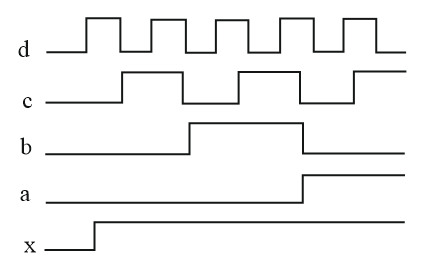
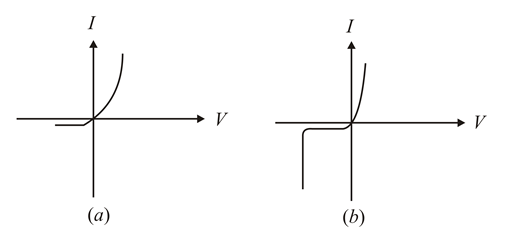
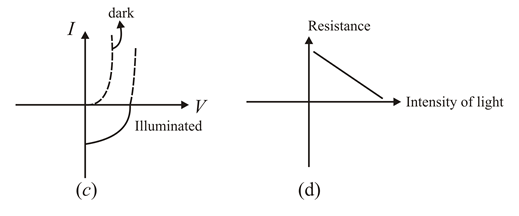
Identify the semiconductor devices whose characteristics are given below, in the order (a), (b), (c), (d):

Choose the correct statement:

A screw gauge with a pitch of 0.5 mm and a circular scale with 50 divisions is used to measure the thickness of a thin sheet of aluminium. Before starting the measurement, it is found that when the two jaws of the screw gauge are brought in contact, the 45th division coincides with the main scale line and that the zero of the main scale is barely visible. What is the thickness of the sheet if the main scale reading is 0.5 mm and the 25th division coincides with the main scale line?

At 300 K and 1 atm, 15 mL of a gaseous hydrocarbon requires 375 mL air containing 20% $$O_2$$ by volume, for complete combustion. After combustion, the gases occupy 345 mL. Assuming that the water formed is in liquid form and the volumes were measured at the same temperature and pressure, the formula of the hydrocarbon is: (Assume complete combustion of reactant)

A stream of electrons from a heat filament was passed between two charge plates kept at a potential difference V esu. If e and m are charge and mass of an electron, respectively, then the value of $$\frac{h}{\lambda}$$ (where $$\lambda$$ is wavelength associated with the electron wave) is given by:

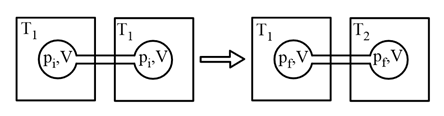
Two closed bulbs of equal volume (V) containing an ideal gas initially at pressure $$p_i$$ and temperature $$T_1$$ are connected through a narrow tube of negligible volume, as shown in the figure below. The temperature of one of the bulbs is then raised to $$T_2$$. The final pressure $$P_f$$ is:

The heats of combustion of carbon and carbon monoxide are $$-393.5$$ and $$-283.5$$ kJ mol$$^{-1}$$, respectively. The heat of formation (in kJ) of carbon monoxide per mole is:

The equilibrium constant at 298 K for a reaction $$A + B \rightleftharpoons C + D$$ is 100. If the initial concentration of all the four species were 1 M each, then the equilibrium concentration of D (in mol $$L^{-1}$$) will be:

Which of the following statements about water is FALSE?

The main oxides formed on combustion of Li, Na and K in excess of air are respectively:

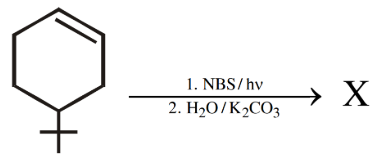
The reaction of propene with HOCl ($$Cl_2 + H_2O$$) proceeds through the intermediate:

The concentration of fluoride, lead, nitrate and iron in a water sample from an underground lake was found to be 1000 ppb, 40 ppb, 100 ppm and 0.2 ppm, respectively. This water is unsuitable for drinking due to high concentration of:

Decomposition of $$H_2O_2$$ follows a first order reaction. In fifty minutes the concentration of $$H_2O_2$$ decreases from 0.5 to 0.125 M in one such decomposition. When the concentration of $$H_2O_2$$ reaches 0.05 M, the rate of formation of $$O_2$$ will be:

For a linear plot of log $$\left(\frac{x}{m}\right)$$ versus log p in a Freundlich adsorption isotherm, which of the following statements is correct? (k and n are constants)

The pair in which phosphorous atoms have a formal oxidation state of +3 is:

Which one of the following complexes shows optical isomerism? (en=ethylenediamine)

The pair having the same magnetic moment is: [At. No.: Cr = 24, Mn = 25, Fe = 26, Co = 27]

In the Hoffmann bromamide degradation reaction, the number of moles of NaOH and $$Br_2$$ used per mole of amine produced are:

Which of the following statements about low density polythene is FALSE?

A value of $$\theta$$ for which $$\frac{2 + 3i\sin\theta}{1 - 2i\sin\theta}$$ is purely imaginary, is

If the $$2^{nd}$$, $$5^{th}$$ and $$9^{th}$$ terms of a non-constant arithmetic progression are in geometric progression, then the common ratio of this geometric progression is

If the sum of the first ten terms of the series $$\left(1\frac{3}{5}\right)^2 + \left(2\frac{2}{5}\right)^2 + \left(3\frac{1}{5}\right)^2 + 4^2 + \left(4\frac{4}{5}\right)^2 + \ldots$$, is $$\frac{16}{5}m$$, then $$m$$ is equal to

If the number of terms in the expansion of $$\left(1 - \frac{2}{x} + \frac{4}{y^2}\right)^n$$, $$x, y \neq 0$$, is 28, then the sum of the coefficients of all the terms in this expansion is

Two sides of a rhombus are along the lines, $$x - y + 1 = 0$$ and $$7x - y - 5 = 0$$. If its diagonals intersect at $$(-1, -2)$$, then which one of the following is a vertex of this rhombus?

The centres of those circles which touch the circle, $$x^2 + y^2 - 8x - 8y - 4 = 0$$, externally and also touch the x-axis, lie on

If one of the diameters of the circle, given by the equation, $$x^2 + y^2 - 4x + 6y - 12 = 0$$, is a chord of a circle $$S$$, whose centre is at $$(-3, 2)$$, then the radius of $$S$$ is

Let $$P$$ be the point on the parabola, $$y^2 = 8x$$ which is at a minimum distance from the center $$C$$ of the circle, $$x^2 + (y+6)^2 = 1$$. Then the equation of the circle, passing through $$C$$ and having its center at $$P$$ is

The eccentricity of the hyperbola whose length of its conjugate axis is equal to half of the distance between its foci, is

If the standard deviation of the numbers 2, 3, $$a$$ and 11 is 3.5, then which of the following is true?

A man is walking towards a vertical pillar in a straight path, at a uniform speed. At a certain point $$A$$ on the path, he observes that the angle of elevation of the top of the pillar is $$30°$$. After walking for 10 minutes from $$A$$ in the same direction, at a point $$B$$, he observes that the angle of elevation of the top of the pillar is $$60°$$. Then the time taken (in minutes) by him, from $$B$$ to reach the pillar, is

The system of linear equations
$$x + \lambda y - z = 0$$
$$\lambda x - y - z = 0$$
$$x + y - \lambda z = 0$$
has a non-trivial solution for

If $$f(x) + 2f\left(\frac{1}{x}\right) = 3x$$, $$x \neq 0$$, and $$S = \{x \in R : f(x) = f(-x)\}$$, then $$S$$

For $$x \in R$$, $$f(x) = |\log 2 - \sin x|$$ and $$g(x) = f(f(x))$$, then

Consider $$f(x) = \tan^{-1}\left(\sqrt{\frac{1+\sin x}{1-\sin x}}\right)$$, $$x \in \left(0, \frac{\pi}{2}\right)$$. A normal to $$y = f(x)$$ at $$x = \frac{\pi}{6}$$ also passes through the point

A wire of length 2 units is cut into two parts which are bent respectively to form a square of side = $$x$$ units and a circle of radius = $$r$$ units. If the sum of the areas of the square and the circle so formed is minimum, then

The integral $$\int \frac{2x^{12} + 5x^9}{(x^5 + x^3 + 1)^3} dx$$, is equal to

The area (in sq. units) of the region $$\{(x, y) : y^2 \geq 2x$$ and $$x^2 + y^2 \leq 4x$$, $$x \geq 0$$, $$y \geq 0\}$$ is

If a curve $$y = f(x)$$ passes through the point $$(1, -1)$$ and satisfies the differential equation, $$y(1 + xy)dx = x\,dy$$, then $$f\left(-\frac{1}{2}\right)$$ is equal to

Let $$\vec{a}$$, $$\vec{b}$$ and $$\vec{c}$$ be three unit vectors such that $$\vec{a} \times (\vec{b} \times \vec{c}) = \frac{\sqrt{3}}{2}(\vec{b} + \vec{c})$$. If $$\vec{b}$$ is not parallel to $$\vec{c}$$, then the angle between $$\vec{a}$$ and $$\vec{b}$$ is

The distance of the point $$(1, -5, 9)$$ from the plane $$x - y + z = 5$$ measured along the line $$x = y = z$$ is

Let two fair six-faced dice $$A$$ and $$B$$ be thrown simultaneously. If $$E_1$$ is the event that die $$A$$ shows up four, $$E_2$$ is the event that die $$B$$ shows up two and $$E_3$$ is the event that the sum of numbers on both dice is odd, then which of the following statements is not true?