
Join Our JEE Preparation Group
Prep with like-minded aspirants; Get access to free daily tests and study material.
Sign in
Please select an account to continue using cracku.in
↓ →
Join Our JEE Preparation Group
Prep with like-minded aspirants; Get access to free daily tests and study material.
A combination of capacitors is set up as shown in the figure. The magnitude of the electric field, due to a point charge Q (having a charge equal to the sum of the charges on the 4 $$\mu$$F and 9 $$\mu$$F capacitors), at a point distant 30 m from it, would equal:
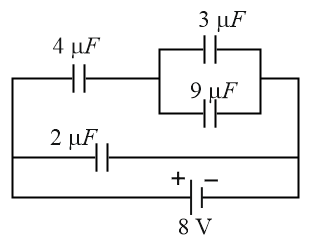
$$C_p = 3\ \mu\text{F} + 9\ \mu\text{F} = 12\ \mu\text{F}$$
The $$4\ \mu\text{F}$$ capacitor is in series with $$C_p$$ ($$12\ \mu\text{F}$$):
$$\frac{1}{C_{top}} = \frac{1}{4} + \frac{1}{12} = \frac{3+1}{12} = \frac{4}{12}$$
$$C_{top} = 3\ \mu\text{F}$$
Charge on the $$4\ \mu\text{F}$$ capacitor ($$q_1$$): $$q_1 = C_{top} \times V = 3\ \mu\text{F} \times 8\ \text{V} = 24\ \mu\text{C}$$
Charge on the $$9\ \mu\text{F}$$ capacitor ($$q_2$$):
$$V_p = V \times \frac{C_{series\_other}}{C_{series\_total}} = 8 \times \frac{4}{4 + 12} = 8 \times \frac{4}{16} = 2\ \text{V}$$
$$q_2 = C \times V_p = 9\ \mu\text{F} \times 2\ \text{V} = 18\ \mu\text{C}$$
$$Q = q_1 + q_2 = 24\ \mu\text{C} + 18\ \mu\text{C} = 42\ \mu\text{C} = 42 \times 10^{-6}\ \text{C}$$
$$E = \frac{kQ}{r^2}$$
$$E = \frac{9 \times 10^9 \times 42 \times 10^{-6}}{(30)^2}$$
$$E = 420\ \text{N/C}$$
Was this solution helpful?
Create a FREE account and get:
_1.webp)

Educational materials for JEE preparation

Ask our AI anything

AI can make mistakes. Please verify important information.
AI can make mistakes. Please verify important information.
