
Join Our JEE Preparation Group
Prep with like-minded aspirants; Get access to free daily tests and study material.
Sign in
Please select an account to continue using cracku.in
↓ →
Join Our JEE Preparation Group
Prep with like-minded aspirants; Get access to free daily tests and study material.
The region between two concentric spheres of radii 'a' and 'b', respectively (see figure), has volume charge density $$\rho = \frac{A}{r}$$, where A is a constant and r is the distance from the centre. At the centre of the spheres is a point charge Q. The value of A such that the electric field in the region between the spheres will be constant, is:
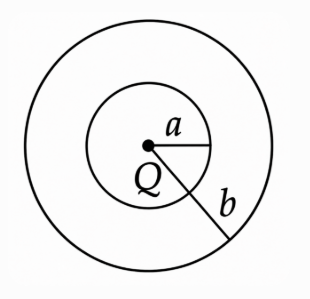
First, let us identify the geometry. We have two concentric spheres with radii $$a$$ and $$b$$ satisfying $$a < r < b$$. The shell lying between these two radii is filled with a volume charge whose density varies as $$\rho = \dfrac{A}{r}$$, while the very centre (at $$r = 0$$) carries a point charge $$Q$$.
We wish to make the electric field $$E(r)$$ anywhere in the region $$a < r < b$$ the same for all values of $$r$$, that is, independent of $$r$$. To obtain the required value of $$A$$ we use Gauss’s law.
Gauss’s law in integral form states
$$\displaystyle \oint_S \vec E \cdot d\vec S \;=\;\frac{1}{\varepsilon_0}\,Q_{\text{enc}}.$$
For spherical symmetry, we choose a Gaussian surface that is itself a sphere of radius $$r$$ (with $$a < r < b$$). On this surface the magnitude $$E(r)$$ is the same everywhere and the flux becomes
$$E(r)\,(4\pi r^2)\;=\;\frac{1}{\varepsilon_0}\,Q_{\text{enc}}(r).$$
So
$$E(r)=\frac{Q_{\text{enc}}(r)}{4\pi\varepsilon_0\,r^2}.$$
Now we calculate the total charge enclosed inside radius $$r$$, namely
$$Q_{\text{enc}}(r)=Q_{\text{point}}+Q_{\text{shell up to }r}.$$
The point charge contributes simply $$Q_{\text{point}} = Q.$$
For the shell portion (from $$a$$ out to $$r$$) we integrate the given volume charge density. The differential charge in a thin spherical shell of radius $$r'$$ and thickness $$dr'$$ is
$$dQ = \rho(r')\,d\tau = \frac{A}{r'}\;\bigl(4\pi r'^2\,dr'\bigr)=4\pi A\,r'\,dr'.$$
Integrating from $$r' = a$$ to $$r' = r$$ gives
$$Q_{\text{shell up to }r}=4\pi A\int_{a}^{r}r'\,dr'$$
$$\hspace{3.55cm}=4\pi A\left[\frac{r'^2}{2}\right]_{a}^{r}$$
$$\hspace{3.55cm}=2\pi A\bigl(r^2 - a^2\bigr).$$
Hence
$$Q_{\text{enc}}(r)=Q+2\pi A\bigl(r^2-a^2\bigr).$$
Substituting this into the earlier result for $$E(r)$$ we obtain
$$E(r)=\frac{Q+2\pi A\bigl(r^2-a^2\bigr)}{4\pi\varepsilon_0\,r^2}.$$
We now enforce the requirement that $$E(r)$$ must not depend on $$r$$. For that to happen, the numerator must be directly proportional to $$r^2$$ so that the $$r^2$$ in the denominator cancels out and leaves a constant.
Let us write the numerator in the desired proportional form:
$$Q+2\pi A\bigl(r^2-a^2\bigr)=k\,r^2,$$
where $$k$$ is some constant (its exact value is immaterial—only the absence of any other $$r$$-dependence matters).
Comparing coefficients of like powers of $$r$$ on both sides, we see:
• For the $$r^2$$ terms: $$2\pi A=k.$$
• For the terms independent of $$r$$: $$Q-2\pi A a^2=0.$$
The second equality immediately gives us the needed value of $$A$$:
$$Q-2\pi A a^2=0\;\;\Longrightarrow\;\;A=\frac{Q}{2\pi a^2}.$$
This is a unique choice; any other value would leave residual $$r$$-dependence in the field.
Hence, the correct answer is Option C.
Was this solution helpful?
Create a FREE account and get:
_1.webp)

Educational materials for JEE preparation

Ask our AI anything

AI can make mistakes. Please verify important information.
AI can make mistakes. Please verify important information.
