
Join Our JEE Preparation Group
Prep with like-minded aspirants; Get access to free daily tests and study material.
Sign in
Please select an account to continue using cracku.in
↓ →
Join Our JEE Preparation Group
Prep with like-minded aspirants; Get access to free daily tests and study material.
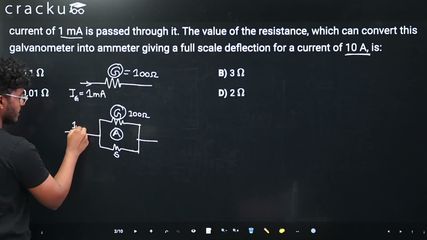
A galvanometer having a coil resistance of 100 $$\Omega$$ gives a full scale deflection, when a current of 1 mA is passed through it. The value of the resistance, which can convert this galvanometer into ammeter giving a full scale deflection for a current of 10 A, is:
We are given a moving-coil galvanometer with an internal resistance $$R_g = 100\;\Omega$$. It shows full-scale deflection when the current through it is $$I_g = 1\ \text{mA} = 0.001\ \text{A}$$.
We wish to use this galvanometer as an ammeter that can measure a much larger full-scale current $$I = 10\ \text{A}$$. To achieve this, a very small resistance, called a shunt resistance, is connected in parallel with the galvanometer. The shunt diverts most of the current so that only the safe current $$I_g$$ flows through the delicate galvanometer coil.
First, we recall (and state) the standard relation for a shunt resistance $$S$$ connected in parallel with a galvanometer:
$$ S \;=\; \dfrac{I_g\,R_g}{I - I_g}. $$
This formula arises from the condition that the potential difference across the galvanometer and the shunt must be equal, because they are in parallel. The derivation is:
The current through the shunt is the remainder $$I - I_g$$. The potential drop across the galvanometer is
$$ V_g \;=\; I_g\,R_g. $$
Since the same potential drop appears across the shunt, Ohm’s law for the shunt gives
$$ V_g \;=\; (I - I_g)\,S. $$
Equating the two expressions for the same voltage, we have
$$ I_g\,R_g \;=\; (I - I_g)\,S. $$
Now we solve for $$S$$ by dividing both sides by $$(I - I_g):$$
$$ S \;=\; \dfrac{I_g\,R_g}{I - I_g}. $$
With the formula stated and derived, we now substitute the numerical values.
First, calculate the numerator $$I_g\,R_g$$:
$$ I_g\,R_g \;=\; (0.001\ \text{A})\,(100\ \Omega) \;=\; 0.1\ \text{V}. $$
Next, compute the denominator $$I - I_g$$:
$$ I - I_g \;=\; 10\ \text{A} - 0.001\ \text{A} \;=\; 9.999\ \text{A}. $$
Now form the fraction:
$$ S \;=\; \dfrac{0.1\ \text{V}}{9.999\ \text{A}}. $$
Divide the numbers:
$$ S \;=\; 0.010001\ \Omega. $$
The result rounds off neatly to
$$ S \;\approx\; 0.01\ \Omega. $$
This is exactly the value of resistance that must be connected in parallel with the galvanometer to convert it into an ammeter capable of reading up to $$10\ \text{A}$$ at full scale.
Hence, the correct answer is Option C.
Was this solution helpful?
Click on the Email ☝️ to Watch the Video Solution
Create a FREE account and get:
_1.webp)

Educational materials for JEE preparation

Ask our AI anything

AI can make mistakes. Please verify important information.
AI can make mistakes. Please verify important information.
