
Join Our JEE Preparation Group
Prep with like-minded aspirants; Get access to free daily tests and study material.
Sign in
Please select an account to continue using cracku.in
↓ →
Join Our JEE Preparation Group
Prep with like-minded aspirants; Get access to free daily tests and study material.
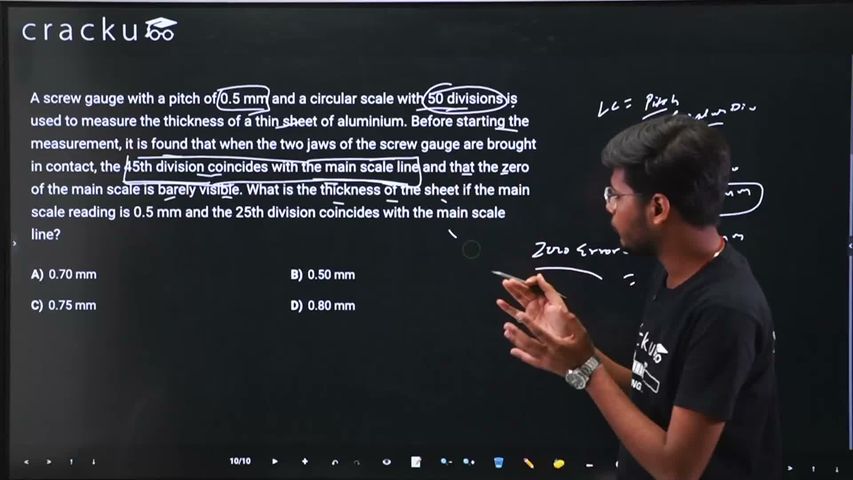
A screw gauge with a pitch of 0.5 mm and a circular scale with 50 divisions is used to measure the thickness of a thin sheet of aluminium. Before starting the measurement, it is found that when the two jaws of the screw gauge are brought in contact, the 45th division coincides with the main scale line and that the zero of the main scale is barely visible. What is the thickness of the sheet if the main scale reading is 0.5 mm and the 25th division coincides with the main scale line?
We have a screw gauge whose pitch is given as $$0.5\ \text{mm}$$. The circular scale is divided into $$50$$ equal parts.
First, we find the least count. The formula is
$$\text{Least count (LC)}=\frac{\text{Pitch}}{\text{Number of circular-scale divisions}}.$$
Substituting the values,
$$\text{LC}=\frac{0.5\ \text{mm}}{50}=0.01\ \text{mm}.$$
Now we determine the zero error of the screw gauge. When the two jaws are in contact, the question tells us that the $$45^{\text{th}}$$ circular-scale division coincides with the main-scale line and the zero of the main scale is just visible. This means the zero mark of the circular scale has travelled past the reference line by $$5$$ divisions, because one full revolution would have taken the index from $$45$$ to $$50$$ divisions.
The displacement corresponding to these $$5$$ divisions is
$$5 \times \text{LC}=5 \times 0.01\ \text{mm}=0.05\ \text{mm}.$$
Since the zero of the circular scale has gone beyond the reference line, the instrument is reading less than the true length; this is termed a negative zero error. Hence
$$\text{Zero error} = -0.05\ \text{mm}.$$
For future measurements we must therefore add $$0.05\ \text{mm}$$ (the zero correction) to every observed reading. Symbolically, if Z.E. is negative, then
$$\text{Zero correction} = -(\text{Zero error}) = +0.05\ \text{mm}.$$
Next we take the actual observation with the aluminium sheet in between the jaws. The main-scale reading is given as $$0.5\ \text{mm}$$ and the $$25^{\text{th}}$$ circular-scale division coincides with the main-scale line.
The observed reading is therefore
$$\text{Observed reading} = (\text{Main-scale reading}) + (\text{Circular-scale division})\times\text{LC}.$$
Substituting,
$$\text{Observed reading} = 0.5\ \text{mm} + 25 \times 0.01\ \text{mm} = 0.5\ \text{mm} + 0.25\ \text{mm} = 0.75\ \text{mm}.$$
To obtain the true thickness we add the zero correction:
$$\text{True thickness} = 0.75\ \text{mm} + 0.05\ \text{mm} = 0.80\ \text{mm}.$$
Hence, the correct answer is Option D.
Click on the Email ☝️ to Watch the Video Solution
Create a FREE account and get:
_1.webp)

Educational materials for JEE preparation

Ask our AI anything

AI can make mistakes. Please verify important information.
AI can make mistakes. Please verify important information.


