
Join Our JEE Preparation Group
Prep with like-minded aspirants; Get access to free daily tests and study material.
Sign in
Please select an account to continue using cracku.in
↓ →
Join Our JEE Preparation Group
Prep with like-minded aspirants; Get access to free daily tests and study material.
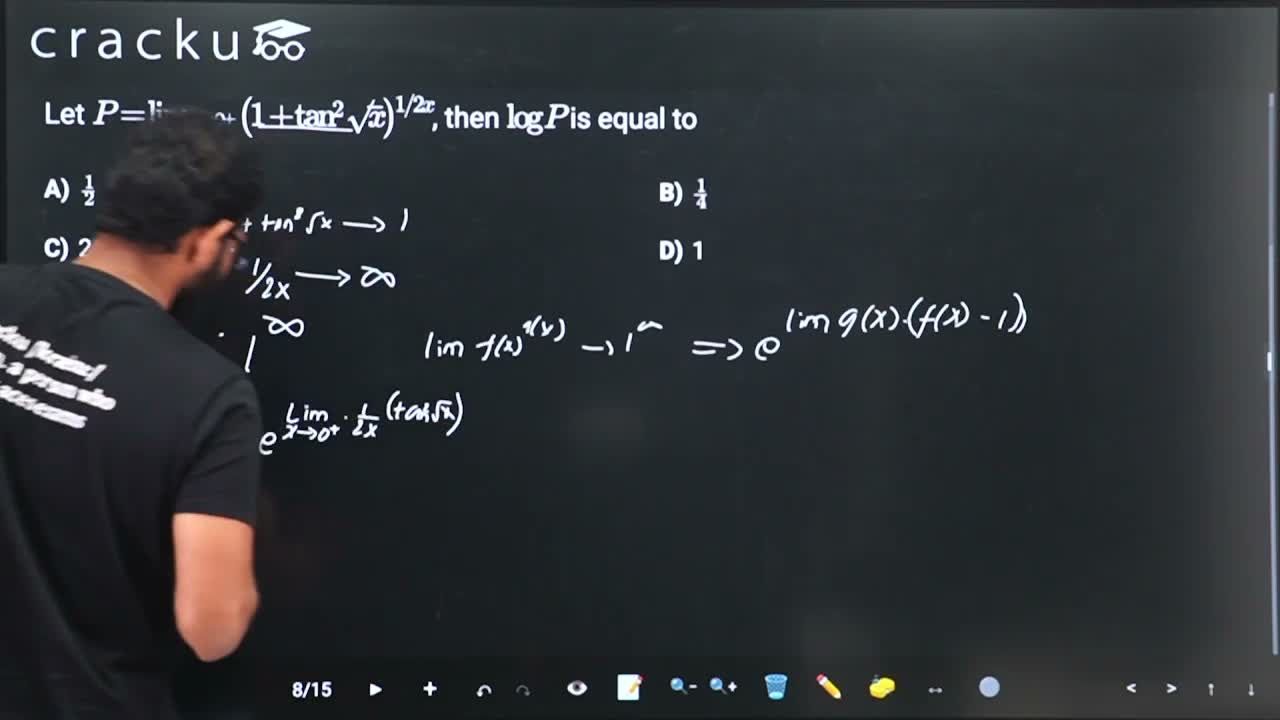
Let $$P = \lim_{x \to 0^+} \left(1 + \tan^2\sqrt{x}\right)^{1/2x}$$, then $$\log P$$ is equal to
$$ \frac{1}{2} $$
Step-by-Step Explanation
We are given the limit:
$$ P = \lim_{x \to 0^+} \left(1 + \tan^2\sqrt{x}\right)^{\frac{1}{2x}} $$
Step 1: Identify the Indeterminate Form
As $$ x \to 0^+ $$, we have $$ \sqrt{x} \to 0 $$, which means $$ \tan\sqrt{x} \to 0 $$ and $$ \tan^2\sqrt{x} \to 0 $$.
The exponent $$ \frac{1}{2x} \to \infty $$.
Thus, the limit is of the indeterminate form $$ 1^\infty $$.
Step 2: Apply the $$ 1^\infty $$ Limit Formula
For any limit of the form $$ \lim_{x \to a} [f(x)]^{g(x)} = 1^\infty $$, the evaluated value can be found using:
$$ P = e^{\lim_{x \to a} g(x) \cdot [f(x) - 1]} $$
Substituting our values into the formula gives:
$$ P = e^{\lim_{x \to 0^+} \frac{1}{2x} \cdot \left[\left(1 + \tan^2\sqrt{x}\right) - 1\right]} $$
$$ P = e^{\lim_{x \to 0^+} \frac{\tan^2\sqrt{x}}{2x}} $$
Step 3: Evaluate the Exponent Limit
Let us focus on solving the limit in the power:
$$ L = \lim_{x \to 0^+} \frac{\tan^2\sqrt{x}}{2x} $$
We can rewrite the expression to exploit the standard trigonometric limit $$ \lim_{\theta \to 0} \frac{\tan\theta}{\theta} = 1 $$:
$$ L = \frac{1}{2} \cdot \lim_{x \to 0^+} \left(\frac{\tan\sqrt{x}}{\sqrt{x}}\right)^2 $$
Since $$ \sqrt{x} \to 0 $$ as $$ x \to 0^+ $$, the term inside the parenthesis becomes 1:
$$ L = \frac{1}{2} \cdot (1)^2 = \frac{1}{2} $$
Step 4: Find $$ P $$ and $$ \log P $$
Now, substitute the value of the exponent limit back into the expression for $$ P $$:
$$ P = e^{1/2} $$
Taking the natural logarithm ($$ \log $$ refers to $$ \ln $$) on both sides:
$$ \log P = \log\left(e^{1/2}\right) = \frac{1}{2} $$
Therefore, the value of $$ \log P $$ is $$ \frac{1}{2} $$ (or $$ 0.5 $$).
Click on the Email ☝️ to Watch the Video Solution
Create a FREE account and get:
_1.webp)

Educational materials for JEE preparation

Ask our AI anything

AI can make mistakes. Please verify important information.
AI can make mistakes. Please verify important information.


