
Join Our JEE Preparation Group
Prep with like-minded aspirants; Get access to free daily tests and study material.
Sign in
Please select an account to continue using cracku.in
↓ →
Join Our JEE Preparation Group
Prep with like-minded aspirants; Get access to free daily tests and study material.
If the sum of the first ten terms of the series $$\left(1\frac{3}{5}\right)^2 + \left(2\frac{2}{5}\right)^2 + \left(3\frac{1}{5}\right)^2 + 4^2 + \left(4\frac{4}{5}\right)^2 + \ldots$$, is $$\frac{16}{5}m$$, then $$m$$ is equal to
The first term of the series is the square of the mixed number $$1\frac{3}{5}$$. A mixed number is converted to an improper fraction by the rule “$$\text{whole}+\dfrac{\text{numerator}}{\text{denominator}}$$”. Hence
$$1\frac{3}{5}=1+\dfrac35=\dfrac85.$$
Squaring gives $$\left(\dfrac85\right)^2.$$ Repeating the same conversion for the next few mixed numbers, we have
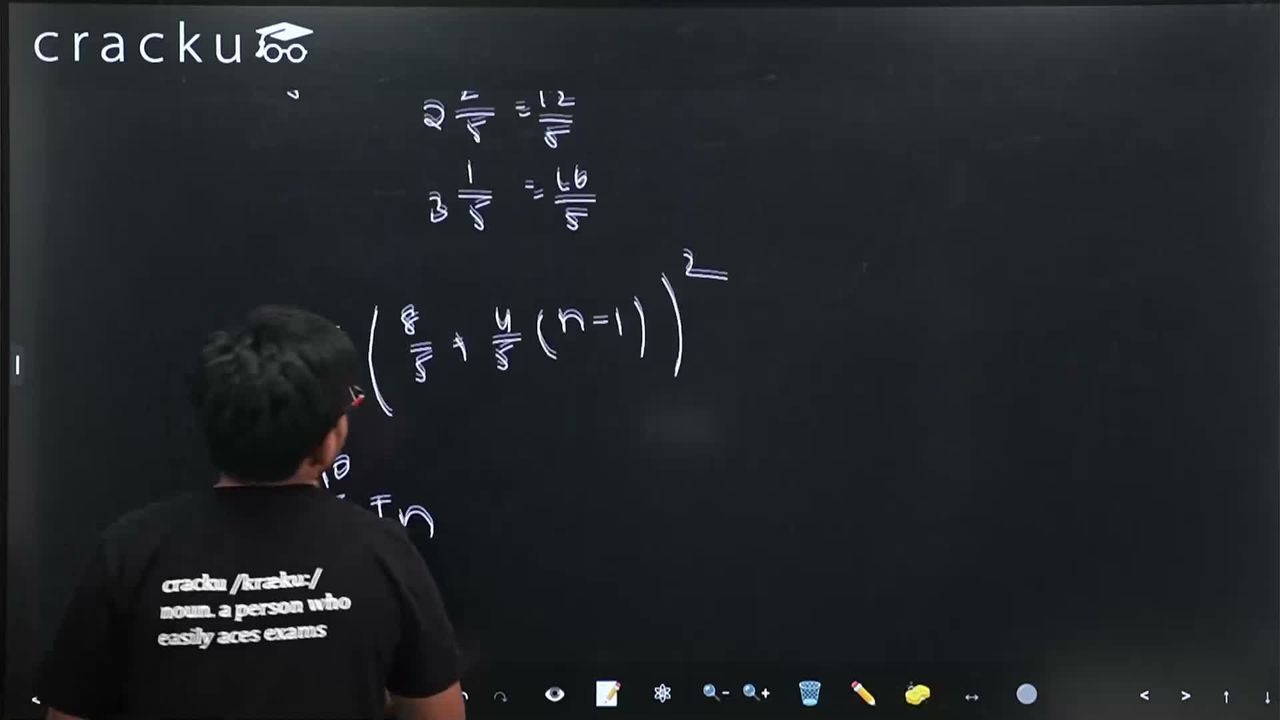
$$2\frac25=\dfrac{12}{5}, \qquad 3\frac15=\dfrac{16}{5}, \qquad 4=\dfrac{20}{5}, \qquad 4\frac45=\dfrac{24}{5}.$$
So the numerical quantities being squared are
$$\dfrac85,\,\dfrac{12}{5},\,\dfrac{16}{5},\,\dfrac{20}{5},\,\dfrac{24}{5},\ldots$$
The common difference between successive numerators is $$4$$, while the denominator $$5$$ is fixed. Thus every step increases the number itself by $$\dfrac45$$. Observing this, we can write the general (before-squaring) term as
$$a_n=\dfrac85+\dfrac45(n-1)=\dfrac{4n+4}{5}=\dfrac{4(n+1)}{5}.$$
Therefore the square that actually appears in the series is
$$T_n=\left(a_n\right)^2=\left(\dfrac{4(n+1)}{5}\right)^2=\dfrac{16\,(n+1)^2}{25}.$$
The question asks for the sum of the first ten terms, so we need
$$S_{10}=\sum_{n=1}^{10}T_n=\sum_{n=1}^{10}\dfrac{16\,(n+1)^2}{25}=\dfrac{16}{25}\sum_{n=1}^{10}(n+1)^2.$$
Now notice that $$n+1$$ runs from $$2$$ to $$11$$ as $$n$$ runs from $$1$$ to $$10$$. Hence
$$\sum_{n=1}^{10}(n+1)^2=\sum_{k=2}^{11}k^2=\left(\sum_{k=1}^{11}k^2\right)-1^2.$$
We recall the standard formula for the sum of squares of the first $$N$$ natural numbers:
$$\sum_{k=1}^{N}k^2=\dfrac{N(N+1)(2N+1)}{6}.$$
Using $$N=11$$, we have
$$\sum_{k=1}^{11}k^2=\dfrac{11\cdot12\cdot23}{6}.$$
Multiplying the numerator step by step, we get $$11\cdot12=132$$ and $$132\cdot23=3036$$, so
$$\sum_{k=1}^{11}k^2=\dfrac{3036}{6}=506.$$
Subtracting the square of $$1$$ gives
$$\sum_{n=1}^{10}(n+1)^2=506-1=505.$$
Substituting this value back into $$S_{10}$$ yields
$$S_{10}=\dfrac{16}{25}\times505=\dfrac{16}{25}\times\dfrac{505}{1}.$$
Because $$505=5\times101$$, we may cancel a factor $$5$$ between numerator and denominator:
$$S_{10}=\dfrac{16}{5}\times101=\dfrac{1616}{5}.$$
The problem statement says that this same sum can be written as $$\dfrac{16}{5}m$$. Thus
$$\dfrac{16}{5}m=\dfrac{1616}{5}.$$
Multiplying both sides by $$5$$ gives $$16m=1616$$, and dividing by $$16$$ finally gives
$$m=\dfrac{1616}{16}=101.$$
Hence, the correct answer is Option D.
Click on the Email ☝️ to Watch the Video Solution
Create a FREE account and get:
_1.webp)

Educational materials for JEE preparation

Ask our AI anything

AI can make mistakes. Please verify important information.
AI can make mistakes. Please verify important information.


