
Join Our JEE Preparation Group
Prep with like-minded aspirants; Get access to free daily tests and study material.
Sign in
Please select an account to continue using cracku.in
↓ →
Join Our JEE Preparation Group
Prep with like-minded aspirants; Get access to free daily tests and study material.
If the $$2^{nd}$$, $$5^{th}$$ and $$9^{th}$$ terms of a non-constant arithmetic progression are in geometric progression, then the common ratio of this geometric progression is
Let us denote the first term of the required arithmetic progression by $$a$$ and its common difference by $$d$$. Because the progression is stated to be non-constant, we have $$d \neq 0$$.
The general $$n^{\text{th}}$$ term of an arithmetic progression is given by the well-known formula
$$T_n = a + (n-1)d.$$
Using this, we can write
$$\begin{aligned} T_2 &= a + (2-1)d = a + d,\\[4pt] T_5 &= a + (5-1)d = a + 4d,\\[4pt] T_9 &= a + (9-1)d = a + 8d. \end{aligned}$$
We are told that the $$2^{\text{nd}}$$, $$5^{\text{th}}$$ and $$9^{\text{th}}$$ terms - namely $$a+d,\; a+4d,\; a+8d$$ - are in geometric progression. For any three numbers $$x,\;y,\;z$$ in a geometric progression, the defining condition is
$$y^2 = xz.$$
Applying this condition to our three terms, we have
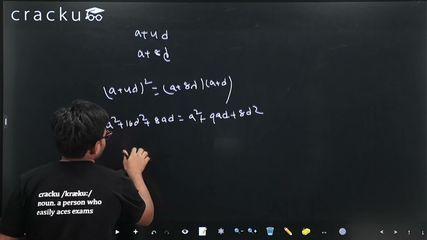
$$\bigl(a+4d\bigr)^2 = (a+d)\bigl(a+8d\bigr).$$
Now we expand both sides:
Left-hand side
$$\bigl(a+4d\bigr)^2 = a^2 + 8ad + 16d^2.$$
Right-hand side
$$\begin{aligned} (a+d)\bigl(a+8d\bigr) &= a(a+8d) + d(a+8d)\\[4pt] &= a^2 + 8ad + ad + 8d^2\\[4pt] &= a^2 + 9ad + 8d^2. \end{aligned}$$
Equating the two expressions and then cancelling the identical $$a^2$$ term on each side, we obtain
$$a^2 + 8ad + 16d^2 \;=\; a^2 + 9ad + 8d^2$$
$$\Longrightarrow\; 8ad + 16d^2 \;=\; 9ad + 8d^2$$
$$\Longrightarrow\; 0 \;=\; 9ad + 8d^2 - 8ad - 16d^2$$
$$\Longrightarrow\; 0 \;=\; ad - 8d^2$$
$$\Longrightarrow\; d(a - 8d) = 0.$$
Because $$d \neq 0$$, the only admissible solution is
$$a - 8d = 0 \;\;\Longrightarrow\;\; a = 8d.$$
The common ratio $$r$$ of the geometric progression is the quotient of any term by its preceding term, so we use
$$r = \dfrac{T_5}{T_2} = \dfrac{a+4d}{a+d}.$$
Substituting $$a = 8d$$ into this expression gives
$$r = \dfrac{8d + 4d}{8d + d} = \dfrac{12d}{9d} = \dfrac{12}{9} = \dfrac{4}{3}.$$
Hence, the common ratio is $$\dfrac{4}{3}$$.
Hence, the correct answer is Option 4.
Click on the Email ☝️ to Watch the Video Solution
Create a FREE account and get:
_1.webp)

Educational materials for JEE preparation

Ask our AI anything

AI can make mistakes. Please verify important information.
AI can make mistakes. Please verify important information.


