
Join Our JEE Preparation Group
Prep with like-minded aspirants; Get access to free daily tests and study material.
Sign in
Please select an account to continue using cracku.in
↓ →
Join Our JEE Preparation Group
Prep with like-minded aspirants; Get access to free daily tests and study material.
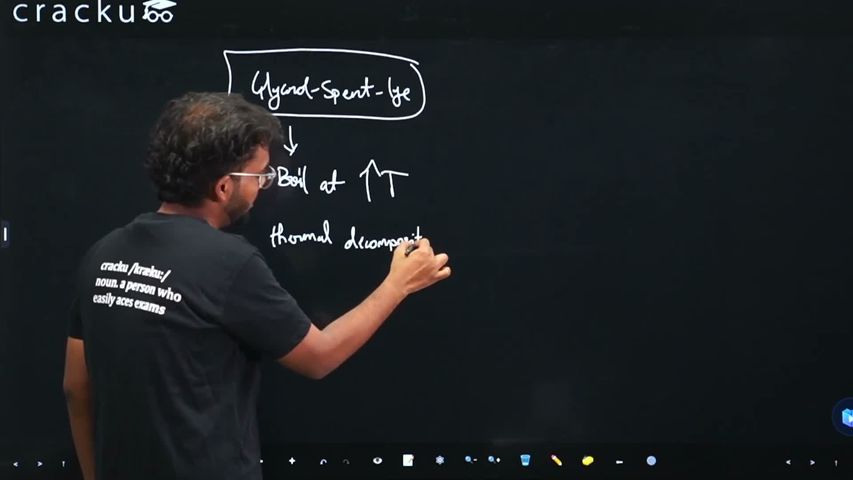
The distillation technique most suited for separating glycerol from spent - lye in the soap industry is:
We begin by recalling a general fact from thermodynamics: the boiling point of a liquid decreases when the external pressure is lowered. Mathematically, this tendency is described by the Clausius-Clapeyron relation, which in one convenient integrated form is written as $$\ln\!\left(\dfrac{P_2}{P_1}\right)= -\dfrac{\Delta H_{\text{vap}}}{R}\left(\dfrac{1}{T_2}-\dfrac{1}{T_1}\right),$$ where $$P_1,\,P_2$$ are the vapour pressures corresponding to the absolute temperatures $$T_1,\,T_2,$$ $$\Delta H_{\text{vap}}$$ is the molar enthalpy of vaporisation, and $$R$$ is the gas constant. The key message of this formula is that if the external pressure $$P_2$$ is made smaller than $$P_1,$$ then the temperature $$T_2$$ needed for boiling becomes lower than $$T_1.$$
Now let us look at the substance we wish to separate. Glycerol (sometimes called glycerine) has a very high normal boiling point, approximately $$290^\circ\text{C}$$ at $$1\,\text{atm}.$$ If we attempted to distil glycerol by ordinary or even fractional distillation at this temperature, the prolonged strong heating would lead to its thermal decomposition, charring, and loss of product. Therefore we must find a way to make glycerol boil at a markedly lower temperature so that distillation can proceed gently.
According to the relation quoted above, lowering the external pressure achieves exactly this goal. By distilling under reduced pressure (also called vacuum distillation), the boiling point of glycerol can be cut down to roughly $$180^\circ\text{C}$$ or even lower, depending on how strong a vacuum is applied. At such temperatures glycerol remains chemically stable, and it can be separated cleanly from the aqueous alkaline solution known in the soap industry as “spent-lye.”
Let us briefly examine the other techniques listed:
• Simple distillation still operates at atmospheric pressure, so it suffers from the same overheating problem.
• Fractional distillation again does not alter the pressure; it merely provides multiple vapour-liquid equilibria for mixtures whose components have moderate boiling-point differences. It does not solve the high-temperature issue for glycerol.
• Steam distillation is useful for substances that are immiscible with water and volatile in steam. Glycerol, however, is miscible with water and is not sufficiently volatile in steam, so this method will not work either.
Thus, the only technique that tackles the core difficulty—glycerol’s very high boiling point—is to perform the distillation while the pressure is reduced.
Hence, the correct answer is Option B.
Was this solution helpful?
Click on the Email ☝️ to Watch the Video Solution
Create a FREE account and get:
_1.webp)

Educational materials for JEE preparation

Ask our AI anything

AI can make mistakes. Please verify important information.
AI can make mistakes. Please verify important information.
