
Join Our JEE Preparation Group
Prep with like-minded aspirants; Get access to free daily tests and study material.
Sign in
Please select an account to continue using cracku.in
↓ →
Join Our JEE Preparation Group
Prep with like-minded aspirants; Get access to free daily tests and study material.
$$n$$ moles of an ideal gas undergoes a process $$A \to B$$ as shown in the figure. The maximum temperature of the gas during the process will be:
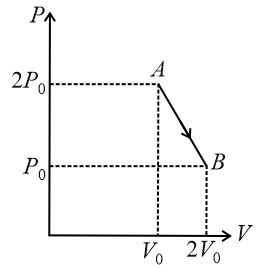
The coordinates of the two marked points on the $$P-V$$ diagram can be read directly from the figure.
At point $$A$$, the pressure is twice the reference value while the volume equals the reference value, so $$P_A = 2P_0 ,\qquad V_A = V_0.$$
At point $$B$$, the pressure is the reference value while the volume is twice the reference value, so $$P_B = P_0 ,\qquad V_B = 2V_0.$$
During the process $$A \rightarrow B$$ the line joining the two points is a straight line on the $$P-V$$ plane. Hence the relation between pressure and volume is linear and can be written in the form $$P = mV + c,$$ where $$m$$ is the slope and $$c$$ is the intercept.
We first evaluate the slope. Using the two end-points,
$$m = \frac{P_B - P_A}{V_B - V_A}
= \frac{P_0 - 2P_0}{\,2V_0 - V_0\,}
= \frac{-P_0}{V_0}.$$
Next we find the intercept by substituting the co-ordinates of point $$A$$: $$P_A = mV_A + c \;\Longrightarrow\; 2P_0 = \left(-\frac{P_0}{V_0}\right)V_0 + c \;\Longrightarrow\; c = 3P_0.$$
So the complete equation of the path is $$P = -\frac{P_0}{V_0}\,V + 3P_0.$$
For an ideal gas, the temperature at any stage is given by the ideal-gas law $$T = \frac{PV}{nR}.$$
Substituting the expression for $$P$$ obtained above, the temperature as a function of volume becomes
$$T(V) = \frac{\left(-\dfrac{P_0}{V_0}V + 3P_0\right)V}{nR}
= \frac{P_0}{nR}\left(-\frac{V^2}{V_0} + 3V\right).$$
To locate the maximum temperature, we differentiate this expression with respect to volume and set the derivative to zero:
$$\frac{dT}{dV} = \frac{P_0}{nR}\left(-\frac{2V}{V_0} + 3\right).$$
At the extremum, $$\dfrac{dT}{dV}=0,$$ so
$$-\frac{2V}{V_0} + 3 = 0
\;\Longrightarrow\; \frac{2V}{V_0} = 3
\;\Longrightarrow\; V = \frac{3}{2}V_0.$$
This intermediate volume is indeed between $$V_0$$ and $$2V_0,$$ confirming that we have an internal maximum.
We now calculate the corresponding pressure. Substituting $$V = \dfrac{3}{2}V_0$$ into the line equation,
$$P = -\frac{P_0}{V_0}\left(\frac{3}{2}V_0\right) + 3P_0
= -\frac{3}{2}P_0 + 3P_0
= \frac{3}{2}P_0.$$
Finally, substituting these $$P$$ and $$V$$ values back into the ideal-gas relation gives the maximum temperature:
$$T_{\text{max}}
= \frac{PV}{nR}
= \frac{\left(\dfrac{3}{2}P_0\right)\left(\dfrac{3}{2}V_0\right)}{nR}
= \frac{9P_0V_0}{4nR}.$$
Hence, the correct answer is Option C.
Create a FREE account and get:
_1.webp)

Educational materials for JEE preparation

Ask our AI anything

AI can make mistakes. Please verify important information.
AI can make mistakes. Please verify important information.


