
Join Our JEE Preparation Group
Prep with like-minded aspirants; Get access to free daily tests and study material.
Sign in
Please select an account to continue using cracku.in
↓ →
Join Our JEE Preparation Group
Prep with like-minded aspirants; Get access to free daily tests and study material.
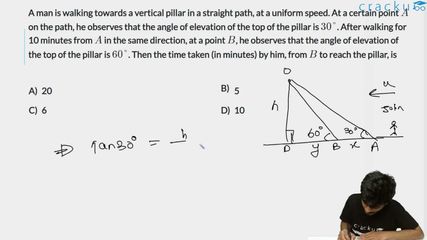
A man is walking towards a vertical pillar in a straight path, at a uniform speed. At a certain point $$A$$ on the path, he observes that the angle of elevation of the top of the pillar is $$30°$$. After walking for 10 minutes from $$A$$ in the same direction, at a point $$B$$, he observes that the angle of elevation of the top of the pillar is $$60°$$. Then the time taken (in minutes) by him, from $$B$$ to reach the pillar, is
Let us denote
$$h$$ = height of the pillar,
$$x$$ = horizontal distance of point $$A$$ from the foot of the pillar,
$$v$$ = uniform speed of the man (in units of distance per minute).
At point $$A$$ the angle of elevation of the top of the pillar is $$30^\circ$$. The right-angled triangle formed has the pillar as the opposite side and the distance $$x$$ as the adjacent side. We therefore write the tangent relation:
$$\tan 30^\circ=\frac{\text{opposite}}{\text{adjacent}}=\frac{h}{x}.$$
We know the standard value $$\tan 30^\circ=\frac1{\sqrt3}$$, so
$$\frac1{\sqrt3}=\frac{h}{x}\quad\Longrightarrow\quad h=\frac{x}{\sqrt3}.$$
Now the man walks for 10 minutes from $$A$$ to $$B$$ at speed $$v$$. Hence the horizontal distance he covers is
$$AB = 10v.$$
The new horizontal distance of point $$B$$ from the pillar’s foot is therefore
$$x-AB=x-10v.$$
At $$B$$ the angle of elevation becomes $$60^\circ$$, so again using the tangent formula,
$$\tan 60^\circ=\frac{h}{x-10v}.$$
The standard value $$\tan 60^\circ=\sqrt3$$ gives
$$\sqrt3=\frac{h}{x-10v}\quad\Longrightarrow\quad h=\sqrt3\,(x-10v).$$
But we already found $$h=\dfrac{x}{\sqrt3}$$. Equating the two expressions for $$h$$:
$$\frac{x}{\sqrt3}=\sqrt3\,(x-10v).$$
Multiply both sides by $$\sqrt3$$ to clear the denominator:
$$x = 3x - 30v.$$
Bring like terms together:
$$x - 3x = -30v \quad\Longrightarrow\quad -2x = -30v \quad\Longrightarrow\quad 2x = 30v.$$
Divide by $$2$$:
$$x = 15v.$$
The remaining horizontal distance from $$B$$ to the pillar is
$$x-10v = 15v - 10v = 5v.$$
Time is distance divided by speed, so the time required from $$B$$ to reach the pillar is
$$\text{time}=\frac{5v}{v}=5\text{ minutes}.$$
Hence, the correct answer is Option B.
Was this solution helpful?
Click on the Email ☝️ to Watch the Video Solution
Create a FREE account and get:
_1.webp)

Educational materials for JEE preparation

Ask our AI anything

AI can make mistakes. Please verify important information.
AI can make mistakes. Please verify important information.
