
Join Our JEE Preparation Group
Prep with like-minded aspirants; Get access to free daily tests and study material.
Sign in
Please select an account to continue using cracku.in
↓ →
Join Our JEE Preparation Group
Prep with like-minded aspirants; Get access to free daily tests and study material.
A point particle of mass m, moves along the uniformly rough track PQR as shown in the figure. The coefficient of friction, between the particle and the rough track equals $$\mu$$. The particle is released, from rest, from the point P and it comes to rest at a point R. The energies, lost by the ball, over the parts, PQ and QR, of the track, are equal to each other, and no energy is lost when particle changes direction from PQ to QR. The values of the coefficient of friction $$\mu$$ and the distance x = (QR), are respectively close to:
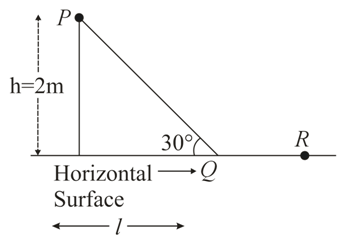
On the inclined track $$PQ$$, the distance $$d$$ is $$h / \sin(30^\circ) = 2 / 0.5 = 4\text{ m}$$. The normal force acting on the particle is $$mg \cos(30^\circ)$$. The energy lost ($$W_1$$) is: $$W_1 = \text{Friction} \times \text{Distance} = (\mu mg \cos 30^\circ) \times 4$$
$$W_1 = \mu mg \left( \frac{\sqrt{3}}{2} \right) \times 4 = 2\sqrt{3} \mu mg$$
On the horizontal track $$QR$$ of length $$x$$, the normal force is simply $$mg$$. The energy lost is $$W_2 = \mu mgx$$.
The energy lost over $$PQ$$ is equal to the energy lost over $$QR$$ ($$W_1 = W_2$$):
$$2\sqrt{3} \mu mg = \mu mgx$$
$$x = 2\sqrt{3} \approx 2 \times 1.732 = 3.464\text{ m}$$
This is approximately $$3.5\text{ m}$$.
By conservation of energy, the total initial potential energy ($$mgh$$) equals the total energy dissipated by friction:
$$mgh = W_1 + W_2$$
Since $$W_1 = W_2$$, $$mgh = 2W_1$$
$$mg(2) = 2(2\sqrt{3} \mu mg)$$
$$2 = 4\sqrt{3} \mu$$
$$\mu = \frac{1}{2\sqrt{3}} \approx \frac{1}{3.464} \approx 0.2887$$
This value is approximately $$0.29$$.
Click on the Email ☝️ to Watch the Video Solution
Create a FREE account and get:
_1.webp)

Educational materials for JEE preparation

Ask our AI anything

AI can make mistakes. Please verify important information.
AI can make mistakes. Please verify important information.


