
Join Our JEE Preparation Group
Prep with like-minded aspirants; Get access to free daily tests and study material.
Sign in
Please select an account to continue using cracku.in
↓ →
Join Our JEE Preparation Group
Prep with like-minded aspirants; Get access to free daily tests and study material.
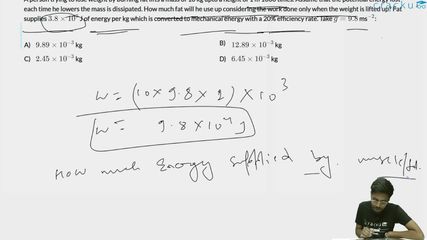
A person trying to lose weight by burning fat lifts a mass of 10 kg upto a height of 1 m 1000 times. Assume that the potential energy lost each time he lowers the mass is dissipated. How much fat will he use up considering the work done only when the weight is lifted up? Fat supplies $$3.8 \times 10^{7}$$ J of energy per kg which is converted to mechanical energy with a 20% efficiency rate. Take $$g = 9.8$$ ms$$^{-2}$$:
First, we recall the expression for the gravitational potential energy gained when a body of mass $$m$$ is raised through a height $$h$$ in a uniform gravitational field:
$$W = mgh$$
Here we have
$$m = 10 \text{ kg}, \qquad g = 9.8 \text{ m s}^{-2}, \qquad h = 1 \text{ m}.$$
So, for one single lift the mechanical work done is
$$W_1 = (10)(9.8)(1) = 98 \text{ J}.$$
The person repeats this lift $$1000$$ times. Therefore the total mechanical work performed while lifting, denoted by $$W_{\text{tot}},$$ is
$$W_{\text{tot}} = 1000 \times 98 = 98\,000 \text{ J}.$$
The body converts chemical energy stored in fat into mechanical energy with an efficiency of $$20\%$$. Stating the efficiency relation, we have
$$\text{Efficiency} = \eta = \frac{\text{Mechanical energy output}}{\text{Chemical energy input}}.$$
With $$\eta = 0.20$$ we can solve for the chemical energy that must be supplied by the fat:
$$E_{\text{fat}} = \frac{W_{\text{tot}}}{\eta} = \frac{98\,000}{0.20} = 4.9 \times 10^{5} \text{ J}.$$
Next, we use the given calorific value of fat. One kilogram of fat can release
$$e = 3.8 \times 10^{7} \text{ J}$$
of energy.
Therefore, the mass of fat actually consumed, $$m_{\text{fat}},$$ is obtained from
$$m_{\text{fat}} = \frac{E_{\text{fat}}}{e} = \frac{4.9 \times 10^{5}}{3.8 \times 10^{7}} \text{ kg}.$$
Now we carry out the division step by step. First, factor out the powers of ten:
$$\frac{4.9 \times 10^{5}}{3.8 \times 10^{7}} = \frac{4.9}{3.8} \times 10^{5 - 7} = \frac{4.9}{3.8} \times 10^{-2}.$$
Next, divide the numerators:
$$\frac{4.9}{3.8} = 1.289\ (\text{approximately}).$$
Combining this with the power of ten gives
$$m_{\text{fat}} \approx 1.289 \times 10^{-2} \text{ kg}.$$
Writing this in the same form as the options, we have
$$m_{\text{fat}} \approx 12.89 \times 10^{-3} \text{ kg}.$$
This numerical value matches the second choice in the list.
Hence, the correct answer is Option B.
Click on the Email ☝️ to Watch the Video Solution
Create a FREE account and get:
_1.webp)

Educational materials for JEE preparation

Ask our AI anything

AI can make mistakes. Please verify important information.
AI can make mistakes. Please verify important information.


