
Join Our JEE Preparation Group
Prep with like-minded aspirants; Get access to free daily tests and study material.
Sign in
Please select an account to continue using cracku.in
↓ →
Join Our JEE Preparation Group
Prep with like-minded aspirants; Get access to free daily tests and study material.
A particle of mass m is moving along the side of a square of side 'a', with a uniform speed v in the x-y plane as shown in the figure:
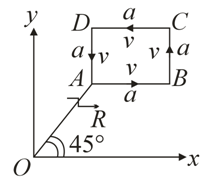
Which of the following statements is false for the angular momentum $$\vec{L}$$ about the origin?
Coordinates of points:
$$A = \left( R\cos45^\circ, R\sin45^\circ \right) = \left( \frac{R}{\sqrt{2}}, \frac{R}{\sqrt{2}} \right)$$
$$B = \left( \frac{R}{\sqrt{2}} + a, \frac{R}{\sqrt{2}} \right)$$ (moving distance $a$ along the x-axis)
$$C = \left( \frac{R}{\sqrt{2}} + a, \frac{R}{\sqrt{2}} + a \right)$$ (moving distance $a$ along the y-axis)
$$D = \left( \frac{R}{\sqrt{2}}, \frac{R}{\sqrt{2}} + a \right)$$ (moving distance $a$ back along the x-axis)
The general formula for angular momentum is $$\vec{L} = \vec{r} \times \vec{p} = m(\vec{r} \times \vec{v})$$.
Path A to B (Moving Right)
Velocity: $$\vec{v} = v\hat{i}$$
Constant y-component: $$y = \frac{R}{\sqrt{2}}$$
$$\vec{L} = m \left( x\hat{i} + \frac{R}{\sqrt{2}}\hat{j} \right) \times (v\hat{i}) = -mv \frac{R}{\sqrt{2}}\hat{k}$$
Statement C is TRUE.
Path B to C (Moving Up)
Velocity: $$\vec{v} = v\hat{j}$$
Constant x-component: $$x = \frac{R}{\sqrt{2}} + a$$
$$\vec{L} = m \left( \left[\frac{R}{\sqrt{2}} + a\right]\hat{i} + y\hat{j} \right) \times (v\hat{j}) = mv \left( \frac{R}{\sqrt{2}} + a \right)\hat{k}$$
Statement A is TRUE.
Path C to D (Moving Left)
Velocity: $$\vec{v} = -v\hat{i}$$
Constant y-component: $$y = \frac{R}{\sqrt{2}} + a$$
$$\vec{L} = m \left( x\hat{i} + \left[\frac{R}{\sqrt{2}} + a\right]\hat{j} \right) \times (-v\hat{i}) = mv \left( \frac{R}{\sqrt{2}} + a \right)\hat{k}$$
Statement D is TRUE.
Path D to A (Moving Down)
Velocity: $$\vec{v} = -v\hat{j}$$
Constant x-component: $$x = \frac{R}{\sqrt{2}}$$
$$\vec{L} = m \left( \frac{R}{\sqrt{2}}\hat{i} + y\hat{j} \right) \times (-v\hat{j}) = -mv \frac{R}{\sqrt{2}}\hat{k}$$
Statement B is FALSE because it incorrectly gives a positive $$+\hat{k}$$ direction.
Create a FREE account and get:
_1.webp)

Educational materials for JEE preparation

Ask our AI anything

AI can make mistakes. Please verify important information.
AI can make mistakes. Please verify important information.


