
Join Our JEE Preparation Group
Prep with like-minded aspirants; Get access to free daily tests and study material.
Sign in
Please select an account to continue using cracku.in
↓ →
Join Our JEE Preparation Group
Prep with like-minded aspirants; Get access to free daily tests and study material.
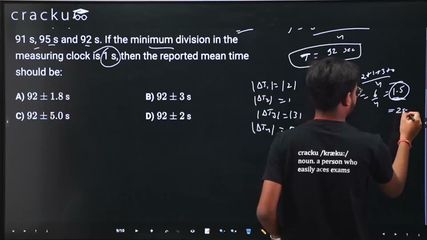
A student measures the time period of 100 oscillations of a simple pendulum four times. The data set is 90 s, 91 s, 95 s and 92 s. If the minimum division in the measuring clock is 1 s, then the reported mean time should be:
We are given four measurements of the time period of 100 oscillations: 90 s, 91 s, 95 s, and 92 s. The least count of the measuring clock is 1 s.
Step 1: Calculate the mean time.
$$\bar{T} = \frac{90 + 91 + 95 + 92}{4} = \frac{368}{4} = 92 \text{ s}$$
Step 2: Calculate absolute errors for each measurement.
$$|\Delta T_1| = |90 - 92| = 2 \text{ s}$$
$$|\Delta T_2| = |91 - 92| = 1 \text{ s}$$
$$|\Delta T_3| = |95 - 92| = 3 \text{ s}$$
$$|\Delta T_4| = |92 - 92| = 0 \text{ s}$$
Step 3: Calculate the mean absolute error.
The mean absolute error is the average of all absolute errors:
$$\Delta \bar{T} = \frac{|\Delta T_1| + |\Delta T_2| + |\Delta T_3| + |\Delta T_4|}{4} = \frac{2 + 1 + 3 + 0}{4} = \frac{6}{4} = 1.5 \text{ s}$$
Step 4: Round to the appropriate precision.
Since the least count of the measuring clock is 1 s, the error must be rounded to the nearest whole number. The mean absolute error 1.5 s rounds up to 2 s.
Therefore, the reported mean time is $$92 \pm 2$$ s.
The correct answer is Option D.
Click on the Email ☝️ to Watch the Video Solution
Create a FREE account and get:
_1.webp)

Educational materials for JEE preparation

Ask our AI anything

AI can make mistakes. Please verify important information.
AI can make mistakes. Please verify important information.


