
Join Our JEE Preparation Group
Prep with like-minded aspirants; Get access to free daily tests and study material.
Sign in
Please select an account to continue using cracku.in
↓ →
Join Our JEE Preparation Group
Prep with like-minded aspirants; Get access to free daily tests and study material.
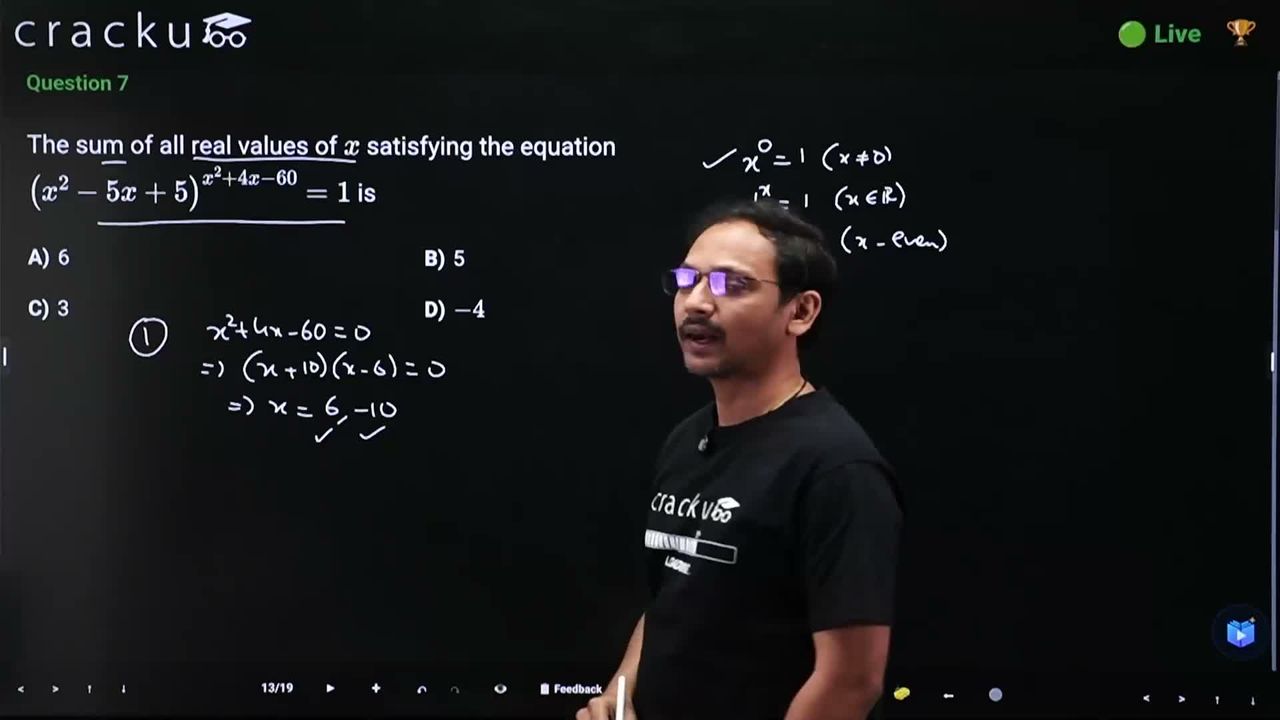
The sum of all real values of $$x$$ satisfying the equation $$\left(x^2 - 5x + 5\right)^{x^2 + 4x - 60} = 1$$ is
We begin with the equation
$$\left(x^{2}-5x+5\right)^{\,x^{2}+4x-60}=1.$$
For any real numbers $$a$$ and $$b$$, the expression $$a^{b}$$ equals $$1$$ in the following real-number situations:
$$\begin{aligned} \text{(i)}\;& b=0 &\text{and}&\; a\neq0,\; &\text{because}&\; a^{0}=1,\\[2pt] \text{(ii)}\;& a=1 &\text{with}&\; b\in\mathbb R,\; &\text{because}&\; 1^{b}=1,\\[2pt] \text{(iii)}\;& a=-1 &\text{with}&\; b=\text{even integer},\; &\text{because}&\;(-1)^{\text{even}}=1. \end{aligned}$$
We shall apply each case to the base
$$f(x)=x^{2}-5x+5$$
and the exponent
$$g(x)=x^{2}+4x-60.$$
Case 1: Exponent zero. We set $$g(x)=0$$ and require $$f(x)\neq0.$$
$$x^{2}+4x-60=0.$$
The discriminant is $$\Delta=4^{2}-4(1)(-60)=16+240=256,$$ so $$\sqrt{\Delta}=16.$$
$$x=\frac{-4\pm16}{2}\;\Rightarrow\;x=\frac{12}{2}=6,\quad x=\frac{-20}{2}=-10.$$
Checking the base:
$$f(6)=36-30+5=11\neq0,$$, $$f(-10)=100+50+5=155\neq0.$$
Thus $$x=6$$ and $$x=-10$$ satisfy the equation.
Case 2: Base equal to 1. We set $$f(x)=1$$ (no restriction on $$g(x)$$).
$$x^{2}-5x+5=1\;\Rightarrow\;x^{2}-5x+4=0.$$
The discriminant is $$25-16=9,$$ so $$\sqrt{\Delta}=3.$$
$$x=\frac{5\pm3}{2}\;\Rightarrow\;x=4,\quad x=1.$$
Hence $$x=1$$ and $$x=4$$ are solutions.
Case 3: Base equal to $$-1$$ and exponent an even integer.
First make the base $$-1$$:
$$x^{2}-5x+5=-1\;\Rightarrow\;x^{2}-5x+6=0.$$
The discriminant is $$25-24=1,$$ so $$\sqrt{\Delta}=1.$$
$$x=\frac{5\pm1}{2}\;\Rightarrow\;x=3,\quad x=2.$$
Now we need $$g(x)$$ to be an even integer at these $$x$$ values.
For $$x=3:$$ $$g(3)=3^{2}+4\cdot3-60=9+12-60=-39,$$ which is odd, so $$x=3$$ is rejected.
For $$x=2:$$ $$g(2)=2^{2}+4\cdot2-60=4+8-60=-48,$$ which is an even integer, so $$x=2$$ is accepted.
No other cases produce real solutions equal to $$1,$$ so the complete set of real solutions is
$$\{\, -10,\; 6,\; 1,\; 4,\; 2 \,\}.$$
The problem asks for the sum of all these real values:
$$\begin{aligned} -10+6+1+4+2 &= (-10+6)+1+4+2\\ &= -4+1+4+2\\ &= (-4+1)+4+2\\ &= -3+4+2\\ &= 1+2\\ &= 3. \end{aligned}$$
Hence, the correct answer is Option C.
Click on the Email ☝️ to Watch the Video Solution
Create a FREE account and get:
_1.webp)

Educational materials for JEE preparation

Ask our AI anything

AI can make mistakes. Please verify important information.
AI can make mistakes. Please verify important information.


