
Join Our JEE Preparation Group
Prep with like-minded aspirants; Get access to free daily tests and study material.
Sign in
Please select an account to continue using cracku.in
↓ →
Join Our JEE Preparation Group
Prep with like-minded aspirants; Get access to free daily tests and study material.
Two closed bulbs of equal volume (V) containing an ideal gas initially at pressure $$p_i$$ and temperature $$T_1$$ are connected through a narrow tube of negligible volume, as shown in the figure below. The temperature of one of the bulbs is then raised to $$T_2$$. The final pressure $$P_f$$ is:
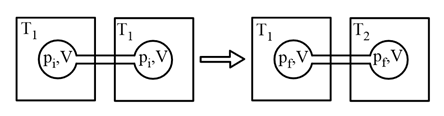
Initially, both bulbs have a volume $$V$$, pressure $$p_i$$, and temperature $$T_1$$.
Using the Ideal Gas Law ($$PV = nRT$$), the number of moles in each bulb is:
$$n_1 = \frac{p_i V}{R T_1}$$, $$n_2 = \frac{p_i V}{R T_1}$$
$$n_{total} = n_1 + n_2 = \frac{2 p_i V}{R T_1}$$
In the final state, the bulbs reach a common pressure $$P_f$$. Bulb 1 remains at temperature $$T_1$$, while bulb 2 is raised to temperature $$T_2$$.
$$n'_1 = \frac{P_f V}{R T_1}$$, $$n'_2 = \frac{P_f V}{R T_2}$$
The total number of moles remains the same:
$$n_{total} = n'_1 + n'_2$$
$$n_{total} = \frac{P_f V}{R} \left( \frac{1}{T_1} + \frac{1}{T_2} \right)$$
$$n_{total} = \frac{P_f V}{R} \left( \frac{T_1 + T_2}{T_1 T_2} \right)$$
$$\frac{2 p_i V}{R T_1} = \frac{P_f V}{R} \left( \frac{T_1 + T_2}{T_1 T_2} \right)$$
$$P_f = 2 p_i \left( \frac{T_2}{T_1 + T_2} \right)$$
Was this solution helpful?
Create a FREE account and get:
_1.webp)

Educational materials for JEE preparation

Ask our AI anything

AI can make mistakes. Please verify important information.
AI can make mistakes. Please verify important information.
