Join WhatsApp Icon JEE WhatsApp Group

NTA JEE Main 2nd September 2020 Shift 2 - Physics

For the following questions answer them individually

Two uniform circular discs are rotating independently in the same direction around their common axis passing through their centres. The moment of inertia and angular velocity of the first disc are 0.1 kg - m$$^2$$ and 10 rad s$$^{-1}$$ respectively while those for the second one are 0.2 kg - m$$^2$$ and 5 rad s$$^{-1}$$ respectively. At some instant they get stuck together and start rotating as a single system about their common axis with some angular speed. The kinetic energy of the combined system is:

The height 'h' at which the weight of a body will be the same as that at the same depth 'h' from the surface of the earth is (Radius of the earth is R and effect of the rotation of the earth is neglected):

A capillary tube made of glass of radius 0.15 mm is dipped vertically in a beaker filled with methylene iodide (surface tension = 0.05 N m$$^{-1}$$, density = 667 kg m$$^{-3}$$) which rises to height h in the tube. It is observed that the two tangents drawn from observed that the two tangents drawn from liquid-glass interfaces (from opp. sides of the capillary) make an angle of 60$$°$$ with one another. Then h is close to (g = 10 m s$$^{-2}$$):

An ideal gas in a closed container is slowly heated. As its temperature increases, which of the following statements are true?
(A) the mean free path of the molecules decreases
(B) the mean collision time between the molecules decreases.
(C) the mean free path remains unchanged.
(D) the mean collision time relations unchanged.

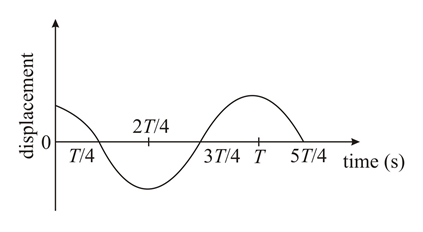
The displacement time graph of a particle executing SHM is given in figure: (sketch is schematic and not to scale)


Which of the following statements is/are true for this motion?
(A) The force is zero at $$t = \frac{3T}{4}$$
(B) The magnitude of acceleration is maximum at $$t = T$$
(C) The speed is maximum at $$t = \frac{T}{4}$$
(D) The P.E. is equal to K.E. of the oscillation at $$t = \frac{T}{2}$$

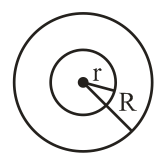
A charge Q is distributed over two concentric conducting thin spherical shells radii r and R (R > r). If the surface charge densities on the two shells are equal, the electric potential at the common centre is:

A 10 $$\mu$$F capacitor is fully charged to a potential difference of 50 V. After removing the source voltage it is connected to an uncharged capacitor in parallel. Now the potential difference across them becomes 20 V. The capacitance of the second capacitor is:

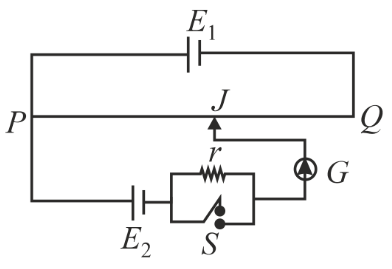
A potentiometer wire PQ of 1m length is connected to a standard cell $$E_1$$. Another cell $$E_2$$ of emf 1.02 V is connected with a resistance 'r' and switch S (as shown in figure). With switch S open, the null position is obtained at a distance of 49 cm from Q. The potential gradient in the potentiometer wire is:

image

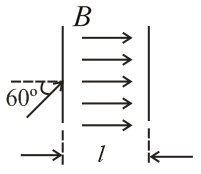
The figure shows a region of length 'l' with a uniform magnetic field of 0.3 T in it and a proton entering the region with velocity $$4 \times 10^5$$ m s$$^{-1}$$ making an angle 60$$°$$ with the field. If proton completes 10 revolution by the time it cross the region shown, 'l' is close to (mass of proton $$= 1.67 \times 10^{-27}$$ kg, charge of the proton $$= 1.6 \times 10^{-19}$$ C):

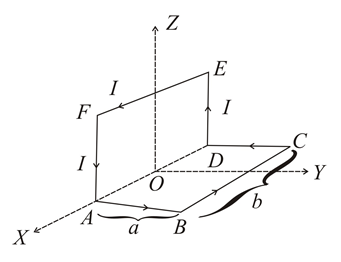
A wire carrying current I is bent in the shape ABCDEFA as shown, where rectangle ABCDA and ADEFA are perpendicular to each other. If the sides of the rectangles are of lengths a and b, then the magnitude and direction of magnetic moment of the loop ABCDEFA is:

A small point mass carrying some positive charge on it, is released from the edge of a table. There is a uniform electric field in this region in the horizontal direction. Which of the following options then correctly describe the trajectory of the mass? (Curves are drawn schematically and are not to scale)

An inductance coil has a reactance of 100 $$\Omega$$. When an AC signal of frequency 1000 Hz is applied to the coil, the applied voltage leads the current by 45$$°$$. The self-inductance of the coil is:

In a plane electromagnetic wave, the directions of electric field and magnetic field are represented by $$\hat{k}$$ and $$2\hat{i} - 2\hat{j}$$, respectively. What is the unit vector along direction of propagation of the wave.

A particle is moving 5 times as fast as an electron. The ratio of the de-Broglie wavelength of the particle to that of the electron is $$1.878 \times 10^{-4}$$. The mass of the particle is close to:

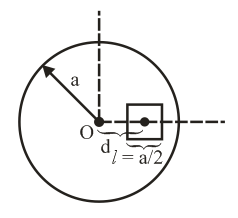
A square shaped hole of side $$l = \frac{a}{2}$$ is carved out at a distance $$d = \frac{a}{2}$$ from the centre 'O' of a uniform circular disk of radius a. If the distance of the centre of mass of the remaining portion from O is $$-\frac{a}{x}$$, value of X (to the nearest integer) is:

Backspace
789
456
123
0.-
Clear All

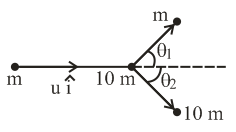
A particle of mass m is moving along the x-axis with initial velocity $$u\hat{i}$$. It collides elastically with a particle of mass 10m at rest and then moves with half its initial kinetic energy (see figure). If $$\sin\theta_1 = \sqrt{n}\sin\theta_2$$, then value of n is ___________.

Backspace
789
456
123
0.-
Clear All

A wire of density $$9 \times 10^{-3}$$ kg cm$$^{-3}$$ is stretched between two clamps 1 m apart. The resulting strain in the wire is $$4.9 \times 10^{-4}$$. The lowest frequency of the transverse vibrations in the wire (Young's modulus of wire $$Y = 9 \times 10^{10}$$ Nm$$^{-2}$$), (to the nearest integer) is ___________.

Backspace
789
456
123
0.-
Clear All

A light ray enters a solid glass sphere of refractive index $$\mu = \sqrt{3}$$ at an angle of incidence 60$$°$$. The ray is both reflected and refracted at the farther surface of the sphere. The angle (in degrees) between the reflected and refracted rays at this surface is ___________.

Backspace
789
456
123
0.-
Clear All