
Join Our JEE Preparation Group
Prep with like-minded aspirants; Get access to free daily tests and study material.
Sign in
Please select an account to continue using cracku.in
↓ →
Join Our JEE Preparation Group
Prep with like-minded aspirants; Get access to free daily tests and study material.
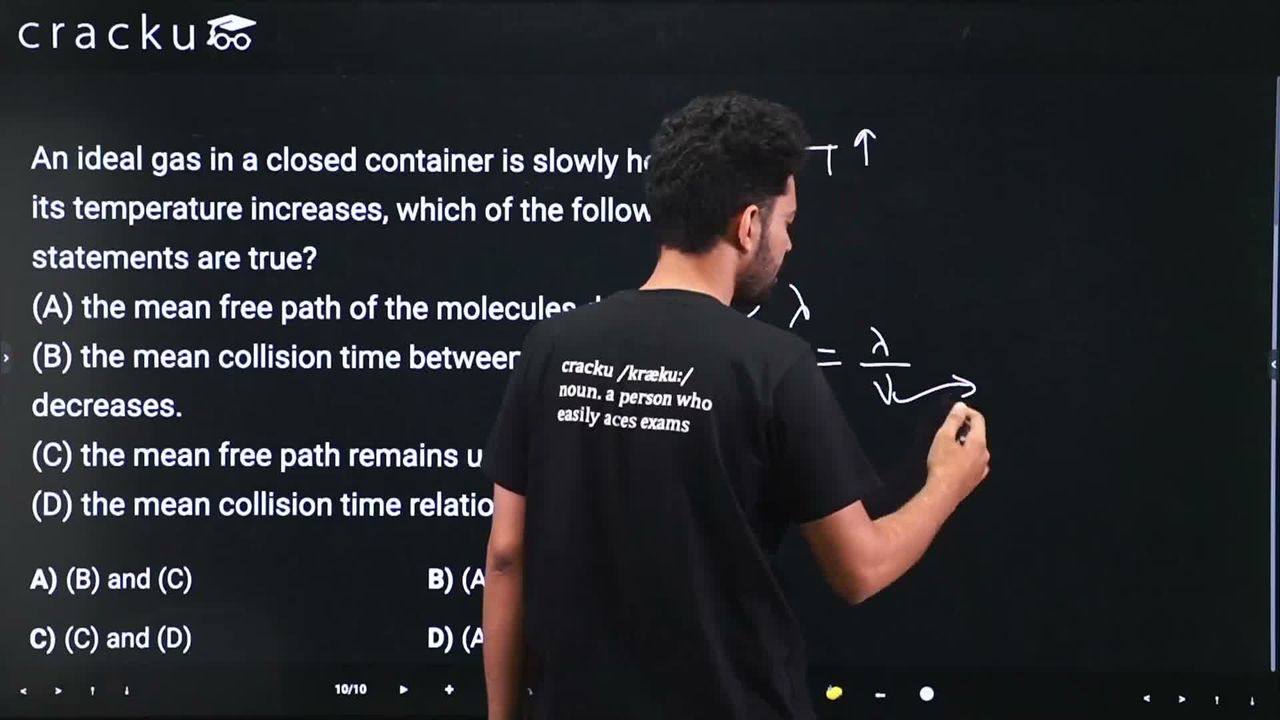
An ideal gas in a closed container is slowly heated. As its temperature increases, which of the following statements are true?
(A) the mean free path of the molecules decreases
(B) the mean collision time between the molecules decreases.
(C) the mean free path remains unchanged.
(D) the mean collision time relations unchanged.
For an ideal gas, the number of molecules is $$N$$ and the container is closed, so its volume $$V$$ is fixed. Therefore the number density is
$$n \;=\;\dfrac{N}{V},$$
and this value $$n$$ does not change when we raise the temperature, because neither $$N$$ nor $$V$$ changes.
Now recall the kinetic-theory formula for the mean free path. We state it first:
$$\lambda \;=\;\dfrac{1}{\sqrt{2}\,\pi d^{2}\,n},$$
where $$d$$ is the effective molecular diameter and $$n$$ is the number density. Since $$d$$ is a property of the molecule and $$n$$ has just been shown to stay constant, we see immediately
$$\lambda \;$$ remains constant when the temperature rises.
So, statement (A) “the mean free path decreases” is false, while statement (C) “the mean free path remains unchanged” is true.
Next we look at the mean collision time, often denoted $$\tau$$. The definition is
$$\tau \;=\;\dfrac{\text{mean free path}}{\text{average speed}},$$ $$\text{so}$$ $$\tau \;=\;\dfrac{\lambda}{v_{\text{avg}}}.$$
For an ideal gas, the average (more precisely the root-mean-square) speed is given by the kinetic-theory result
$$v_{\text{rms}} \;=\;\sqrt{\dfrac{3kT}{m}},$$
where $$k$$ is Boltzmann’s constant, $$T$$ is the absolute temperature, and $$m$$ is the molecular mass. Thus as the temperature increases,
$$v_{\text{avg}} \propto \sqrt{T}$$ $$\Longrightarrow$$ $$v_{\text{avg}}\ \text{increases}.$$
Because $$\lambda$$ is constant while $$v_{\text{avg}}$$ increases, the quotient $$\tau=\lambda/v_{\text{avg}}$$ decreases:
$$\tau \;=\;\dfrac{\lambda}{v_{\text{avg}}}\;\;\Longrightarrow\;\;\tau \propto \dfrac{1}{\sqrt{T}}.$$
Therefore statement (B) “the mean collision time decreases” is true, and statement (D) “the mean collision time remains unchanged” is false.
Collecting the results:
• (B) is true. Mean collision time decreases.
• (C) is true. Mean free path remains unchanged.
• (A) is false. Mean free path does not decrease.
• (D) is false. Mean collision time does not remain the same.
Hence, the correct answer is Option A.
Was this solution helpful?
Click on the Email ☝️ to Watch the Video Solution
Create a FREE account and get:
_1.webp)

Educational materials for JEE preparation

Ask our AI anything

AI can make mistakes. Please verify important information.
AI can make mistakes. Please verify important information.


