
Join Our JEE Preparation Group
Prep with like-minded aspirants; Get access to free daily tests and study material.
Sign in
Please select an account to continue using cracku.in
↓ →
Join Our JEE Preparation Group
Prep with like-minded aspirants; Get access to free daily tests and study material.
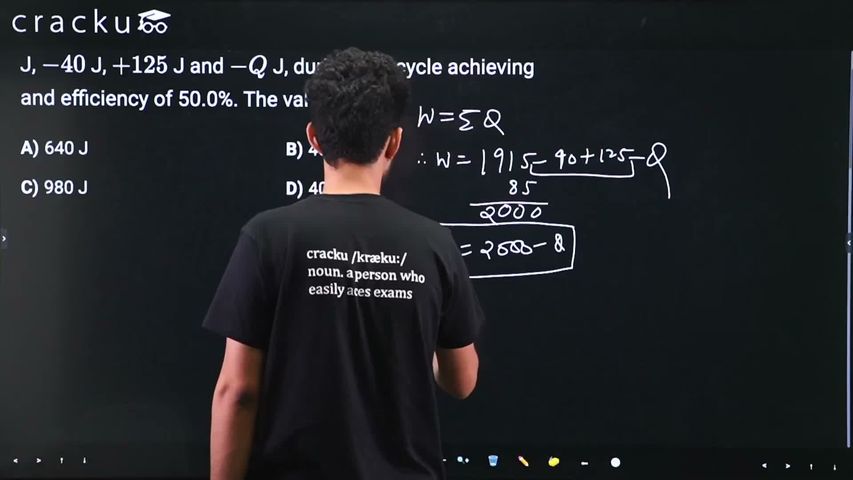
A heat engine is involved with exchange of heat of 1915 J, $$-40$$ J, $$+125$$ J and $$-Q$$ J, during one cycle achieving and efficiency of 50.0%. The value of Q is:
For a heat engine we use the First Law of Thermodynamics which says that over one complete cycle, the net work done $$W$$ equals the algebraic sum of all heats exchanged:
$$W=\sum Q_i$$
The heats exchanged in the given cycle are
$$+1915\ \text{J},\; -40\ \text{J},\; +125\ \text{J},\; -Q\ \text{J}$$
(A positive sign means heat is absorbed by the engine, a negative sign means heat is rejected.)
So the net heat, and therefore the work done in one cycle, is
$$W = 1915 + (-40) + 125 + (-Q)$$
Adding the known numbers step by step:
$$1915 + 125 = 2040$$
$$2040 - 40 = 2000$$
Hence
$$W = 2000 - Q$$
Next, efficiency $$\eta$$ of a heat engine is defined as
$$\eta = \frac{W}{Q_{\text{in}}}$$
where $$Q_{\text{in}}$$ is the total heat absorbed (all positive terms only). The positive heats here are $$1915\ \text{J}$$ and $$125\ \text{J}$$, so
$$Q_{\text{in}} = 1915 + 125 = 2040\ \text{J}$$
The given efficiency is $$\eta = 0.500$$, therefore
$$0.500 = \frac{W}{2040}$$
Substituting $$W = 2000 - Q$$ into this relation gives
$$0.500 = \frac{2000 - Q}{2040}$$
Multiplying both sides by $$2040$$:
$$0.500 \times 2040 = 2000 - Q$$
$$1020 = 2000 - Q$$
Rearranging to isolate $$Q$$:
$$-Q = 1020 - 2000$$
$$-Q = -980$$
$$Q = 980\ \text{J}$$
Hence, the correct answer is Option C.
Was this solution helpful?
Click on the Email ☝️ to Watch the Video Solution
Create a FREE account and get:
_1.webp)

Educational materials for JEE preparation

Ask our AI anything

AI can make mistakes. Please verify important information.
AI can make mistakes. Please verify important information.


