
Join Our JEE Preparation Group
Prep with like-minded aspirants; Get access to free daily tests and study material.
Sign in
Please select an account to continue using cracku.in
↓ →
Join Our JEE Preparation Group
Prep with like-minded aspirants; Get access to free daily tests and study material.
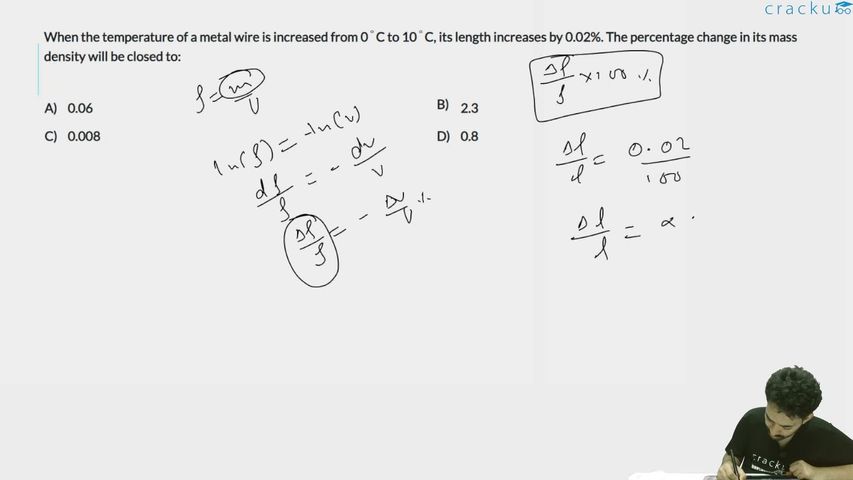
When the temperature of a metal wire is increased from 0$$°$$C to 10$$°$$C, its length increases by 0.02%. The percentage change in its mass density will be closed to:
We are told that when the temperature of a metal wire rises from $$0^{\circ}\text C$$ to $$10^{\circ}\text C$$ its length increases by $$0.02\%$$. First, let us convert this percentage increase in length into a fractional form because all expansion formulae use fractional changes.
$$0.02\% = \frac{0.02}{100}=0.0002$$
So the fractional change in length is
$$\frac{\Delta L}{L}=0.0002$$
The formula for linear (one-dimensional) thermal expansion is first stated:
$$\frac{\Delta L}{L}=\alpha\,\Delta T$$
where $$\alpha$$ is the coefficient of linear expansion and $$\Delta T$$ is the rise in temperature. We substitute the known values:
$$0.0002=\alpha\,(10^{\circ}\text C)$$
Solving for $$\alpha$$, we divide both sides by $$10$$:
$$\alpha=\frac{0.0002}{10}=2\times10^{-5}\;{}^{\circ}\text C^{-1}$$
Now we turn to the volume change. For an isotropic solid, the relation between the coefficient of volume expansion $$\beta$$ and the linear coefficient $$\alpha$$ is stated:
$$\beta = 3\alpha$$
Therefore, substituting $$\alpha = 2\times10^{-5}\;{}^{\circ}\text C^{-1}$$, we get
$$\beta = 3 \times 2\times10^{-5}=6\times10^{-5}\;{}^{\circ}\text C^{-1}$$
The fractional change in volume is then
$$\frac{\Delta V}{V}=\beta\,\Delta T = (6\times10^{-5})(10)=6\times10^{-4}$$
To convert this fractional change to a percentage, we multiply by $$100$$:
$$6\times10^{-4}\times100 = 0.06\%$$
Thus, the volume increases by $$0.06\%$$ when the temperature rises from $$0^{\circ}\text C$$ to $$10^{\circ}\text C$$.
Because the mass of the wire does not change, density $$\rho$$ varies inversely with volume. The relation is written as
$$\rho = \frac{M}{V}\quad\Longrightarrow\quad \frac{\Delta\rho}{\rho} = -\frac{\Delta V}{V}$$
So the fractional change in density is the negative of the fractional change in volume. Hence
$$\frac{\Delta\rho}{\rho}= -6\times10^{-4}$$
In percentage terms this is
$$-6\times10^{-4}\times100 = -0.06\%$$
The negative sign merely tells us the density decreases; the magnitude of the percentage change is $$0.06\%$$.
Hence, the correct answer is Option A.
Was this solution helpful?
Click on the Email ☝️ to Watch the Video Solution
Create a FREE account and get:
_1.webp)

Educational materials for JEE preparation

Ask our AI anything

AI can make mistakes. Please verify important information.
AI can make mistakes. Please verify important information.


