
Join Our JEE Preparation Group
Prep with like-minded aspirants; Get access to free daily tests and study material.
Sign in
Please select an account to continue using cracku.in
↓ →
Join Our JEE Preparation Group
Prep with like-minded aspirants; Get access to free daily tests and study material.
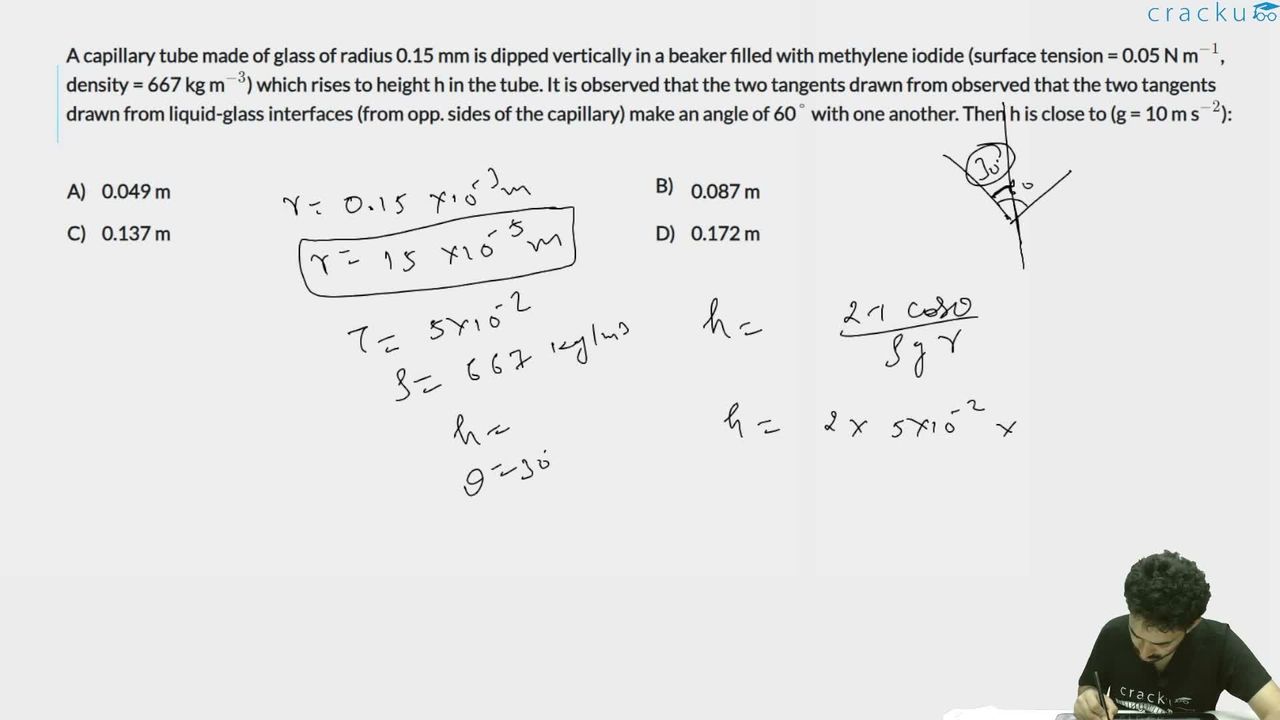
A capillary tube made of glass of radius 0.15 mm is dipped vertically in a beaker filled with methylene iodide (surface tension = 0.05 N m$$^{-1}$$, density = 667 kg m$$^{-3}$$) which rises to height h in the tube. It is observed that the two tangents drawn from observed that the two tangents drawn from liquid-glass interfaces (from opp. sides of the capillary) make an angle of 60$$°$$ with one another. Then h is close to (g = 10 m s$$^{-2}$$):
For a liquid that wets the tube, the height to which it rises in a capillary of radius $$r$$ is obtained from the balance between the upward vertical component of surface-tension force and the downward weight of the liquid column.
First we recall the formula:
$$h \;=\; \frac{2T\cos\theta}{\rho g r}$$
where
$$T$$ is the surface tension, $$\theta$$ is the contact angle, $$\rho$$ is the density of the liquid, $$g$$ is the acceleration due to gravity, and $$r$$ is the radius of the capillary tube.
We are told that the two tangents drawn to the meniscus from opposite sides make an angle of $$60^{\circ}$$ with each other. Since these two tangents are symmetric about the vertical, the angle each tangent makes with the wall is the contact angle. Hence
$$2\theta = 60^{\circ}\;\;\Longrightarrow\;\;\theta = 30^{\circ}.$$
The numerical values given are
$$T = 0.05 \;\text{N\,m}^{-1}, \qquad \rho = 667 \;\text{kg\,m}^{-3}, \qquad g = 10 \;\text{m\,s}^{-2}, \qquad r = 0.15 \;\text{mm}.$$
Converting the radius to metres,
$$r = 0.15 \times 10^{-3} \;\text{m} = 1.5 \times 10^{-4} \;\text{m}.$$
Now we substitute every quantity into the capillary-rise formula.
First evaluate the numerator:
$$2T\cos\theta = 2 \times 0.05 \times \cos 30^{\circ}.$$
Since $$\cos 30^{\circ} = \frac{\sqrt3}{2} \approx 0.8660,$$ we have
$$2T\cos\theta = 0.10 \times 0.8660 = 0.0866 \;\text{N}.$$
Next evaluate the denominator:
$$\rho g r = 667 \times 10 \times 1.5 \times 10^{-4}.$$
Multiplying step by step,
$$667 \times 10 = 6670,$$
and
$$6670 \times 1.5 = 10005,$$
so
$$\rho g r = 10005 \times 10^{-4} \;\text{N\,m}^{-1} = 1.0005 \;\text{N\,m}^{-1}.$$
Finally, divide the numerator by the denominator to obtain the height:
$$h = \frac{0.0866}{1.0005} \;\text{m} \approx 0.0866 \;\text{m}.$$
Rounding to three significant figures gives
$$h \approx 0.087\;\text{m}.$$
Hence, the correct answer is Option B.
Was this solution helpful?
Click on the Email ☝️ to Watch the Video Solution
Create a FREE account and get:
_1.webp)

Educational materials for JEE preparation

Ask our AI anything

AI can make mistakes. Please verify important information.
AI can make mistakes. Please verify important information.


