
Join Our JEE Preparation Group
Prep with like-minded aspirants; Get access to free daily tests and study material.
Sign in
Please select an account to continue using cracku.in
↓ →
Join Our JEE Preparation Group
Prep with like-minded aspirants; Get access to free daily tests and study material.
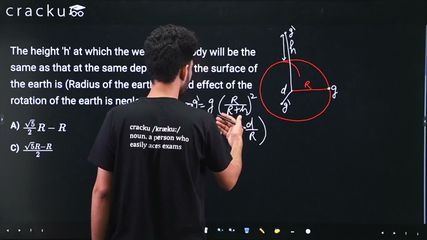
The height 'h' at which the weight of a body will be the same as that at the same depth 'h' from the surface of the earth is (Radius of the earth is R and effect of the rotation of the earth is neglected):
Let the acceleration due to gravity on the surface of the Earth be denoted by $$g$$. We have two different positions to consider for the same body:
1. At a height $$h$$ above the surface. 2. At a depth $$h$$ below the surface.
According to Newton’s law of gravitation, the magnitude of $$g$$ varies with distance from the centre of the Earth. First we state the two standard formulae that connect $$g$$ with height and depth (rotation neglected):
• For a height $$h$$ above the surface, the distance from the centre becomes $$R+h$$. The formula is $$g_h = g\left(\dfrac{R}{R+h}\right)^2$$.
• For a depth $$h$$ below the surface, only the mass enclosed within the radius $$R-h$$ contributes. For a uniform Earth, $$g_d = g\left(1-\dfrac{h}{R}\right)$$.
The problem states that the weight (and hence the gravitational acceleration) is the same in both cases, so we equate the two expressions:
$$g\left(\dfrac{R}{R+h}\right)^2 \;=\; g\left(1-\dfrac{h}{R}\right).$$
Because the factor $$g$$ appears on both sides, it cancels out, leaving
$$\left(\dfrac{R}{R+h}\right)^2 = 1-\dfrac{h}{R}.$$
To simplify the algebra, we introduce the dimensionless variable
$$x = \dfrac{h}{R}.$$
Substituting $$h = xR$$ into the equation gives
$$\left(\dfrac{R}{R + xR}\right)^2 = 1 - x.$$
Inside the brackets, factor out $$R$$:
$$\left(\dfrac{R}{R(1 + x)}\right)^2 = 1 - x \;\;\Longrightarrow\;\; \left(\dfrac{1}{1 + x}\right)^2 = 1 - x.$$
Remove the fraction by multiplying both sides by $$(1 + x)^2$$:
$$(1 + x)^2\,(1 - x) = 1.$$
Now expand the left-hand side step by step. First, square the binomial:
$$(1 + x)^2 = 1 + 2x + x^2.$$
Next, multiply this result by $$(1 - x)$$:
$$(1 + 2x + x^2)(1 - x) = 1(1 - x) + 2x(1 - x) + x^2(1 - x).$$
Carrying out each product:
$$1 - x + 2x - 2x^2 + x^2 - x^3.$$
Combine like terms:
$$1 + x - x^2 - x^3.$$
Therefore the equation becomes
$$1 + x - x^2 - x^3 = 1.$$
Subtract $$1$$ from both sides to bring all terms to one side:
$$x - x^2 - x^3 = 0.$$
Factor out the common factor $$x$$:
$$x\bigl(1 - x - x^2\bigr) = 0.$$
One solution is $$x = 0$$, corresponding to $$h = 0$$, which is trivial. For a non-zero height we require
$$1 - x - x^2 = 0.$$
This is a quadratic in $$x$$. Rewriting it in standard form:
$$x^2 + x - 1 = 0.$$
We now apply the quadratic formula $$x = \dfrac{-b \pm \sqrt{b^2 - 4ac}}{2a}$$ with $$a = 1,\; b = 1,\; c = -1$$:
$$x = \dfrac{-1 \pm \sqrt{1^2 - 4(1)(-1)}}{2(1)} = \dfrac{-1 \pm \sqrt{1 + 4}}{2} = \dfrac{-1 \pm \sqrt{5}}{2}.$$
The negative root gives a negative height, which is not meaningful here, so we choose the positive root:
$$x = \dfrac{-1 + \sqrt{5}}{2}.$$
Now revert to the original variable $$h$$ using $$x = \dfrac{h}{R}$$:
$$\dfrac{h}{R} = \dfrac{\sqrt{5} - 1}{2} \;\;\Longrightarrow\;\; h = \dfrac{\sqrt{5}\,R - R}{2}.$$
This expression exactly matches Option C.
Hence, the correct answer is Option C.
Was this solution helpful?
Click on the Email ☝️ to Watch the Video Solution
Create a FREE account and get:
_1.webp)

Educational materials for JEE preparation

Ask our AI anything

AI can make mistakes. Please verify important information.
AI can make mistakes. Please verify important information.


