
Join Our JEE Preparation Group
Prep with like-minded aspirants; Get access to free daily tests and study material.
Sign in
Please select an account to continue using cracku.in
↓ →
Join Our JEE Preparation Group
Prep with like-minded aspirants; Get access to free daily tests and study material.
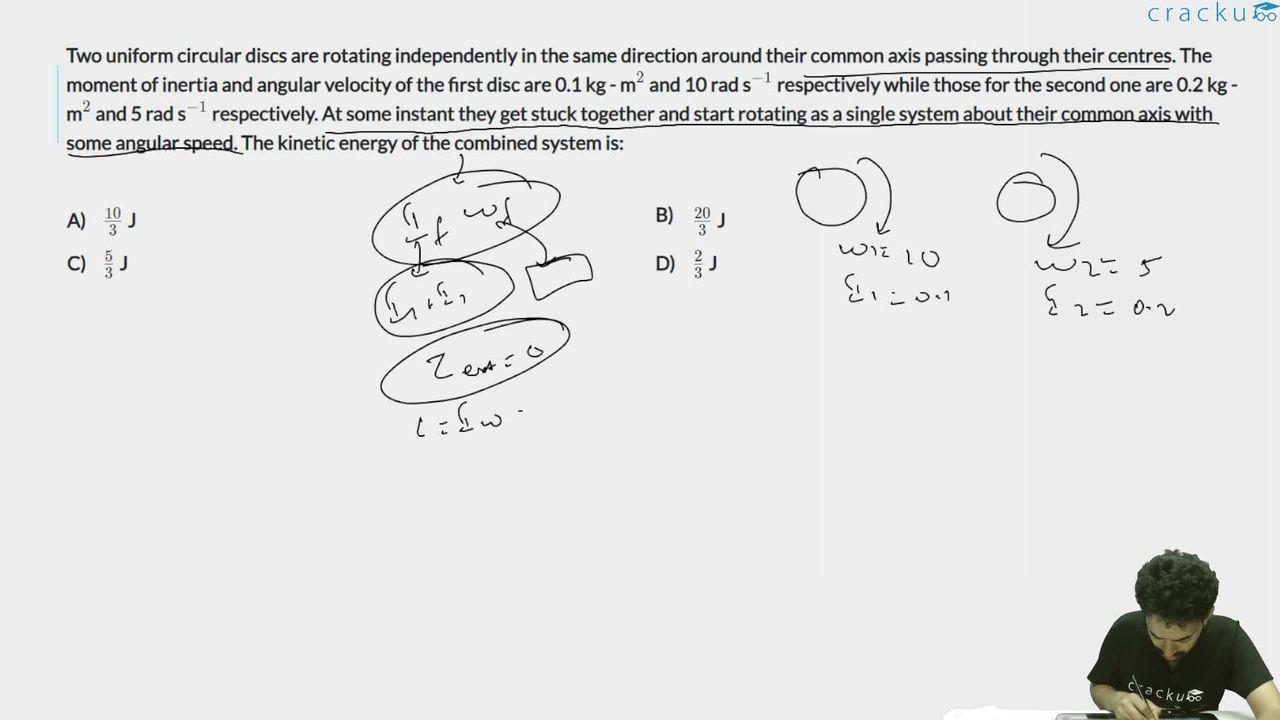
Two uniform circular discs are rotating independently in the same direction around their common axis passing through their centres. The moment of inertia and angular velocity of the first disc are 0.1 kg - m$$^2$$ and 10 rad s$$^{-1}$$ respectively while those for the second one are 0.2 kg - m$$^2$$ and 5 rad s$$^{-1}$$ respectively. At some instant they get stuck together and start rotating as a single system about their common axis with some angular speed. The kinetic energy of the combined system is:
We have two identical axes, so the external torque about that common axis is zero. Whenever external torque is zero, the law of conservation of angular momentum tells us that the total angular momentum $$L$$ of the system remains constant. Mathematically the law is stated as $$L_{\text{initial}} = L_{\text{final}}$$, where $$L = I\,\omega$$ for each rigid body. Here $$I$$ is the moment of inertia and $$\omega$$ is the angular speed.
For the first disc the data are $$I_1 = 0.1\ \text{kg·m}^2$$ and $$\omega_1 = 10\ \text{rad·s}^{-1}$$. Hence its angular momentum is
$$L_1 = I_1\,\omega_1 = 0.1 \times 10 = 1\ \text{kg·m}^2\text{·s}^{-1}.$$
For the second disc we are given $$I_2 = 0.2\ \text{kg·m}^2$$ and $$\omega_2 = 5\ \text{rad·s}^{-1}$$, so its angular momentum equals
$$L_2 = I_2\,\omega_2 = 0.2 \times 5 = 1\ \text{kg·m}^2\text{·s}^{-1}.$$
Both discs rotate in the same direction, hence their angular momenta add algebraically. The total initial angular momentum of the system therefore is
$$L_{\text{initial}} = L_1 + L_2 = 1 + 1 = 2\ \text{kg·m}^2\text{·s}^{-1}.$$
Now the discs suddenly stick together. Because no external torque acts, the final angular momentum is the same:
$$L_{\text{final}} = 2\ \text{kg·m}^2\text{·s}^{-1}.$$
After sticking, the two discs behave like a single rigid body whose moment of inertia is simply the sum of the individual moments, since both masses are still distributed at the same radii from the common axis. Thus
$$I_{\text{combined}} = I_1 + I_2 = 0.1 + 0.2 = 0.3\ \text{kg·m}^2.$$
If $$\omega_f$$ is the common angular speed after they join, conservation of angular momentum gives
$$I_{\text{combined}}\;\omega_f = L_{\text{final}}.$$
Substituting the known numbers,
$$0.3\;\omega_f = 2$$
and therefore
$$\omega_f = \frac{2}{0.3} = \frac{20}{3}\ \text{rad·s}^{-1}.$$
We now compute the rotational kinetic energy of the combined system. The formula for rotational kinetic energy is
$$K = \frac{1}{2}\,I\,\omega^2.$$
Using $$I = 0.3\ \text{kg·m}^2$$ and $$\omega = \dfrac{20}{3}\ \text{rad·s}^{-1}$$, we get
$$K = \frac{1}{2}\times 0.3 \times \left(\frac{20}{3}\right)^2.$$
First square the angular speed:
$$\left(\frac{20}{3}\right)^2 = \frac{400}{9}.$$
Now multiply step by step:
$$\frac{1}{2}\times 0.3 = 0.15,$$
so
$$K = 0.15 \times \frac{400}{9} = \frac{0.15 \times 400}{9}.$$
Multiplying $$0.15 \times 400$$ gives $$60$$, hence
$$K = \frac{60}{9} = \frac{20}{3}\ \text{joule}.$$
Hence, the correct answer is Option B.
Was this solution helpful?
Click on the Email ☝️ to Watch the Video Solution
Create a FREE account and get:
_1.webp)

Educational materials for JEE preparation

Ask our AI anything

AI can make mistakes. Please verify important information.
AI can make mistakes. Please verify important information.


