
Join Our JEE Preparation Group
Prep with like-minded aspirants; Get access to free daily tests and study material.
Sign in
Please select an account to continue using cracku.in
↓ →
Join Our JEE Preparation Group
Prep with like-minded aspirants; Get access to free daily tests and study material.
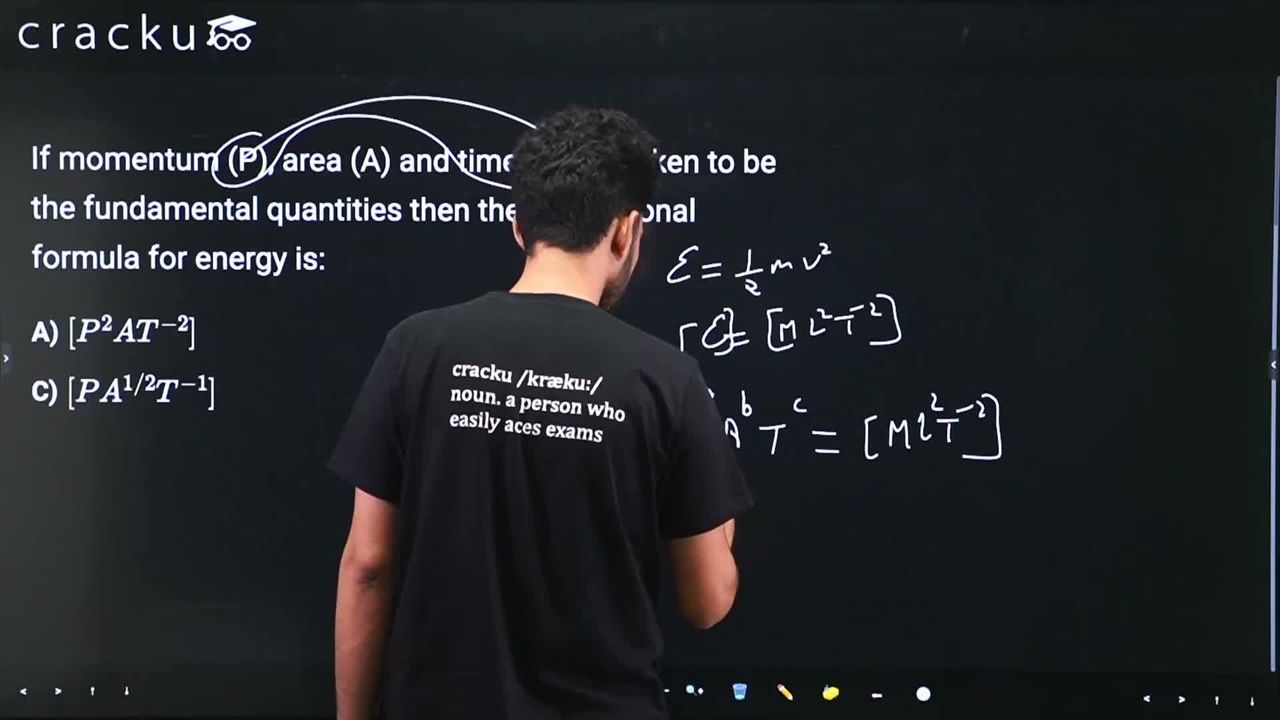
If momentum (P), area (A) and time (T) are taken to be the fundamental quantities then the dimensional formula for energy is:
We know that in the usual MLT system the dimensional formula for mechanical energy (work) is $$[E]=[M\,L^{2}\,T^{-2}]$$, because work is force times distance and force itself is mass times acceleration.
Now the problem tells us to treat momentum $$P$$, area $$A$$ and time $$T$$ as the new fundamental quantities. Therefore we must rewrite the above $$[M\,L^{2}\,T^{-2}]$$ in terms of $$P$$, $$A$$ and $$T$$ only.
First we recall the standard dimensional expressions of the given fundamental quantities in the MLT system:
Momentum is defined as mass times velocity, so $$[P]=[M\,L\,T^{-1}].$$
Area is the product of two lengths, hence $$[A]=[L^{2}].$$
Time is already fundamental, so $$[T]=[T].$$
Let us now assume that the energy dimension can be built as a product of powers of these three fundamental quantities. We therefore write $$[E]=P^{x}\,A^{y}\,T^{z},$$ where $$x$$, $$y$$ and $$z$$ are the unknown exponents to be determined.
Next, we substitute the MLT expressions of $$P$$, $$A$$ and $$T$$ into this assumed form:
$$$ [E]=\bigl(M^{1}L^{1}T^{-1}\bigr)^{x}\; \bigl(L^{2}\bigr)^{y}\; \bigl(T^{1}\bigr)^{z}. $$$
Collecting the powers of each fundamental symbol $$M$$, $$L$$ and $$T$$ separately, we get
$$$ [E]=M^{\,x}\; L^{\,x+2y}\; T^{\,-x+z}. $$$
This combined exponent form must equal the original energy dimension $$M^{1}L^{2}T^{-2}$$, so we equate the corresponding powers term by term:
For mass $$M$$: $$$ x = 1. $$$
For length $$L$$: $$$ x + 2y = 2. $$$
For time $$T$$: $$$ -x + z = -2. $$$
We now solve these three simple linear equations step by step.
From the first equation we immediately have $$$ x = 1. $$$
Substituting $$x=1$$ into the second equation gives $$$ 1 + 2y = 2 \quad\Longrightarrow\quad 2y = 1 \quad\Longrightarrow\quad y = \frac{1}{2}. $$$
Substituting $$x=1$$ into the third equation gives $$$ -1 + z = -2 \quad\Longrightarrow\quad z = -1. $$$
Thus the required exponents are $$$ x = 1,\qquad y = \tfrac12,\qquad z = -1. $$$
Putting these values back into the assumed form $$P^{x}A^{y}T^{z}$$, we obtain
$$$ [E]=P^{1}\,A^{1/2}\,T^{-1}. $$$
Therefore the dimensional formula for energy, when momentum, area and time are chosen as fundamental quantities, is written as $$[PA^{1/2}T^{-1}].$$
Looking at the given options, this matches Option C.
Hence, the correct answer is Option C.
Was this solution helpful?
Click on the Email ☝️ to Watch the Video Solution
Create a FREE account and get:
_1.webp)

Educational materials for JEE preparation

Ask our AI anything

AI can make mistakes. Please verify important information.
AI can make mistakes. Please verify important information.


