
Join Our JEE Preparation Group
Prep with like-minded aspirants; Get access to free daily tests and study material.
Sign in
Please select an account to continue using cracku.in
↓ →
Join Our JEE Preparation Group
Prep with like-minded aspirants; Get access to free daily tests and study material.
A particle is moving 5 times as fast as an electron. The ratio of the de-Broglie wavelength of the particle to that of the electron is $$1.878 \times 10^{-4}$$. The mass of the particle is close to:
According to de-Broglie, the wavelength associated with any moving particle is given by the formula $$\lambda=\dfrac{h}{mv},$$ where $$h$$ is Planck’s constant, $$m$$ the mass of the particle and $$v$$ its speed.
For the unknown particle we write $$\lambda_p=\dfrac{h}{m_p v_p},$$ and for the electron $$\lambda_e=\dfrac{h}{m_e v_e}.$$
Dividing the two expressions, we obtain
$$\dfrac{\lambda_p}{\lambda_e}=\dfrac{h}{m_p v_p}\,\Big/\,\dfrac{h}{m_e v_e}=\dfrac{m_e v_e}{m_p v_p}.$$
The question states that the particle is moving five times as fast as the electron, so $$v_p = 5\,v_e.$$ Substituting this into the ratio gives
$$\dfrac{\lambda_p}{\lambda_e}=\dfrac{m_e v_e}{m_p\,(5v_e)}=\dfrac{m_e}{5m_p}.$$
We are told that $$\dfrac{\lambda_p}{\lambda_e}=1.878\times10^{-4}.$$ Equating the two expressions and solving for $$m_p$$, we have
$$1.878\times10^{-4}=\dfrac{m_e}{5m_p}.$$
Now cross-multiplying,
$$5m_p\,(1.878\times10^{-4})=m_e.$$
So,
$$m_p=\dfrac{m_e}{5(1.878\times10^{-4})}.$$
The rest mass of the electron is $$m_e = 9.1\times10^{-31}\,\text{kg}.$$ Substituting this numerical value, we get
$$m_p=\dfrac{9.1\times10^{-31}}{5\times1.878\times10^{-4}} =\dfrac{9.1\times10^{-31}}{9.39\times10^{-4}}.$$
Dividing term by term,
$$m_p=\left(\dfrac{9.1}{9.39}\right)\times10^{-31+4} \approx0.969\times10^{-27}\,\text{kg} =9.69\times10^{-28}\,\text{kg}.$$
This numerical value matches most closely with option D, $$9.7\times10^{-28}\,\text{kg}.$$
Hence, the correct answer is Option D.
Was this solution helpful?
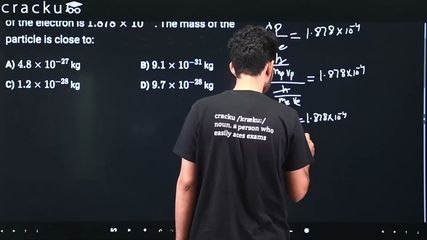
Click on the Email ☝️ to Watch the Video Solution
Create a FREE account and get:
_1.webp)

Educational materials for JEE preparation

Ask our AI anything

AI can make mistakes. Please verify important information.
AI can make mistakes. Please verify important information.


