
Join Our JEE Preparation Group
Prep with like-minded aspirants; Get access to free daily tests and study material.
Sign in
Please select an account to continue using cracku.in
↓ →
Join Our JEE Preparation Group
Prep with like-minded aspirants; Get access to free daily tests and study material.
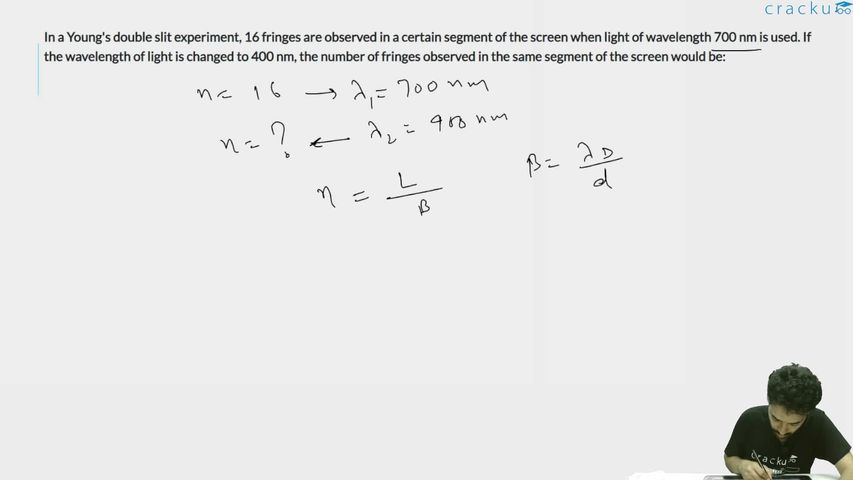
In a Young's double slit experiment, 16 fringes are observed in a certain segment of the screen when light of wavelength 700 nm is used. If the wavelength of light is changed to 400 nm, the number of fringes observed in the same segment of the screen would be:
In a Young’s double slit experiment the distance between successive bright (or dark) fringes on the screen is called the fringe width. It is given by the well-known formula
$$\beta=\frac{\lambda D}{d},$$
where $$\lambda$$ is the wavelength of light, $$D$$ is the distance of the screen from the slits, and $$d$$ is the separation between the two slits.
Let the fixed length of the screen segment in which we are counting fringes be $$L$$. The number of fringes that fit into this segment is simply the total length divided by the width of one fringe:
$$n=\frac{L}{\beta}.$$
Substituting the expression for $$\beta$$, we get
$$n=\frac{L}{\dfrac{\lambda D}{d}} =\frac{L d}{\lambda D}.$$
Notice that $$L$$, $$d$$ and $$D$$ remain unchanged when we replace one light source by another. Hence the product $$\dfrac{L d}{D}$$ is a constant for the given apparatus. We can therefore write
$$n\propto\frac{1}{\lambda}.$$
This proportionality means that the number of fringes is inversely proportional to the wavelength.
Now, with wavelength $$\lambda_1=700\ \text{nm}$$, the observed number of fringes is
$$n_1=16.$$
If the wavelength is changed to $$\lambda_2=400\ \text{nm}$$, the new number of fringes $$n_2$$ is obtained from the ratio
$$\frac{n_2}{n_1}=\frac{\lambda_1}{\lambda_2}.$$
Substituting the values, we have
$$n_2 = n_1 \times \frac{\lambda_1}{\lambda_2} =16 \times \frac{700\ \text{nm}}{400\ \text{nm}} =16 \times \frac{700}{400}.$$
We simplify the fraction:
$$\frac{700}{400}=\frac{7}{4}=1.75.$$
Therefore,
$$n_2 = 16 \times 1.75 = 28.$$
So, when the wavelength is reduced to 400 nm, 28 fringes will be observed in the same segment of the screen.
Hence, the correct answer is Option D.
Was this solution helpful?
Click on the Email ☝️ to Watch the Video Solution
Create a FREE account and get:
_1.webp)

Educational materials for JEE preparation

Ask our AI anything

AI can make mistakes. Please verify important information.
AI can make mistakes. Please verify important information.


