
Join Our JEE Preparation Group
Prep with like-minded aspirants; Get access to free daily tests and study material.
Sign in
Please select an account to continue using cracku.in
↓ →
Join Our JEE Preparation Group
Prep with like-minded aspirants; Get access to free daily tests and study material.
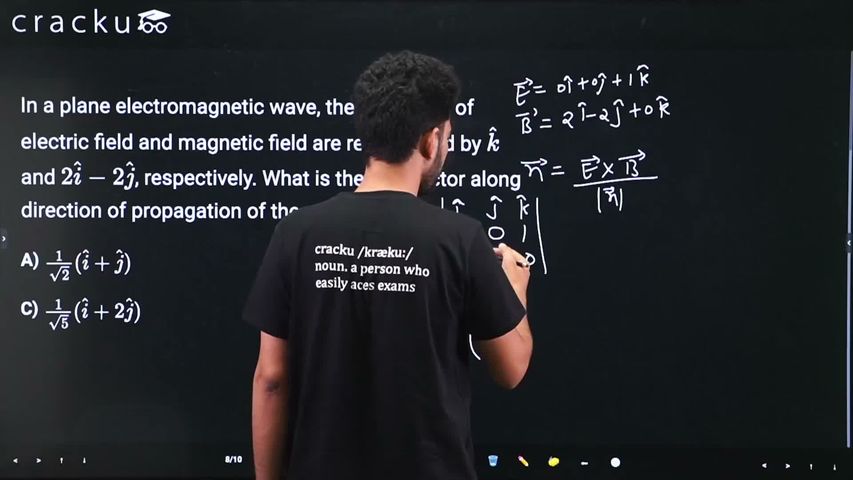
In a plane electromagnetic wave, the directions of electric field and magnetic field are represented by $$\hat{k}$$ and $$2\hat{i} - 2\hat{j}$$, respectively. What is the unit vector along direction of propagation of the wave.
For a plane electromagnetic wave we know the basic fact that the electric field $$\vec E$$, the magnetic field $$\vec B$$ and the direction of propagation (represented by the Poynting vector $$\vec S$$) are mutually perpendicular. Mathematically, the propagation direction is given by the cross-product
$$\vec S \propto \vec E \times \vec B.$$
Therefore, a unit vector along the propagation is obtained from
$$\hat n = \dfrac{\vec E \times \vec B}{|\vec E \times \vec B|}.$$
Now we translate the information given in the question into component form. The electric field is along $$\hat k$$, so
$$\vec E = \hat k = (0,\;0,\;1).$$
The magnetic field is along $$2\hat i - 2\hat j$$, so
$$\vec B = 2\hat i - 2\hat j = (2,\;-2,\;0).$$
To evaluate $$\vec E \times \vec B$$ we use the standard determinant formula for the cross product of two vectors $$\vec a=(a_x,a_y,a_z)$$ and $$\vec b=(b_x,b_y,b_z):$$
$$\vec a \times \vec b = \begin{vmatrix} \hat i & \hat j & \hat k \\ a_x & a_y & a_z \\ b_x & b_y & b_z \end{vmatrix} = (a_y b_z - a_z b_y)\hat i - (a_x b_z - a_z b_x)\hat j + (a_x b_y - a_y b_x)\hat k.$$
Substituting $$a_x=0,\;a_y=0,\;a_z=1$$ and $$b_x=2,\;b_y=-2,\;b_z=0$$ we get
$$\vec E \times \vec B = \Big(0\cdot0 - 1\cdot(-2)\Big)\hat i - \Big(0\cdot0 - 1\cdot2\Big)\hat j + \Big(0\cdot(-2) - 0\cdot2\Big)\hat k.$$
Evaluating each term step by step:
$$\begin{aligned} \text{i-component} & : 0 - (-2) = 2,\\ \text{j-component} & : -\big(0 - 2\big) = -(-2) = 2,\\ \text{k-component} & : 0 - 0 = 0. \end{aligned}$$
Thus
$$\vec E \times \vec B = 2\hat i + 2\hat j + 0\hat k = 2\hat i + 2\hat j.$$
Next we find the magnitude of this vector:
$$|\vec E \times \vec B| = \sqrt{(2)^2 + (2)^2 + 0^2} = \sqrt{4 + 4} = \sqrt{8} = 2\sqrt{2}.$$
Dividing the vector by its magnitude converts it into a unit vector:
$$\hat n = \dfrac{2\hat i + 2\hat j}{2\sqrt{2}} = \dfrac{2}{2\sqrt{2}}\hat i + \dfrac{2}{2\sqrt{2}}\hat j = \dfrac{1}{\sqrt{2}}\hat i + \dfrac{1}{\sqrt{2}}\hat j.$$ Therefore
$$\hat n = \frac{1}{\sqrt{2}}\bigl(\hat i + \hat j\bigr).$$
This matches Option A in the given list.
Hence, the correct answer is Option A.
Was this solution helpful?
Click on the Email ☝️ to Watch the Video Solution
Create a FREE account and get:
_1.webp)

Educational materials for JEE preparation

Ask our AI anything

AI can make mistakes. Please verify important information.
AI can make mistakes. Please verify important information.


