
Join Our JEE Preparation Group
Prep with like-minded aspirants; Get access to free daily tests and study material.
Sign in
Please select an account to continue using cracku.in
↓ →
Join Our JEE Preparation Group
Prep with like-minded aspirants; Get access to free daily tests and study material.
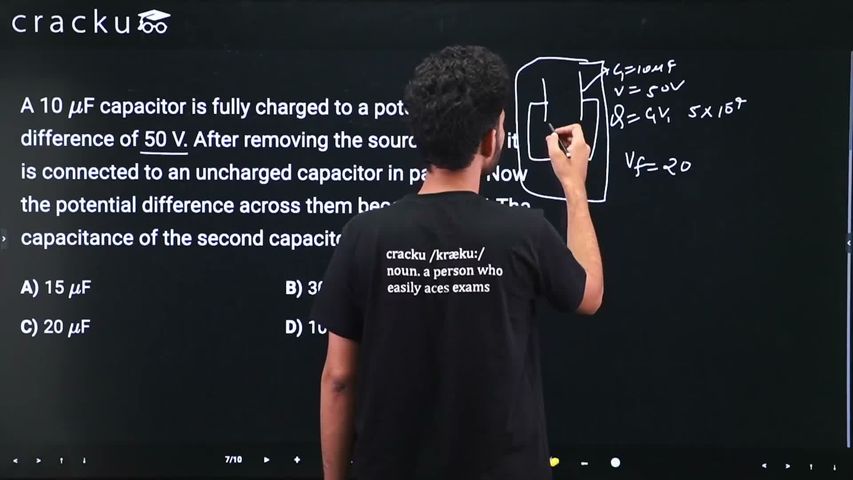
A 10 $$\mu$$F capacitor is fully charged to a potential difference of 50 V. After removing the source voltage it is connected to an uncharged capacitor in parallel. Now the potential difference across them becomes 20 V. The capacitance of the second capacitor is:
We have a first capacitor of capacitance $$C_1 = 10\;\mu\text{F}$$ that is initially charged to a potential difference $$V_1 = 50\;\text{V}$$.
According to the basic relation for a capacitor,
$$Q = C\,V,$$
where $$Q$$ is the charge stored, $$C$$ is the capacitance and $$V$$ is the potential difference across the plates.
Using this formula, the initial charge on the first capacitor is
$$Q_1 = C_1\,V_1 = (10\;\mu\text{F})\,(50\;\text{V}) = 10 \times 10^{-6}\,\text{F}\;\times\;50\;\text{V} = 500 \times 10^{-6}\,\text{C} = 5 \times 10^{-4}\,\text{C}.$$
Now the battery is removed, so this charge $$Q_1$$ is trapped on the capacitor plates. The charged capacitor is then connected in parallel to another, previously uncharged, capacitor of capacitance $$C_2$$ (the value we must find).
Because the two capacitors are connected in parallel, after connection they share the same final potential difference. Let us denote this common final voltage by $$V_f$$. The problem states that this final voltage is
$$V_f = 20\;\text{V}.$$
No charge is lost to the external circuit (we assume ideal wires with no resistance and no radiation), so total charge is conserved. Therefore, the total charge after connection must still be equal to the initial charge $$Q_1$$. After connection, the total charge is the sum of the charges on each capacitor:
$$Q_{\text{total after}} = Q_1' + Q_2' = C_1\,V_f + C_2\,V_f = (C_1 + C_2)\,V_f.$$
By conservation of charge,
$$Q_1 = (C_1 + C_2)\,V_f.$$
We already know $$Q_1 = C_1 V_1$$, so substituting this into the conservation equation gives
$$C_1 V_1 = (C_1 + C_2)\,V_f.$$
Our aim is to solve this equation for $$C_2$$. First, divide both sides by $$V_f$$ to make $$C_2$$ appear alone:
$$\frac{C_1 V_1}{V_f} = C_1 + C_2.$$
Next, subtract $$C_1$$ from both sides:
$$C_2 = \frac{C_1 V_1}{V_f} - C_1.$$
Now substitute the known numerical values $$C_1 = 10\;\mu\text{F}$$, $$V_1 = 50\;\text{V}$$, and $$V_f = 20\;\text{V}$$:
$$C_2 = \frac{(10\;\mu\text{F})(50\;\text{V})}{20\;\text{V}} - 10\;\mu\text{F} = (10\;\mu\text{F})\left(\frac{50}{20}\right) - 10\;\mu\text{F}.$$
Simplify the fraction $$\frac{50}{20} = 2.5$$, so
$$C_2 = (10\;\mu\text{F})(2.5) - 10\;\mu\text{F} = 25\;\mu\text{F} - 10\;\mu\text{F} = 15\;\mu\text{F}.$$
Hence, the correct answer is Option A.
Was this solution helpful?
Click on the Email ☝️ to Watch the Video Solution
Create a FREE account and get:
_1.webp)

Educational materials for JEE preparation

Ask our AI anything

AI can make mistakes. Please verify important information.
AI can make mistakes. Please verify important information.


