
Join Our JEE Preparation Group
Prep with like-minded aspirants; Get access to free daily tests and study material.
Sign in
Please select an account to continue using cracku.in
↓ →
Join Our JEE Preparation Group
Prep with like-minded aspirants; Get access to free daily tests and study material.
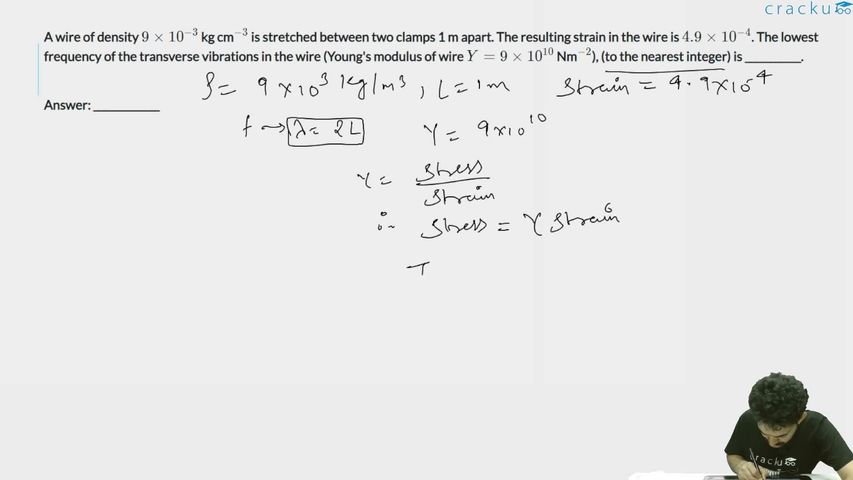
A wire of density $$9 \times 10^{-3}$$ kg cm$$^{-3}$$ is stretched between two clamps 1 m apart. The resulting strain in the wire is $$4.9 \times 10^{-4}$$. The lowest frequency of the transverse vibrations in the wire (Young's modulus of wire $$Y = 9 \times 10^{10}$$ Nm$$^{-2}$$), (to the nearest integer) is ___________.
Correct Answer: 35
We have a stretched wire of length $$L = 1\;{\rm m}$$. Our aim is to find the lowest (fundamental) frequency of the transverse vibrations produced in this wire.
First, let us convert the given density into SI units. The density is provided as $$\rho = 9 \times 10^{-3}\;{\rm kg\;cm^{-3}}$$. We know the conversion factor
$$1\;{\rm cm^3} = 10^{-6}\;{\rm m^3}.$$
Therefore,
$$\rho = 9 \times 10^{-3}\;{\rm kg\;cm^{-3}} = 9 \times 10^{-3}\;{\rm kg}\,\bigl(10^{6}\;{\rm m^{-3}}\bigr) = 9 \times 10^{3}\;{\rm kg\;m^{-3}}.$$
Next, the strain in the wire is given as $$\varepsilon = 4.9 \times 10^{-4}.$$ By definition,
$$\text{Stress} \; \sigma = Y \times \text{strain},$$
where $$Y = 9 \times 10^{10}\;{\rm N\,m^{-2}}$$ is Young’s modulus. Substituting the values, we get
$$\sigma = (9 \times 10^{10}) \times (4.9 \times 10^{-4}) = 9 \times 4.9 \times 10^{10-4} = 44.1 \times 10^{6} = 4.41 \times 10^{7}\;{\rm N\,m^{-2}}.$$
In a stretched wire, the tension $$T$$ is related to the stress $$\sigma$$ and the cross-sectional area $$A$$ by
$$T = \sigma A.$$
The mass per unit length $$\mu$$ of the same wire is
$$\mu = \rho A.$$
Now, the speed $$v$$ of transverse waves on a stretched string is given by the standard formula
$$v = \sqrt{\frac{T}{\mu}}.$$
Substituting $$T=\sigma A$$ and $$\mu=\rho A$$ into this expression, we find
$$v = \sqrt{\frac{\sigma A}{\rho A}} = \sqrt{\frac{\sigma}{\rho}}.$$
Notice that the area $$A$$ cancels out, which means we do not need to know the actual thickness of the wire. Putting the numerical values,
$$v = \sqrt{\frac{4.41 \times 10^{7}}{9 \times 10^{3}}} = \sqrt{\,\bigl(4.41/9\bigr) \times 10^{4}} = \sqrt{0.49 \times 10^{4}} = \sqrt{4900} = 70\;{\rm m\,s^{-1}}.$$
The fundamental (lowest) mode of vibration of a stretched string fixed at both ends has a wavelength equal to twice the length of the string, i.e.
$$\lambda_1 = 2L.$$
Its frequency is therefore
$$f_1 = \frac{v}{\lambda_1} = \frac{v}{2L}.$$
Substituting $$v = 70\;{\rm m\,s^{-1}}$$ and $$L = 1\;{\rm m}$$, we get
$$f_1 = \frac{70}{2 \times 1} = \frac{70}{2} = 35\;{\rm Hz}.$$
So, the answer is $$35$$.
Was this solution helpful?
Click on the Email ☝️ to Watch the Video Solution
Create a FREE account and get:
_1.webp)

Educational materials for JEE preparation

Ask our AI anything

AI can make mistakes. Please verify important information.
AI can make mistakes. Please verify important information.


