
Join Our JEE Preparation Group
Prep with like-minded aspirants; Get access to free daily tests and study material.
Sign in
Please select an account to continue using cracku.in
↓ →
Join Our JEE Preparation Group
Prep with like-minded aspirants; Get access to free daily tests and study material.
A particle of mass m is moving along the x-axis with initial velocity $$u\hat{i}$$. It collides elastically with a particle of mass 10m at rest and then moves with half its initial kinetic energy (see figure). If $$\sin\theta_1 = \sqrt{n}\sin\theta_2$$, then value of n is ___________.
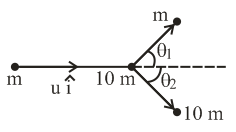
Correct Answer: 10
Initial kinetic energy of mass $$m$$: $$K_i = \frac{1}{2}mu^2$$
Final kinetic energy of mass $$m$$: $$K_f = \frac{1}{2}mv_1^2 = \frac{1}{2}K_i \implies \frac{1}{2}mv_1^2 = \frac{1}{4}mu^2 \implies v_1 = \frac{u}{\sqrt{2}}$$
Conservation of linear momentum along the y-axis:
$$p_{iy} = p_{fy} \implies 0 = m v_1 \sin\theta_1 - 10m v_2 \sin\theta_2$$
$$v_1 \sin\theta_1 = 10 v_2 \sin\theta_2$$
Using the given relation $$\sin\theta_1 = \sqrt{n}\sin\theta_2$$:
$$v_1 \sqrt{n}\sin\theta_2 = 10 v_2 \sin\theta_2 \implies v_1 \sqrt{n} = 10 v_2$$
$$n v_1^2 = 100 v_2^2 \implies v_2^2 = \frac{n}{100}v_1^2$$
Conservation of total kinetic energy:
$$K_i = K_{f1} + K_{f2} \implies \frac{1}{2}mu^2 = \frac{1}{2}mv_1^2 + \frac{1}{2}(10m)v_2^2$$
$$u^2 = v_1^2 + 10v_2^2$$
$$2v_1^2 = v_1^2 + 10\left(\frac{n}{100}v_1^2\right)$$
$$v_1^2 = \frac{n}{10}v_1^2 \implies 1 = \frac{n}{10} \implies n = 10$$
Was this solution helpful?
Create a FREE account and get:
_1.webp)

Educational materials for JEE preparation

Ask our AI anything

AI can make mistakes. Please verify important information.
AI can make mistakes. Please verify important information.


