If in a special coded language :
BOOK is written as 8 ;
TABLE is written as 7 ; and
BOTTLE is written as 1 ;
Then, how would COMPUTER be written in that language ?
MAH MBA CET Previous Paper 2025 Slot-1
For the following questions answer them individually
Vehicles have been developed that run on diesel, petrol and electricity, which is a remarkable innovative development. During a survey about the percentage wise distribution of cars in four different states, the information regarding ratio between the diesel engine cars, petrol engine cars and electric cars was collected.
The total number of cars for which data was collected was 8000.
Of these, State 1 had 15% of the total cars in the ratio of 3:4:1 (diesel, petrol and electric);
State 2 had 20% of the total cars in the ratio of 5:3:2 (diesel, petrol and electric);
State 3 had 30% of the total cars in the ratio of 4:5:3 (diesel, petrol and electric), and;
State 4 had 35% of the total cars in the ratio of 7:5:2 (diesel, petrol and electric).
Determine : What is the ratio of diesel cars in State 4 to electric cars in State 3?
Solution
 Share
Share
Total cars in all the four states = 8000
Now, for State 1:
Total number of cars = 15% of the total cars = 15% of 8000 = 1200
Now, the number of diesel, petrol and electric cars are in the ratio of 3:4:1.
Total number of diesel cars = $$\dfrac{3}{3+4+1}\times1200=450$$
Total number of petrol cars = $$\dfrac{4}{3+4+1}\times1200=600$$
Total number of electric cars = $$\dfrac{1}{3+4+1}\times1200=150$$
Now, for State 2:
Total number of cars = 20% of the total cars = 20% of 8000 = 1600
Now, the number of diesel, petrol and electric cars are in the ratio of 5:3:2.
Total number of diesel cars = $$\dfrac{5}{5+3+2}\times1600=800$$
Total number of petrol cars = $$\dfrac{3}{5+3+2}\times1600=480$$
Total number of electric cars = $$\dfrac{2}{5+3+2}\times1600=320$$
Now, for State 3:
Total number of cars = 30% of the total cars = 30% of 8000 = 2400
Now, the number of diesel, petrol and electric cars are in the ratio of 4:5:3.
Total number of diesel cars = $$\dfrac{4}{4+5+3}\times2400=800$$
Total number of petrol cars = $$\dfrac{5}{4+5+3}\times2400=1000$$
Total number of electric cars = $$\dfrac{3}{4+5+3}\times2400=600$$
Now, for State 4:
Total number of cars = 35% of the total cars = 35% of 8000 = 2800
Now, the number of diesel, petrol and electric cars are in the ratio of 7:5:2.
Total number of diesel cars = $$\dfrac{7}{7+5+2}\times2800=1400$$
Total number of petrol cars = $$\dfrac{5}{7+5+2}\times2800=1000$$
Total number of electric cars = $$\dfrac{2}{7+5+2}\times2800=400$$
Hence, the distribution of the cars are as follows:
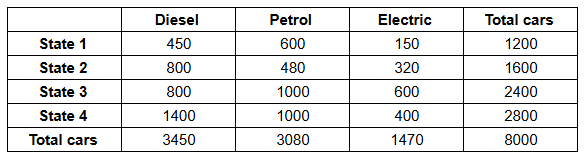
Now, Number of diesel cars in state 4 = 1400
Number of electric cars in state 3 = 600
Ratio = $$\dfrac{1400}{600}=\dfrac{7}{3}$$
Hence, the ratio of the number of diesel cars in state 4 to the number of electric cars in state 3 is 7:3.
$$\therefore\ $$ The required answer is 7:3.
If 45% of the electric cars in State 4 are air conditioned (AC) and remaining are non-AC, what is the total number of non-AC cars ?
Solution
Total cars in all the four states = 8000
Now, for State 1:
Total number of cars = 15% of the total cars = 15% of 8000 = 1200
Now, the number of diesel, petrol and electric cars are in the ratio of 3:4:1.
Total number of diesel cars = $$\dfrac{3}{3+4+1}\times1200=450$$
Total number of petrol cars = $$\dfrac{4}{3+4+1}\times1200=600$$
Total number of electric cars = $$\dfrac{1}{3+4+1}\times1200=150$$
Now, for State 2:
Total number of cars = 20% of the total cars = 20% of 8000 = 1600
Now, the number of diesel, petrol and electric cars are in the ratio of 5:3:2.
Total number of diesel cars = $$\dfrac{5}{5+3+2}\times1600=800$$
Total number of petrol cars = $$\dfrac{3}{5+3+2}\times1600=480$$
Total number of electric cars = $$\dfrac{2}{5+3+2}\times1600=320$$
Now, for State 3:
Total number of cars = 30% of the total cars = 30% of 8000 = 2400
Now, the number of diesel, petrol and electric cars are in the ratio of 4:5:3.
Total number of diesel cars = $$\dfrac{4}{4+5+3}\times2400=800$$
Total number of petrol cars = $$\dfrac{5}{4+5+3}\times2400=1000$$
Total number of electric cars = $$\dfrac{3}{4+5+3}\times2400=600$$
Now, for State 4:
Total number of cars = 35% of the total cars = 35% of 8000 = 2800
Now, the number of diesel, petrol and electric cars are in the ratio of 7:5:2.
Total number of diesel cars = $$\dfrac{7}{7+5+2}\times2800=1400$$
Total number of petrol cars = $$\dfrac{5}{7+5+2}\times2800=1000$$
Total number of electric cars = $$\dfrac{2}{7+5+2}\times2800=400$$
Hence, the distribution of the cars are as follows:
Now, Number of electric cars in state 4 = 400
Out of these 400 cars, 45% of them are AC and 55% of them are non AC cars.
Number of non AC cars = 55% of 400 = 220
Hence, state 4 has 220 non AC electric cars.
$$\therefore\ $$ The required answer is B.
For the following questions answer them individually
A, B, C, D, E, F, G, and H are sitting in a row, not necessarily in the same order. E is immediate neighbour of C. Two persons sit between A and E. C is sitting fourth from one end. There is only one person sitting between H and C. D is sitting second from the left end. Five people are sitting between D and B. G and F are immediate neighbours of each other.
Which of the following is a correct arrangement in the given scenario?
Solution
It is given that G and F are immediate neighbours. It means that no one is sitting between G and F.
So, we can remove the options C, D and E as in these cases, G and F are not immediate neighbours.
Now, it is given that C is sitting fourth from one end.
It means that C can either sit fourth from the left or fourth from the right.
But in option B, it is given that C is sitting 3rd from the left. So, we can eliminate this option.
Hence, we are left with option A as the answer.
The correct arrangement is : (A, D, H, E, C, G, F, B) or (A, D, H, E, C, F, G, B)
$$\therefore\ $$ The required answer is A.
There are Seven male friends named, A, B, C, D, E, F and G.
Each one of them is either a Lawyer, Doctor, Plumber, Teacher, Retired, Electrician or a Hotelier.
Each one of them cleans their respective homes on either a Monday, Tuesday, Wednesday, Thursday, Friday, Saturday or Sunday.
Each one has a favorite colour amongst Blue, Black, White, Green, Orange, Red or Silver.
Also, it is to be noted that no two friends have the same profession, nor do more than one person likes the same colour and nor do any two or more of them clean their homes on the same day.
Further, its known that the Retired friend is neither D or A or F and his favorite colour is Orange.
The friend who likes Blue is either a Lawyer or cleans his home on a Saturday. The person who likes Saturday is a hotelier and is neither C or D.
B is a Doctor but does not clean his home on Monday or Saturday.
The friend who is a teacher cleans home on Friday and likes Green colour.
The Plumber and the Lawyer do not clean their homes on Saturday or Thursday, also the Hotelier cleans his home on a Saturday.
Electrician's favorite colour is Red but his same is neither G nor E. The person who likes Black definitely cleans his home on Thursday. The Teacher and the Electrician clean their homes on two consecutive days.
G likes Silver and the Doctor does not like White. The Plumber likes White colour and his name is not C.
Determine who is the Plumber ?
What is the favorite color of the Lawyer ?
Who cleans his home on Saturday ?
Who cleans his home on Sunday ?
Which of the following friend's favorite colour's name does not have the alphabet E in it ?
Which of the following is most definitely true :
For the following questions answer them individually
Neena told Deepali that, "your mother-in-law is my father's granddaughter's father's grandfather's daughter-in-law''. How is Deepali related to Neena ?
Solution
Neena told Deepali that the mother-in-law of Deepali is Neena's father's granddaughter's father's grandfather's daughter-in-law.
Neena's father's granddaughter means that there is a person who is the daughter of either Neena or her sibling. Father of the granddaughter means that he is the husband of either Neena or her sibling.
Now, daughter-in-law of the Grandfather of the husband means the mother of the husband of Neena or her sibling i.e. mother-in-law. It means that the mother-in-law mentioned in the question is the mother-in-law of either Neena or her sibling.
But, it is mentioned that the mother-in-law in this question is for Deepali.
Hence, Deepali is the sister of Neena.
Option A.
Arnav rolls an ordinary dice and gets a 3 on the face of the dice. What shall be the number if the number that is on the side that is exactly opposite to the face of the dice is multiplied by itself four times ?
Solution
In a dice, the sum of the numbers on the opposite sides is equal to 7 i.e. (1,6) ; (2,5) ; (3,4).
Now, Arnav got 3 when he rolled the dice. Hence, the opposite side of the face of the dice will be 4.
Now, 4 is multiplied to itself for 4 times.
$$\therefore\ \left(4\times4\times4\times4\right)=256$$
Hence, the answer is 256.
Option C

Determine the number of times 3 is present in the given series where it is followed by a prime number but not preceded by a number which is a multiple of 2 ?
3 5 4 8 4 3 7 0 9 8 3 9 4 3 7 7 5 3 1 2 0 7 3 2
Solution
In the above series, 3 occurs 6 times.
Out of those 6 times, 3 is preceded by a number which is a multiple of 2 (4,8,4).
Out of the remaining 3 times, one 3 is followed by 1 which is not a prime number. Hence, we can rule that out.
The only possible cases remaining are two where 3 is followed by a prime number and not preceded by a number which is multiple of 2 (The first digit which is followed by 5 and not preceded by any number and 7,2).
Hence, we have 2 such 3.
Option B.
Determine the number that shall come in place of ? in the given series:
8 13 10 15 12 ?
Solution
In the given series, 8 13 10 15 12, the difference between the numbers are in the form of 5, -3, 5, -3 etc in the alternate form.
Difference between 8 and 13 = 5
Difference between 13 and 10 = -3
Difference between 10 and 15 = 5
Difference between 15 and 12 = -3
Hence, the difference between 12 and the next number must be 5.
So, the required number is 17.
Option E.
Pravesh, Quila, Roshesh, Smitha, Tanaav, Urus, Vihaaz and Wahaab are all sitting on a horizontal desk and with each of them facing the same side.
Further, it is known that :
Pravesh is fourth to the right of Tanaav ;
Wahaab is second to the right of Smitha ;
Roshesh and Urus are at the two extreme and their immediate neighbors are either Quila and Tanaav ;
Wahaab is the immediate to the left of Pravesh and Pravesh is on one of the immediate sides of Quila ;
Determine as to who are the immediate neighbors of Wahaab ?
Solution
Roshesh and Urus are at the two extremes and their immediate neighbours are either Quila and Tanaav.
It is given that, Pravesh is fourth to the right of Tanaav. It means that Tanaav can't be the neighbour of a person who is at the extreme right.
So, two cases can be formed.
Case 1: Roshesh is at the immediate left and Urus is at the immediate right.
Now, Quila and Tanaav will be their immediate neighbours of Urus and Roshesh respectively and Pravesh will be fourth to the right of Tannav.
Required arrangement: (R, T, , , , P, Q, U)
It is given that, Wahab is the immediate left of Pravesh and Wahab is second to the right of Smitha.
Required arrangement: (R, T, S, , W, P, Q, U)
Now, only one place is left and it will be allotted to Vihaaz.
Final arrangement: (R, T, S, V, W, P, Q, U)
Case 2: Roshesh is at the immediate right and Urus is at the immediate left.
Now, Quila and Tanaav will be their immediate neighbours of Roshesh and Urus respectively and Pravesh will be fourth to the right of Tannav.
Required arrangement: (U, T, , , , P, Q, R)
It is given that, Wahab is the immediate left of Pravesh and Wahab is second to the right of Smitha.
Required arrangement: (U, T, S, , W, P, Q, R)
Now, only one place is left and it will be allotted to Vihaaz.
Final arrangement: (U, T, S, V, W, P, Q, R)
Hence, Vihaaz and Pravesh are the immediate neighbours of Wahaab.
Option B.
If :
A # B means B is the mother of A ;
A $ B means A is the father of B ;
A % B means A is the sister of B ;
A * B means A is the son of B ;
A @ B means A is the brother of B ;
A ! B means A is the daughter of B
Then determine that if:
P $ Q # R % S
Then, how is R related to P ?
Solution
From the 2nd condition, P is the father of Q and from the 1st condition, R is the mother of Q.
Hence, R is the wife of P.
Option D.
Determine the alphabets that shall come in the blank space :
UNR ICF LEI OGL RIO ________________
Solution
UNR ICF LEI OGL RIO
In the above series, look at the changing pattern from ICF to RIO
From ICF to LEI,
I + 3 = L
C + 2 = E
F + 3 = I
From LEI to OGL,
L + 3 = O
E + 2 = G
I + 3 = L
Similarly, from OGL to RIO,
O + 3 = R
G + 2 = I
L + 3 = O
Hence, we can see a clear pattern that the first and last term is increasing by 3 and the second term is increasing by 2.
R + 3 = U
I + 2 = K
O + 3 = R
Hence, the final term will be UKR.
Option B.
A stream which flows from west to east in the middle turns left. Further, then it comes across an island and goes around it in an anti-clock manner to take a quarter circle of the island, Then it takes a right from that direction.
Determine that finally in which direction is the stream flowing ?
Solution
A stream is flowing from west to east and it takes a left turn in the middle. So, now the stream is facing North.
Now, it comes across an island and covers a quarter circle of the island in the counter clockwise direction.
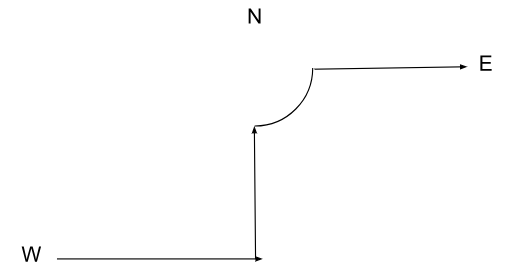
The above diagram shows the way the stream is moving.
Hence, after taking a right turn from the island, the stream is again facing East.
Option A.
If 'dog' is called 'lion', 'lion' is called 'bison', 'bison' is called 'snake', 'snake' is called 'mongoose', 'mongoose' is called 'crocodile', then which of the following may be domesticated as a pet ?
Solution
In option A, the name of the animal is Lion and we know that Dog is called Lion. Hence, the actual animal in the option A is a dog.
In option B, the name of the animal is Bison and we know that Lion is called Bison. Hence, the actual animal in the option B is a Lion.
In option C, the name of the animal is Snake and we know that Bison is called Snake. Hence, the actual animal in the option C is a Bison.
In option D, we don't know the actual animal as the name Dog is not assigned to any of the animals in the question.
In option E, the name of the animal is Mongoose and we know that Snake is called Mongoose. Hence, the actual animal in the option D is a Snake.
Hence, we can only pet a dog which is called Lion (given).
Option A.
Five friends are standing in a row and all facing North.
Tony is not adjacent to Bony or Mony. Sony is not adjacent to Bony.
Tony is adjacent to Dony. Dony is at the middle in the row.
Then, which pair is at the extreme ends of the row ?
Solution
It is given that Dony is at the middle of the row. So, he can't be at the extreme of the arrangement. Hence, all the options which contains Dony can be eliminated (Option A, B and C).
It is also given that Tony is adjacent to Dony. Which means that Tony can't be at the extremes as Dony is in the middle of the arrangement.
Hence, we can also reject the condition is which it is given that Tony is at the extremes (Option D).
So, the only option left is Option E. Which means that, Sony and Mony will be at the extremes.
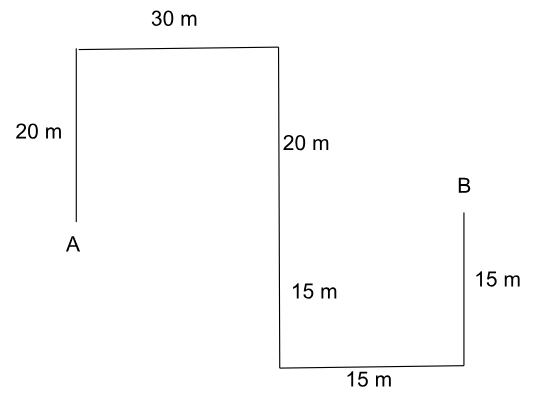
Krishna walked 20 m towards the north. Then he turned right and walked 30 m. Then he turned right and walked 35 m. Then he turned left and walked 15 m. Finally he turns left and went 15 m. In which direction and how many meters is Krishna compared to from the starting position ?
Solution
Let the initial point of Krishna be A.
He travelled for 20 m in the North. Then he turned right and travelled for 30 m. So, now he is 20 m north and 30 m east of A.
Then again turned right and travelled for 35 m. Now, he is 30 m east and 15 m south of A.
Then, he turned left and walked for 15 m. Now, he is 45 m east and 15 m south of A.
Finally, he travelled 15 m north. Now, he is 45 m to the east of A.
Hence, Krishna is 45 m east of A after travelling the entire distance.
Option E.
J,K,L,M,N,O,P and R are eight huts. Further, L is 2 km east of K, J is 1 km north of K and Q is 2 km south of J. P is 1 km west of Q while M is 3 km east of P and O is 2 km north of P. R is situated right in the middle of K and L while N is just in the middle of Q and M.
Determine the distance between K and P.
Solution
In the given question, we have to find the distance between K and P.
Now, it is given that, J is 1 km north of K and Q is 2 km south of J. It means that, Q is 1 km south of K.
It is also given that, P is 1 km west of Q.
So, P, Q and K forms a right angled triangle at Q.
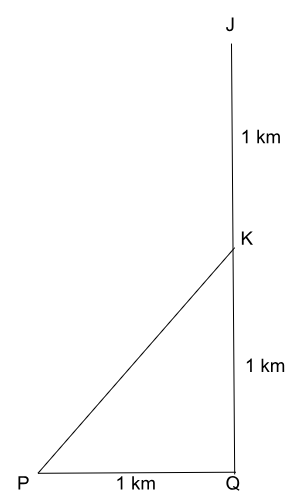
So, we can apply the Pythagoras theorem to find the distance between P and K.
$$\left(PK\right)^2=\left(PQ\right)^2+\left(KQ\right)^2$$
$$\left(PK\right)^2=\left(1\right)^2+\left(1\right)^2$$
$$PK=\sqrt{2}\ km=1.414\ km$$
Hence, the distance between P and K is 1.41 km.
Option C.
6: 222 :: 7 : ?
Solution
6 : 222 : : 7 : $$x$$
To get to 222, we do the following operation: $$\left(6\right)^3+6=216+6=222\ $$
Hence, $$\left(7\right)^3+7=x$$
$$343+7=x$$
$$x=350$$
Option A.
Identify the odd one out from the options given below :
Solution
PATTERN : Options A , B and C follow the rule ( FIRST TERM / SECOND TERM ) = ( FOURTH TERM / THIRD TERM ) which is equal to (2/3)
Option A : ( 6.40/9.60) =(12.80/19.20) = (2/3)
Option B : ( 1.0/1.50) =(2/3) = (2/3)
Option c : ( 0.40/0.60) =(0.80/1.20) = (2/3)
NOW
In Option D : left hand side ( 0.50/1.50) = (1/3)
Right hand side (0.25/3.0) = (1/8)
This option breaks the pattern here as neither LHS = RHS nor the resultant on either side equal to (2/3).

In a row of girls, Rimmi and Mimmi occupy ninth place from right end and tenth place from left end respectively. If they interchange their positions then Rimmi and Mimmi will occupy seventeenth place from right end and eighteenth place from left end respectively.
How many girls are there over all in all the given row :
Solution
Let the number of girls in between Rimmi and Mimmi be $$x$$.
It is given that Rimmi and Mimmi occupies ninth and tenth place from the right end and left end respectively.
Number of girls to the right of Rimmi = 8 (as she occupies 9th place from the right end)
Number of girls to the left of Mimmi = 9 (as she occupies 10th place from the left end)
The initial arrangement : $$9,\ M,\ x,\ R,\ 8$$
Now, both Rimmi and Mimmi interchanged their positions.
Now, the new arrangement: $$9,\ R,\ x,\ M,\ 8$$
Now, Rimmi is 17th place from the right. It means that Rimmi has 16 girls to her right.
$$8+1+x=16$$
$$x=16-9=7$$
We have 7 girls in between Rimmi and Mimmi.
Total number of girls in the arrangement = $$8+1+7+1+9=26$$
Hence, we have a total of 26 girls in the given row.
Option C.
In a special coded language ;
the Alphabets G, R, J are represented as 5 ;
the Alphabets B, V, N are represented as 4 ;
the Alphabets K, C, T are represented as 1 ;
the Alphabets H, S, L are represented as 3 ;
the Alphabets F, X, P are represented as 7 ;
the Alphabets Z, D, W are represented as 2;
the Alphabets M, Q, Y are represented as 8 ;
Further, it is known that any vowel of the English language is coded as 6, if it is not placed at the beginning or end, if any vowel is placed in the beginning or end, it is coded as 9 and if the same vowel is placed both at the beginning and also at the end, then it is coded as $ at both the places.
Choose the correct code as per the given information in the question that follows :
AFDQENI
Solution
It is given that if a vowel is placed at the beginning or the end of the word, then it will be coded as 9.
The word that we have to code contains A and I at the beginning and at the end. So, the required code will start and end with 9.
Now, F, D, Q and N are coded as 7, 2, 8 and 4 (given).
It is also given that if a vowel is not at the start or at the end, then it will be coded as 6. Hence, E will be coded as 6.
The required code for AFDQENI is 9728649.
Option C.
Choose the correct code as per the given information in the question that follows :
OLSWYCZIT
Solution
It is given that if a vowel is placed at the beginning or the end of the word, then it will be coded as 9.
The word that we have to code contains O at the beginning. So, the required code will start with 9.
Now, L, S, W, Y, C, Z and T are coded as 3, 3, 2, 8, 1, 2 and 1 (given).
It is also given that if a vowel is not at the start or at the end, then it will be coded as 6. Hence, I will be coded as 6.
The required code for OLSWYCZIT is 933281261.
Option D.

Choose the correct code as per the given information in the question that follows :
TJITAVRQXU
Solution
It is given that if a vowel is placed at the beginning or the end of the word, then it will be coded as 9.
The word that we have to code contains U at the end. So, the required code will end with 9.
Now, T, J, V, R, Q and X are coded as 1, 5, 4, 5, 8 and 7 (given).
It is also given that if a vowel is not at the start or at the end, then it will be coded as 6. Hence, I and A will be coded as 6.
The required code for TJITAVRQXU is 1561645879.
Option E.
Choose the correct code as per the given information in the question that follows :
XLPVRYTQDC
Solution
Since, there are no vowels in the given word, so we have to find the code for each digit from the given values.
So, X, L, P, V, R, Y, T, Q, D and C are coded as 7, 3, 7, 4, 5, 8, 1, 8, 2 and 1 (given).
The required code for XLPVRYTQDC is 7374581821.
Option C.
For the following questions answer them individually
A clock is set right at 8 AM. This clock gains 10 minutes in 24 hours.
What is the true time when the clock indicates 11 AM ?
Solution
The clock gains a total of 10 min in 24 hours.
So, in 3 hours, the clock will gain a total of $$\dfrac{10\times3}{24}=\dfrac{10}{8}=1\dfrac{1}{4}$$ min
When the clock indicates a time of 11 am, after it started at 8 am, it has gained a total of $$1\dfrac{1}{4}$$ min.
The true time can be found by subtracting the time gained from the actual time indicating by the clock.
So, we have to subtract 1 min and 15 seconds from 11 am to find the true time.
Hence, the true time is 10:58:45 am.
Option D.
Determine the probability of getting a 'nine' or 'ten' on a single throw of two dice simultaneously ?
Solution
If two die are thrown simultaneously, a total of $$\left(6\times6\right)=36$$ outcomes are possible.
We have to find the probability of getting a total of 9 or 10.
Outcomes which gives a total of 9 from the two die = (3,6) ; (4,5) ; (5,4) ; (6,3)
Outcomes which gives a total of 10 from the two die = (4,6) ; (5,5) ; (6,4)
Total favourable outcomes = 4 + 3 = 7
Probability = $$\dfrac{7}{36}$$
The average age of three men is 50 years and their ages are in the proportion 3:5:7 respectively. Determine the age of the youngest man in the group?
Solution
Let the age of 3 men be 3$$x$$, 5$$x$$ and 7$$x$$ years.
Average age of these 3 men = $$\dfrac{3x+5x+7x}{3}=5x$$
Average age of these 3 men = 50 years (given)
$$5x=50$$
$$x=10$$
The age of the youngest man = 3$$x$$ = $$\left(3\times10\right)=30$$ years
Option D.
Looking at Sweety, Raj says to his friend , "Sweety is the grand-daughter of the elder brother of my father". How is Sweety related to Raj?
Solution
Sweety is the grand daughter of the elder brother of Raj's father.
It means that, Sweety is the daughter of Raj's cousin.
Hence, Sweety is the niece of Raj.
Option A.
Seven experts, N, G, M, W, J , Kand L give expert advice sessions to school students. These sessions can take place either before the school, during lunch period or after the school. In scheduling these sessions, the following conditions are followed. At least two experts must hold the sessions before school. At least three experts must hold their sessions after school. M is not available after school and J is available only after school. W always takes extra session during lunch. G will take session before school only if N is also scheduled before school.
Then, all the following statements could be true except :
Solution
From the information above we know that at least two experts must hold the sessions before school and at least three experts must hold their sessions after school that leaves a maximum of just 2 experts that could take the session in lunch time if we ignore every other conditions. Hence it can never happen that the same number of experts are taking sessions after school as during lunch. Hence OPTION E could never be true.
Six male friends A, B, C, D, E and F are married to R, S, U, V, T and W and not necessarily is same order. Following facts are additionally known about them : -
R and S are A's sisters
Neither R nor T are wives of C
W is wife of E
V is wife of B
D is not married to R, S or T
Who is A's wife ?
Solution
It is given that E and B are wives of W and V respectively.
Hence, R, S, U and T are left to be assigned as wives.
It is given that D is not married to R, S or T. It means that U is the wife of D.
Now, R and S are A's sister (given).
Hence, T is the only possibility for the wife of A.
Option C.
If southeast becomes east and northwest becomes west and all the other directions are changed in the same way, then what will be the direction for north?
Solution
If south east becomes the new east and north west becomes the new west, it means that the all the directions are tilted by 45$$^{\circ\ }$$ in the clockwise direction.
It means that the original north is also rotated by 45$$^{\circ\ }$$ clockwise.
Hence, the new north will be the same as north east (lies exactly in between the original east and north axis).
Option D.
A, B, C and D are four medical representatives of a company. Each of them must visit exactly two of the eight cities - Delhi, Chennai , Kolkata, Hyderabad, Bangalore, Mumbai, Lucknow and Patna and each city is visited by only one person. C does not visit Mumbai and Delhi, While D does not visit Patna, Kolkata and Hyderabad. B does not visit Lucknow and Patna. Whereas A does not visit Bangalore and Chennai. Patna and Bangalore are visited neither by B nor by C. If Delhi and Lucknow were visited by A, then which one of the following cities could B visit ?
Solution
We know that A visits Delhi and Lucknow. So A is done.
Now, we are given the following conditions:
B does not visit Lucknow, Patna
C does not visit Mumbai or Delhi
D does not visit Patna, Kolkata, Hyderabad
A does not visit Bangalore, Chennai (This is already satisfied)
If we notice, Patna and Bangalore are visited neither by B nor by C. So, Patna and Bangalore must be visited by A or D But A already has 2 cities so both must go to D
Therefore, D visits Bangalore and Patna
Now, remaining cities: Chennai, Kolkata, Hyderabad, Mumbai
These must be divided between B and C (2 each)
C cannot visit Mumbai , so C must pick 2 from: Chennai, Kolkata, Hyderabad. Therefore, B will get the remaining 2 cities
Possible choices for C:
C → Chennai, Kolkata and B → Hyderabad, Mumbai
C → Chennai, Hyderabad and B → Kolkata, Mumbai
C → Kolkata, Hyderabad and B → Chennai, Mumbai
In all cases, B always gets Mumbai.
Visheshbar who is a food inspector has to inspect five restaurants A, B, C, D and E. Further, if he inspects B, he cannot inspect C immediately. If he inspects A, he cannot go to E after that. Which of the following can be the correct order of his inspection?
The Six statements below that are labelled as A, B, C, D, E and F are then followed by four combinations of three statements.
Choose the set in which the statements are logically related i.e the third
statement can be deduced from the first two statements together.
Read the information carefully and answer the question.
A. All honest persons are good natured.
B. Some good natured persons are not honest.
C. Some honest persons are good natured.
D. All honest person are obese.
E. All obese person are good natured.
F. Some good natured person are honest.
P, Q, R, S and T are the five corners of a table with five sides. Chairs A, B, C, D and E are placed along the sides joining the angular comers. Neither P, Q, R, S, T nor A, B, C, D and E are necessarily in that order. Chair A is along the side joining the corner P and R. S is to the immediate right of P, and R is between P and T. Chair B is along the side of Q and T. Chairs D and E are next to B on either side.
Determine the corners that join the side where the chair C is placed ?
There are three boxes of three different colors - Green, Blue and Red, and 6 toys of which 2 are of Green colour, 2 are of Blue colour and 2 are of Red colour. The toys are packed in the three boxes such that each box has 2 toys of different colours in it and also the colour of the box is different from the colour of the toys packed in it. Now, 10 chocolates are kept in these boxes in such a way that the Green box has the maximum possible chocolates in it whereas, the Red box has the least possible chocolates in it. Each box should have at least one chocolate and no two boxes have the same number of chocolates.
Determine which of the following is definitely true ?
Solution
Boxes have 2 toys which are of different colors to each other and to the color of box.
so Green box has 1 red toy and 1 blue toy
Blue box has 1 red toy and 1 green toy
Red box has 1 blue toy and 1 green toy
Also
so Green Box should have maximum possible chocolates and the Red box has the least possible chocolates in it. Such that each box has at least one chocolate and no two boxes have equal number of chocolates.
so to minimize chocolates minimum 1 chocolate needs to be there in it. In blue box, in order to maximize chocolates in green box, needs to have only 2 chocolates ( as no two boxes have equal number of chocolates and minimum we can put now here is 2 chocolates ) and finally the green box will have 7 chocolates left which is the maximum that can be done.
Therefore option c : 'The box ( blue colored box ) which has the toys of Green and Red colors has 2 chocolates in it' is correct
A, B, C are three girls who go to buy six items - namely, P, Q, R, S, T and U. Each one of them buys two different items in such a way that if A buys R, then B buys neither P nor S. If B buys Q, then C buys neither U nor T.
Determine that if A buys R and T, then B buys :
Solution
A bought R and T.
It is given that if A bought R, then B will neither buy P nor S.
So, B can only buy Q and U and C can buy P and S.
Option D.
P, Q, R, S, T and U are six members of a family. R is not the mother of Q but Q is the son of R. P and R are a married couple. T is the brother of R. U is the brother of Q. S is the daughter of P. In this case, T is related to S as being :
Ambatta's watch works in the following manner during a particular week consisting of Seven Days where each day consists of twenty-four hours :
Day 1 : Correctly throughout the whole day
Day 2 : Skips One Second during the whole day
Day 3 : Skips Three Seconds during the whole day
Day 4 : Skips Four Seconds during the whole day
Day 5 : Skips Seven Seconds during the whole day
Day 6 : Skips Thirteen Seconds during the whole day
Day 7 : Skips Seven Seconds during the whole day
How many Seconds did Ambatta's watch work during the given duration as per the information provided ?
Solution
Solution: So as per the given data Ambatta's watch skips 35 seconds in total in the week ( 0+1+3+4+7+13+7 ) .
Now total number of seconds in 1 week is : 7 (days) * 24 (hours in 1 day) * 60(minutes in 1 hour) *60 (seconds in 1 minute)
which gives us 6,04,800 seconds in total
Now in order to arrive at our answer we need to subtract the seconds Ambatta's watch skipped.
Therefore How many Seconds did Ambatta's watch work during the given duration = 6,04,800 - 35 = 604 765 Seconds
Therefore option c is correct
Fifteenth August, 1947 was a Friday. Determine the day of the week on the Twenty-Sixth of January, 1957 ?
Solution
First, we will count odd days from 15 Aug 1947 to 26 Jan 1957
(A) From 15 Aug 1947 to 15 Aug 1956 → 9 years
Leap years in between: 1948, 1952, 1956 → 3 leap years
-
Normal years = 6 → 6 × 1 = 6 odd days
-
Leap years = 3 → 3 × 2 = 6 odd days
Total = 6 + 6 = 12 odd days → 12 ≡ 5 (mod 7)
Now, (B) From 15 Aug 1956 to 26 Jan 1957
Aug (remaining 16 days)
Sep = 30
Oct = 31
Nov = 30
Dec = 31
Jan = 26
Total: 16 + 30 + 31 + 30 + 31 + 26 = 164 days
164mod7 = 3 odd days
Total odd days: 5 + 3 = 8 ≡ 1 (mod 7)
Hence, the final day: Friday + 1 = Saturday
Neena purchased two oranges, three bananas and four apples which cost her Rs. 15.
Had Neena purchased three oranges, two bananas and one apple, it would have cost her only Rs. 10.
If Neeena bought 3 oranges, 3 bananas and 3 apples, determine as to how much did she have to pay ?
Solution
Let:
Cost of one orange = O
Cost of one banana = B
Cost of one apple = A
We are given that:
2O + 3B + 4A = 15...(1)
3O + 2B + A = 10...(2)
Now, we need 3O + 3B + 3A = 3(O + B + A)
Now, we will aim to eliminate the variables.
Multiply (2) by 4: 12O + 8B + 4A = 40...(3)
Subtract (1) from (3): (12O - 2O) + (8B - 3B) + (4A - 4A) = 40 - 15
We get: 10O + 5B = 25
Or, 2O + B = 5...(4)
Now, From (4): B = 5 - 2O
Substitute into (2): 3O + 2(5 - 2O) + A = 10
3O + 10 - 4O + A = 10
-A + O + 10 = 10
A = O
We need to find O + B + A.
O + B + A = O + (5 - 2O) + O = 5
Final value 3(O + B + A) = 3 × 5 = 15
Cost of Type - I Liquid is Rs. 32 per ltr ;
Cost of Type - II Liquid is Rs. 40 per ltr.
If both types of liquids are mixed in the ratio 3 : 5 to create a new type of Liquid (named Type - Ill), then determine the cost per ltr of the the newly created Type - Ill Liquid, considering the fact that there have been no other costs involved in creation of the new liquid ?
Solution
We are given that:
Type I → Rs. 32/ltr
Type II → Rs. 40/ltr
Ratio = 3 : 5
We can simply solve this using the weighted average method.
Cost = $$\dfrac{\left(32\times3\right)+\left(40\times5\right)}{3+5}=\dfrac{96+200}{8}=\dfrac{296}{8}=37$$
Hence, the answer is Rs. 37 per litre.
A cricket umpire has to pick 6 caps and 4 sweaters before a match. She picks up 3 articles at random. Determine the probability that at least one sweater was picked by the umpire ?
Solution
We have to find the probability that the umpire picked up at least 1 sweater.
It means that we can subtract the probability in which no sweater was picked (i.e. picking up 3 caps) from 1 to get the desired probability.
Number of ways in which 3 caps were picked = $$\large{6_{\large{C_3}}}$$
Number of ways in which 3 articles were picked = $$\large{10_{\large{C_3}}}$$
Probability of picking up 3 articles with no sweaters = $$\dfrac{\large{6_{\large{C_3}}}}{\large{10_{\large{C_3}}}}$$ = $$\dfrac{1}{6}$$
Probability of picking up at least 1 sweater = $$1-\dfrac{1}{6}=\dfrac{5}{6}$$
Hence, the probability of an umpire picking up 3 articles with at least 1 sweater is $$\dfrac{5}{6}$$.
Option D.
If one third of one-fourth of a number is 15, then three-tenth of that number will be :
Solution
Let the number be X.
Forming the equation:
$$\dfrac{1}{3}\times\dfrac{1}{4}\times X=15$$
$$\dfrac{1}{12}\times X=15$$
$$X=12\times15=180$$
Now, three-tenths of the number: $$\dfrac{3}{10}\times180=54$$
Male and female students from a particular subject took a class test. The average score of male students was 70 and of female students was 83. The class average however was 76. Determine the ratio of males to females in the class ?
Solution
Let the number of males = M and females = F
We can now use the weighted average formula:
$$\dfrac{70M+83F}{M+F}=76$$
Or, $$70M+83F=76M+76F$$
$$70M+83F=76M+76F$$
$$7F=6M$$
Hence, ratio: $$\dfrac{M}{F}=\dfrac{7}{6}$$
Two hands of an ordinary clock lie exactly over one another how many times in a continuous period of 72 hours ?
Solution
In a clock, the hour hand and minute hand coincide 11 times in 12 hours.
Number of 12-hour cycles in 72 hours: 72 ÷ 12 = 6
Total coincidences = 6 × 11 = 66 times.
If the sum of three consecutive odd numbers is 20 more than the first number. What is the middle number ?
Solution
Solution: Let us assume the three odd numbers be 2n+1, 2n+3 and 2n+5.
now as per information given:
sum of these three numbers = first number + 20
2n+1 + 2n+3 + 2n+5 = 2n+1 + 20
6n+9 = 2n+21
4n=12
n=3
Therefore the middle number is = 2n+3 = 2(3)+3= 9
Hence option E is correct option
The speeds of 3 cars in the ratio 5 : 4 : 6. The ratio between the time taken by them to travel same distance shall be:
Solution
Given speeds: 5:4:6
Time taken is inversely proportional to the speed. Hence, the time taken ratio =
$$\dfrac{1}{5}:\dfrac{1}{4}:\dfrac{1}{6}$$
Convert to whole numbers (LCM = 60)
$$\dfrac{1}{5}=\dfrac{12}{60},\dfrac{1}{4}=\dfrac{15}{60},\dfrac{1}{6}=\dfrac{10}{60}$$
Hence, the final ratio = 12:15:10
There are four Trees, namely, Lemon Tree, Coconut Tree, Mango Tree and Neem Tree each of which is at a different corner of a rectangular plot. A well is located at one corner and a cabin at another corner. Lemon and Coconut trees are on either side of the gate, which is located at the centre of side, opposite to the side, extremes of which the well and cabin are located. The Mango tree is not at the corner where the cabin is located.
Determine as to which of the following pairs can be diagonally opposite to each other in the plot ?
Solution
Solution : Based on data we get 2 different figures here.
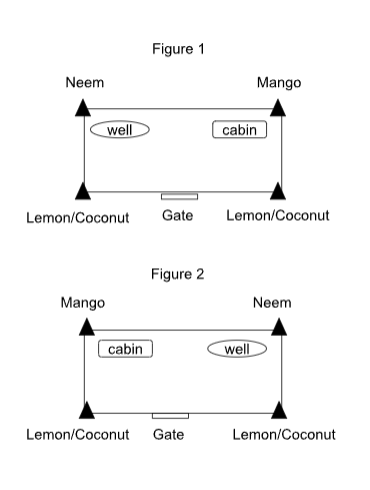
Now out of all options only Neem tree and Lemon tree are diagonally opposite so option B is the correct option
In the following question below, 3 statements I, II and Ill are given. You are required to find out which of the given statement(s) is/are sufficient to answer the question.
Question : How old was Amav on October 30th 2018 ?
Statement I : Amav is 6 years older than his sister Ananyaa.
Statement II : Ananyaa is 29 yrs younger than her mother, Deepali.
Statement Ill: Deepali celebrated her 77th birthday on June 3rd 2018.
Solution
Solution: Statement 1 connects Amav's age to his sister Ananyaa.
Statement 2 connects Ananyaa's age to her Mother Deepali.
Statement 3 provides Amav's Mother Deepali's age.
Essentially we will require all three statements if we need to find Amav's age.
So option c is correct.
Rajesh can check the quality of 1000 items in 5 hours and Rakesh can complete 75% of the same job in 3 hours. How much time is required for both of them to check 1300 items, if Rakesh stops checking after 2 hours ?
Solution
Rajesh: 1000 items in 5 hours
Rate = 200 items/hour
Rakesh: 75% of 1000 = 750 items in 3 hours
Rate = 250 items/hour
Now, Work done in the first 2 hours ( when both working):
Combined rate: 200 + 250 = 450 items/hour
Work in 2 hours: 450 × 2 = 900 items
Remaining work: 1300 − 900 = 400 items
After 2 hours, only Rajesh works.
So, time taken by Rajesh: 400/200 = 2 hours
Total time taken: 2 + 2 hours = 4 hours
Akshay and Ajay are friends studying in same class. Ajay could not score as much marks as Akshay scored and hence Ajay's father demanded explanation from Ajay for his poor score. Ajay replied that, "there are so many like me in the class".
Based on the information given by Ajay to his father as below, find out the answer to the question that follows :
Akshay ranks 13th in the class where 33 students are studying.
There are 5 students below Ajay rankwise.
Question : How many students are there between Akshay and Ajay ?
Solution
Total number of students = 13
There are 5 students below Ajay . So, Ajay’s rank from top: 33-5 = 28th
Akshay is 13th.
Students between them = 28 - 13 - 1 = 14
A group of 200 people are chosen randomly at a conference. Later, it was found that 120 of them like blue pens and 140 like green pens while 70 like both green and blue pens. Determine the number of people thus chosen who do not like neither green nor blue pens ?
Solution
Let:
Total people = 200
Like Blue = 120
Like Green = 140
Like both = 70
We can use the Inclusion-Exclusion Principle.
Like at least one=120 + 140 − 70 = 190
Hence, liked neither: 200 − 190 = 10
Therefore, the answer is 10 people.
Kamje travelled towards East from his office. After travelling 10 Km, he took a right turn and covered 2 km. Then he took a 45 Degree turn in clockwise direction and traveled 3 km. In which direction will he be travelling finally ?
Solution
Kamje starts and moves East
First turn: From East, he takes a right turn, so Right of East = South
Second turn: Now he is facing South, so he takes a 45° turn in a clockwise direction
Clockwise from South means moving towards South-West. Since it’s 45°, the new direction is exactly between South and West.
At 3'o Clock, if Hour hand of an ordinary clock points towards West, then determine that in which direction will the minute hand point at 7.45 p.m. of the same clock ?
Solution
At 3:00, the hour hand points to 3.
Given: At 3:00, hour hand points West
So: 3 → West
Therefore:
12 → North
6 → South
9 → East
At 7:45, the minute hand is at 9 (since 45 minutes = 9th division)
From our mapping:
9 → East
In a certain code language, '^' means 'is less than', '#' means 'is greater than' and '*' means 'is equal to' and given that a^b, c*d, and c#b, then which of the following is most definitely true ?
Solution
We are given that:
^ → less than (<)
# → greater than (>)
* → equal to (=)
Now:
a ^ b → 𝑎 < 𝑏
c * d → c = d
c # b → c > b
Now, we can combine the relations:
From: c > b and a < b and c = d, we can say: a < b < c = d
Option A) a ^ b ^ c → a < b < c
Option B) a # b # c → a > b > c (Incorrect)
Option C) d ^ a → 𝑑 < 𝑎 and c < a (Incorrect)
Option D) a * c→ a = c (Incorrect)
Option E) b # d → b > d →b > c (Incorrect)
A, B, C, D, E and F are six members of a family. A is mother of B, who is the husband of D. F is the brother of one of the parents of C. Dis the daughter in law of E and has no siblings. C is son of D. How is C related to A?
Solution
A is the mother of B
B is the husband of D → so D is B’s wife
C is the son of D → so B and D are the parents of C
Now:
D is the daughter-in-law of E
→ So E is the parent of B (since D is B’s wife)
D has no siblings (not directly needed further)
F is the brother of one of the parents of C
→ Parents of C = B or D
→ So F is the brother of B or D (extra info, not critical here)
We already know:
A → mother of B
B → father of C
Therefore, A is the grandmother of C or C is the grandson of A
Read the instructions given below carefully and answer the question that follows :
The Hi-Lo game is a four-player game played in six rounds. In every round, each player chooses to bid Hi or Lo. The bids are made simultaneously. If all four bid Hi, then all four lose 1 point each. If three players bid Hi and one bids Lo, then the players bidding Hi gain 1 point each and the player bidding Lo loses 3 points. If two players bid Hi and two bid Lo, then the players bidding Hi gain 2 points each and the players bidding Lo lose 2 points each. If one player bids Hi and three bid Lo, then the player bidding Hi gains 3 points and the players bidding Lo lose 1 point each. If all four bid Lo, then all four gain 1 point each. Four players Arun, Bankim, Charu, and Dipak played the Hi-Lo game. The following facts are known about their game:
1. At the end of three rounds, Arun had scored6 points,Dipak had scored2 points,Bankim and Charu had scored -2 points each.
2. At the end of six rounds, Arun had scored? points, Bankim and Dipak had scored -1 point each, and Charu had scored-5 points.
3. Dipak's score in the third round was less than his score in the first round but was more than his score in the second round.
4. In exactly two out of the six rounds, Arun wasthe only player who bid Hi
What could have been the bids by Arun, Bankim, Charu and Dipak, respectively in the first round ?
In how many round did Bankim bid Lo ?
In how many rounds did all the four players made an identical bid ?
In which round was Arun the only player to bid Hi ?
Read the instructions given below carefully and answer the question that follows :
Five women decided to go shopping at a mall. They arrived at the designated meeting place in the following order: 1. Archana, 2. Chellamma, 3. Dhenuka, 4. Helen, and 5. Shahnaz. Each woman spent at least Rs. 1000. Below are some additional facts about how much they spent during their shopping spree.
i. The woman who spent Rs. 2234 arrived before the lady who spent Rs. 1193.
ii. One woman spent Rs. 1340 and she was not Dhenuka.
iii. One woman spent Rs. 1378 more than Chellamma.
iv. One woman spent Rs. 2517 and she was not Archana.
v. Helen spent more than Dhenuka.
vi. Shahnaz spent the largest amount and Chellamma the smallest.
The woman who spent Rs. 1193 is which of the following :
Solution
Smallest Amount: Let C be Chellamma’s spending.
Largest Amount: One woman spent Rs. 1378 more than Chellamma (From iii).
Given Values: We are given Rs. 2234, Rs. 1193, Rs. 1340, and Rs. 2517.
Now, since
Shahnaz (5th) spent the largest amount (From vi), and Rs. 2517 is the highest explicit value given, let's test if Rs. 2517 is the "largest."
If Rs. 2517 is the largest, then: Smallest (Chellamma) = 2517 − 1378 = 1139.
The five amounts are: Rs. 1139, Rs. 1193, Rs. 1340, Rs. 2234, and Rs. 2517.
We know the arrival order: 1. Archana, 2. Chellamma, 3. Dhenuka, 4. Helen, 5. Shahnaz.
Shahnaz: Rs. 2517 (Largest - From vi).
Chellamma: Rs. 1139 (Smallest - From vi).
Archana: Cannot be Rs. 2517 (From iv). (i) says the woman who spent Rs. 2234 arrived before the one who spent Rs. 1193. Since Archana is 1st, she is the only one who can be Rs. 2234 to satisfy this for multiple people.
Now, the remaining amounts are Rs. 1193 and Rs. 1340.
From ii: Dhenuka is not Rs. 1340. Therefore, Dhenuka = Rs. 1193.
From v: Helen spent more than Dhenuka (1340 > 1193).
| Arrival Order | Name | Amount Spent |
| 1 | Archana | Rs. 2234 |
| 2 | Chellamma | Rs. 1139 |
| 3 | Dhenuka | Rs. 1193 |
| 4 | Helen | Rs. 1340 |
| 5 | Shahnaz | Rs. 2517 |
The woman who spent Rs. 1193 is Dhenuka.
What is the difference in the amount spent by the woman who spent the second-highest amount and the amount spent by Helen?
Solution
Smallest Amount: Let C be Chellamma’s spending.
Largest Amount: One woman spent Rs. 1378 more than Chellamma (From iii).
Given Values: We are given Rs. 2234, Rs. 1193, Rs. 1340, and Rs. 2517.
Now, since
Shahnaz (5th) spent the largest amount (From vi), and Rs. 2517 is the highest explicit value given, let's test if Rs. 2517 is the "largest."
If Rs. 2517 is the largest, then: Smallest (Chellamma) = 2517 − 1378 = 1139.
The five amounts are: Rs. 1139, Rs. 1193, Rs. 1340, Rs. 2234, and Rs. 2517.
We know the arrival order: 1. Archana, 2. Chellamma, 3. Dhenuka, 4. Helen, 5. Shahnaz.
Shahnaz: Rs. 2517 (Largest - From vi).
Chellamma: Rs. 1139 (Smallest - From vi).
Archana: Cannot be Rs. 2517 (From iv). (i) says the woman who spent Rs. 2234 arrived before the one who spent Rs. 1193. Since Archana is 1st, she is the only one who can be Rs. 2234 to satisfy this for multiple people.
Now, the remaining amounts are Rs. 1193 and Rs. 1340.
From ii: Dhenuka is not Rs. 1340. Therefore, Dhenuka = Rs. 1193.
From v: Helen spent more than Dhenuka (1340 > 1193).
| Arrival Order | Name | Amount Spent |
| 1 | Archana | Rs. 2234 |
| 2 | Chellamma | Rs. 1139 |
| 3 | Dhenuka | Rs. 1193 |
| 4 | Helen | Rs. 1340 |
| 5 | Shahnaz | Rs. 2517 |
Second Highest Amount: Rs. 2234 (Archana)
Helen's Spending: Rs. 1340
Difference: 2234 − 1340 = 894
What is the total sum of amount spent by the women who came first and fourth?
Solution
Smallest Amount: Let C be Chellamma’s spending.
Largest Amount: One woman spent Rs. 1378 more than Chellamma (From iii).
Given Values: We are given Rs. 2234, Rs. 1193, Rs. 1340, and Rs. 2517.
Now, since
Shahnaz (5th) spent the largest amount (From vi), and Rs. 2517 is the highest explicit value given, let's test if Rs. 2517 is the "largest."
If Rs. 2517 is the largest, then: Smallest (Chellamma) = 2517 − 1378 = 1139.
The five amounts are: Rs. 1139, Rs. 1193, Rs. 1340, Rs. 2234, and Rs. 2517.
We know the arrival order: 1. Archana, 2. Chellamma, 3. Dhenuka, 4. Helen, 5. Shahnaz.
Shahnaz: Rs. 2517 (Largest - From vi).
Chellamma: Rs. 1139 (Smallest - From vi).
Archana: Cannot be Rs. 2517 (From iv). (i) says the woman who spent Rs. 2234 arrived before the one who spent Rs. 1193. Since Archana is 1st, she is the only one who can be Rs. 2234 to satisfy this for multiple people.
Now, the remaining amounts are Rs. 1193 and Rs. 1340.
From ii: Dhenuka is not Rs. 1340. Therefore, Dhenuka = Rs. 1193.
From v: Helen spent more than Dhenuka (1340 > 1193).
| Arrival Order | Name | Amount Spent |
| 1 | Archana | Rs. 2234 |
| 2 | Chellamma | Rs. 1139 |
| 3 | Dhenuka | Rs. 1193 |
| 4 | Helen | Rs. 1340 |
| 5 | Shahnaz | Rs. 2517 |
1st Woman (Archana): Rs. 2234
4th Woman (Helen): Rs. 1340
Total Sum: 2234 + 1340 = 3574
The woman who spent Rs. 1193 arrived :
Solution
Smallest Amount: Let C be Chellamma’s spending.
Largest Amount: One woman spent Rs. 1378 more than Chellamma (From iii).
Given Values: We are given Rs. 2234, Rs. 1193, Rs. 1340, and Rs. 2517.
Now, since
Shahnaz (5th) spent the largest amount (From vi), and Rs. 2517 is the highest explicit value given, let's test if Rs. 2517 is the "largest."
If Rs. 2517 is the largest, then: Smallest (Chellamma) = 2517 − 1378 = 1139.
The five amounts are: Rs. 1139, Rs. 1193, Rs. 1340, Rs. 2234, and Rs. 2517.
We know the arrival order: 1. Archana, 2. Chellamma, 3. Dhenuka, 4. Helen, 5. Shahnaz.
Shahnaz: Rs. 2517 (Largest - From vi).
Chellamma: Rs. 1139 (Smallest - From vi).
Archana: Cannot be Rs. 2517 (From iv). (i) says the woman who spent Rs. 2234 arrived before the one who spent Rs. 1193. Since Archana is 1st, she is the only one who can be Rs. 2234 to satisfy this for multiple people.
Now, the remaining amounts are Rs. 1193 and Rs. 1340.
From ii: Dhenuka is not Rs. 1340. Therefore, Dhenuka = Rs. 1193.
From v: Helen spent more than Dhenuka (1340 > 1193).
| Arrival Order | Name | Amount Spent |
| 1 | Archana | Rs. 2234 |
| 2 | Chellamma | Rs. 1139 |
| 3 | Dhenuka | Rs. 1193 |
| 4 | Helen | Rs. 1340 |
| 5 | Shahnaz | Rs. 2517 |
The woman who spent Rs. 1193 (Dhenuka) arrived third.
For the following questions answer them individually
A test has 50 questions. A student scores 1 mark for a correct answer, - 1/3 for a wrong answer, and -1/6 for not attempting a question. If the net score of a student is 32, the number of questions answered wrongly by that student cannot be less than :
Solution
Let Correct Answers, Wrong Answers and Unattempted be C, W and N respectively.
Total questions: C+W+N=50
Score: $$C-\dfrac{W}{3}-\dfrac{N}{6}=32$$
Multiply the score equation by 6 to eliminate the fraction: 6C - 2W - N = 192
Substituting N with N=50−C−W from equation 1:
6C − 2W − (50 − C − W) = 192
6C − 2W − 50 + C + W = 192
7C − W − 50 = 192
7C − W = 242
W = 7C − 242
We want minimum W, so minimise C, but ensure: $$W\ge\ 0,\ N\ge\ 0$$
Condition 1: W ≥ 0
7C − 242 ≥ 0 ⇒ C ≥ 34.57
So C ≥ 35
Condition 2: N ≥ 0
N = 50 − C − W
Substitute W: N = 50 − C − (7C − 242) = 292 − 8C ≥ 0
C ≤ 36.5 ⇒ C ≤ 36
So, C = 35 or 36
If C = 35: W = 7(35) − 242 = 245 − 242 = 3
If C = 36: W = 252 − 242 = 10
Hence, the minimum possible wrong answers = 3
Identify the Odd One Out :
Solution
All options seem to be arrangements of the same 5 letters: F, G, H, J, S
But if we notice, the sequence is basically the rotations.
Option B: F G H J S → perfectly alphabetical order
Option C: J S F G H → rotation of B
Option D: H J S F G → rotation
Option E: S F G H J → rotation
So B, C, D, E are all cyclic rotations of the same sequence: F → G → H → J → S
Option A: A: G S F H J - This is not a cyclic rotation of F G H J S
Determine the 288th term of the series
a,b,b,c,c,c,d,d,d,d,e,e,e,e,e,f,f,f,f,f,f ... :
Solution
The pattern:
a appears 1 time
b appears 2 times
c appears 3 times
d appears 4 times
e appears 5 times, and so on.
Hence, we need cumulative sums. The sum of the first n numbers can be given by the formula: $$\dfrac{n\left(n+1\right)}{2}$$
We want to find the 288th term.
Hence, $$\dfrac{n\left(n+1\right)}{2}\ge\ 288$$
Checking:
When n = 23, $$\dfrac{\left(23\times24\right)}{2}=276$$
When n = 24, $$\dfrac{\left(24\times25\right)}{2}=300$$
So, the 288th term lies in the 24th group
24th alphabet is x.
A friend is spotted by Lala at a distance of 200 m. When Lala starts to approach him, the friend also starts moving in the same direction as Lala. If the speed of his friend is 15 kmph, and that of Lala is 20 kmph, then how far will the friend have to walk before Lala meets him ?
Solution
Since both move in the same direction:
Relative Speed = 20 - 15 = 5 Km/hr
Convert to m/s: $$5\times\dfrac{1000}{3600}=\dfrac{25}{18}$$ m/sec
Time taken to catch up = $$\dfrac{200}{\dfrac{25}{18}}=200\times\dfrac{18}{25}=144\ $$ seconds
Friend’s speed = 15 km/h
So the distance walked by that friend = $$15\times\dfrac{1000}{3600}=\dfrac{25}{6}$$ m/sec
Distance = $$\dfrac{25}{6}\times144=600\ m$$
If A+ B means A is the sister of B; A x B means A is the wife of B, A % B means A is the father of B and A - B means A is the brother of B, then which of the following means T is the daughter of P ?
Observe the given figure and read the statements that follow :
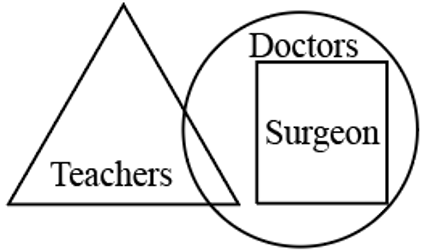
Statements :
A. All teachers are doctors
B. Some doctors are teachers
C. All surgeons are doctors
Which of the following is true :
Solution
Solutions: lets look at all the statements one by one.
A. All teachers are doctors
This statement is false as the triangular area that represents Teachers is not completely under the circular region that represents doctors.
B. Some doctors are teachers.
This statement is True as some part of the triangular region that represents teachers is under the circular region that represents doctors.
C. All surgeons are doctors
This statement is also true as the entire square region that represents surgeons is under the circular region that represents doctors.
Therefore option c is true.
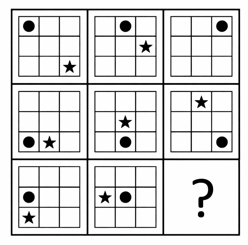
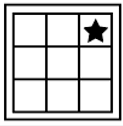
Which option shall come in place of '?' :
A.
B.
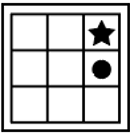
C.
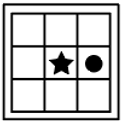
D.
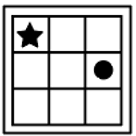
E.
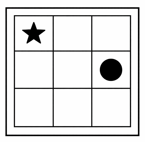
Solution
Solution: Based on data given we can identify the following pattern :
Dot: Moves 1 step right in next image
Star: Moves 1 Step up in next image
whenever the position of star and dot is same then only the dot appears in the image
All these things are happening together.
Hence the solution would be option E
Which option from the figure in the lower row shall come in place of '?' :
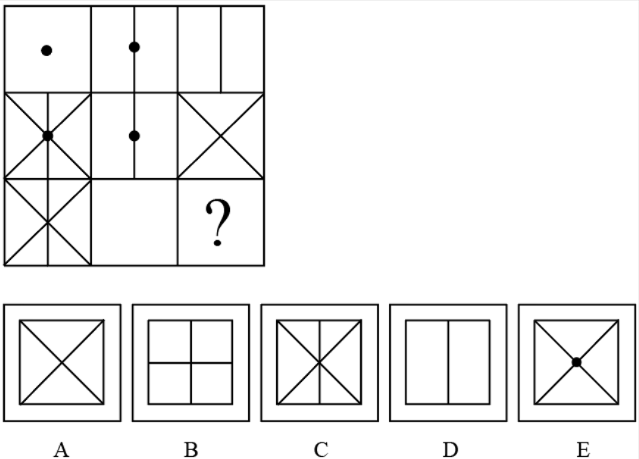
Solution
Solution: Based on data provided we can identify the following pattern here
The resultant image is the image that remains after removing the common things in both images and showing only the distinct things in both images and Based on this pattern Option C is correct
Identify the Odd One Out :
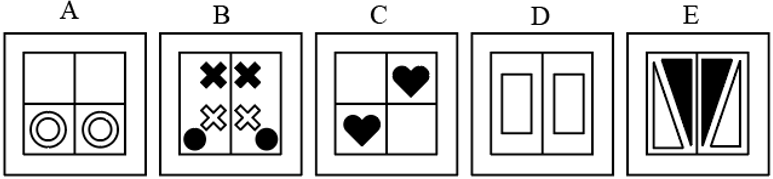
Solution
Solution: Based on the images given we can see that images A, B, D and E are symmetric about Y axis and only the image C is not following this pattern. Correct option that is odd out of all is option C
Which option from the lower row shall complete the sequence of the upper in the best manner ?
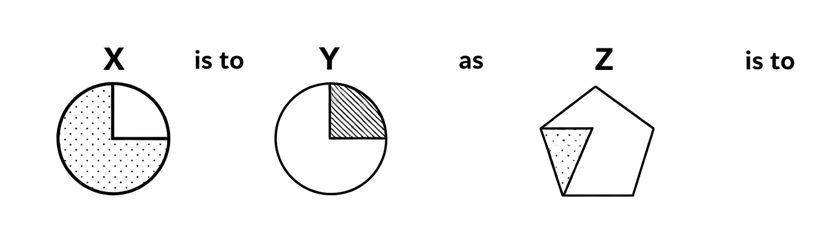
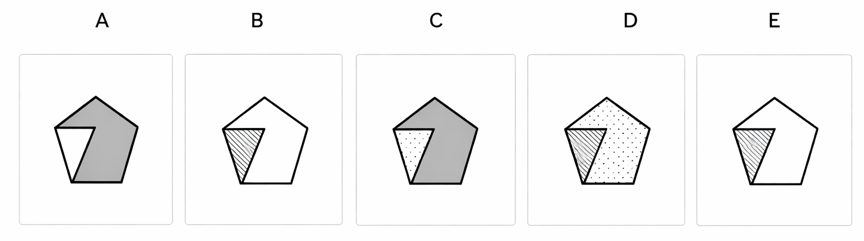
Solution
The example case follows the pattern that the dotted area disappears in next image and the shaded area appears Blank in next image.
Therefore as per the pattern the answer should be option A here.
Which option from the lower row shall complete the sequence of the upper in the best manner ?
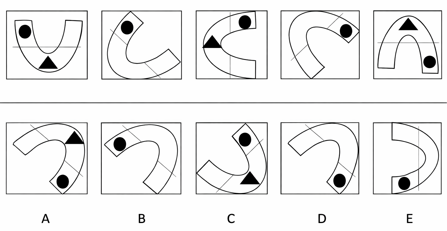
Solution
From the given example case we can identify the pattern that the Next image is reflection of previous image about x-axis ( vertical reflection ). Therefore the correct option as per the given pattern is OPTION C.
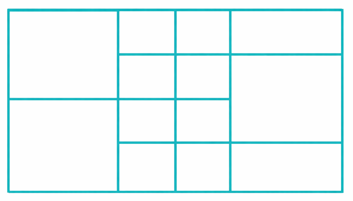
Count the number of squares in the given figure ?
Identify the number of rhombus in the figure given below ?

Solution
Here we can see that there are 8 small individual rhombuses and then we can combine multiple smaller fragments to get 6 larger rhombuses which are about 4 times the size of individual ones making the final total equal to 14. Hence option B is correct.
Which option as given in the lower row shall come next in sequence in the upper row ?
Solution
From the example diagram we can find the following patterns here :
1. Rotation of about 60 degrees to the right of internal figure.
2. A top facing triangle appears in every alternating figure.
Now as per this pattern the correct option is option D.
If a cube is to be constructed by folding the given figure along the lines shown, then in the cube so formed, what would the number be opposite to the number 4 ?
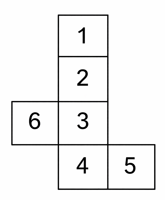
Solution
The base of cube is 3 and thus when we start folding the edges of face 3 we have face 2 and face 4 parallel and opposite to each other. Hence the answer here would be OPTION B.
Identify the Odd One Out :
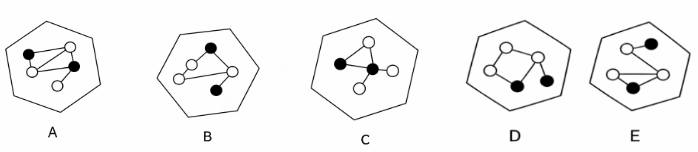
Solution
In none of the figures except figure c, the two black colored nodes adjacent to each other. This makes OPTION C the correct option.
Count the number of triangles given in the figure below :
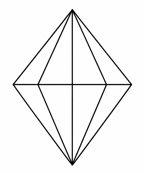
Solution
We can see that this figure is symmetric from the middle horizontally and vertically.
Lets first see the top half part vertically, we can see that we have 4 triangular fragments.
So smallest triangles present here are 4
Next we can combine 2 adjacent fragments to get 3 bigger triangles, similarly we can combine 3 adjacent fragments to get 2 even bigger triangles and finally we can combine all fragments to get the largest triangle in this selection.
Therefore vertical half part has 10 triangles and due to symmetry in figure bottom half will also have 10 triangles.
Now, If we look the figure horizontally these are total of 4 more triangles possible.
Thus total count is : 10+10+4 = 24
Hence option D is correct.
Select the option which is not embedded in the figure given :
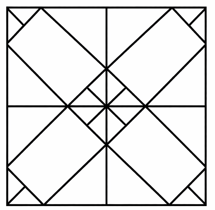
Solution
Here we can find that figures in options A,B,C and E are all in the given figure. Only figure in OPTION D is not present so this is our answer.
Select the option which is given figure is embedded in:

Solution
Here we were supposed to find the figure in which our initial figure is present. Now if we look at center of figure in option D, we would be able to spot the given figure. Hence OPTION D is correct.
Choose the option from the options given in the lower row that shall complete the pattern given in the upper row ?
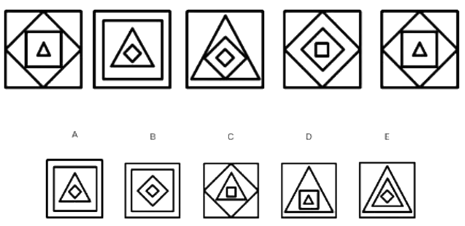
Solution
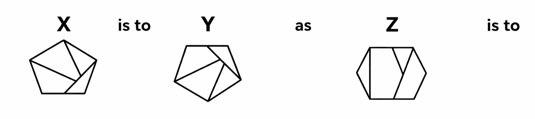
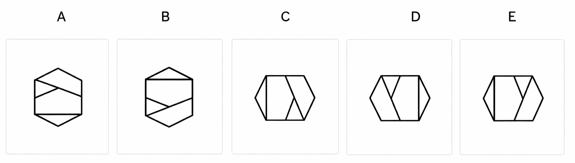
In this question a consistent pattern converts the previous figure to next one , now since first figure and last figure is same and figure 1 gets transformed to next figure so by law of symmetry the next figure should be same as second figure. Hence the answer here should be option A.
Find out which of the figures (1 ), (2), (3) and (4) can be formed from the pieces given in figure (X). If none of the figures can be used to form (X), then mark your answer as (5).
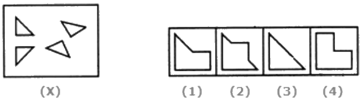
Solution
Here we have 4 right angle triangles and we need to find the figure that can be generated by combining these figures. Here by trial we can see that only figure in option C can be made by using only these 4 right triangles rest all figures require many more right angle triangles to make them. Hence OPTION C is correct.
Select a suitable figure from the four alternatives that would complete the figure matrix by coming in place of '?'. If you think that none of the figures can come in the square with '?', then mark your answer as (5).
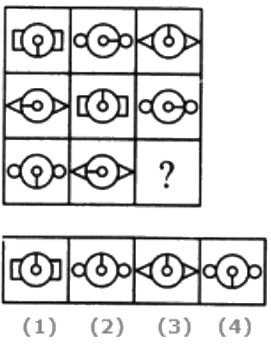
Solution
The three figures in first and second row contains figures that have a circular, triangular and rectangular outer parts and each is present only once. Therefore following this pattern the answer figure should have rectangular outer parts. Hence OPTION A should be our answer.
The six faces of a dice have been marked with alphabets A, B, C, D, E and F respectively. This dice is rolled down three times. The three positions are shown as :
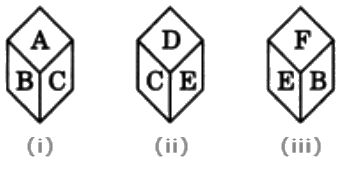
Find the alphabet that will lie absolutely opposite A on the dice ?
Identify the Odd One Out :
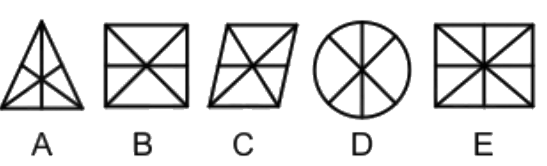
Solution
All figures in option A,B,C and D have 6 distinct regions created by the lines inside the polygon. Only option E has 8 distinct regions so the correct option here is OPTION E.
Identify the Odd One Out :
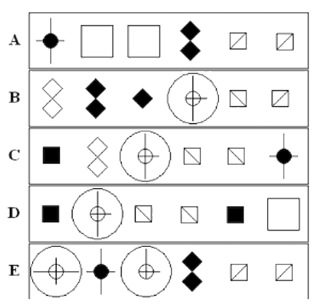
Find the number of triangles in the given figure ?
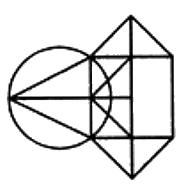
Solution
Lets break the figure and fist calculate the triangles in 3 triangular parts mounted on top of the rectangular base. Here each mounted part contains 3 triangles so 3 mounted parts have 9 total triangles. Now the square part itself contains 4 smaller right triangles and 1 larger triangle making the total triangles present in figure equal to 14. Hence OPTION D is correct.
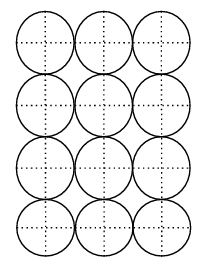
In the given figure, if the centres of all the circles are joined by horizontal and vertical lines, then determine the number of squares that can be thus formed ?
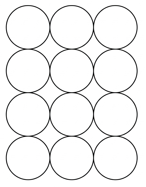
Solution
Lets connect the centers of these 8 circles. Now we can see that there are 6 smaller squares as shown in figure below. Also we can join 4 adjacent squares we can make a larger square and thus there are 2 such squares possible making the total count equal to 8. Hence OPTION D is correct.
Which of the options shall be the mirror image of the figure shown here ?
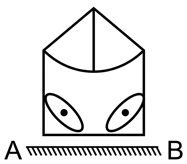
Solution
The correct mirror image we can draw here is given in option c. Hence OPTION C is correct.
How many minor sectors are there in the figure given below ?
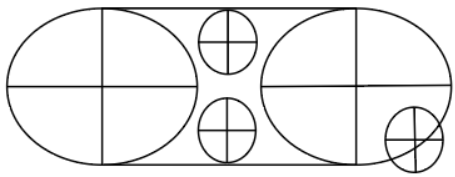
Solution
Here we have to calculate minor sectors present in the given image. Now we have 5 circles with 4 quadrants each and each quadrant is a minor sector to the circle. Therefore we have 20 quadrants in total ( 4 x 5 ) and hence OPTION E is correct.
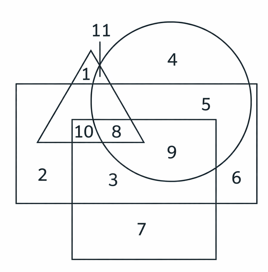
In the figure given above ; Triangle represents civil servants, circle represents urban, square represents educated and rectangle represents male.
Which of the following shall represent uneducated urban males :
Solution
In the figure given above ; Triangle represents civil servants, circle represents urban, square represents educated and rectangle represents male. In order to find area that represent uneducated urban males should be area that is inside both circle and rectangle but not inside the square region. This very region is marked region 5 and hence OPTION A is correct.
The cost price of a toy is Rs . 225. The marked price is twice of the cost price. What will be the discount offered to get profit of 56% on the sale of the toy?
Solution
CP = Rs. 225
MP = 2*225 = Rs. 450
Now, to get a profit of 56%, the toy must be sold for 156% of its cost price:
Hence, SP = 225*1.56 = Rs. 351
Discount = MP - SP
Discount = Rs. 450 - Rs. 351 = Rs. 99
Discount % = $$\dfrac{99}{450}\times100=22\%$$
What is the product of all the prime numbers between 0 to 100 ?
Solution
Prime numbers from 0 to 100 are 2,3,5,7,11,........
The multiplication will be very complicated. So, the question requires you to find number of zeros at the end.
Product = 2*3*5*7.....
No. of zeros at end = highest power of 10, which is 1 in this case(since 2,5 occur only once each and no higher powers of 2 and 5 occur).
So, the answer is option D as it has only 1 zero at the end.
The product of :
17 X 17 X 18 X 18 X 19 X 19
shall be fully divisible by which of the following number ?
Solution
17*17*18*18*19*19 = $$2^2\times\ 3^4\times\ 17^2\times\ 19^2$$
971 is not divisible by 2 or 3 or 17 or 19
173,23,5813 are also not divisible by 2 or 3 or 17 or 19
646=2*19*17. So, it can divide the given no.
Option C is the answer.
Find the remainder when :
(1719 X 1721 X 1723 X 1725 X 1727) is divided by 18?
Solution
R($$\ \frac{\ 1719*1721*1723*1725*1727}{18}$$) = R($$\frac{9\times\ 11\times\ 13\times\ 15\times\ 17\ }{18}$$) = 9
A dealer has 1000 kg sugar and he sells a part of it at 8% profit and the rest of it at 18% profit. The overall profit he earns is 14%. What is the quantity which is sold at 18% profit ?
Solution
Let the cost price be 100x.
Let the part sold at 8% profit be K kg. So, part sold at 18% profit would be (1000-K) kg
Total profit = $$\ \frac{\ SP\ -\ CP}{CP}\times\ 100$$ = $$\ \frac{\ 108x\times K\ +\ 118x\left(1000-K\right)\ \ -\ 1000\times\ 100x}{1000\times\ 100x}\times\ 100$$ = 14
On solving it, we get K=400kg.
Quantity sold at 18% profit = 1000-K = 600 Kg.
So, option E is the answer.
The length of a room exceeds its breadth by 2 meters. If the length be increased by 4 meters and the breadth decreased by 2 meters, the area remains the same. Find the surface area of its walls if the height is 3 meters?
Solution
Let the breadth of room be 'b' meters. So, the length will be 'b+2' meters. So, Area = b(b+2)
If the length is increased by 4 meters, then length='b+6' meters and the breadth decreased by 2 meters, then breadth='b-2' meters
So, initial area = new area.
b(b+2) = (b+6)(b-2)
$$b^2+2b\ =\ b^2+4b-12$$
On solving, b = 6 meters. So, Breadth = 6 meters and length=8 meters.
Surface area of walls = 2*h(l+b) = 2*3(6+8) = 84m^2
A bus covers a distance of first 50 km in 40 minutes, next 50 km at a speed of 2 km per minute and the next 30 km at a speed of 1.0 km per minute. What is its average speed during the entire journey ?
Solution
Average speed = $$\ \frac{\ Total\ Distance}{Total\ time}$$
Total distance = 50+50+30 = 130km
Total time = $$\ \frac{\ 40}{60}$$+$$\ \ \ \frac{\ 50km}{120kmph}$$+$$\ \ \ \frac{\ 30km}{60kmph}$$ = $$\ \frac{\ 19}{12}hr$$
Avg speed = $$\ \frac{\ 130}{\frac{19}{12}}=82.1\ kmph$$
So, option E is the answer.
If the height of a right circular cone is increased by 200% and the radius of the base is reduced by 50%, then volume of the cone shall :
Solution
Volume of cone = $$\ \frac{\ 1}{3}\pi\ r^2h$$
Let initial height be 'h' and radius be 'r' of the cone.
So, Initial volume = $$\ \frac{\ 1}{3}\pi\ r^2h$$
New height H = h(1+200%) = h(1+$$\ \frac{\ 200}{100}$$) = 3h
New radius R = r(1-50%) = r(1-0.5) = $$\ \frac{\ r}{2}$$
New volume = $$\ \ \frac{\ 1}{3}\pi\ \times\ \left(\frac{r}{2}\right)^2\times\ 3h$$ = $$\ \frac{\ \pi\ r^2h}{4}$$
Change in volume = $$\frac{\left(\frac{\ \pi\ r^2h}{4}-\frac{\ \pi\ r^2h}{3}\right)}{\ \frac{\ \pi\ r^2h}{3}}\times\ 100$$ = -25%
So, volume decreased by 25%.
Option B is the answer.
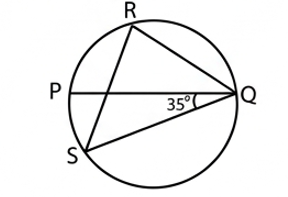
If the Angle PQS is 35$$^{\circ}$$, determine the Angle QRS :
Three ordinary coins having only two sides, namely, heads and tails are tossed in the air and two of such tossed coins land with tails facing upwards.
Determine that what are the chances on the next toss of the coins, at least two of the coins will land with the tails facing upwards ?
Solution
When tossing 3 coins, each coin has 2 possibilities (H or T). The total number of possible outcomes is 2^3 = 8.
The sample space (S) is:
HHH
HHT
HTH
THH
HTT
THT
TTH
TTT
The condition is "at least two" tails, which means we are looking for outcomes with exactly 2 tails or exactly 3 tails.
Exactly 2 tails: {HTT, THT, TTH} — 3 outcomes
Exactly 3 tails: {TTT} — 1 outcome
Total favorable outcomes = 3 + 1 = 4
Hence:
P(Atleast 2 tails) = 4/8 = 1/2 = 50%
Study the chart given carefully and answer the question that
follows:
The following table lists the marks of seven students (givenn in rows) of a class across six subjects (given in columns ). The Numbers in the brackets indicate the maximum marks of the subject concerned.
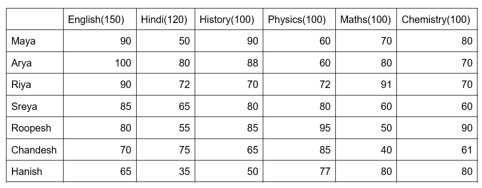
Who is the topper of the class ?
Solution
The total marks of every student is follows:
Maya-440
Arya-478
Riya-465
Sreya-430
Roopesh-455
Chandesh-396
Hanish-387
So, the topper of the class is Arya. Option A is the answer.
What will be the remainder if you subtract the marks scored by Roopesh from the marks scored by Riya ?
Solution
The total marks of every student is follows:
Maya-440
Arya-478
Riya-465
Sreya-430
Roopesh-455
Chandesh-396
Hanish-387
Total marks of Riya - Total marks of Roopesh = 465-455 = 10.
Option E is the answer.
If the maximum marks scored by the students in the Hindi subject were to be upscaled to 200 uniformly by the Examinations Department without affecting their percentages scored currently by each student, then what will be the difference in the marks scored by Chandesh and Hanish in Hindi?
Solution
Chandesh scored 75 out of 120 marks in Hindi. So, out of 200 marks, his score = $$\ \frac{\ 75}{120}\times\ 200$$ = 125
Hanish scored 35 out of 120 marks in Hindi. So, out of 200 marks, his score = $$\ \frac{35}{120}\times\ 200$$ = 58.33
Difference in their marks = 125-58.33 = 66.67
The nearest option is option E, which is the answer.
For the following questions answer them individually
Sunil Makihija can check the quality of 1000 items in 5 hours and Nilesh Desai can complete 75% of the same job in 3 hours. How much time is required for both of them to check 1300 items, if Nilesh stops checking after 2 hours ?
Solution
Sunil checks 1000 items in 5 hours, so Sunil's rate = 1000/5 = 200 items/hour
Nilesh completes 75% of the same job (1000 items) in 3 hours. 75% of 1000 is 750 items. = 750/3 = 250 items/hour
In the first 2 hours, both Sunil and Nilesh are working together. Combined Rate: 200 + 250 = 450 items / hour
Items checked in 2 hours: 450*2 = 900
The total target is 1300 items. Remaining Items = 1300 - 900 = 400 items.
Now, Nilesh stops checking after the first 2 hours, so Sunil must finish the remaining 400 items alone.
Time required by Sunil = 400 items / 200 items/hour = 2 hours
Total Time = 2 hours + 2 hours = 4 hours.
The ratio of weight of three friends , namely, Aashiqui, Aarohi and Aamrohi is 4 : 9: 7. Their total weight is 100 kilograms. □How much weight would Aamrohi would have put on if the ratio after her weight gain is 4 : 7 : 9 and their collective weight becomes 140 kilograms?
Solution
Let the initial weights of Aashiqui, Aarohi and Aamrohi be 4x,9x and 7x respectively.
We are given total initial weight is 100kg.
So,4x+9x+7x=100, which gives x=5.
Initial Weights of Aashiqui, Aarohi and Aamrohi are 20kg,45kg and 35kg respectively.
Let the weights of Aashiqui, Aarohi and Aamrohi be 4y,7y and 9y respectively after Aamrohi weight gain.
So, we are given 4y+7y+9y=140.
We get y=7kg
Aamrohi's weight after weight gain=9y=63kg.
Aamrohi's weight gain = Final weight - Initial weight = 63kg-35kg = 28kg.
Option A is the answer.
In a triangle ABC, AD is the bisector of angle A If AC = 4.2 cm , DC = 6 cm, BC =10 cm , then find AB ?
Solution
We can use the Angle Bisector Theorem:
In triangle ABC, if AD bisects ∠A, then $$\dfrac{AB}{AC}=\dfrac{BD}{DC}$$
We know: BC=10 and DC=6
So, BD = BC − DC = 10 − 6 = 4
Applying the theorem
$$\dfrac{AB}{AC}=\dfrac{BD}{DC}$$
Given
AC=4.2, so:$$AB=\dfrac{2}{3}\times4.2=2.8\ cm$$
There are 6 tasks and 6 persons. Task 1 cannot be assigned either to person 1 or person 2. Task 2 must be assigned to either person 3 or person 4. Every person is to be assigned one task. In how many ways can the assignment be done?
Solution
Assign Task 2 first: 2 choices (Person 3 or 4).
Total ways to assign the remaining 5 tasks: 5! = 120.
Total without Task 1 restrictions: 2*120 = 240.
Subtract restricted cases for Task 1:
If Task 1 is given to Person 1: 2*1*4! = 48.
If Task 1 is given to Person 2: 2*1*4! = 48.
Final Result: 240 - 48 - 48 = 144.
The speed of a boat in still water is 5 km/hr. If it takes thrice as much time to go 20 km upstream as to go the same distance downstream, find the speed of the stream.
Solution
Let the speed of stream be 's' km/hr.
$$\ \frac{\ 20}{5-s}=\ 3\times\frac{20}{5+s}$$
5+s=15-3s
s=2.5km/hr
Option B is the answer.
Four sheep farmers, namely Umla, Vimla, Wilma and Xema rented a
pasture, as per the following details :
Umla grazed her 24 sheep for 3 months ;
Vimla grazed her 10 sheep for 5 months ;
Wilma grazed her 35 sheep for 4 months ; and
Xema grazed her 21 sheep for 3 months.
If Umla's share of rent is Rs . 720, find the total rent of the pasture ?
Solution
Umla: 24 sheep * 3 months = 72 sheep-months
Vimla: 10 sheep * 5 months = 50 sheep-months
Wilma: 35 sheep * 4 months = 140 sheep-months
Xema: 21 sheep * 3 months = 63 sheep-months
Total sheep-months = $72 + 50 + 140 + 63 = 325 sheep-months
We are given that Umla’s share of the rent is Rs. 720. Since her contribution was 72 sheep-months, we can find the cost per sheep-month:
Rate = $$\dfrac{720}{72}$$ = Rs. 10 per sheep-month
Total Rent = 325 sheep-months * Rs. 10 per sheep-month = Rs. 3,250
A copper wire having a length of 243 m and a diameter of 4 mm was melted to form a sphere. Find the diameter of the sphere thus formed.
Solution
Volume remains conserved during melting.
Volume before melting = Volume after melting
Before melting, the wire was in cylindrical shape and after melting, it became sphere.
So, Vol. before = $$\pi r^2l$$ = Vol. after = $$\ \frac{\ 4}{3}\pi\ R^3$$, where R is the radius of sphere formed.
$$\left(2\times\ 10^{-3}\right)^2\times\ 243\ =\ \frac{\ 4}{3}R^3$$
$$R^3=729\times\ 10^{-6}$$
R=9cm.
So, diameter of the sphere = 18cm.
Option C is the answer.
The following pie chart lists the details about the per cent production by seven different companies, namely, A, B, C, D, E, F and G. The total production for all companies is 1500 units.
Percentag (%) of Total Production
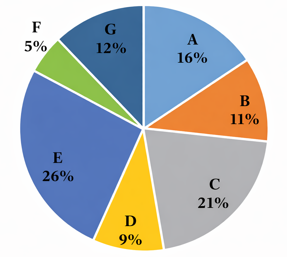
Further, it is known that :
A. Companies A & G are producing more than 500 units ;
B. Companies B & F are producing less than 250 units ;
C. Companies C & E account for 705 units ;
D. Companies D & Gare producing less than 200 units ;
E. Companies E, F & G account for 545 units.
Choose the correct answer from the options given below :
Solution
Total production of all companies = 1500 units
Production of A - $$\ \frac{\ 16}{100}\times\ 1500$$ = 240 units
Production of B - $$\ \frac{\ 11}{100}\times\ 1500$$ = 165 units
Production of C - $$\ \frac{\ 21}{100}\times\ 1500$$ = 315 units
Production of D - $$\ \frac{\ 9}{100}\times\ 1500$$ = 135 units
Production of E - $$\ \frac{\ 26}{100}\times\ 1500$$ = 390 units
Production of F - $$\ \frac{\ 5}{100}\times\ 1500$$ = 75 units
Production of G - $$\ \frac{\ 12}{100}\times\ 1500$$ = 180 units
Statement A - A+G=240+180=420 units, which is less than 500 units. So, A is false.
Statement B - B+F=165+75=240 units, which is less than 250 units. So, B is true.
Statement C - C+E=315+390=705 units, which is equal to 705 units. So, C is true.
Statement D - D+G=135+180=315 units, which is more than 200 units. So, D is false.
Statement E - E+F+G=390+75+180=645 units, which is greater than 545 units. So, E is false.
Only B and C are true.
Option D is the answer.
In a local election between two candidates, one candidate got 55% of the total valid votes and was declared as winner. 15% of the votes were invalid. If the total number of votes polled were 15200, what were the valid votes of the loser?
Solution
Total votes polled = 15,200
Invalid votes = 15% of 15,200 = 0.15 × 15,200 = 2,280
So, valid votes = 15,200 − 2,280 = 12,920
Winner got 55% of valid votes ⇒ Winner’s votes = 0.55 × 12,920 = 7,106
So, loser’s valid votes = 12,920 − 7,106 = 5,814
Study the information given below carefully and answer the question that follows :
The following table shows the percentage distribution of workforce in India and the ratio of male to female workforce in India in various sectors during a particular year. Further, its known that the total work force in India during the given year was 6000000.
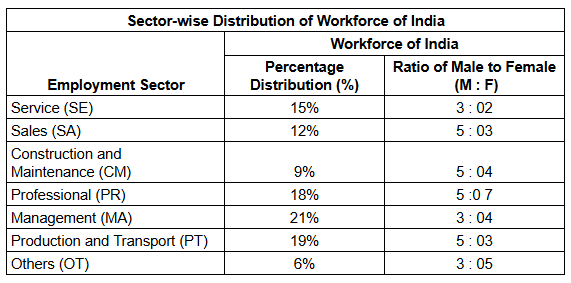
Table
The number of male workforce in SA and MA sectors put together is approximately what percent of the total number of workforce in the PT sector?
Solution
Male workforce in SA sector = $$\ \frac{\ 5}{8}\times\ $$ Total workforce in SA sector = $$\ \frac{\ 5}{8}\times\ \frac{\ 12}{100}\times\ 6000000\ =\ 450000$$
Male workforce in MA sector = $$\ \frac{\ 3}{7}\times\ $$ Total workforce in MA sector = $$\ \frac{\ 3}{7}\times\ \ \frac{\ 21}{100}\times\ 6000000\ =\ 540000$$
Number of male workforce in SA and MA sectors put together = 450000+540000 = 990000
Total workforce in PT sector = $$\frac{\ 19}{100}\times\ 6000000\ =\ 1140000$$
Required percent = $$\ \frac{\ 990000}{1140000}\times\ 100\ =\ 86.84\%\ \approx\ 87\%$$
Option B is the answer.
The difference in the number of female workforce in SA and MA sectors put together and the number of female workforce in PT sector is approximately close to how much ?
Solution
Female workforce in SA sector = $$\ \frac{\ 3}{8}\times\ $$ Total workforce in SA sector = $$\ \frac{\ 3}{8}\times\ \frac{\ 12}{100}\times\ 6000000\ =\ 270000$$
Female workforce in MA sector = $$\ \frac{\ 4}{7}\times\ $$ Total workforce in MA sector = $$\ \frac{\ 4}{7}\times\ \frac{\ 21}{100}\times6000000\ =\ 720000\ $$
Number of female workforce in SA and MA sectors put together = 270000+720000 = 990000
Number of female workforce in PT sector = $$\ \frac{3}{8}\times\ $$ Total workforce in PT sector = $$\ \frac{3}{8}\times\ \frac{19\ }{100}\times\ 6000000\ =$$ 427500
Required difference = 990000-427500 = 56250 which is close to 560000
Option A is the answer.
For the following questions answer them individually
One year payment to the servant is Rs. 90 plus one gift coupon. The servant leaves after 9 months and receives Rs. 65 and a gift coupon. Determine the value of the gift coupon ?
Solution
Let the value of the gift coupon be Rs. x.
Total Yearly Payment: Rs. 90 + x
Payment for 9 months = $$\dfrac{3}{4}\left(90+x\right)$$
According to the question, this equals what the servant actually received: $$\dfrac{3}{4}\left(90+x\right)=65+x$$
$$67.5+\dfrac{3x}{4}=65+x$$
$$67.5-65=x-\dfrac{3x}{4}$$
$$2.5=\dfrac{x}{4}$$
$$x=10$$
How many integer solutions exists for the equation 11x + 15y = -1 such that both x and y are less than 100 ?
Solution
11x + 15y = -1
Solution of this equation will be of the form x=a+15k , y=b-11k, where (a,b) is any solution of the equation
We can clearly see that x=4,y=-3 is one solution of the equation.
x=4+15k, y=-3-11k
Given x<100,y<100
4+15k<100, k$$\le\ $$6 and -3-11k<100, k$$\ge-9\ $$
$$-9\le\ k\ \le\ 6$$, k can take 16 values.
There exists 16 solutions for the equation.
Option D is the answer.
Let A and B be two solid spheres such that the surface area of B is 300% higher than the surface area of A. The volume of A is found to be k% lower than the volume of B. Determine the value of k.
Solution
Let the radius of sphere A be 'r' and sphere B be 'R'
Surface area of A = $$4\pi r^2$$
Surface area of B = $$4\pi R^2$$ = (1+300%) of A = 4 * $$4\pi r^2$$
R=2r
Volume of A = $$\frac{4}{3}\pi r^3$$
Volume of B = $$\frac{4}{3}\pi R^3\ =\ \ \frac{\ 4}{3}\pi\ \left(2r\right)^3\ =\ \ \frac{\ 32}{3}\pi\ r^3$$
Required percent = $$\ \frac{\ \left(\frac{32}{3}\pi\ r^3\ -\ \frac{4}{3}\pi\ r^3\right)}{\ \frac{32}{3}\pi\ r^3}\times\ 100\ =87.5\ \%\ $$
Option C is the answer.
A ship 156 km from the shore develops a leak which admits 2.5 metric tons of water in 6 minutes and 30 seconds. A quantity of 68 metric tons would □suffice to sink the ship, but luckily the ship's pumps can throw out 15 metric tons in an hour. The average rate of sailing so that it just reaches the shore from where it left as it begins to sink should be :
Solution
The ship admits 2.5 metric tons of water in 6 minutes and 30 seconds.
Water Influx rate = $$\frac{2.5}{\ \frac{\ 6.5}{60}}$$ metric tons/hr = 23.07 metric tons/hr
Water outflux rate = 15 metric tons/hr
Net influx rate = 23.07-15 = 8.07 metric tons/hr
Time after which ship starts sinking = $$\ \frac{\ 68}{8.07}$$ = 8.42 hours
Average rate of sailing=$$\frac{156}{8.42}$$=18.53kmph
Closest option is option C.
How many even integers 'n', where, $$ 100 \leq n \leq 200 $$, are divisible neither by 7 nor by 9?
Solution
Total even integers between 100 and 200 = $$\frac{200-100}{2}\ \ +\ \ 1\ =\ 51$$
Even integers divisible by 7 = Number of multiple of 14.
There are 7 integers which are of form 14k(112,126,...) between 100-200
Even integers divisible by 9 = Number of multiple of 18.
There are 6 integers which are of form 18k(108,126,...) between 100-200
Even integers divisible by both 7 and 9 = No. of multiple of LCM(14,18) = No. of multiple of 126k = 1
So, Required answer = 51-(7+6)+1 = 39.
Option C is the answer.
The cost of running a movie theatre is Rs . 10,000 per day, plus additional Rs. 5000 per show. The theatre has 200 seats. A new movie released on Friday. There were three shows, where the ticket price was Rs. 250 each for the first two shows and Rs. 200 for the late-night show.
For all shows together, total occupancy was 80%. What was the maximum amount of profit possible?
Solution
The total cost consists of a fixed daily fee plus a per-show fee: Daily fixed cost: Rs. 10,000
Cost for 3 shows: 3*5,000 = Rs. 15,000
Total Cost: 10,000 + 15,000 = Rs. 25,000
The theatre has 200 seats and runs 3 shows, meaning there are 600 total available seats.
Total occupancy (80%): 0.80*600 = 480
To maximise profit, we want the most expensive tickets to sell out first.
Show 1 (Rs. 250): Max capacity = 200 viewers.
Show 2 (Rs. 250): Max capacity = 200 viewers.
Show 3 (Rs. 200): Remaining viewers = 480 - (200 + 200) = 80 viewers.
First two shows: 400 × 250 = Rs. 100,000
Late-night show: 80*200 = Rs. 16,000
Total Revenue: 1,16,000
Profit = Revenue - Cost
Profit = 1,16,000 - 25,000 = Rs. 91,000
The least common multiple of a number and 990 is 6930. The greatest common divisor of that number and 550 is 110. What is the sum of the digits of the least possible value of that number?
Solution
Let the no. be x
LCM(x,990) = 6930
6930=$$2\times3^2\times5\times7\times11$$
990=$$2\times3^2\times5\times11$$
Factor of 7 is missing in 990, so x has to be multiple of 7.
x=7a
GCD(x,550)=110
x=110b
x=7a=110b. So, x=770k
Least value of x is 770.
Sum of digits of 770=7+7+0=14
Option B is the answer.
How many isosceles triangles with integer sides are possible such that sum of two of the side is 12 ?
Solution
Let the sides of the isosceles triangle be (a, a, b), where a and b are integers.
Case 1: The sum of the two equal sides is 12
a + a = 12 ⇒ a = 6
a + a = 12 ⇒ a = 6
Triangle inequality: 6 + 6 > b ⇒ b < 12
Also b > 0 and integer.
So, b = 1, 2, 3, …, 11
So, Total = 11 triangles
Case 2: One equal side + base = 12
a + b = 12 ⇒ b = 12 − a
Triangle inequality: a + a > b ⇒ 2a > 12 − a ⇒ 3a > 12 ⇒ a > 4
Also: b > 0 ⇒ 12 − a > 0 ⇒ a < 12
So, a = 5,6,7,8,9,10,11
Hence, Total = 7 triangles
But when a=6, the triangle is (6,6,6), which was already counted in Case 1. So subtract 1 duplicate.
So final count: 11 + 7 - 1 = 17
A student is standing with a banner at the top of a 100 m high college building. From a point on the ground, the angle of elevation of the top of the student is 60$$^{\circ}$$ and from the same point, the angle of elevation of the top of the tower is 45$$^{\circ}$$. Find the height of the student?
Solution
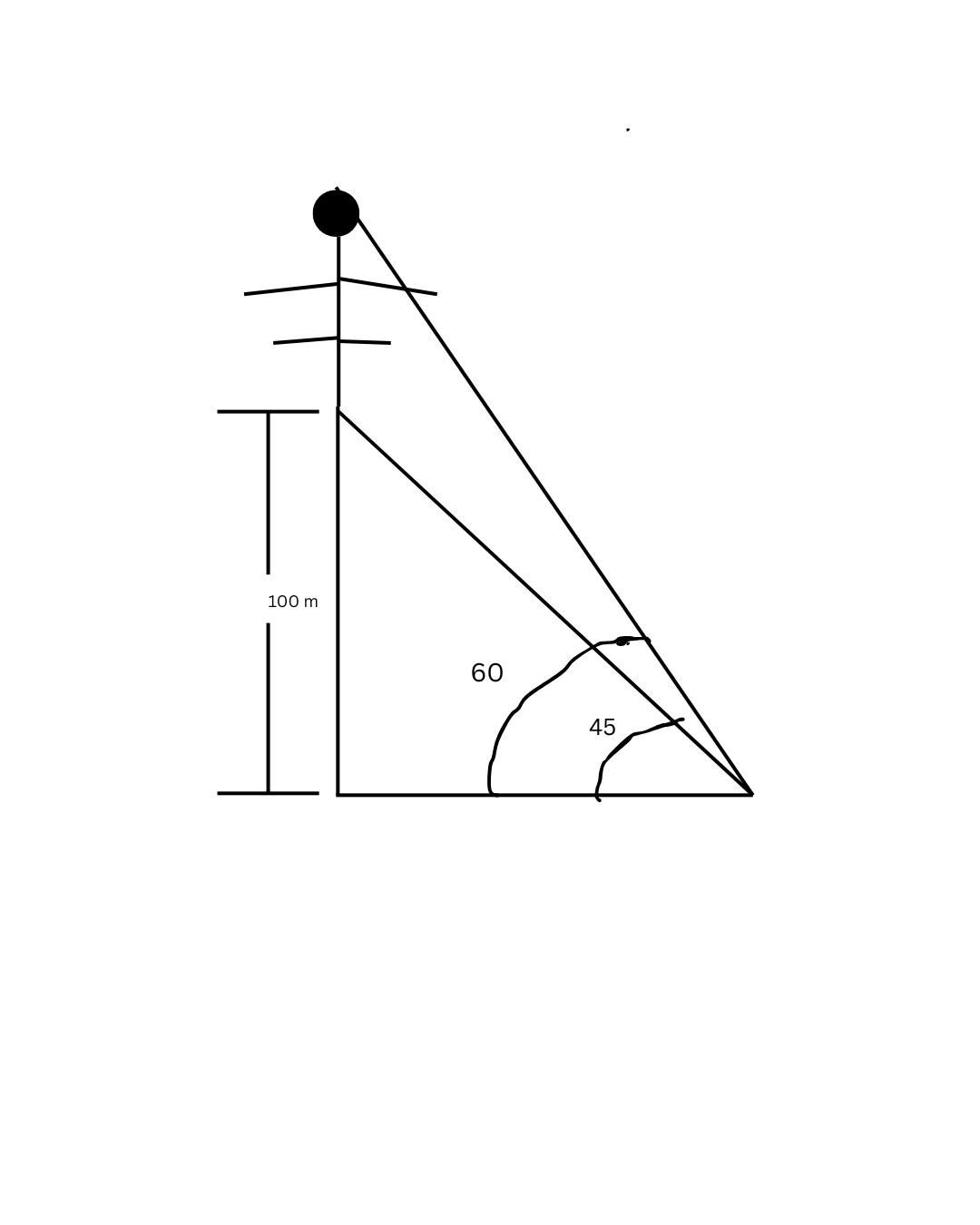
Let the base of building be 'x' m and height of student be 'k' m
tan 45 = $$\ \frac{\ 100}{x}$$
x=100m
tan 60 = $$\frac{100+k}{100}$$
k=100($$\sqrt{3}$$ - 1) = 73.2m
Option D is the answer.
Pipe A, B and C are kept open and together fill a tank in t minutes. Pipe A is kept open throughout, pipe B is kept open for the first 10 minutes and then closed. Two minutes after pipe B is closed , pipe C is opened and is kept open till the tank is full. Each pipe fills an equal share of the tank. Furthermore, it is known that if pipe A and Bare kept open continuously, the tank would be filled completely in t minutes. How long will it take C alone to fill the tank ?
Solution
Let the total portion of tank to be filled be '3x' units.
Let the amount of units filled per minute by A,B and C be a,b and c respectively.
We are given that, at+10b+(t-12)c = 3x
Also, each pipe fills equal share of tank i.e. x units
at=x, 10b=x, (t-12)c=x.
$$\therefore\ $$ b=$$\ \frac{\ x}{10}$$
Also, at+bt=3x
bt=2x, substitute b=$$\ \frac{\ x}{10}$$, t=20 min.
(t-12)c=x
c=$$\ \frac{\ x}{8}$$
Let k be time taken by c to fill the tank alone,
ck=3x
k=$$\ \ \frac{\ 3x}{c}$$=24 minutes.
Option B is the answer.
a, b, c, d and e are 5 distinct numbers that from an arithmetic progression.
They are not necessarily consecutive terms but form the first 5 terms of the AP. It is known that c is the arithmetic mean of a and b, and d is the arithmetic mean of b anc c.
Determie which of the following statements is / are true in light of the above stated information ?
i. Average of all 5 terms put together is c
ii. Average of d and e is not greater than average of a and b
iii. Average of b and c is greater than average of a and d
Solution
a, b, c, d and e are distinct.
Given that c is the arithmetic mean of a and b, there can be 2 cases.
Case 1 : The sequence is a,c,b
Case 2: The sequence is b,c,a
Given that d is the arithmetic mean of b anc c, there can be 2 cases.
Case 1 : The sequence is b,d,c
Case 2: The sequence is c,d,b
Only 2 final cases are possible here.
Sequence 1 : a,e,c,d,b
Sequence 2 : b,d,c,e,a
Statement (i) is true as in both sequence 1 and sequence 2, the average of all terms is c.
Statement (ii) is true as in both sequence 1 and sequence 2, the average of d and e is c and average of a and b is c. c is not greater than c.
Statement (iii) is false as average of b and c, which is d is not greater than average of a and d in both sequences simultaneously.
Option A is the answer.
Vijay buys some eggs. After bringing the eggs home, he finds two to be rotten and throws them away. Of the remaining eggs, he puts five-ninth in his fridge , and brings the rest to his mother, Rashmi's house. She cooks two eggs and puts the rest in her fridge. If her fridge cannot hold more than five eggs, what is the maximum possible number of eggs bought by Vijay ?
Solution
Let the eggs bought by Vijay be N.
Vijay throws 2 eggs, so remaining=N-2
Eggs in Vijay's fridge=$$\frac{5}{9}\left(N-2\right)$$
Remaining eggs=$$\frac{4}{9}\left(N-2\right)$$
Rashmi cooks 2 eggs, so Eggs in her fridge = $$\frac{4}{9}\left(N-2\right)\ -\ 2$$
$$\frac{4}{9}\left(N-2\ \right)-\ 2\ \le\ 5$$
N$$\le$$17.75
Also, for $$\ \frac{5}{9}\left(N-2\right)$$ and $$\ \frac{4}{9}\left(N-2\right)$$ to be an integer N-2=9k (k is an integer greater than 0)
N=9k+2=11,20,....
Maximum possible value of N is 11.
Option A is the answer.
Some coins are to be put into 7 pockets so that each pocket contains at least one coin. At most 3 of the pockets are to contain the same number of coins, and no two of the remaining pockets are to contain an equal number of coins. What is the least possible number of coins needed for the pockets?
Solution
We want to minimise the total number of coins under these conditions:
7 pockets, each has at least 1 coin
At most 3 pockets can have the same number of coins
The remaining pockets must all have distinct numbers
To minimise total coins: we can use the smallest possible positive integers and allow exactly 3 pockets to have the same number (since “at most 3” → we use 3 to minimise total). The other 4 pockets must all be distinct and different from the repeated number.
Let the repeated number be 1 (smallest possible): so 3 pockets: 1, 1, 1
Now choose 4 distinct numbers, all different from 1: Next smallest distinct numbers: 2, 3, 4, 5
Hence, Total coins: 1 + 1 + 1 + 2 + 3 + 4 + 5 = 17
Read the Question given below and choose the option that is sufficient to answer the Question.
What is the monthly rent for a certain apartment ?
(1) The monthly rent per person for 4 people to share the rent for the apartment is $375.
(2) The monthly rent per person for 4 people to share the rent of the apartment is $125 less than the monthly rent per person for 3 people to share the rent.
Solution
Let the monthly rent per person for the apartment be $P.
Statement 1 - P=$375 and Total rent=4P=$1500. So, statement 1 alone is sufficient to answer the question.
Statement 2 - 4P=3(P+125). P=$375, so total rent=4P=$1500. So, statement 2 alone is sufficient to answer the question.
So, Each statement alone is sufficient.
Option D is answer.
If a certain wheel turns at a constant rate of x revolutions per minute, how many revolutions will the wheel make in k seconds?
Solution
Given:
Rate = x revolutions per minute and Time = k seconds
Convert time into minutes: $$\dfrac{k}{60}$$ minutes
Number of revolutions: $$x\times\dfrac{k}{60}$$ = $$\dfrac{xk}{60}$$
Archit invested an amount of Rs. 13,900 divided into two different schemes, A and B, at the simple interest rate of 14% p.a. and 11% p.a., respectively. If the total amount of simple interest earned in 2 years is Rs. 3508, then determine the amount invested in Scheme B by Archit?
Solution
Let the amount invested in Scheme A be Rs. X.
Then, the amount invested in Scheme B = 13900 - X
Interest from Scheme A: $$\dfrac{\left(X\times14\times2\right)}{100}=0.28X$$
Interest from Scheme B: $$\dfrac{\left(\left(13,00-X\right)\times11\times2\right)}{100}=0.22\left(13900-X\right)$$
Total interest: 0.28X + 0.22(13900 - X) = 3508
0.28X + 3058 - 0.22X = 3508
0.06X = 450
X = 7500
Amount in Scheme B: 13900 - 7500 = 6400
Choose the correct option that should come next in the series given below :
2, 1, (1/2), (1/4), ...
Solution
We are noticing that each term is obtained by dividing the previous term by 2.
So, the next term: $$\dfrac{1}{4}\ \times\dfrac{1}{2}=\dfrac{1}{8}$$
Two friends, Alka and Alkit appear for an interview for two vacancies for the same post in an Organisation. The probability of Alka's selection is 1/7 and Alkit is 1/ 5. What is the probability that only one of them will be selected?
Solution
Let
P(Alka selected) = 1/7 so P(Alka not selected) = 6/7
P(Alkit selected) = 1/5 sp P (Alkit not selected) = 4/5
So, the probability of only one being selected:
Case 1: Alka selected, Alkit not selected
$$\dfrac{1}{7}\times\dfrac{4}{5}=\dfrac{4}{35}$$
Case 2: Alka not selected, Alkit selected
$$\dfrac{6}{7}\times\dfrac{1}{5}=\dfrac{6}{35}$$
Total probability: $$\dfrac{4}{35}+\dfrac{6}{35}=\dfrac{10}{35}=\dfrac{2}{7}$$
If :
X stands for addition ;
$$\div$$ stands for subtraction ;
- stands for division, then ;
20 X 8 $$\div$$ 8 - 4 + 2 shall be equal to :
Solution
20 X 8 ÷ 8 - 4 + 2 = 20+8-8÷4*2(Since + sign meaning is not given, we are taking it as multiplication)
Applying BODMAS rule,
20+8-2*2=20+8-4=24.
Option C is the answer.
Read the information provided and answer the question that follows:
Given below in the first chart is the percentage distribution of total cars (MUV & SUV) distributed by 8 dealers, namely, A, B, C, D, E, F, G, and H, across the country. Similarly, the second chart shows the SUV cars distributed by the same dealers in the year 2023.
Further, it is known that the sum total of SUV and MUV cars sold by all the 8 dealers for the year 2023 is 56000, and the total number of SUV cars sold during the same duration is 32000.
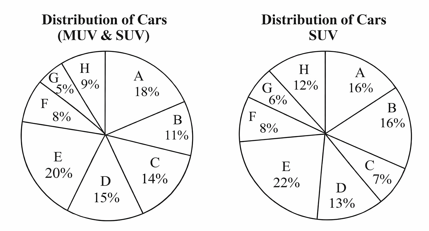
The total number of cars sold by the dealer D is by what percentage more than the total number of SUV cars sold by dealers C, F and G together?
Solution
Total cars sold(SUV+MUV)=56000
Number of SUV cars sold=32000
So, Number of MUV Cars sold=24000
Total cars sold by D=$$\ \frac{\ 15}{100}\times\ 56000$$=8400
Total SUV cars sold by C,F and G=(7%+8%+6%) of 32000=$$\ \frac{\ 21}{100}\times\ 32000$$=6720
Required answer=$$\ \frac{\ \left(8400-6720\right)}{6720}\times\ 100=\ \frac{\ 1680}{6720}\times\ 100=25\ \%\ $$
Option E is the answer.
Determine the ratio between the total number of SUV cars distributed by dealers A and B together and total number of SUV and MUV cars distributed by dealers C and F together.
Solution
Total cars sold(SUV+MUV)=56000
Number of SUV cars sold=32000
So, Number of MUV Cars sold=24000
X=Total SUV cars distributed by A and B=(16%+16%) of 32000 = 32*320 = 10240
Y=Total(SUV+MUV) cars distributed by C and F together=(14%+8%) of 56000 = 12320
Required answer=$$\ \frac{\ X}{Y}=\ \frac{\ 10240}{12320}=\frac{\ 64}{77}$$
Option C is the answer.
Determine the average number of MUV cars distributed by dealers A, D, E, F and H together.
Solution
Total cars sold(SUV+MUV)=56000
Number of SUV cars sold=32000
So, Number of MUV Cars sold=24000
Average number of MUV cars distributed by dealers A, D, E, F and H = $$\ \frac{\ TotalMUVcarsdistributedbydealersA,D,E,FandH}{5}$$
Total MUV cars distributed by dealers A, D, E, F and H = Total(SUV+MUV) cars distributed by dealers A, D, E, F and H - Total SUV cars distributed by dealers A, D, E, F and H
=(18%+15%+20%+8%+9%) of 56000 - (16%+13%+22%+8%+12%) of 32000 = $$\ \frac{\ 70}{100}\times\ 56000\ -\ \ \frac{\ 71}{100}\times\ 32000\ =\ 39200\ -\ 22720\ =\ 16480$$
Average number of MUV cars distributed by dealers A, D, E, F and H = $$\ \frac{\ 16480}{5}$$ = 3296
Option D is the answer.
For the following questions answer them individually
What number shall you get in the unit digit on solving the following problem :
$$\left\{ (6374)^{1793}\times(625)^{317}\times (341^{491}) \right\}$$
Solution
Unit digit of $$6374^{1793}\times625^{317}\times341^{491}\ $$ = Unit digit of $$4^{1793}\times5^{317}\times1^{491}\ $$ = unit digit of 4*5*1 = 0
Option A is the answer.
Gajodhar throws two ordinary dice simultaneously. What is the probability that he shall get two numbers whose product will be an even number?
Solution
Total possible combinations when 2 dice are thrown=6*6=36
Product of 2 numbers is even when either both of them are even or one is even, other is odd.
There are 3 even no.(2,4,6) and 3 odd no.(1,3,5) possible in a dice.
Total combinations when both are even = 3*3 = 9
Total combinations when one is even and other is odd = 3*3(first no. is odd, second even) + 3*3(first no. is even, second odd) = 18
Required probability = $$\frac{\ 9+18}{36}=\ \frac{\ 27}{36}=\ \frac{\ 3}{4}\ $$
Option E is the answer.
What number must be added to $$16a^{2} - 12a$$ to make it a perfect square ?
Solution
Perfect square of a quadratic equation is of form $$\left(pa\ +\ q\right)^2$$
Let 'k' be the no. added to make the required equation as a perfect square
$$\left(pa\ +\ q\right)^2=p^2a^2\ +\ 2apq\ +\ q^2=16a^2-12a\ +\ k$$
Comparing the coefficients, we get $$p^2=16,\ p=\pm\ 4.$$
$$2apq=-12a.\ So,\ pq=-6,\ \ $$ which gives q=$$\ \pm\frac{\ 3}{2}$$
k=$$\ q^2$$=$$\ \frac{\ 9}{4}$$
Option A is the answer.
There are 8436 steel balls, each with a radius of 1 centimeter, stacked in a pile, with 1 ball on top, 3 balls in the second layer, 6 in the third layer, 10 in the fourth, and so on. Determine the number of horizontal layers in the pile?
Solution
There is 1 ball on top, 3 balls in second layer, 6 balls in third layer,10 balls in fourth layer .......... and so on
Total balls=8436
Sum of balls across all layers = S = 1+3+6+10+.........
S = 1+3+6+10+.......+$$t_n$$
S = 1+3+6+........+$$t_{n-1}\ +\ t_n$$
Subtracting both equations,
0 = 1+2+3+4+......... - $$t_n$$
$$t_n$$ = 1+2+3+4+.......... = $$\ \frac{\ n\left(n+1\right)}{2}$$
$$S_n=\Sigma\ t_n=\Sigma\ \ \frac{\ n\left(n+1\right)}{2}=\ \frac{\ 1}{2}\Sigma\ \left(n^2+n\right)$$
$$S_n=\ \frac{\ 1}{2}\left(\ \frac{\ n\left(n+1\right)\left(2n+1\right)}{6}+\ \frac{\ n\left(n+1\right)}{2}\right)=\ \frac{\ n\left(n+1\right)\left(n+2\right)}{6}=8436$$
n(n+1)(n+2)=50616
On solving, we get n=36.
Option B is the answer.
Identify the Odd One Out from the options provided below :
Smokejumpers are often asked to address to organizations and the public groups about the importance of fire protection, particularly fire deterrence and detection. Because smoke detectors reduce the risk of dying in a fire by half, smokejumpers often provide audiences with information on how to fix these protective devices in their homes. Specifically, they tell them these things : A smoke detector should be placed on each floor of a home. While sleeping, people are in particular risk of a surfacing fire, and there must be a detector outside each sleeping area. A good site for a detector would be a hallway that runs between living spaces and bedrooms. Because of the dead-air space that might be missed by turbulent hot air bouncing around above a fire, smoke detectors should be installed either on the ceiling at least four inches from the adjoining wall, or high on a wall at least four, but no further than twelve inches from the ceiling. Detectors should not be mounted near windows, exterior doors, or other places where drafts might direct the smoke away from the unit. Nor should they be placed in kitchens and garages, where cooking and gas fumes are likely to cause bogus alarms.
What is the main focus of the author of this passage?
Solution
The passage begins by telling what smoke jumpers do and their role in fire control and training, thenafter this extract, "specifically, they tell them these things" onwards, the passage mentions the use and installation of smoke detectors at home and how they can prevent fires at home.
So option D is the correct choice.
Analysing other options:
Option A: The passage mentions one of the many jobs of smoke jumpers and talks about their role in informing about smoke detectors in the house, so the passage is not about how smoke jumpers do their work.
Option B: Concealment of dead air space is just a specific point mentioned in the passage, not the overall idea of it.
Option C: Smoke jumpers' job is to fight fires, but the passage focuses on home smoke detectors.
Option D: The passage focuses on home smoke detectors and how proper placement can thwart fires, and therefore, it is correct.
Option E: The passage mentions where to install smoke detectors, but the purpose is to explain how those placements will help thwart fires.
Which word used in the passage is the synonym of LANCET
Solution
The Lancet is a long window with a pointed arch at the top, a characteristic of Gothic architecture.
Therefore, a lancet means a window.
The passage indicates that one responsibility of smokejumpers is to :
Solution
The passage begins with the mention of "Smokejumpers are often asked to address organisations and public groups about the importance of fire protection, particularly fire deterrence and detection," which implies that smoke-jumpers address companies about fire prevention. Therefore, option E is correct.
Which of the following should be avoided as per the contents of the passage :
Solution
The passage mentions-" Nor should they be placed in kitchens and garages, where cooking and gas fumes are likely to cause bogus alarms," clearly suggesting avoiding bogus alarms to ensure proper usage of smoke detectors in thwarting fires and therefore, option C is correct.
Which word used in the passage is the antonym of NESCIENCE
Solution
Nescience is a formal or literary noun meaning a total lack of knowledge, awareness, or information about something. It signifies simple ignorance or unfamiliarity. The antonym of the word among the options can be 'detection' which refers to knowing and then finding something.
For the following questions answer them individually
Choose the correctly spelt word :
Solution
Let us first break the word and then assess if the spelling of each part is correct.
Anti-dis + establishmentarian + ism, where the suffix anti and dis is used, and the prefix ism is used for the root word, "establishmentarian", which means an advocate of social or political order.
Therefore, option B is correct.
Choose the correctly spelt word :
Solution
An otorhinolaryngologist (or ENT specialist) is a medical doctor trained in both medical and surgical management of diseases of the ears, nose, and throat, as well as related structures of the head and neck. They treat issues such as chronic sinus infections, hearing loss, allergies, thyroid disorders, and throat cancers. Therefore, option D is correct.
Choose the correctly spelt word :
Solution
Sesquipedalian describes long, polysyllabic words or a writing/speaking style that overuses them, often creating a ponderous or formal tone. Therefore, option A is correct.
Choose the correctly spelt word :
Solution
Pulchritudinous is an adjective meaning physically beautiful, stunning, or comely, often used in formal, literary, or humorous contexts to describe a person's outward appearance. It refers specifically to striking visual attractiveness. Therefore, option C is correct.
Choose the correctly spelt word :
Solution
A curmudgeon is a crusty, ill-tempered, and often elderly person who is easily annoyed, cantankerous, and stubborn. Therefore, option E is correct.
Five sentences related to a topic are given below. Four of them can be put together to form a meaningful and coherent short paragraph. Identify the odd one out :
Solution
We first try to form a sequence and then pick the odd one out.
The overall idea of the paragraph is to highlight the connection between the muscle and the mind that the scientists have discovered.
Sentence A is a good introductory sentence telling what exactly is being studied by the scientists and talked of, that is, the impact of exercise on the brain.
Sentence B refers to what 'they' have found out from studying the brain and exercise connection, and therefore is the follow-up of A.
The sentence B ends with mentioning a connection being found, and sentence D explains that connection and the impact of muscle movement on our minds. Therefore, D is a follow-up.
The sentence E follows up on shedding light on the factors and their background discussed in sentence D.
Therefore, ABDE is the correct sequence.
Sentence C talks of movement and how we have reduced it in our lives, but it does not fit with the flow of the passage, and putting it anywhere would break the chain of thought and connection. Moreover, it does not touch upon the main premise of the passage, which is the connection between the mind and the muscle. Therefore, C is the odd one out.
Select the grammatically correct sentence :
Solution
The sentence refers to a past event that affected another past event.
Therefore, the combination of the tenses would be Past perfect (event in the past) and Simple past (event that was impacted)
Sentence D makes the correct usage of these tenses (he had failed- past perfect), (received- simple past), with the right punctuation and therefore it is correct.
The following are jumbled up parts of a sentence. Rearrange them in a proper sequence :
P : did he realize
Q : helped by a man
R : that he had been
S : he never respected
Solution
This sentence, in its right sequence, should sound like a question.
Did he realise
That he had been
Helped by a man
He never respected
Any other sequence will not make sense. Therefore, option E is correct.
Choose the option which is opposite in meaning to the word : Intrepid
Solution
In prefix means 'absence of' and trepid means fearful, therefore intrepid would mean absence of fear, that is, fearless.
The opposite of the same is cowardly; hence option C is correct.
The five sentences labelled (1, 2, 3, 4, 5) given in this question, when
properly sequenced , form a coherent paragraph . Each sentence is labelled
with a number. Decide on the proper order for the sentences and key in
this sequence of five numbers as your answer.
1. Scientists have for the first time managed to edit genes in a human embryo to repair a genetic mutation, fueling hopes that such procedures may one day be available outside laboratory conditions.
2 . The cardiac disease causes sudden death in otherwise healthy young athletes and affects about one in 500 people overall.
3. Correcting the mutation in the gene would not only ensure that the child is healthy but also prevent transmission of the mutation to future generations.
4. It is caused by a mutation in a particular gene, and a child will suffer from the condition even if they inherit only one copy of the mutated gene.
5. In results announced in Nature this week, scientists fixed a mutation that thickens the heart muscle, a condition called hypertrophic cardiomyopathy.
Solution
We will first try to find the introductory sentence and then form pairs.
Sentence 1 forms a good introductory sentence, introducing the fact that scientists have been successful in editing a gene in a human embryo.
Sentence 5 follows up on the above sentence, mentioning that the finding has been published in 'Nature'.
Sentence 5 ends with the mention of a disease- hypertrophic cardiomyopathy and the sentence 2 mentions more about this disease.
Sentence 4 mentions the cause of the disease as a genetic mutation.
Sentence 3 tells what impact fixing this mutation would have.
Therefore, 15243 is the correct sequence describing the chain of events.
1. The implications of retelling of Indian stories, hence, takes on new meaning in a modem India.
2. The stories we tell reflect the world around us.
3. We cannot help but retell the stories that we value - after all, they are never quite right for us - in our time.
4. And even if we manage to get them quite right, they are only right for us - other people living around us will have different reasons for telling similar stories.
5. As soon as we capture a story, the world we were trying to capture has changed .
Solution
Let's look at introductory sentence and likely pairs to form meaningful paragraph.
Sentences 3 and 4 clearly form a pair, as sentence 3 discusses the retelling of stories and how it can go wrong, and sentence 4 begins with a connector saying that even if it goes right, the meaning can be changed.
Sentence 2 sounds like a decent opening, as it lacks a connector and introduces the idea that the stories we tell reflect the world around us.
Between sentences 1 and 5, 5 is the more appropriate follow-up of the opening sentence, as it builds on the point of sentence 2 and has no final connector; sentence 1 ends with 'hence', thereby concluding a point, so it is best suited to be the last sentence.
Therefore, the sequence is 25341
Read the passage given below and answer the question that follows :
Shaw's defense of a theater of ideas brought him up against both his great bugbears-commercialized art on the one hand and Art for Art's Sake on the other. His teaching is that beauty is a by-product of other activity; that the artist writes out of moral passion , not out of love of art; that the pursuit of art for its own sake is a form of self-indulgence as bad as any other sort of sensuality. In the end, the errors of "pure" art and of commercialized art are identical: they both appeal primarily to the senses. True art, on the other hand, is not merely a matter of pleasure. It may be unpleasant. A favorite Shavian metaphor for the function of the arts is that of tooth-pulling . Even if the patient is under laughing gas, the tooth is still pulled.
The history of aesthetics affords more examples of a didactic than of a hedonist view. But Shaw's didacticism takes an unusual turn in its application to the history of arts. If, as Shaw holds, ideas are a most important part of a work of art, and if, as he also holds, ideas go out of date , it follows that even the best works of art go out of date in some important respects and that the generally held view that great works are in all respects eternal is not shared by Shaw. In the preface to Three Plays for Puritans, he maintains that renewal in the arts means renewal in philosophy, that the first great artist who comes along after a renewal gives to the new philosophy full and final form , that subsequent artists, though even more gifted , can do nothing but refine upon the master without matching him. Shaw, whose essential modesty is as disarming as his pose of vanity is disconcerting, assigns to himself the role , not of the master, but of the pioneer, the role of a Marlowe rather than of a Shakespeare. "The whirligig of time will soon bring my audiences to my own point of view," he writes, "and then the next Shakespeare that comes along will turn these petty tentatives of mine into masterpieces final for their epoch."
"Final for their epoch"-even Shakespearean masterpieces are not final beyond that. No one, says Shaw, will ever write a better tragedy than Lear or a better opera than Don Giovanni or a better music drama than Der Ring des Nibelungen; but just as essential to a play as this aesthetic merit is moral relevance which , if we take a naturalistic and historical view of morals, it loses, or partly loses, in time. Shaw, who has the courage of his historicism , consistently withstands the view that moral problems do not change, and argues therefore that for us modern literature and music form a Bible surpassing in significance the Hebrew Bible. That is Shaw's anticipatory challenge to the neo-orthodoxy of today.
The author sets off the word "pure" with quotation marks in order to :
Solution
Picking up the extract that mentions 'pure', "the errors of 'pure' art and of commercialised art are identical: they both appeal primarily to the senses. True art, on the other hand, is not merely a matter of pleasure."
In this extract, pure art is compared to true art to draw a distinction between them, noting that pure art is created to appeal to the senses, whereas true art's primary goal is not the same.
Hence, option A is correct.
According to the author, Shaw's didacticism was unusual in that it was characterized by :
Solution
Navigating to the point where Shaw's didactism is discussed, we find the sentence, "But Shaw's didacticism takes an unusual turn in its application to the history of arts." This means that Shaw's didactism, or literary philosophy, was unusual in its application to the history of arts, or Historicism.
Therefore, option E is correct.
According to the author, Shaw compares art to tooth-pulling in order to show that :
Solution
The sentence preceding this example is, "True art, on the other hand, is not merely a matter of pleasure. It may be unpleasant." Therefore, the author here is trying to convey that to generate pleasure is not a prerequisite to make true art; true art can also be unpleasant. Then the example of tooth-pulling is given to further highlight this point.
Therefore, option D is the most direct and appropriate choice.
Fill in the blanks with the most appropriate options :
Early ________ of maladjustment to college culture is _______ by the tendency to develop friendship networks outside college which mask signals of maladjustment.
Solution
Let's first try to make sense of the sentence without the blanks.
The sentence conveys that something related to maladjustment or improper adjustment to the college environment is masked by the tendency to make friends outside the college.
Identification can be masked; treatment, prevention, and detection cannot. So identification is the correct choice for blank A.
For blank B, "complicated" also fits, as the tendency to make friends outside college can complicate the process of identifying maladjustment to the college environment.
Therefore, option A is the correct choice.
Companies that try to improve employees' performance by ______ rewards encourage negative kinds of behavior instead of ______ a genuine interest in doing the work well.
Solution
Let's first try to make sense of the sentence without the blanks. The sentence is trying to convey that companies that try to boost employee performance through something (blank) instead encourage negative behaviour. That implies that the blank will have a word with a negative implication because the impact described is termed as negative in the sentence.
Withholding is the only word that carries a negative implication, and the pair word fostering would also make sense, which would mean that withholding rewards would have a negative impact rather than fostering genuine interest.
Therefore, option B is the correct choice.
Read the passage given be low and answer the question that follows :
I eschew the notion of racial kinship. I do so in order to be free to claim what the distinguished political theorist Michael Sandel labels "the unencumbered self. "The unencumbered self is free and independent, "unencumbered by aims and attachments it does not choose for itself," Sandel writes. "Freed from the sanctions of custom and tradition and inherited status, unbound by moral ties antecedent to choice, the self is installed as sovereign, cast as the author of the only obligations that constrain . " Sandel believes that the unencumbered self is an illusion and that the yearning for it is a manifestation of a shallow liberalism that "cannot account for certain moral and political obligations that we commonly recognize , even prize "- "obligations of solidarity, religious duties, and other moral ties that may claim us for reasons unrelated to a choice," which are "indispensable aspects of our moral and political experience."
Sandal's objection to those who, like me, seek the unencumbered self is that they fail to appreciate loyalties that should be accorded moral force partly because they influence our identity, such that living by these attachments "is inseparable from understanding ourselves as the particular persons we are-as members of this family or city or nation or people, as bearers of that history, as citizens of this republic. " There is an important virtue in this assertion of the value of black life. It combats something still eminently in need of challenge: the assumption that because of their race black people are stupid , ugly, and low, and that because of their race white people are smart, beautiful , and righteous. But within some of the forms that this assertiveness has taken are important vices-including the belief that because of racial kinship blacks ought to value blacks more highly than others.
I shun racial pride because of my conception of what should properly be the object of pride for an individual: something that he or she has accomplished. I cannot feel pride in some state of affairs that is independent of my contribution to it. The color of my skin, the width of my nose, the texture of my hair, and the various other signs that prompt people to label me black constitute such a state of affairs. I did not achieve my racial designation. It was something I inherited-l ike my creed and socio-economic starting place and gender-and therefore something I should not be credited with.
In taking this position I follow Frederick Douglass, the great nineteenth -century reformer, who declared that ''the only excuse for pride in individuals is in the fact of their own achievements. " I admire Sandel's work and have learned much from it. But a major weakness in it is a conflation of "is " and "ought. " Sandel privileges what exists and has existed so much that his deference to tradition lapses into historical determinism. He faults the model of the unencumbered self because, he says, it cannot account for feelings of solidarity and loyalty that most people have not chosen to impose upon themselves but that they cherish nonetheless. This represents a fault, however, only if we believe that the unchosen attachments Sandel celebrates should be accorded moral weight. I am not prepared to do that simply on the basis that such attachments exist, have long existed , and are passionately felt. Feelings of primordial attachment often represent mere prejudice or superstition , a hangover of the childhood socialization from which many people never recover.
Through his discussion of the works and beliefs of Michael Sandel, the author suggests all of the following characteristics of the encumbered self EXCEPT :
Solution
The passage presents the writer's opinions and counterarguments regarding Sandel's beliefs about the "unencumbered" self, the self not bound by anything and independent by nature.
Encumbered is the opposite of unencumbered, which would naturally mean something that is not independent and tied to various aspects, dependent on them.
Only option D, that is product of independent accomplishment, means the opposite of encumbered as asked and is therefore the right choice.
The author states his definition of "what should properly be the object of pride for an individual " in order to :
Solution
Tracing back to the said line, "I shun racial pride because of my conception of what should properly be the object of pride for an individual: something that he or she has accomplished. I cannot feel pride in some state of affairs that is independent of my contribution to it."
We can observe that the author is shunning the concept of racial pride and is providing the reason for the same, the reason being, that he sees no point in having pride over something that is not one's own doing, where one has not contributed, race is something people are simply born into, they have not contributed anything to it to be proud of.
Therefore, this sentence sets the premise for his argument against racial solidarity. Hence, option E is the most appropriate choice.
With an eye towards the passage as a whole, which of the following represents the author's primary focus ?
Solution
In the passage, the author presents Michael Sandel's rejection of the idea of an unencumbered or independent self and offers his own counterarguments. The author promotes the idea of an unencumbered self and notes that one's pride should come from one's contributions and accomplishments, not from one's social, racial, or moral backgrounds. Therefore, option E is correct.
Option D is incorrect because the author challenges Sandler's notions, not validates them.
Option C is incorrect because the passage is not about consciousness.
Option B does not capture the main intent of the passage and only focuses on one example of race.
Option A is incorrect because the author does not imply that rejection of racial kinship will result in an accomplishment, the author says that one's accomplishments should be the matter of pride and not their kinship and associations to groups.
For the following questions answer them individually
Read the passage carefully and answer the question that follows :
Multitasking has been found to increase the production of the stress hormone cortisol as well as the fight-or-flight hormone adrenaline, which can overstimulate your brain and cause mental fog or scrambled thinking. Multitasking creates a dopamine addiction feedback loop, effectively rewarding the brain for losing focus and for constantly searching for external stimulation. To make matters worse, the prefrontal cortex has a novelty bias, meaning that its attention can be easily hijacked by something new-the proverbial shiny objects we use to entice infants, puppies, and kittens. The irony here for those of us who are trying to focus amid competing activities is clear: The very brain region we need to rely on for staying on task is easily distracted. We answer the phone, look up something on the Internet, check our email, send an SMS, and each of these things tweaks the novelty-seeking, reward-seeking centers of the brain, causing a burst of endogenous opioids (no wonder it feels so good!), all to the detriment of our staying on task. It is the ultimate empty-caloried brain candy. Instead of reaping the big rewards that come from sustained, focused effort, we instead reap empty rewards from completing a thousand little sugarcoated tasks. In the old days, if the phone rang and we were busy, we either didn't answer or we turned the ringer off. When all phones were wired to a wall, there was no expectation of being able to reach us at all times-one might have gone out for a walk or be between places, and so if someone couldn't reach you (or you didn't feel I ke being reached), that was considered normal. Now more people have cell phones than have toilets. This has created an implicit expectation that you should be able to reach someone when it is convenient for you , regardless of whether it is convenient for them. This expectation is so ingrained that people in meetings routinely answer their cell phones to say, "I'm sorry, I can't talk now, I'm in a meeting." Just a decade or two ago, those same people would have let a land line on their desk go unanswered during a meeting, so different were the expectations for reachability.
According to the passage, why do people in meetings routinely answer their cell phones to say, "I'm sorry, I can't talk now, I'm in a meeting."?
Solution
Tracing back to the passage where the mention of cellphones is made, we find the extract, "This has created an implicit expectation that you should be able to reach someone when it is convenient for you, regardless of whether it is convenient for them. This expectation is so ingrained that people in meetings routinely answer their cell phones to say, "I'm sorry, I can't talk now, I'm in a meeting."
This means that people expect others to respond to them, irrespective of whether the receiver is busy, simply because they all have cell phones with them almost all the time.
Option D is the closest choice and is therefore correct.
Read the passage given below and answer the question that follows:
Schools expect textbooks to be a valuable source of information for students. My research suggests, however, that textbooks that address the place of Native Americans within the history of the United States distort history to suit a particular cultural value system. In some textbooks, for example, settlers are pictured as more humane, complex, skilful, and wise than Native Americans. In essence, textbooks stereotype and depreciate the numerous Native American cultures while reinforcing the attitude that the European conquest of the New World denotes the superiority of European cultures. Although textbooks evaluate Native American architecture, political systems, and homemaking, I contend that they do it from an ethnocentric, European perspective without recognising that other perspectives are possible.
One argument against my contention asserts that, by nature, textbooks are culturally biased and that I am simply underestimating children's ability to see through these biases. Some researchers even claim that by the time students are in high school, they know they cannot take textbooks literally. Yet substantial evidence exists to the contrary. For example, two researchers have conducted studies suggesting that children's attitudes toward particular cultures are strongly influenced by the textbooks used in schools. Given this, an ongoing, careful review of how school textbooks depict Native Americans is certainly warranted.
Which of the following would most logically be the topic of the paragraph immediately following the passage?
Solution
The passage through the example of the description of Native Americans and settlers in textbooks challenges the idea that there might be bias in describing certain aspects of history, and that impacts children's perceptions of history, as evidenced by some research as well. Towards the end of the passage, the author calls for the review of textbooks to ensure they accurately depict history.
The most likely follow-up among the options would be a discussion of ways to evaluate the biases in the textbooks. Therefore, option D is correct, as the passage ends with a demand for re-evaluation of the textbooks.
The sentences as given below, when properly sequenced , form a coherent paragraph . Each sentence is labeled as A, B, C, D and E.
Choose the most logical order of sentences from among the given choices to construct a coherent paragraph .
A. Surrendered , or captured, combatants cannot be incarcerated in razor wire cages; this ·war' has a dubious legality.
B. How can then one characterize a conflict to be waged against a phenomenon as war?
C. The phrase ·war against terror ', which has passed into the common lexicon, is a huge misnomer.
D. Besides, war has a juridical meaning in international law, which has codified the laws of war, imbuing them with a humanitarian content.
E. Terror is a phenomenon , not an entity- either State or non-State
Solution
The passage details why the phrase "war against terror" is a misnomer.
We first look at an introductory sentence, then form pairs.
Sentence C describes the war against terror as a misnomer and sets the context of the passage. Hence, it is the introductory sentence.
Sentence E describes terror as a phenomenon, and Sentence B questions how something can be waged against a phenomenon. Therefore, E&B is a pair.
Sentence D begins with besides and assigns a juridical meaning to war, whereas sentence A mentions legality, hence forming a follow-up pair.
The correct sequence is CEBDA, and therefore, option E is correct.
A. To avoid this, the QWERTY layout put the keys most likely to be hit in rapid succession on opposite sides. This made the keyboard slow, the story goes, but that was the idea.
B. A different layout, which had been patented by August Dvorak in 1936, was shown to be much faster.
C. The QWERTY design (patented by Christopher Sholes in 1868 and sold to Remington in 1873) aimed to solve a mechanical problem of early typewriters.
D. Yet the Dvorak layout has never been widely adopted , even though (with electric typewriters and then PCs) the anti-jamming rational for QWERTY has been defunct for years.
E. When certain combinations of keys were struck quickly, the type bars often jammed.
Solution
The paragraph discusses why the QWERTY keyboard layout was introduced and mentions another format as well.
We first try to figure out the opening sentence and then form pairs.
The sentence C introduces the QWERTY design and its inventor, and is hence the appropriate opening sentence.
The sentence C mentions the problem with alphabetic placement of letters, and sentence E mentions what the problem was, hence, it is the follow-up of C.
Sentence A presents the solution to the problem and is hence the next sentence.
Sentence B mentions that another faster design was also introduced and then sentence D mentions that the faster design was never widely adopted forming a pair.
Therefore, the sequence is CEABD.
For the following questions answer them individually
Choose the option that best describes the idiom given below :
To catch a tartar
Solution
"To catch a tartar" means to unexpectedly encounter, oppose, or deal with a person who is far stronger, more powerful, or more troublesome than anticipated. It often implies that the person trying to take advantage of another ends up being overpowered or outmatched.
Therefore, option D is the correct choice.
Read the passage given be low carefully and answer the question that follows :
Most diseases or conditions improve by themselves, are self-limiting, or even if fatal, seldom follow a strictly downward spiral. In each case, intervention can appear to be quite efficacious. This becomes all the more patent if you assume the point of view of a knowing practitioner of fraudulent medicine.
To take advantage of the natural ups and downs of any disease (as well as of any placebo effect), it's best to begin your treatment when the patient is getting worse. In this way, anything that happens can more easily be attributed to your wonderful and probably expensive
intervention. If the patient improves, you take credit; if he remains stable, your treatment stopped his downward course . On the other hand, if the patient worsens , the dosage or intensity of the treatment was not great enough ; if he dies, he delayed too long in coming to you.
In any case , the few instances in which your intervention is successful will likely be remembered (not so few, if the disease in question is self-limiting), while the vast majority of failures will be forgotten and buried. Chance provides more than enough variation to account for the sprinkling of successes that will occur with almost any treatment; indeed, it would be a miracle if there weren't any "miracle cures."
Even in outlandish cases, it's often difficult to refute conclusively some proposed cure or procedure. Consider a diet doctor who directs his patients to consume two whole pizzas, four birch beers, and two pieces of cheesecake for every breakfast, lunch, and dinner, and an entire box of fig bars with a quart of milk for a bedtime snack, claiming that other people have lost six pounds a week on such a regimen . When several patients follow his instructions for three weeks, they find they've gained about seven pounds each. Have the doctor's claims been refuted?
Not necessarily, since he might respond that a whole host of auxiliary understandings weren't met: the pizzas had too much sauce, or the dieters slept sixteen hours a day, or the birch beer wasn't the right brand . Number and probability do, however, provide the basis for statistics, which, together with logic, constitutes the foundation of the scientific method, which will eventually sort matters out if anything can. However, just as the existence of pink does not undermine the distinction between red and white, and dawn doesn't indicate that day and night are really the same, this problematic fringe area doesn't negate the fundamental differences between science and its impostors.
The philosopher Willard Van Orman Quine ventures even further and maintains that experience never forces one to reject any particular belief. He views science as an integrated web of interconnecting hypotheses, procedures, and formalisms , and argues that any impact of the world on the web can be distributed in many different ways. If we're willing to make drastic enough changes in the rest of the web of our beliefs, the argument goes, we can hold to our belief in the efficacy of the above diet, or indeed in the validity of any pseudoscience.
The claim that "it would be a miracle if there weren't any 'miracle cures" would be most weakened by evidence that showed that :
Solution
The extract from the passage that states the line is, "Chance provides more than enough variation to account for the sprinkling of successes that will occur with almost any treatment; indeed, it would be a miracle if there weren't any 'miracle cures." The statement states that, by sheer probability, there will always be some success in the treatment of almost all conditions, and it would be extremely unlikely that there wouldn't be any miracle cures, since some success is inadvertent.
Let's analyse every option:
Option A: If there is no improvement possible at all in some conditions, then the entire claim the statement makes of some success always being possible fails; therefore, it is the correct choice.
Option B: If some patients recover without intervention, then also the claim that success is possible in all cases remains true; therefore, it is not the right choice.
Option C: if most illnesses have the ability to cure themselves, then the claim of the possibility of success is supported and is, hence, the wrong choice.
Option D: Even if some crackpot treatments have worked and have imparted medical benefit, the claim is also supported.
Option E: The dwindling number of fraudulent practitioners has no impact on the claim of success in cures; this choice is incorrect because it is irrelevant.
Suppose that in order to demonstrate the legitimacy of his work, a faith healer compiles a book of interviews of people who swear that he has cured them just by blessing them. The author would most likely respond by asserting that :
Solution
The author mentions the following about the dubious claims of fraudulent medicine and how it can take advantage of a patient improving as well as declining, "To take advantage of the natural ups and downs of any disease (as well as of any placebo effect), it's best to begin your treatment when the patient is getting worse. In this way, anything that happens can more easily be attributed to your wonderful and probably expensive intervention. If the patient improves, you take credit."
That implies that a fraudulent practitioner can exploit the fact that people are naturally healing or healing through other interventions by claiming that their practice is working.
Therefore, option D fits best.
Doctors and scientists continue to debate whether certain types of alternative medicine are scientific or pseudo-scientific. How is this information relevant to the passage ?
Solution
The passage mentions the opinion of philosopher Willard Van Orman Quine and concludes that , "If we're willing to make drastic enough changes in the rest of the web of our beliefs, the argument goes, we can hold to our belief in the efficacy of the above diet, or indeed in the validity of any pseudoscience," which means that by making drastic changes in belief system one can validate pseudoscience as well forgetting to differentiate it from science.
The fact that scientists debate whether certain alternative medicine has scientific or pseudoscientific origins implies that science and pseudoscience are sometimes hard to distinguish, and that is why the debate happens.
Therefore, E is the correct choice.
The author of the passage would most likely inclined to agree with the individual who argues that Willard Van Orman Quine's philosophical views are :
Solution
The passage's point is to highlight that beliefs can be proven true or false depending on the context in which they are applied.
The question is basically asking which of the views about the philosopher the author agrees with.
The philosopher says, "that experience never forces one to reject any particular belief," which implies that the philosopher believes that experience would never make anyone reject a belief, and the author says that any belief can be either rejected or accepted as true.
Therefore, the author disagrees with the philosopher.
Hence, option C is correct.
For the following questions answer them individually
Select the option that is most nearly the opposite in meaning to the word given below :
Fiendish
Solution
Fiendish describes someone or something extremely cruel, evil, or devilish
Therefore, sympathetic would be the right antonym.
Choose the option which best expresses the meaning of the given word :
ELEGIAC
Solution
Elegiac is an adjective describing something mournful, sad, or lamenting, often relating to the memory of dead people or lost times.
Therefore 'mournful' is the correct synonym.
Select the option that is most nearly the opposite in meaning to the word given below :
Acme
Solution
"Acme" refers to the highest point, summit, or pinnacle of achievement/development.
Therefore, the correct antonym would be 'lowest'.
Choose the option which best expresses the opposite of the meaning of the given word :
Emancipate
Solution
Emancipate (verb) means to free someone from legal, social, or political restrictions, bondage, or another's contro
Therefore, its opposite would be, enslave.
Select the option that is most nearly the opposite in meaning to the word given below :
Sanguine
Solution
Sanguine means being cheerfully optimistic, hopeful, or confident, particularly in difficult situations
Therefore, pessimistic is the appropriate antonym.
Select the option that is most nearly the opposite in meaning to the word given below :
Wrench
Solution
A wrench (or spanner) is a versatile hand tool designed to provide grip and mechanical advantage for tightening or loosening fasteners like nuts, bolts, and pipes
Since a wrench is a tightening tool, the closest antonym would be 'seal'.
Choose the option that best describes the idiom given below :
Thick as two short planks
Solution
"Thick as two short planks" is a British idiom meaning someone is extremely stupid, unintelligent, or slow to understand.
Therefore, option B is correct.
Choose the option that best describes the idiom given below :
On the breadline
Solution
"On the breadline" is an idiom describing people who are extremely poor, living at a subsistence level with barely enough money for basic necessities like food.
Therefore, the most appropriate meaning is option E, being in condition of poverty.
Choose the option that best describes the meaning of the sentence given below:
Use of mild words in place of words required by truth
Solution
A euphemism is a mild, indirect, or polite word/expression substituted for one considered too harsh, blunt, or offensive. Used to soften topics like death ("passed away"), firing ("let go"), or bodily functions ("powder my nose"), they facilitate sensitive communication.
Therefore, euphemism is the correct choice.
Choose the option which best expresses the meaning of the word given below:
VITUPERATE
Solution
Vituperate means to criticise, berate, or revile someone with harsh, abusive language. It is used to describe intense, often public, verbal attacks or condemnation, commonly in political or formal settings.
Therefore, abuse is the correct synonym.
Choose the option which best expresses the meaning of the word given below: CONTRITE
Solution
Contrite (adjective) describes someone feeling deep remorse, guilt, or repentance for wrongdoing. It is often used to describe sincere apologies, sorrowful expressions, or a desire for atonement, frequently in a formal context.
Penitent describes feeling, showing, or expressing remorse, regret, or sorrow for wrongdoing or sins.
Therefore, option A is the correct choice.
Read the passage given below and answer the question that follows:
Seeking a competitive advantage, some professional service firms have considered offering unconditional guarantees of satisfaction. Such guarantees specify what clients can expect and what the firm will do if it fails to fulfil these expectations. Particularly with first-time clients, an unconditional guarantee can be an effective marketing tool if the client is very cautious, the firm's fees are high, the negative consequences of bad service are grave, or business is difficult to obtain through referrals and word-of-mouth.
However, an unconditional guarantee can sometimes hinder marketing efforts. With its implication that failure is possible, the guarantee may, paradoxically, cause clients to doubt the service firm's ability to deliver the promised level of service. It may conflict with a firm's desire to appear sophisticated or even suggest that the firm is begging for business. In legal and health care services, it may mislead clients by suggesting that lawsuits or medical procedures will have guaranteed outcomes. Indeed, professional service firms with outstanding reputations and performance to match have little to gain from offering unconditional guarantees. And any firm that implements an unconditional guarantee without undertaking a commensurate commitment to quality of service is merely employing a potentially costly marketing gimmick.
The passage's description of the issue raised by unconditional guarantees for health care or legal services most clearly implies that which of the following is true?
Solution
The impact of unconditional guarantees in legal and medical professions implies that outcomes are assured, as evident by the extract."In legal and health care services, it may mislead clients by suggesting that lawsuits or medical procedures will have guaranteed outcomes."
Therefore, option E is the correct choice.
Read the passage given below carefully and answer the question that follows :
Mode of transportation affects the travel experience and thus can produce new types of travel writing and perhaps even new "identities ." Modes of transportation determine the types and duration of social encounters; affect the organisation and passage of space and time; and also affect perception and knowledge-how and what the traveller comes to know and write about. The completion of the first U. S. transcontinental highway during the 1920s ... for example, inaugurated a new genre of travel literature about the United States-the automotive or road narrative. Such narratives highlight the experiences of mostly male protagonists "discovering themselves" on their journeys, emphasising the independence of road travel and the value of rural folk traditions.
Travel writing's relationship to empire building- as a type of "colonialist discourse"-has drawn the most attention from academicians. Close connections have been observed between European (and American) political, economic, and administrative goals for the colonies and their manifestations in the cultural practice of writing travel books. Travel writers' descriptions of foreign places have been analysed as attempts to validate, promote, or challenge the ideologies and practices of colonial or imperial domination and expansion. Mary Louise Pratt's study of the genres and conventions of 18th- and 19th-century exploration narratives about South America and Africa (e.g, the "monarch of all I survey" trope) offered ways of thinking about travel writing as embedded within relations of power between metropole and periphery, as did Edward Said's theories of representation and cultural imperialism. Particularly Said's book, Orientalism , helped scholars understand ways in which representations of people in travel texts were intimately bound up with notions of self, in this case, that the Occident defined itself through essentialist, ethnocentric, and racist representations of the Orient. Said's work became a model for demonstrating cultural forms of imperialism in travel texts, showing how the political, economic, or administrative fact of dominance relies on legitimating discourses such as those articulated through travel writing.
Feminist geographers' studies of travel writing challenge the masculinist history of geography by questioning who and what are relevant subjects of geographic study and, indeed, what counts as geographic knowledge itself. Such questions are worked through ideological constructs that posit men as explorers and women as travellers, or, conversely, men as travellers and women as tied to the home. Studies of Victorian women who were professional travel writers, tourists, wives of colonial administrators, and other (mostly) elite women who wrote narratives about their experiences abroad during the 19th century have been particularly revealing. From a "liberal" feminist perspective, travel presented one means toward female liberation for middle- and upper-class Victorian women . Many studies from the 1970s onward demonstrated the ways in which women 's gendered identities were negotiated differently "at home" than they were "away ," thereby showing women's self-development through travel. The more recent poststructural turn in studies of Victorian travel writing has focused attention on women 's diverse and fragmented identities as they narrated their travel experiences, emphasising women's sense of themselves as women in new locations, but only as they worked through their ties to nation, class, whiteness, and colonial and imperial power structures.
According to the passage, which of the following options could most appropriately be attributed to the American travel literature of the 1920's ?
Solution
The following extract is cited with respect to travel in the 1920s, "emphasising the independence of road travel and the value of rural folk traditions."
This extract highlights the sense of independence and freedom that travel gives. Hence option D is appropriate,
Let's analyse other options:
Option A: The travel did not develop the male protagonist's desire for independence; it simply led them to feel free.
Option B: 1920s travel does not bracket women; this option is irrelevant and therefore wrong.
Option C: Travels did not highlight the difference between identities.
Option E: The 1920s travel showed the value of rural folk traditions; it does not mention participation.
Homichlophobia is the fear of :
Solution
Homichlophobia is the intense, irrational, or persistent fear of fog or mist, often linked to feelings of uncertainty, danger, or being lost
Therefore, option E is the correct choice.
A person suffering from Aichmophobia is most likely to be afraid of which of the following object ?
Solution
Aichmophobia is an intense, irrational, and persistent fear of sharp or pointed objects, such as needles, knives, scissors, or pens.
Therefore, knives are the correct choice.
