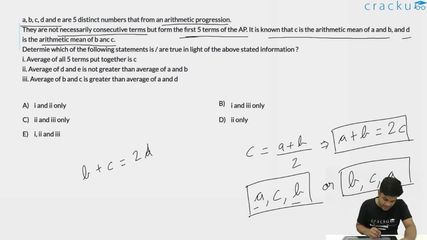
a, b, c, d and e are 5 distinct numbers that from an arithmetic progression.
They are not necessarily consecutive terms but form the first 5 terms of the AP. It is known that c is the arithmetic mean of a and b, and d is the arithmetic mean of b anc c.
Determie which of the following statements is / are true in light of the above stated information ?
i. Average of all 5 terms put together is c
ii. Average of d and e is not greater than average of a and b
iii. Average of b and c is greater than average of a and d
Solution
a, b, c, d and e are distinct.
Given that c is the arithmetic mean of a and b, there can be 2 cases.
Case 1 : The sequence is a,c,b
Case 2: The sequence is b,c,a
Given that d is the arithmetic mean of b anc c, there can be 2 cases.
Case 1 : The sequence is b,d,c
Case 2: The sequence is c,d,b
Only 2 final cases are possible here.
Sequence 1 : a,e,c,d,b
Sequence 2 : b,d,c,e,a
Statement (i) is true as in both sequence 1 and sequence 2, the average of all terms is c.
Statement (ii) is true as in both sequence 1 and sequence 2, the average of d and e is c and average of a and b is c. c is not greater than c.
Statement (iii) is false as average of b and c, which is d is not greater than average of a and d in both sequences simultaneously.
Option A is the answer.
Get AI Help
Video Solution
Click on the Email ☝️ to Watch the Video Solution
Create a FREE account and get:
- Download Maths Shortcuts PDF
- Get 300+ previous papers with solutions PDF
- 500+ Online Tests for Free

Book Free CAT Mentorship
Get personalized CAT strategy from a 99%iler
500+ students mentored
OTP Verification
Enter the 6-digit code sent to your phone
Booking Summary
Enter OTP
Didn't receive the OTP?


