 91- 6303239042
DIRECTIONS for the question: In the following letter series, some of the letters are missing which are given in that order as one of the alternatives below it. Choose the correct alternative.
cccb _ aa _ cc _ bbbaa _ c
Sign in
Please select an account to continue using cracku.in
↓ →
DIRECTIONS for the question: In the following letter series, some of the letters are missing which are given in that order as one of the alternatives below it. Choose the correct alternative.
cccb _ aa _ cc _ bbbaa _ c
DIRECTION for the question: Solve the following question and mark the best possible option.
How many such pairs of letters are there in the word 'PREAMBLE', each of which has as many letters between them as in the English alphabet?
DIRECTION for the question: Find the missing character (?).
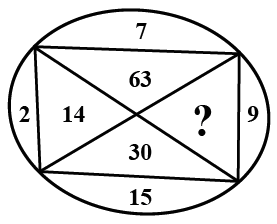
DIRECTION for the question: Solve the following question and mark the best possible option.
If the $$1^{st}$$ half of the English alphabet is reversed and so is the $$2^{nd}$$ half, then which letter is $$7^{th}$$ to the right of the $$12^{th}$$letter from the left side?
DIRECTIONS for the question: The following question consists of six statements (A, B, C, D, E and F) followed by options consisting of three statements put together in a specific order.
Choose the option which indicates a valid argument containing logically related statements that is, where the third statement is a conclusion drawn from the preceding two statements.
A. All balls are locks
B. All keys are locks
C. All keys are balls
D. Some keys are locks
E. Some locks are, balls
F. No ball is lock
DIRECTION for the question: Solve the following question and mark the best possible option.
How many such 5's are there in the following number sequence, each of which is preceded by 3 or 4 but not followed by 8 or 9?
3 5 9 5 4 5 5 3 5 8 4 5 6 7 3 5 7 5 5 4 5 2 3 5 1 0
DIRECTIONS for the question : In the following question three words are given below, which have something in common among themselves. Choose one out of the four given alternatives, which mentions the quality common to the three given words.
Harmattan : Chinook : Foehn
Harmattan: A very dry, dusty easterly or northeasterly wind on the West African coast, occurring from December to February. It is often called "The Doctor" because it brings relief from high humidity.
Chinook: A warm, dry wind that blows down the eastern slopes of the Rocky Mountains in North America. It is known as the "Snow Eater" because it can melt large amounts of snow very quickly.
Foehn: A warm, dry, southerly wind off the northern slopes of the Alps in Europe. It is a rain-shadow wind that results from the subsequent adiabatic warming of air that has dropped most of its moisture on windward slopes.
Since all three are specific meteorological phenomena involving air movement, the common quality is that they are Winds (Option A).
DIRECTIONS for the question: Solve the following question and mark the best possible option.
If 'room' is called 'bed','bed' is called 'window', 'window' is called 'flower', 'flower' is called 'cooler', on what would a man sleep?
DIRECTION for the question: Solve the following question and mark the best possible option.
Maya starts at point T, walks straight to point U which is 4 ft away. She turns left at $$90^{\circ}$$ and walks to W which fs 4 ft away, turns $$90^{\circ}$$ right and goes 3 ft to P, turns $$90^{\circ}$$ and walks 1 ft to Q, turns left at $$90^{\circ}$$ and goes to V, which is 1 ft away and once again turns $$90^{\circ}$$ right and goes to R, 3 ft away. What is the distance between T and R?
DIRECTION for the question: Solve the following question and mark the best possible option.
After distributing the sweets equally among 25 children, 8 sweets remain. Had the number of children been 28, 22 sweets would have been left after equal distribution. What was the total number of sweets?
Let us assume that the total number of sweets = N.
N = 25a + 8 where "a" sweets are given to each one of the 25 children and,
N = 28b + 22 where "b" sweets are given to each one of the 28 children.
Equating them, we get: 25a - 28b = 14 ==> 25a = 14 (2b + 1)
Possible values for (a,b) are (14, 12), (42, 37),... and so on.
Possible values of N = 358, 1058,.. and so on.
Thus, out of the given options, the correct answer is Option A.
DIRECTIONS for the question: In the following question, an alphabet series is given with term/s missing. Choose the correct alternative to replace the question mark in the given series.
Z, Y, X, U, T, S, P, O, N, K, ?, ?
The constant patter is that we write 3 consecutive letters in reverse alphabetical order, then skip next 2 letters, then write next 3 letters and so on.
ZYX UTS PON KJI
The next letters in the pattern are J and I i.e. Option D.
DIRECTIONS for the question: In the following question, five numbers are given. Out of these, four are alike in a certain way but one of them is different. Choose the one which is different from the rest four.
(1) 385
(2) 572
(3) 671
(4) 264
(5) 427
The odd one out is 427.
All the other numbers are multiples of 11.
Thus, the correct Option is E.

DIRECTIONS for the question: In the following question, five numbers are given. Out of these, four are alike in a certain way but one of them is different. Choose the one which is different from the rest four.
(1) 51
(2) 144
(3) 64
(4) 121
(5) 256
All of 144, 64, 121 and 256 are perfect squares.
thus, the odd one out is 51.
DIRECTIONS for the question: Solve the following question and mark the best possible option.
In a cricket match ,five batsmen A, B, C, D and E. scored an average of 36 runs. D scored 5 more than E; E scored 8 fewer than A; B scored as many as D and E combined; and B and C scored 107 between them. How many runs did E score?
Let us assume that B scored B runs.
Runs of B and C = 107, so C scored 107 - B runs.
B = D + E where D = E + 5. So, B = 2E + 5 and E = (B-5)/2.
D = (B+5)/2.
E = A-8, so A = E + 8 ==> (B+11)/2.
sum of runs of A, B, C, D and E = $$\frac{B+11}{2}+B+\left(107-B\right)+\frac{B+5}{2}+\frac{B-5}{2}=\frac{3B}{2}+112.5$$.
As their average is 36, the sum of their runs is also 5*36 = 180.
So, $$180=\frac{3B}{2}+112.5$$ ==> B = 45.
Runs scored by E = (B-5)2 = 20.
DIRECTIONS for the question: Solve the following question and mark the best possible option.
If the numbers from 5 to 85 which are exactly divisible by 5 are arranged in descending order, which would come at the eleventh place from the bottom?
The arrangement of numbers will look like: 85, 80, 75, .... 5
==> 5*17, 5*16, 5*15,...,5*1.
1st term from the bottom is 1st multiple, 2nd term is 2nd multiple, so nth term will be n th multiple.
So, 11th number will be the 11th multiple i.e. 55.
DIRECTIONS for the question: In the following letter series, some of the letters are which are given in that order as one of the alternatives below it. Choose the correct alternative
m _ nm _ n _ an _ a _ ma _
m_nm_n_an_a_ma_
We will break the series into parts of 3.
m_n / m_n / _an / _a_ / ma_
We can clearly see the pattern that each part is of the form "man".
Thus, the blanks will be filled with "a a m m n n" i.e. Option A.
DIRECTIONS for the question: Choose the correct option
Claymore is related to Sword in the same way as Beretta is related to ...........?...........
A Claymore is a specific type of Sword, just as a Beretta is a specific brand/type of Gun.
DIRECTIONS for the question: Solve the following question and mark the best possible possible option.
Anil, introducing a girl in a party, said she is the wife of the grandson of my mother. How is Anil related to the girl?
The grandson of Anil's mother is Anil's own son.
As the girl is his son's wife, he would be the Father - in - law to her i.e. Option D.
DIRECTIONS for the question: Solve the following question and mark the best possible possible option.
In a certain code,'467' means 'leaves are green', '485' means 'green is good' and '639' means 'they are playing'. Which digit stands for 'leaves' in that code?
DIRECTIONS for the question: Solve the following question and mark the best possible possible option.
If POND is coded as RSTL, how is HEAR written in that code?
DIRECTIONS for the question: Solve the following question and mark the best possible possible option.
Pointing to a photograph, a man said, 'I have to brother or sister but that man's father is my father's son. Whose, photograph was it?
Let us assume that the man in the photo is X.
Now, X's father is his father's son i.e. X's father is either him or his brother.
But, we are explicitly given that he has no brother or sister which means that X is hos own son.
Thus, the correct answer is Option B.
DIRECTIONS for the question: The following question consists of six statements (A, B, C, D, E and F) followed by options consisting of three statements put together in a specific order.
Choose the option which indicates a valid argument containing logically related statements that is, where the third statement is a conclusion drawn from the preceding two statements.
A. Some abra are dabra
B. All abra are cabra
C. All dabra are abra
D. All dabra are not abra
E. Some cabra are abra
F. Some cabra are dabra
BCE (Option A): Since all abra are cabra (B) and all dabra are abra (C), then by nesting the sets, it is logically certain that some cabra are abra (E).
AEF (Option B): Knowing some abra are dabra (A) and all abra are cabra (B) proves some cabra are dabra, but some cabra are dabra (F) is redundant as a conclusion for this specific sequence's internal logic.
ABD (Option C): Some abra are dabra (A) and all abra are cabra (B) actually contradicts the conclusion that all dabra are not abra (D).
BCF (Option D): If all abra are cabra (B) and all dabra are abra (C), it proves all dabra are cabra, but it doesn't inherently link them to the specific subset "some" in a way that makes some cabra are dabra (F) the primary logical conclusion.
FEB (Option E): Knowing some cabra are dabra (F) and some cabra are abra (E) does not provide enough information to conclude that all abra are cabra (B).
Thus, the answer is Option A.
DIRECTIONS for the question: Solve the following question and mark the best possible option.
If 'rose' is called 'poppy', 'poppy' is called 'lily', 'lily' is called ' lotus', and 'lotus' is called 'gladiola', which is the king of flowers?
DIRECTION for the question: Choose the correct option.
If 'bucket' is known as 'tub', 'tub' is known as 'glass', 'glass' is known as 'saucer', 'saucer' is known as 'spoon', then which utensil will be used for drinking water?

DIRECTION for the question: Solve the following question and mark the best possible option.
Two ladies and two men are playing cards and are seated at North, East, South and West of a table. No lady is facing East. Persons sitting opposite to each other are not of the same gender. One man is facing South. Which directions are the ladies facing?
We will assume the persons to be M1 M2 L1 L2 where M1 M2 are men and L1 L2 are ladies.
If M1 is facing South then a lady must be facing North as Persons sitting opposite to each other are not of the same gender.
There are only 2 directions left and no lady is facing East which implies that the other lady is facing West.
So, L1 L2 are facing North and West.
DIRECTIONS for the question: In the following question, four out of the five alternatives are same in certain way and so form a group. Find the odd one that does not belong to the group.
The odd one out is Sky.
The logic is based on the distinction between celestial bodies and the space they occupy:
Planet, Star, Comet, and Moon are all distinct celestial objects or physical bodies found in space.
Sky is the region or the expanse above the Earth in which these celestial bodies appear to be located.
In simpler terms, the first four are "things" in the universe, while the sky is the "view" or atmosphere where we see them.
DIRECTION for the question: Choose the correction option.
In a certain code,'975' means 'throw away garbage', '528' means 'give away smoking', and '213' means 'smoking is harmful', Which digit in that code means 'smoking' ?

DIRECTION for the question: Solve the following question and mark the best possible option.
Raj travelled from a point X straight to Y at a distance of 80 meters. He turned right and walked 50 meters, then again turned right and walked 70 meters. Finally, he turned right and walked 50 meters. How far is he from the starting point?
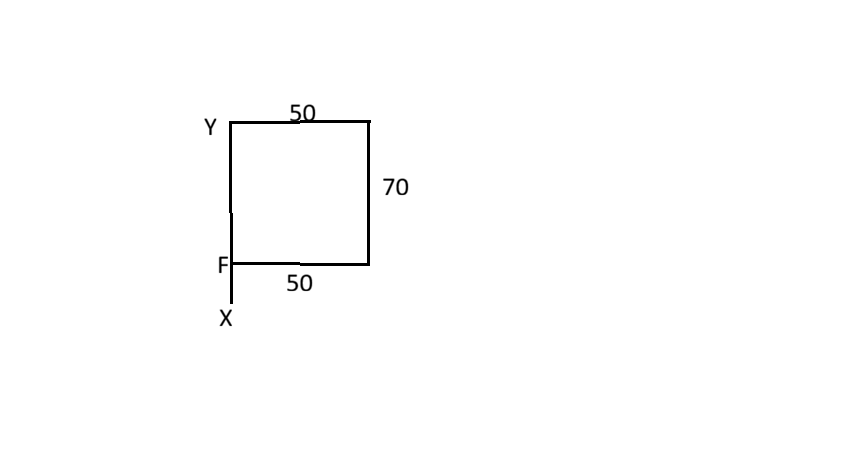
The person started walking from X and finished walking at F. As XY is 80 metres and FY is 70 metres, the distance between X and F is 10 metres i.e. Option C.
DIRECTION for the question: In the following question , there is a particular relationship given, similar relationship has to be identified from the alternatives provided.
583 : 293 : 488 : ?
DIRECTION for the question: Solve the following question and mark the best possible option.
If today is Thursday, then what will be the day on $$363^{rd}$$ day?
We will calculate the odd number of days i.e. remainder when 363 is divided by 7.
The odd number of days will be 6.
So, the day on 363rd day will be Thursday + 6 = Wednesday.
DIRECTION for the question: Solve the following question and mark the best possible option.
Introducing to Rajesh, Neha said , "His brother's father is the only son of my grand father". How Neha is related to Rajesh?
Rajesh's brother's father is also his father.
As Rajesh's father is the "only" son of Neha's grandfather, it means that Rajesh's father is also Neha's father and thus, Neha is the sister of Rajesh.
The correct answer is Option C.
DIRECTION for the question: Solve the following question and mark the correct answer.
A clock gains 15 minutes per day. It is set right at 12 noon. What time, will it show at 4:00 am, the next day?
A clock gains 15 mins in 24 hrs.
From 12 noon to 4 am, 16 hrs have passed and the clock will gain: $$\frac{16}{24}\times\ 15=10\ $$mins.
Thus, the clock will show 4:10 am.
DIRECTION for the question: Choose the correct option.
THEREFORE is to TEROERFRH as HELICOPTER is to .........?...........
DIRECTION for the question: In the following question, a series is given with term/s missing. Choose the correct alternative to replace the question mark in the given series.
90, 180, 12, 50, 100, 200, ?, 3, 50, 25, 2, 6, 30, 3
DIRECTION for the question: Solve the following question and mark the best possible option.
Count each 1 in the following sequence of numbers that is immediately followed by 2, if 2 is not immediately followed by 3.
How many such 1s are there ?
1 2 1 3 4 5 1 2 3 5 2 1 2 6 1 4 5 1 1 2 4 1 2 3 2 1 7 5 2 1 2 5
Essentially, we need to find 12x such that x is not equal to 3.
There are 4 instances when this happens and thus the correct answer is Option B.
DIRECTION for the question: In the following question, five words have been given out of which four are alike in some manner, while the, fifth one is different. Choose out the odd one.
The odd one out is Vapour.
The logic is based on the state of matter and the process of condensation/precipitation:
Hailstone, Fog, Sleet, and Mist are all forms of water that have already condensed or frozen into liquid or solid states. They are visible manifestations of moisture in the atmosphere.
Vapour (specifically water vapour) is the gaseous state of water and is generally invisible to the naked eye.
Essentially, the other four are products formed from vapour.
DIRECTION for the question: In the following question , find out which of the letter-series follows the given rule.
Number of letters skipped in between the adjacent letters in the series is equal.
In RVZDHL, between any 2 consecutive letters, number of letters skipped are 3 and this is constant for any pair.
Thus, the correct answer is Option B.
DIRECTION for the question: Solve the following question and mark the best possible option.
Five boys are standing in a row facing East. Deepak is to the left of Sameer, Tushar and Shailendra. Sameer, Tushar and Shailendra are to the left of Sushil. Shailendra is between Sameer and Tushar. If Tushar is fourth from the left, how far is Sameer from the right?
Deepak is to the left of Sameer, Tushar and Shailendra. Sameer, Tushar and Shailendra are to the left of Sushil.
These statements imply that Deepak is 1st from left and Sushil is 5th from left.
Shailendra is between Sameer and Tushar. This implies that he is 3rd from left.
The 2 possible arrangements are: Deepak Sameer Shailendra Tushar Sushil OR Deepak Tushar Shailendra Sameer Sushil.
If Tushar is fourth from the left, Sameer is also 4th from the right i.e. Option D.
DIRECTION for the question: In tile following question, find out which of the letter-series follows the given rule
Number of letters skipped in between the adjacement letters in the series is equal.
In RVZDHL, between any 2 consecutive letters, the number of letters skipped is 3 and this is constant for any pair.
Thus, the correct answer is Option A.
DIRECTION for the question: Solve the following question and mark the best possible option.
If the first day of the year (other than the leap year) was Friday, then which was the last day of that year?
Last day of a non leap year = first day + 364 .
Now, we calculate the odd days which is the remainder when 364 is divided by 7 = 0.
So, the day on last day of the year = Friday + 0 = Friday.
DIRECTION for the question: Solve the following question and mark the best possible option.
If $$18^{th}$$ February, 1997 falls on Tuesday, then what will be the day on $$18^{th}$$ February, 1999?
We will count the number of odd days.
Odd days per year = 1 and odd days per leap year = 2.
As both 1997 and 1998 are not leap years, the number of odd days = 1 + 1 = 2.
Thus, the day on 18th Feb 1999 will be Tuesday + 2 = Thursday i.e. Option A.
DIRECTIONS for the question: Solve the following question and mark the best possible option.
If in a certain language, INTIETAM is the code for INTIMATE, which wprd has the coded TREVNIETARBI?
DIRECTIONS for the question: In following question, a set of figures carrying certain characters is given. Assuming that the characters in each set follow a similar pattern, find the missing character (?).
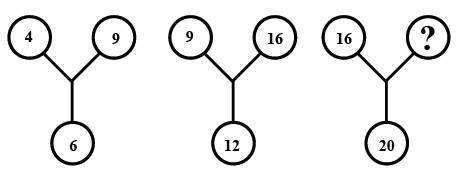
$$4\times\ 9\ =\ 6^2$$.
$$9\times\ 16\ =\ 12^2$$.
Following the same pattern, $$16\times\ ?=20^2$$.
This gives the value of ? = 25.
DIRECTIONS for the question: The following question consists of six statements (A, B, C, D, E and F) followed by options consisting of three statements put together in a specific order.
Choose the option which indicates a valid argument containing logically related statements that is, where the third statement is a conclusion drawn from the preceding two statements.
A. An ostrich lays eggs.
B. All birds lay eggs.
C. Some birds can fly.
D. An ostrich can not fly.
E. An ostrich is a bird.
F. An ostrich can not swim
DEC (Option A): Knowing an ostrich cannot fly (D) and is a bird (E) doesn't prove that some birds can fly (C); it only proves that some birds cannot fly.
BEA (Option B): If all birds lay eggs (B) and an ostrich is a bird (E), it logically follows that an ostrich lays eggs (A).
ABE (Option C): Knowing an ostrich lays eggs (A) and all birds lay eggs (B) does not prove an ostrich is a bird (E), as other non-bird animals (like reptiles) also lay eggs.
ECB (Option D): Knowing an ostrich is a bird (E) and some birds can fly (C) provides no logical basis to conclude that all birds lay eggs (B).
DEF (Option E): Knowing an ostrich cannot fly (D) and is a bird (E) has no logical connection to whether or not an ostrich can swim (F).
Thus, the answer is Option B.
DIRECTIONS for the question: Solve the following question and mark the best possible option.
At a dinner party every two guests used a bowl of rice between them, every three guests used a bowl of dal between them and every four used a bowl of meat between them. Them were altogether 65 dishes. How many guests were present at the party?
Let us assume that there were 12x guests.
Number of bowls of rice used = 12x/2 = 6x.
Number of bowls of Dal used = 12x/3 = 4x.
Number of bowls of meat used = 12x/4 = 3x.
Total number of bowls used = 13x which is equal to 65. This gives value of x = 5 and number of guests i.e. 12 to be 60.
DIRECTIONS for the question: Choose the correct answer
Palaeography is related to Writings in the same way as Ichthyology is related to ..........?..........
Palaeography is the study of ancient Writings, just as Ichthyology is the branch of zoology devoted to the study of Fishes.
DIRECTIONS for the question: Solve the following question and mark the best possible option.
Mrs. Susheela celebrated her wedding anniversary on Tuesday, $$30^{th}$$ September, 1997. When will she celebrate her next wedding anniversary on the same day?
To celebrate her wedding on the exact same day, the year of next celebration should have either 0 or 7 or 14...odd days.
It means that if there are N days to the next day of celebration, then remainder when N is divided by 7 should be 0.
We know that every non leap year has +1 odd days and every leap year has +2 odd days.
30th Sept. 1998 --> +1
30th Sept. 1999 --> +1
30th Sept. 2000 --> +2
30th Sept. 2001 --> +1
30th Sept. 2002 --> +1
30th Sept. 2003 --> +1
Sum of all these odd days = 7 which means that day on 30th Sept. 2003 will be Tuesday + 7 = Tuesday.
DIRECTIONS for the question: Solve the following question and mark the best possible option.
Radha moves towards South-east a distance of 7 km , then she moves towards West and travels a distance of 14 m. From here, she moves towards North-west a distance of 7 m and finally she moves a distance of 4 m towards East and stood at that point.
How far is the starting point from where she stood?
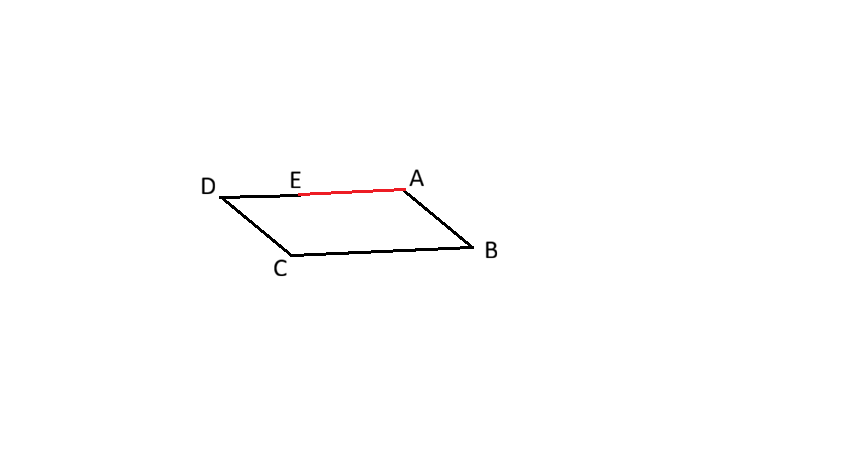
The person first travelled from A to B for 7 kms then travelled to C for 14kms and then to D for 7kms again.
The quadrilateral ABCD formed from this movement is a parallelogram and thus BC should be equal to AD i.e. 14 kms.
Now, he travelled from D to E(towards East) for 4kms. This means that the distance between starting point i.e. A and E is 14- 4 = 10 kms.
DIRECTIONS for the question: Solve the following question and mark the best possible option.
Robin says,"If Jai gives me Rs. 40, he will have half as much, as Atul, but if Atul gives me Rs. 40, then the three of us will have the same amount". What is the total amount of money that Robin, Jai and Atul have between them?
Let us assume the amounts with the them to be R, J and A.
If Atul gives 40 to Robin, A - 40 = R + 40 = J.
A = J+40, R = J-40.
If Jai gives 40 to Robin, J - 40 = half of J + 40. This gives J = 120.
So, A = 160 and R = 80.
Total amount with them = 120 + 160 + 80 = 360.
DIRECTION for the question: In the following question, find out which of the letter-series follows the given rule.
Number of letters skipped in reverse order in between adjacent letters in the series is constant.
If we consider the letters from right to left, in SPMJG, between any 2 consecutive letters, the number of letters skipped is 2 and it is constant for any pair.
Thus, the correct answer is Option A.
DIRECTIONS for the question: In the following letter series, some of the letters are missing which are given in that order as one of the alternatives below it. Choose the correct alternative.
aab _ ab _ cabcca _ bcab _ c
aab_ab_cabcca_bcab_c
The series can be divided into a group of 4:
aab_ / ab_c / abcc / a_bc / ab_c
In every group, abc letters are used but a single letter is repeated.
In the first group, the repeated letter is "a", in the 2nd, it is "b", in the 3rd group, it is "c" and so on...
Thus, completed series will look like:
aabc / abbc / abcc / aabc / abbc
and the gaps are filled by: cbab.
DIRECTIONS for the question: In the following question, five words have been given out of which four are alike in some manner, while the fifth one is different. Choose out the odd one.
1) Metre
b) Furlong
c) Yard
d) Mile
e) Acre
The odd one out is Acre.
Metre, Furlong, Yard, and Mile are all units used to measure linear distance (length).
Acre is a unit used to measure area (the surface of a plot of land).
DIRECTIONS for the question: Find the missing character (?).
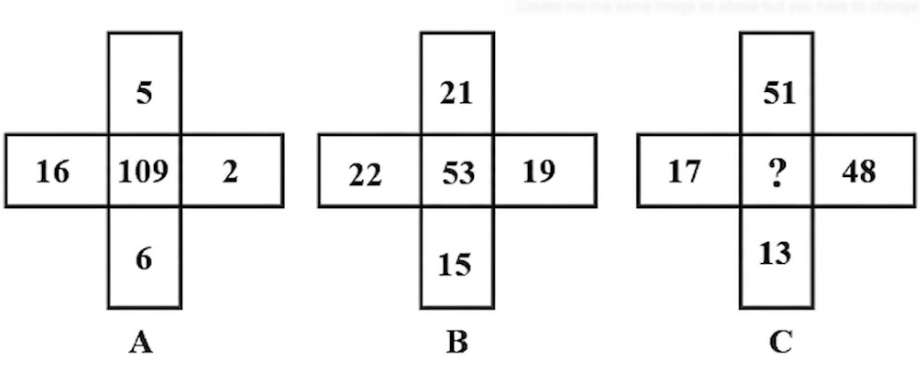
Figure A: $$\left(5-2\right)^2+\left(16-6\right)^2=109$$
Figure B: $$\left(21-19\right)^2+\left(22-15\right)^2=53$$
Figure A: $$\left(51-48\right)^2+\left(17-13\right)^2=25$$
DIRECTION for the question: Solve the following question and mark the best possible option.
Which two months in a year have the same calendar?
A, B, C, D, E, F and G are standing in a straight line facing North with equal distances between them, not necessarily in the same order. Each one is pursuing, a different profession - actor, reporter, doctor, engineer, lawyer, teacher and painter not necessarily in the same order. G is fifth to the left of C. The reporter is third to the right of G. F is fifth to the right of A. E is second to the left of B. The engineer is second to the left of D. There are only three people between the engineer and the painter. The doctor is to the immediate left of the engineer. The lawyer is to the immediate right of the teacher.
Four of the following five are alike in a certain way based on the given standing arrangement and so form a group. Which of the following does not belong to the group?
We are given that G is 5th to the left of C. There are only 2 cases possible:
Case 1: _ G _ _ _ _ C. F is fifth to the right of A. This gives only 1 possibility:
A G _ _ _ F C.
E is 2nd to the left of B. This also gives only 1 possibility:
A G E _ B F C and the remaining place is taken by D:
A G E D B F C. Reporter is 3rd to the right of G and engineer is 2nd to the left of D and doctor is to the immediate left of engineer.
A(doctor) G(engineer) E D B(reporter) F C.
There are only 3 people between engineer and painter and the Lawyer is to the immediate right of the Teacher which is only possible when E is Teacher and D is the Lawyer.
The final arrangement will look like:
A(doctor) G(engineer) E(Teacher) D(Lawyer) B(reporter) F(painter) C(actor).
Case 2: G _ _ _ _ C_. F is fifth to the right of A. This gives only 1 possibility:
G A _ _ _ C F.
E is 2nd to the left of B. This also gives only 1 possibility:
G A E _ B C F and the remaining place is taken by D:
G A E D B C F. Reporter is 3rd to the right of G and engineer is 2nd to the left of D and doctor is to the immediate left of engineer.
G(doctor) A(engineer) E D(reporter) B F C.
There are only 3 people between engineer and painter which means that F will be the painter and the Lawyer is to the immediate right of the Teacher which is not possible in this arrangement.
Thus, Case 2 is invalidated and the only final arrangement is :
A(doctor) - G(engineer) - E(Teacher) - D(Lawyer) - B(reporter) - F(painter) - C(actor).
Only BFC is the correct sequence according to the arrangement and that's why it is the odd one out.
Which of the following statement is true according to the given arrangement?
We are given that G is 5th to the left of C. There are only 2 cases possible:
Case 1: _ G _ _ _ _ C. F is fifth to the right of A. This gives only 1 possibility:
A G _ _ _ F C.
E is 2nd to the left of B. This also gives only 1 possibility:
A G E _ B F C and the remaining place is taken by D:
A G E D B F C. Reporter is 3rd to the right of G and engineer is 2nd to the left of D and doctor is to the immediate left of engineer.
A(doctor) G(engineer) E D B(reporter) F C.
There are only 3 people between engineer and painter and the Lawyer is to the immediate right of the Teacher which is only possible when E is Teacher and D is the Lawyer.
The final arrangement will look like:
A(doctor) G(engineer) E(Teacher) D(Lawyer) B(reporter) F(painter) C(actor).
Case 2: G _ _ _ _ C_. F is fifth to the right of A. This gives only 1 possibility:
G A _ _ _ C F.
E is 2nd to the left of B. This also gives only 1 possibility:
G A E _ B C F and the remaining place is taken by D:
G A E D B C F. Reporter is 3rd to the right of G and engineer is 2nd to the left of D and doctor is to the immediate left of engineer.
G(doctor) A(engineer) E D(reporter) B F C.
There are only 3 people between engineer and painter which means that F will be the painter and the Lawyer is to the immediate right of the Teacher which is not possible in this arrangement.
Thus, Case 2 is invalidated and the only final arrangement is :
A(doctor) - G(engineer) - E(Teacher) - D(Lawyer) - B(reporter) - F(painter) - C(actor).
According to the arrangement, only Option D is correct i.e. Lawyer is standing in the exact middle.
What is D's position with respect to the painter?
We are given that G is 5th to the left of C. There are only 2 cases possible:
Case 1: _ G _ _ _ _ C. F is fifth to the right of A. This gives only 1 possibility:
A G _ _ _ F C.
E is 2nd to the left of B. This also gives only 1 possibility:
A G E _ B F C and the remaining place is taken by D:
A G E D B F C. Reporter is 3rd to the right of G and engineer is 2nd to the left of D and doctor is to the immediate left of engineer.
A(doctor) G(engineer) E D B(reporter) F C.
There are only 3 people between engineer and painter and the Lawyer is to the immediate right of the Teacher which is only possible when E is Teacher and D is the Lawyer.
The final arrangement will look like:
A(doctor) G(engineer) E(Teacher) D(Lawyer) B(reporter) F(painter) C(actor).
Case 2: G _ _ _ _ C_. F is fifth to the right of A. This gives only 1 possibility:
G A _ _ _ C F.
E is 2nd to the left of B. This also gives only 1 possibility:
G A E _ B C F and the remaining place is taken by D:
G A E D B C F. Reporter is 3rd to the right of G and engineer is 2nd to the left of D and doctor is to the immediate left of engineer.
G(doctor) A(engineer) E D(reporter) B F C.
There are only 3 people between engineer and painter which means that F will be the painter and the Lawyer is to the immediate right of the Teacher which is not possible in this arrangement.
Thus, Case 2 is invalidated and the only final arrangement is :
A(doctor) - G(engineer) - E(Teacher) - D(Lawyer) - B(reporter) - F(painter) - C(actor).
D's position with respect to the painter is 2nd to the left i.e. Option E.
What is A's profession?
We are given that G is 5th to the left of C. There are only 2 cases possible:
Case 1: _ G _ _ _ _ C. F is fifth to the right of A. This gives only 1 possibility:
A G _ _ _ F C.
E is 2nd to the left of B. This also gives only 1 possibility:
A G E _ B F C and the remaining place is taken by D:
A G E D B F C. Reporter is 3rd to the right of G and engineer is 2nd to the left of D and doctor is to the immediate left of engineer.
A(doctor) G(engineer) E D B(reporter) F C.
There are only 3 people between engineer and painter and the Lawyer is to the immediate right of the Teacher which is only possible when E is Teacher and D is the Lawyer.
The final arrangement will look like:
A(doctor) G(engineer) E(Teacher) D(Lawyer) B(reporter) F(painter) C(actor).
Case 2: G _ _ _ _ C_. F is fifth to the right of A. This gives only 1 possibility:
G A _ _ _ C F.
E is 2nd to the left of B. This also gives only 1 possibility:
G A E _ B C F and the remaining place is taken by D:
G A E D B C F. Reporter is 3rd to the right of G and engineer is 2nd to the left of D and doctor is to the immediate left of engineer.
G(doctor) A(engineer) E D(reporter) B F C.
There are only 3 people between engineer and painter which means that F will be the painter and the Lawyer is to the immediate right of the Teacher which is not possible in this arrangement.
Thus, Case 2 is invalidated and the only final arrangement is :
A(doctor) - G(engineer) - E(Teacher) - D(Lawyer) - B(reporter) - F(painter) - C(actor).
A's profession --> Doctor i.e. Option B.
Who among the following is an actor?
We are given that G is 5th to the left of C. There are only 2 cases possible:
Case 1: _ G _ _ _ _ C. F is fifth to the right of A. This gives only 1 possibility:
A G _ _ _ F C.
E is 2nd to the left of B. This also gives only 1 possibility:
A G E _ B F C and the remaining place is taken by D:
A G E D B F C. Reporter is 3rd to the right of G and engineer is 2nd to the left of D and doctor is to the immediate left of engineer.
A(doctor) G(engineer) E D B(reporter) F C.
There are only 3 people between engineer and painter and the Lawyer is to the immediate right of the Teacher which is only possible when E is Teacher and D is the Lawyer.
The final arrangement will look like:
A(doctor) G(engineer) E(Teacher) D(Lawyer) B(reporter) F(painter) C(actor).
Case 2: G _ _ _ _ C_. F is fifth to the right of A. This gives only 1 possibility:
G A _ _ _ C F.
E is 2nd to the left of B. This also gives only 1 possibility:
G A E _ B C F and the remaining place is taken by D:
G A E D B C F. Reporter is 3rd to the right of G and engineer is 2nd to the left of D and doctor is to the immediate left of engineer.
G(doctor) A(engineer) E D(reporter) B F C.
There are only 3 people between engineer and painter which means that F will be the painter and the Lawyer is to the immediate right of the Teacher which is not possible in this arrangement.
Thus, Case 2 is invalidated and the only final arrangement is :
A(doctor) - G(engineer) - E(Teacher) - D(Lawyer) - B(reporter) - F(painter) - C(actor).
C is the actor i.e. Option A.
P, Q, R, S, T, V and W are seven friends. Each of them likes a particular fruit, viz. Apple, Banana, Pear, Guava, Orange, Mango and Watermelon and each of them has a favourite city, viz. Mumbai, Pune, Delhi, Kolkata, Chennai, Hyderabad and Cochin.
The choices of fruit and favourite city of the seven friends are not necessarily in the same order. Q likes Mango and his favourite city is Chennai. The one whose favourite city is Pune likes Watermelon. T's Favourite city is Kolkata. R likes Guava and his favourite city is not Mumbai. W's favourite city is Cochin and he does not like either Banana or Pear. The favourite city of the one who likes Orange is Hyderabad. T does not like Pear. P's favourite city is neither Pune nor Hyderabad. S does not like watermelon.
Which fruit does P like?
From the given information, we an construct the table:
Q - Mango - Chennai
_ - Watermelon - Pune
T - _ - Kolkata
R - Guava - _
W - _ - Cochin
_ - Orange - Hyderabad
_ - _ - _
We have 2 cities left to fill in the table i.e. Mumbai and Delhi but we are given that R does not like Mumbai, which means that R liked Delhi.
Also, P's favorite city is neither Pune nor Hyderabad, which leaves only 1 case i.e. P - _ - Mumbai.
Q - Mango - Chennai
_ - Watermelon - Pune
T - _ - Kolkata
R - Guava - Delhi
W - _ - Cochin
_ - Orange - Hyderabad
P - _ - Mumbai
Now, S does not like watermelon, which means that the only space for S is 5th row i.e. S - Orange - Hyderabad, and the remaining place will be filled by V.
Q - Mango - Chennai
V - Watermelon - Pune
T - _ - Kolkata
R - Guava - Delhi
W - _ - Cochin
S - Orange - Hyderabad
P - _ - Mumbai
The remaining fruits are Apple, Banana and Pear and we are given that W does not like either of Banana or Pear which implies that W likes Apple.
We are also given that T does not like Pear which leaves only 1 case T - Banana and P - Pear.
The final arrangement will look like:
Q - Mango - Chennai
V - Watermelon - Pune
T - Banana - Kolkata
R - Guava - Delhi
W - Apple - Cochin
S - Orange - Hyderabad
P - Pear - Mumbai
From the given arrangement, P likes Pear.
Who likes Apple?
From the given information, we an construct the table:
Q - Mango - Chennai
_ - Watermelon - Pune
T - _ - Kolkata
R - Guava - _
W - _ - Cochin
_ - Orange - Hyderabad
_ - _ - _
We have 2 cities left to fill in the table i.e. Mumbai and Delhi but we are given that R does not like Mumbai, which means that R liked Delhi.
Also, P's favorite city is neither Pune nor Hyderabad, which leaves only 1 case i.e. P - _ - Mumbai.
Q - Mango - Chennai
_ - Watermelon - Pune
T - _ - Kolkata
R - Guava - Delhi
W - _ - Cochin
_ - Orange - Hyderabad
P - _ - Mumbai
Now, S does not like watermelon, which means that the only space for S is 5th row i.e. S - Orange - Hyderabad, and the remaining place will be filled by V.
Q - Mango - Chennai
V - Watermelon - Pune
T - _ - Kolkata
R - Guava - Delhi
W - _ - Cochin
S - Orange - Hyderabad
P - _ - Mumbai
The remaining fruits are Apple, Banana and Pear and we are given that W does not like either of Banana or Pear which implies that W likes Apple.
We are also given that T does not like Pear which leaves only 1 case T - Banana and P - Pear.
The final arrangement will look like:
Q - Mango - Chennai
V - Watermelon - Pune
T - Banana - Kolkata
R - Guava - Delhi
W - Apple - Cochin
S - Orange - Hyderabad
P - Pear - Mumbai
From the given arrangement, the person who likes Apple is W.
Which is R's favourite city?
From the given information, we an construct the table:
Q - Mango - Chennai
_ - Watermelon - Pune
T - _ - Kolkata
R - Guava - _
W - _ - Cochin
_ - Orange - Hyderabad
_ - _ - _
We have 2 cities left to fill in the table i.e. Mumbai and Delhi but we are given that R does not like Mumbai, which means that R liked Delhi.
Also, P's favorite city is neither Pune nor Hyderabad, which leaves only 1 case i.e. P - _ - Mumbai.
Q - Mango - Chennai
_ - Watermelon - Pune
T - _ - Kolkata
R - Guava - Delhi
W - _ - Cochin
_ - Orange - Hyderabad
P - _ - Mumbai
Now, S does not like watermelon, which means that the only space for S is 5th row i.e. S - Orange - Hyderabad, and the remaining place will be filled by V.
Q - Mango - Chennai
V - Watermelon - Pune
T - _ - Kolkata
R - Guava - Delhi
W - _ - Cochin
S - Orange - Hyderabad
P - _ - Mumbai
The remaining fruits are Apple, Banana and Pear and we are given that W does not like either of Banana or Pear which implies that W likes Apple.
We are also given that T does not like Pear which leaves only 1 case T - Banana and P - Pear.
The final arrangement will look like:
Q - Mango - Chennai
V - Watermelon - Pune
T - Banana - Kolkata
R - Guava - Delhi
W - Apple - Cochin
S - Orange - Hyderabad
P - Pear - Mumbai
From the given arrangement, R's favorite city is Delhi.
Which of the following combinations of Person-Fruit-City is incorrect?
From the given information, we an construct the table:
Q - Mango - Chennai
_ - Watermelon - Pune
T - _ - Kolkata
R - Guava - _
W - _ - Cochin
_ - Orange - Hyderabad
_ - _ - _
We have 2 cities left to fill in the table i.e. Mumbai and Delhi but we are given that R does not like Mumbai, which means that R liked Delhi.
Also, P's favorite city is neither Pune nor Hyderabad, which leaves only 1 case i.e. P - _ - Mumbai.
Q - Mango - Chennai
_ - Watermelon - Pune
T - _ - Kolkata
R - Guava - Delhi
W - _ - Cochin
_ - Orange - Hyderabad
P - _ - Mumbai
Now, S does not like watermelon, which means that the only space for S is 5th row i.e. S - Orange - Hyderabad, and the remaining place will be filled by V.
Q - Mango - Chennai
V - Watermelon - Pune
T - _ - Kolkata
R - Guava - Delhi
W - _ - Cochin
S - Orange - Hyderabad
P - _ - Mumbai
The remaining fruits are Apple, Banana and Pear and we are given that W does not like either of Banana or Pear which implies that W likes Apple.
We are also given that T does not like Pear which leaves only 1 case T - Banana and P - Pear.
The final arrangement will look like:
Q - Mango - Chennai
V - Watermelon - Pune
T - Banana - Kolkata
R - Guava - Delhi
W - Apple - Cochin
S - Orange - Hyderabad
P - Pear - Mumbai
According to the given arrangement, none of the options is correct.
DIRECTIONS for the questions: Study the following information carefully and answer the questions given below it.
Eight people - E, F, G, H, J, K, L and M are sitting around a circular table facing the centre. Each of them is of different profession - Chartered Accountant, Column is , Doctor, Engineer, Financial Analyst, Lawyer, Professor and Scientist, but not necessarily in the same order. F is sitting second to the left of K.
The Scientist is an immediate neighbour of K. There are only three people between the Scientist and E. Only one person sits between the Engineer and E. The Columnist is to the immediate right of the Engineer. M is second to the right of K. H is he Scientist.
G and J are immediate neighbours of each other. Neither G nor J is an Engineer. The Financial Analyst is to the immediate left of F. The lawyer is second to the right of the Columnist. The Professor is an immediate neighbour of the Engineer. G is second to the right of the Chartered Accountant.
Who amongst the following is the Professor?
What is the position of L with respect to the Scientist?
Four of the following five are alike in a certain way based on the given arrangement and hence form a group. Which of the following does not belong to that group?
Who is sitting second to the right of E?
DIRECTIONS for the questions: Study the following information carefully and answer the questions that follow.
Seven people A, B, C, D, E, F and were appointed to a company on seven different days of the same week starting from Monday to Sunday (but not necessarily in the same order). Each person also plays a different game namely - Cricket, Hockey, Football, Squash, Volleyball, Tennis and Kho-kho, but not necessarily in the same order
Only two people were appointed after the one who plays Hockey. E was appointed on one of the days after the one who plays Hockey. Only three people were appointed between E and G. Only one person was appointed between G and the one who plays Volleyball. A was appointed immediately after the one who plays Volleyball. More than three people were appointed after the one who plays Kho-kho. C was appointed Immediately after F, but not on Friday. Only two people were appointed between F and the one who plays Cricket. More than three people were appointed between D and the one who plays Tennis. G does not play Football. F Plays Squash.
Which of the following statements is true as per the given arrangement?
Only two people were appointed after the one who plays Hockey. This implies that the Hockey Player was appointed on Friday.
E was appointed on one of the days after the one who plays Hockey. This implies that E was either appointed on Saturday or Sunday.
Case 1: E was appointed on Saturday. Only three people were appointed between E and G. This implies that G was appointed on Tuesday.
Only one person was appointed between G and the one who plays Volleyball. The person playing Volleyball can only be appointed on Thursday.
A was appointed immediately after the one who plays Volleyball. This implies that A was appointed on Friday.
C was appointed Immediately after F, but not on Friday. The only possibility is when F was appointed on Wednesday and C was appointed on Thursday.
Only two people were appointed between F and the one who plays Cricket. So, the Cricket player must be appointed on Saturday i.e. E.
F plays squash.
More than three people were appointed after the one who plays Kho-kho which means that this player can only be appointed on Monday or Tuesday.
From this information we can construct the table:
Monday - -
Tuesday- - G
Wednesday - Squash - F
Thursday - Volleyball - C
Friday - Hockey - A
Saturday - Cricket - E
Sunday - -
Case 2: E was appointed on Sunday. Only three people were appointed between E and G. This implies that G was appointed on Wednesday.
Only one person was appointed between G and the one who plays Volleyball. The person playing Volleyball can be appointed on either Monday or Friday but Friday is already taken by the Hockey Player. So, The person playing Volleyball was appointed on Monday.
A was appointed immediately after the one who plays Volleyball. This implies that A was appointed on Tuesday.
C was appointed Immediately after F, but not on Friday. The only possibility is when F was appointed on Friday and C was appointed on Saturday. But F plays squash which is not possible as the Hockey player was appointed on Friday. So, this case is not possible.
From among the options, the only TRUE statement is that only 3 people were appointed before C i.e. Option B.
Which of the following combinations will be definitely true as per the given arrangement?
Only two people were appointed after the one who plays Hockey. This implies that the Hockey Player was appointed on Friday.
E was appointed on one of the days after the one who plays Hockey. This implies that E was either appointed on Saturday or Sunday.
Case 1: E was appointed on Saturday. Only three people were appointed between E and G. This implies that G was appointed on Tuesday.
Only one person was appointed between G and the one who plays Volleyball. The person playing Volleyball can only be appointed on Thursday.
A was appointed immediately after the one who plays Volleyball. This implies that A was appointed on Friday.
C was appointed Immediately after F, but not on Friday. The only possibility is when F was appointed on Wednesday and C was appointed on Thursday.
Only two people were appointed between F and the one who plays Cricket. So, the Cricket player must be appointed on Saturday i.e. E.
F plays squash.
More than three people were appointed after the one who plays Kho-kho which means that this player can only be appointed on Monday or Tuesday.
From this information we can construct the table:
Monday - -
Tuesday- - G
Wednesday - Squash - F
Thursday - Volleyball - C
Friday - Hockey - A
Saturday - Cricket - E
Sunday - -
Case 2: E was appointed on Sunday. Only three people were appointed between E and G. This implies that G was appointed on Wednesday.
Only one person was appointed between G and the one who plays Volleyball. The person playing Volleyball can be appointed on either Monday or Friday but Friday is already taken by the Hockey Player. So, The person playing Volleyball was appointed on Monday.
A was appointed immediately after the one who plays Volleyball. This implies that A was appointed on Tuesday.
C was appointed Immediately after F, but not on Friday. The only possibility is when F was appointed on Friday and C was appointed on Saturday. But F plays squash which is not possible as the Hockey player was appointed on Friday. So, this case is not possible.
From among the options, the only TRUE statement is that the Cricket player was appointed on Saturday i.e. Option A.
Who among the following was appointed on Wednesday?
Only two people were appointed after the one who plays Hockey. This implies that the Hockey Player was appointed on Friday.
E was appointed on one of the days after the one who plays Hockey. This implies that E was either appointed on Saturday or Sunday.
Case 1: E was appointed on Saturday. Only three people were appointed between E and G. This implies that G was appointed on Tuesday.
Only one person was appointed between G and the one who plays Volleyball. The person playing Volleyball can only be appointed on Thursday.
A was appointed immediately after the one who plays Volleyball. This implies that A was appointed on Friday.
C was appointed Immediately after F, but not on Friday. The only possibility is when F was appointed on Wednesday and C was appointed on Thursday.
Only two people were appointed between F and the one who plays Cricket. So, the Cricket player must be appointed on Saturday i.e. E.
F plays squash.
More than three people were appointed after the one who plays Kho-kho which means that this player can only be appointed on Monday or Tuesday.
From this information we can construct the table:
Monday - -
Tuesday- - G
Wednesday - Squash - F
Thursday - Volleyball - C
Friday - Hockey - A
Saturday - Cricket - E
Sunday - -
Case 2: E was appointed on Sunday. Only three people were appointed between E and G. This implies that G was appointed on Wednesday.
Only one person was appointed between G and the one who plays Volleyball. The person playing Volleyball can be appointed on either Monday or Friday but Friday is already taken by the Hockey Player. So, The person playing Volleyball was appointed on Monday.
A was appointed immediately after the one who plays Volleyball. This implies that A was appointed on Tuesday.
C was appointed Immediately after F, but not on Friday. The only possibility is when F was appointed on Friday and C was appointed on Saturday. But F plays squash which is not possible as the Hockey player was appointed on Friday. So, this case is not possible.
The person appointed on Wednesday is F i.e. Option E.
The person who plays Tennis was appointed on which of the following days?
DIRECTION for the questions: Study the following information to answer the given question.
Six lectures are scheduled in a week starting from Monday and ending on Sunday of the same week.. Computer Science is not on Tuesday or Saturday. Psychology is immediately after Organizational Behavior. Statistics is not on Friday and there is one day gap between Statistics and Research methods. One day prior to the schedule of Economics there is no lecture (as that day is the 'off' day and Monday is not the 'off' day).
On which day is Computer Science scheduled?
We are given that Monday is not an off day.
So, we will makes cases on the rest of days being off day.
Case 1: Tuesday is off day. This implies that Economics is scheduled on Wednesday. There is a one day gap between Statistics and Research Methods and Psychology and OB are consecutive which was not possible in this case.
Case 2: Wednesday is Off day. Economics will be on Thursday. Friday and Sunday will have Research methods and Statistics' lectures respectively. Monday and Tuesday will have Psychology and OB respectively but this will leave only Saturday for CS which is not possible. So, this case is also contradictory.
Case 3: Thursday is Off day. Economics will be on Friday. Monday and Wednesday will have Research methods and Statistics' lectures in any order. Saturday and Sunday will have Psychology and OB respectively but this will leave only Tuesday for CS which is not possible. So, this case is also contradictory.
Case 4: Friday is Off day. Economics will be on Saturday. There is a one day gap between Statistics and Research Methods and Psychology and OB are consecutive which was not possible in this case.
Case 5: Saturday is Off day. Economics will be on Sunday. Wednesday and Friday will have Research methods and Statistics' lectures in any order. Monday and Tuesday will have Psychology and OB respectively. This leaves Thursday for CS.
This is the only possible arrangement.
Monday - OB
Tuesday- Psychology
Wednesday - Stats
Thursday - CS
Friday - RM
Saturday - OFF day
Sunday - Eco.
From this arrangement, CS is scheduled on Thursday.
Which of the following is the first lecture scheduled?
We are given that Monday is not an off day.
So, we will makes cases on the rest of days being off day.
Case 1: Tuesday is off day. This implies that Economics is scheduled on Wednesday. There is a one day gap between Statistics and Research Methods and Psychology and OB are consecutive which was not possible in this case.
Case 2: Wednesday is Off day. Economics will be on Thursday. Friday and Sunday will have Research methods and Statistics' lectures respectively. Monday and Tuesday will have Psychology and OB respectively but this will leave only Saturday for CS which is not possible. So, this case is also contradictory.
Case 3: Thursday is Off day. Economics will be on Friday. Monday and Wednesday will have Research methods and Statistics' lectures in any order. Saturday and Sunday will have Psychology and OB respectively but this will leave only Tuesday for CS which is not possible. So, this case is also contradictory.
Case 4: Friday is Off day. Economics will be on Saturday. There is a one day gap between Statistics and Research Methods and Psychology and OB are consecutive which was not possible in this case.
Case 5: Saturday is Off day. Economics will be on Sunday. Wednesday and Friday will have Research methods and Statistics' lectures in any order. Monday and Tuesday will have Psychology and OB respectively. This leaves Thursday for CS.
This is the only possible arrangement.
Monday - OB
Tuesday- Psychology
Wednesday - Stats
Thursday - CS
Friday - RM
Saturday - OFF day
Sunday - Eco.
From this arrangement, the first lecture is of Organizational Behavior.
How many lectures were scheduled between Economics and Psychology?
We are given that Monday is not an off day.
So, we will makes cases on the rest of days being off day.
Case 1: Tuesday is off day. This implies that Economics is scheduled on Wednesday. There is a one day gap between Statistics and Research Methods and Psychology and OB are consecutive which was not possible in this case.
Case 2: Wednesday is Off day. Economics will be on Thursday. Friday and Sunday will have Research methods and Statistics' lectures respectively. Monday and Tuesday will have Psychology and OB respectively but this will leave only Saturday for CS which is not possible. So, this case is also contradictory.
Case 3: Thursday is Off day. Economics will be on Friday. Monday and Wednesday will have Research methods and Statistics' lectures in any order. Saturday and Sunday will have Psychology and OB respectively but this will leave only Tuesday for CS which is not possible. So, this case is also contradictory.
Case 4: Friday is Off day. Economics will be on Saturday. There is a one day gap between Statistics and Research Methods and Psychology and OB are consecutive which was not possible in this case.
Case 5: Saturday is Off day. Economics will be on Sunday. Wednesday and Friday will have Research methods and Statistics' lectures in any order. Monday and Tuesday will have Psychology and OB respectively. This leaves Thursday for CS.
This is the only possible arrangement.
Monday - OB
Tuesday- Psychology
Wednesday - Stats
Thursday - CS
Friday - RM
Saturday - OFF day
Sunday - Eco.
Number of lectures scheduled between Psychology and Economics are 3 i.e. Computer Science, Research Methods and Statistics.
Which of the following is the last lecture scheduled?
We are given that Monday is not an off day.
So, we will makes cases on the rest of days being off day.
Case 1: Tuesday is off day. This implies that Economics is scheduled on Wednesday. There is a one day gap between Statistics and Research Methods and Psychology and OB are consecutive which was not possible in this case.
Case 2: Wednesday is Off day. Economics will be on Thursday. Friday and Sunday will have Research methods and Statistics' lectures respectively. Monday and Tuesday will have Psychology and OB respectively but this will leave only Saturday for CS which is not possible. So, this case is also contradictory.
Case 3: Thursday is Off day. Economics will be on Friday. Monday and Wednesday will have Research methods and Statistics' lectures in any order. Saturday and Sunday will have Psychology and OB respectively but this will leave only Tuesday for CS which is not possible. So, this case is also contradictory.
Case 4: Friday is Off day. Economics will be on Saturday. There is a one day gap between Statistics and Research Methods and Psychology and OB are consecutive which was not possible in this case.
Case 5: Saturday is Off day. Economics will be on Sunday. Wednesday and Friday will have Research methods and Statistics' lectures in any order. Monday and Tuesday will have Psychology and OB respectively. This leaves Thursday for CS.
This is the only possible arrangement.
Monday - OB
Tuesday- Psychology
Wednesday - Stats
Thursday - CS
Friday - RM
Saturday - OFF day
Sunday - Eco.
From this arrangement, the lest lecture scheduled is of Economics.
DIRECTIONS for the question : Study the figure given below and answer the following question.
How many squares are there in the following figure?
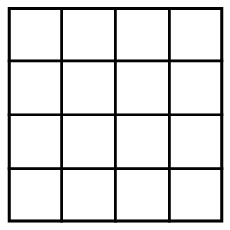
The number of 1*1 squares = 4*4 = 16(4 on each side of the larger square).
The number of 2*2 squares = 3*3 = 9(3 on each side).
The number of 3*3 squares = 2*2 = 4(2 on each side).
The number of 4*4 squares = 1*1 = 1.
Total number of squares = 30.
DIRECTION for the question: In tile following question, a related pair of figures (unnumbered) is followed by five other pairs of figures numbered as 1, 2, 3, 4 and 5. Out of the five numbered pairs, select the pair that has a relationship similar to that in the unnumbered pair.

The first part of the image has 1 arrow.
The 2nd part has exactly same 2 arrows but facing in the opposite direction.
Following this pattern, only 3rd image satisfies it i.e. exact same kind of arrow but facing opposite direction.
Thus, the correct answer is Option A.
DIRECTION for the question: Following question consists of two sets of figures. Figures A, B, C and D constitute the Problem Set while figures 1, 2, 3, 4 and 5 constitute the Answer Set. There is a definite relationship between figures A and B. Establish a Similar relationship between figures C and D by selecting a suitable figure from the Answer Set that would replace the question mark (?) in fig (D).

DIRECTION for the question: In the following question , a related. pair of figures (unnumbered) is followed by five other pairs of figures numbered as 1, 2, 3, 4 and 5. Out of the five numbered pairs, select the pair that has relationship similar to that in the unnumbered pair.

DIRECTION for the question: The following question consists of five figures marked A, B, C, D and E (Problem Figures). They are followed by five other figures marked 1, 2, 3, 4 and 5 (Answer Figures). Select a figure from amongst the (1, 2, 3, 4 and 5) Answer Figures which will continue the same series as established by the five (A, B, C, D and E) Problem Figures

DIRECTION for the question: Study the in formation carefully and choose the correct option.
Two positions of a dice are show below
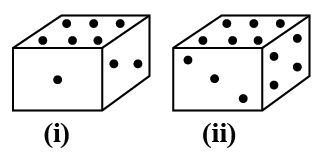
When six is at the bottom, what number come at the top?
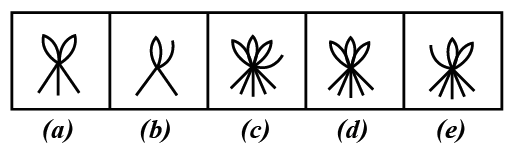
DIRECTION for the question: In the following problem, out of the five figures marked (a), (b), (c), (d) and (e), four are similar in a certain manner. However, one figure is not like the other four. Choose the figure which is different from the rest
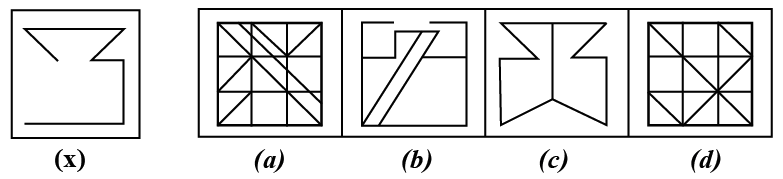
DIRECTION for the question: In following question, you are given a fig. (X) followed by four alternative figures (a), (b), (c) and (d) such that fig. (X) is embedded in one of them. Trace out the alternative figure which contains fig_ (X) as its part. If Fig (X) is not embedded in the given alternatives (a), (b), (c) and (d) then choose option (e) None of these
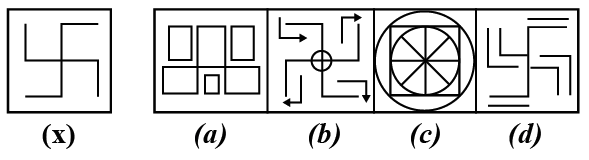
Figure X is embedded in figure C only.
That's why the correct answer is Option A.
DIRECTION for the question: Following question consists of two sets of figures. Figures A, B, C and D constitute the Problem Set while figures 1, 2, 3, 4 and 5 constitute the Answer Set. There is a definite relationship between figures A and B. Establish a similar relationship between figures C and D by selecting a suitable figure from the Answer Set that would replace the question mark (?) in fig (D).

From A to B, the upper 2 arrows moved 90 degrees in clockwise direction and the lower 2 arrows moved 90 degrees in anti-clockwise direction.
Following the same pattern for C, the correct image will be Figure 1 i.e. Option C.
DIRECTION for the question: In the following problem, out of the five figures marked (a), (b), (c), (d) and (e), four are similar in a certain manner. However, one figure is not like the other four. Choose the figure which is different from the rest.
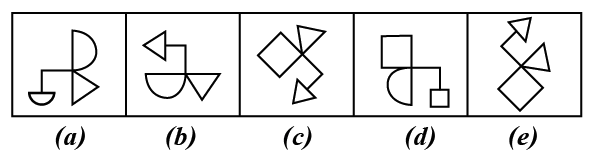
DIRECTION for the question: In the following question, a related pair of figures (unnumbered) is followed by five other pairs of figures numbered as 1, 2, 3, 4 and 5. Out of the five numbered pairs, select the pair that has a relationship similar to that in the unnumbered pair.

DIRECTION for the question: Study the in formation carefully and choose the correct option.
Two positions of a dice are show below
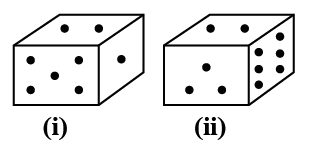
When number 1 is at the top, which number will come at the bottom?
From the 2 images given to us, we can infer that the side with 1 dot is directly opposite to the side with 6 dots.
Thus, the correct answer is Option D.
In following question, choose the correct water-image of the Fig. (X) from amongst the four alternatives (a), (b), (c) and (d) given along with it. If the correct water-image of the Fig. (X) is not there in the given alternatives (a), (b), (c) and (d) then choose option (e) None of these
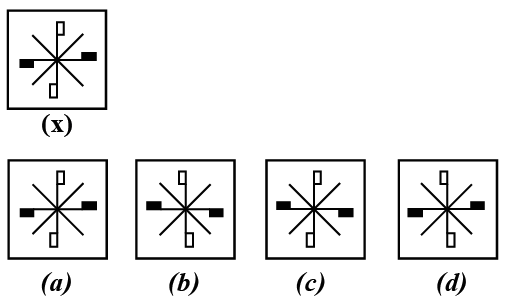
Figure (b) is the correct water image of the given figure X and thus the correct answer is Option B.
DIRECTIONS for the question: In following question, choose the correct mirror-image of the Fig. (X) from amongst the four alternatives (a), (b), (c) and (d) given along with it. If the correct mirror-image of the Fig. (X) is not there in the given alternatives (a), (b), (c) and (d) then choose option (e) None of these
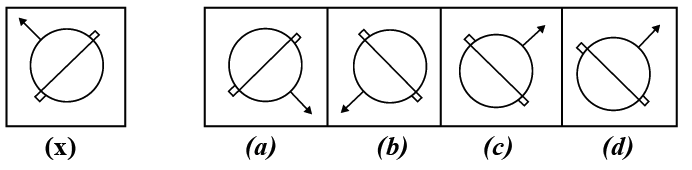
Figure (c) shows the correct mirror image of Figure X and thus the correct answer is Option A.
DIRECTIONS for the question: In following question, choose the correct water-image of the Fig. (X) from amongst the four alternatives (a), (b), (c) and (d) given along with it. If the correct water-image of the Fig. (X) is not there in the given alternatives (a), (b), (c) and (d) then choose option (e) None of these
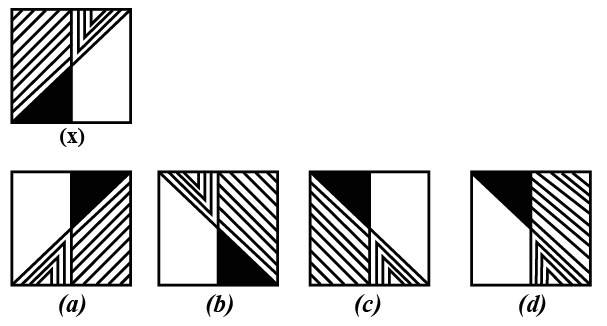
The black colored portion should come on the left top position which disqualify images (a) and (b).
Image (d) is disqualified because the triangles section and stripes should not be aligned.
So, the correct water image is (c).
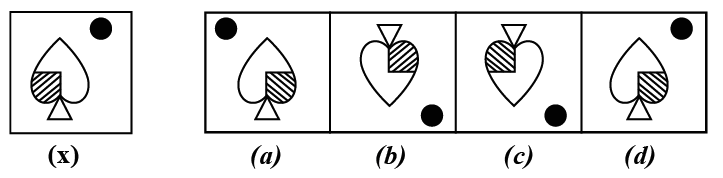
DIRECTIONS for the question: In following question, choose the correct mirror-image of the Fig. (X) from amongst the four alternatives (a), (b), (c) and (d) given along with it. If the correct mirror-image of the Fig. (X) is not there in the given alternatives (a), (b), (c) and (d) then choose option (e) None of these
DIRECTIONS for the question: In the following problem, out of the five figures marked (a), (b), (c), (d) and (e), four are similar in a certain manner. However, one figure is not like the other four.
Choose the figure which is different from the rest.
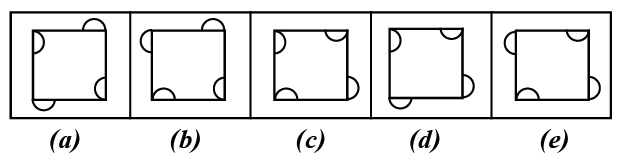
In all the images except C two of the semi circles are inside the square and two semi circles are outside.
Thus, the figure which is different from the rest is C i.e. Option A.
DIRECTION for the question: In following question, you are given a fig. (X) followed by four alternative figures (a), (b), (c) and (d) such that fig. (X) is embedded in one of them. Trace out the alternative figure which contains fig. (X) as its part. If Fig. (X) is not embedded in the given alternatives (a), (b), (c) and (d) then choose option (e) one of these.
DIRECTION for the question: Study the information carefully and choose the correct option.
Two positions of a dice are shown below
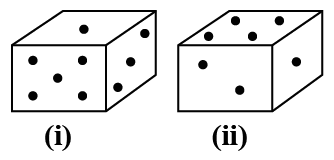
When there are two dots at the bottom, the number of dots at the top will be ?
From the two positions given to us, we can infer that when there are 2 dots at the bottom, the top will have 3 dots.
DIRECTION for the question: In the following problem, out of the five figures marked (a), (b), (c), (d) and (e), four are similar in a certain manner. However, one figure is not like the other four.
Choose the figure which is different from the rest.
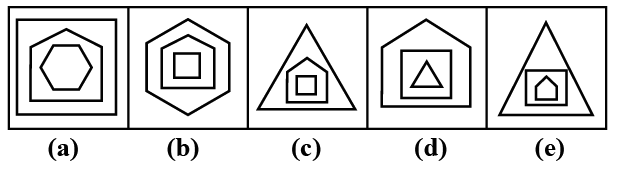
(c) is the odd one out image.
This is so because in all the other images, the number of sides of the polygon either constantly increase or decrease by 1.
But in (c), the number of sides first increase by 2 then decrease by 1 which does not follow the patter.
Thus, the correct answer is Option A.
DIRECTION for the question: In the following problem, out of the five figures marked (a), (b), (c), (d) and (e), four are similar in a certain manner. However, one figure is not like the other four.
Choose the figure which is different from the rest.
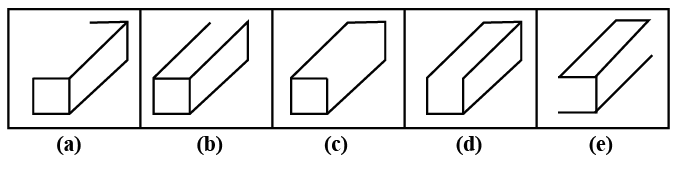
DIRECTION for the question: Study the figure given below and answer the following question.
Count the number of triangles in the figure given below
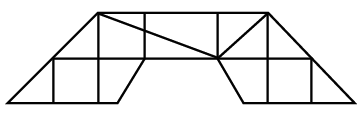
DIRECTION for the question: The following question consists of five figures marked A, B, C, D and E (Problem Figures). They are followed by five other figures marked 1, 2, 3, 4 and 5 (Answer Figures). Select a figure from amongst the (1, 2, 3, 4 and 5) Answer Figures which will continue the same series as established by the five (A, B, C, D and E) Problem Figures

DIRECTION for the question: The following question consists of five figures marked A, B, C, D and E (Problem Figures). They are followed by five other figures marked 1, 2, 3, 4 and 5 (Answer Figures. Select a figure from amongst the (1, 2, 3, 4 and 5) Answer Figures which will continue the same series as established by the five (A, B, C, D and E) Problem Figures

The alternate images follow a pattern.
A C E follow a certain pattern and B D follow another pattern.
From B to D the left most petal was shifted by 45 degrees in the clockwise direction and number of petals increased by 1.
We will apply same pattern on D to get the next image and it will be Figure 2 i.e. option B.
DIRECTION for the question: In following question, choose the correct mirror-image of the Fig. (X) from amongst the four alternatives (a), (b), (c) and (d} given along with it. If the correct mirror-image of the Fig. (X) is not there in the given alternatives (a), (b), (c) and (d) then choose option (e) None of these
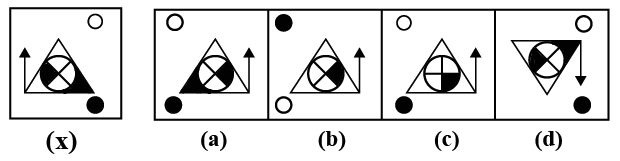
Figure (a) shows the correct mirror image of X and thus the correct answer is Option C.
DIRECTION for the question: Solve the following question and mark the best possible option.
1904 * 1904 =?
DIRECTION for the question: Solve the following question and mark the best possible option.
The ratio of the ages of a man and his wife is 4 : 3. After 4 years, th is ratio will be 9 : 7. If at the time of their marriage, the ratio of their ages was 5 : 3, then how many years ago were they married?
Let us assume their current ages to be 4x and 3x respectively.
After 4 years, the ratio becomes 9:7
==> $$\frac{4x+4}{3x+4}=\frac{9}{7}$$
==> x = 8.
Present ages of the man and his wife are 32 and 24 respectively.
Let y years ago, they had their marriage and the ratio of their ages was 5:3.
$$\frac{32-y}{24-y}=\frac{5}{3}$$
==> y = 12 years.
DIRECTION for the question: Solve the following question and mark the best possible option.
Visitors to a show were charged Rs. 15 each on the first day, Rs 7.50 on the second day and Rs. 2.50 each on the third day. The attendance on the three days was in the ratio 2 : 5 : 13. The average charge per person for the whole show was
Let us assume that the attendance on the three days was 2, 5 and 13 people respectively.
Total amount charged = 2*15 + 5*7.5 + 13*2.5 = 100.
The average charge per person = $$\frac{Total}{Total\ attendance}=\frac{100}{2+5+13}=\frac{100}{20}=5$$ Rs.
DIRECTION for the question: Solve the following question and mark the best possible option.
A and B rent a pasture for 10 months; A puts in 80 cows or 7 months. How many cows can B put for the remaining 3 months, if he pays half as much again as A?
DIRECTION for the question: Solve the following question and mark the best possible option.
Which of the following numbers is a multiple of 8?
DIRECTION for the question: Solve the following question and mark the best possible option.
The square root of $$(2722 - 128^{2})$$ is
DIRECTION for the question: Solve the following question and mark the best possible option.
The average of 10 numbers is 40.2. Later it is found that two numbers have been wrongly copied. The first is 18 greater than the actual number and the second number added is 13 instead of 31. Find the correct average.
Incorrect average of 10 numbers is 40.2 which makes the incorrect sum = 40.2*10 = 402.
The first is 18 greater than the actual number which means that the actual sum will be 18 lesser.
Also, we need to remove 13 and add 31 instead.
This makes the actual sum = 402 - 18 -13 + 31 = 402.
Thus, the actual average = 402/10 = 40.2.
DIRECTION for the question: Solve the following question and mark the best possible option.
A boat takes 90 minutes less to travel 36 miles downstream than to travel the same distance upstream. If the speed of the boat in still water is 10 mph, the speed of the stream is :
Let us assume the speed of stream = x mph.
Speed going downstream = 10 + x mph
Speed going upstream = 10 - x mph.
Difference in time taken to cover 36 miles ==> $$\frac{36}{10-x}-\frac{36}{10+x}$$
This is equal to 90 mins = 1.5 hrs.
$$36\left(\frac{1}{10-x}-\frac{1}{10+x}\right)=1.5$$
$$24\left(10+x\ -\ 10+x\right)=\left(10+x\right)\left(10-x\right)$$
$$48x\ =\ 100\ -\ x^2$$
$$x^2+48x-100=0$$
$$\left(x+50\right)\left(x-2\right)=0$$
This gives x = 2 mph.
So, the speed of stream = 2 mph.
DIRECTION for the question: Solve the following question and mark the best possible option.
The owner of a boutique decides to calculate the percentage of customers who purchase hats. If 40 percent of the store's customers decide to purchase items, and of those customers 15 percent purchase hats, what percent of the store's customers purchase hats ?
Let us assume that the store has a total of 100 customers.
Out of these, 40% purchase items i.e. 0.4*100 = 40 customers.
Out of these 40 customers, 15% purchase hats i.e. 0.15*40 = 6 people.
These amount to 6% of the Total customers.
DIRECTION for the question: Solve the following question and mark the best possible option.
A man sells an article at a gain of 15%. If he had bought it at 10% less and sold it for Rs 4 less, he would have gained 25%. Find the cost price of the article
Let us assume the Cost Price = 100x.
As he gained 15%, the SP = 115x.
The new CP is 10% lesser than the original = 90x and the new SP = 115x - 4.
As he gained 25% with this SP over new CP, we can say that:
1.25*90x = 115x - 4
112.5x = 115x - 4
2.5x = 4
x = 1.6.
The Cost price = 100x = 160 Rs.
DIRECTION for the question: Solve the following question and mark the best possible option.
One quality of wheat at Rs. 9.30 per kg is mixed with another quality at a certain rate in the ratio 8 : 7. If the mixture so formed be worth Rs. 10 per kg, what is the rate per kg of the second quality of wheat?
Solution:
Let the rate of another quality wheat be Rs 'a'/kg.
Let the amount of 1st and 2nd quality wheats be '8x' Kg and '7x' Kg respectively
So, $$\ \frac{\ 9.3\times\ 8x\ \ +\ \ a\times\ 7x}{8x+7x}=10$$
7a=75.6
a=Rs 10.8/Kg
Option A is the answer.
Alternate Solution:
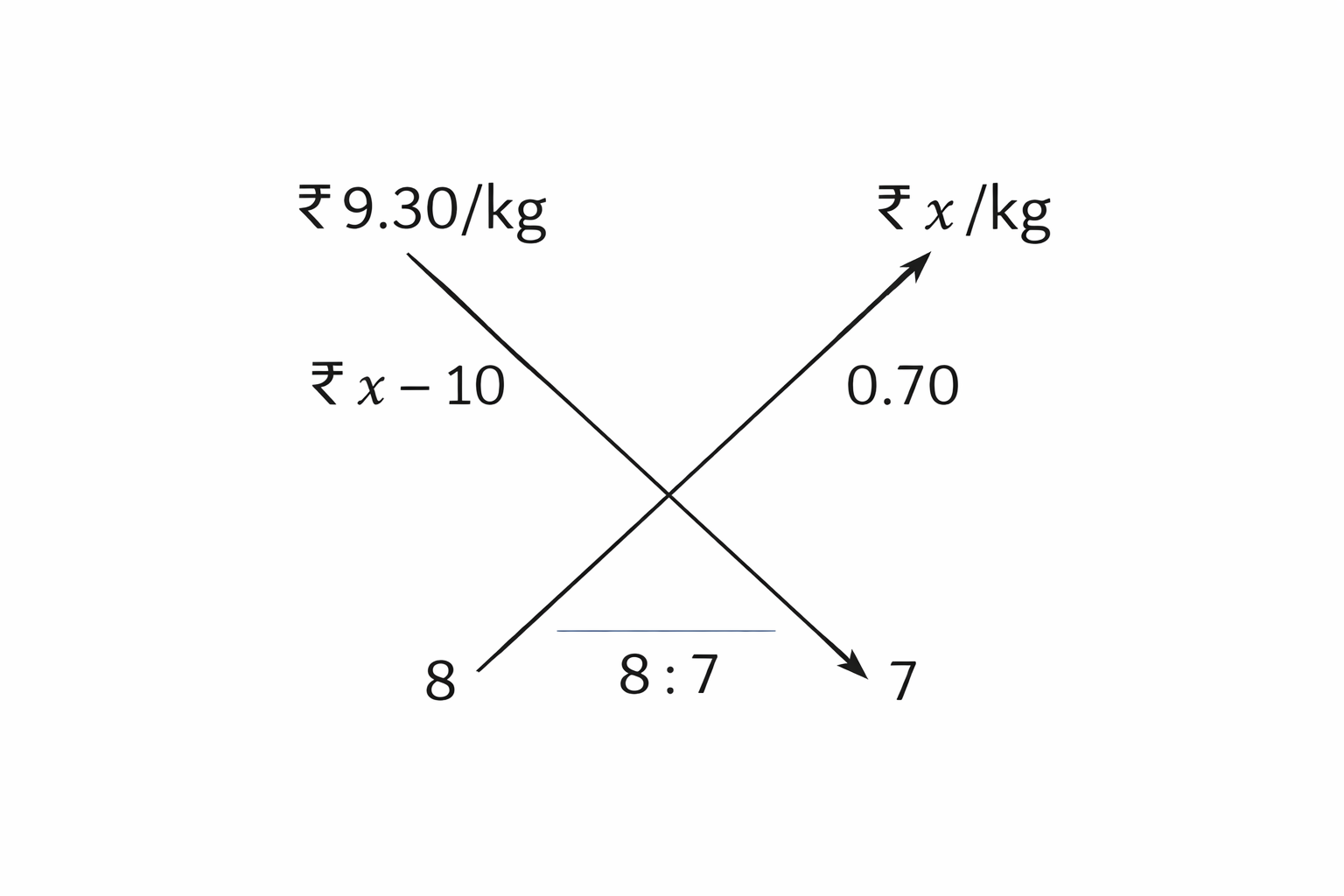
$$\ \frac{\ x-10}{10-9.3}=\frac{8}{7}$$
7(x-10)=8*0.7
x=Rs 10.8/Kg
Option A is the answer.
DIRECTION for the question: Solve the following question and mark the best possible option.
Two cards are drawn together from a pack of 52 cards. The probability that one is a spade and one is a heart, is
There are 2 cases possible.
Case 1: 1st card is spades and 2nd card is hearts. Probability of this cases = $$\frac{13}{52}\times\ \frac{13}{51}$$.
Case 2: 1st card is hearts and 2nd card is spades. Probability of this cases = $$\frac{13}{52}\times\ \frac{13}{51}$$.
So, Overall probability = $$2\times\ \frac{13}{52}\times\ \frac{13}{51}=\frac{13}{102}$$.
DIRECTION for the question: Solve the following question and mark the best possible option.
David and Michael together can finish a job in 4 days 19 hrs 12 min. If David works at two-thirds Michael's speed, how long does it take Michael alone to finish the same job?
We will assume that the efficiency of Michael = 3x units per min and David's efficiency will be 2/3 * 3x = 2x units per min.
Together, their efficiency is 5x units/min and the total time taken by them to finish the job is (4*24 + 19)*60 + 12 mins = 6912 mins.
So, the total work = 6912*5x units.
Michael alone can do this job in $$\frac{6912\times\ 5x}{3x}=2304\times\ 5\min\ =192hrs\ =8\ days$$.
DIRECTION for the question: Solve the following question and mark the best possible option.
Excluding stoppages, the speed of a train in 45 km/h and including stoppages, it is 36 km/h. For how many minutes does the train stop per hour?
For a fixed distance, ratio of speeds is inverse to the ratio of time taken.
So, the ratio of time with stoppages and without stoppages = 45 : 36 = 5:4 = 60 : 48.
For every 60 mins of trave time with stoppages, the train travelled without stoppages for 48 mins.
This means that the train stopes for 60 - 48 = 12 mins every hour.
DIRECTION for the question: Solve the following question and mark the best possible option.
At 8:30, the hour hand and the minute hand of clock form an angle of
DIRECTION for the question: Solve the following question and mark the best possible option.
A shopkeeper offers 15% discount on all plastic toys. He offers a further discount of 4% on the reduced price to those customers who pay cash. What does a customer have to pay (in Rs.) in case for a toy of Rs 200?
After a discount of 15%, the price for the customer will be 0.85*200 = 170.
After a further discount of 4% on cash payments, the final price for the customers will be 0.96*170 = 163.2.
DIRECTION for the question: Solve the following question and mark the best possible option.
Which of the following number is divisible by 99?
For a number to be divisible by 99, it has to be divisible by both 9 and 11.
Only 114345 i.e. Option D is divisible by both 9 and 11 and thus it is the correct answer.
DIRECTION for the question: Solve the following question and mark the best possible option.
A watch goes fast by 15 minutes compared to the right time every day. If it is corrected and set to the standard time at 12 O'clock at noon, which of the following will be the time shown by it at 4 : 00 a.m. in the morning?
DIRECTION for the question: Solve the following question and mark the best possible option.
The H.C.F of two numbers is 12 and their difference is 12. The numbers are
DIRECTION for the question: Solve the following question and mark the best possible option.
A car company sold 150 cars in a special 6-day sale. Each day, the company sold 6 more than the previous day. How many cars were sold on the 6th day?
DIRECTION for the question: Solve the following question and mark the best possible option.
Zinc and copper are melted together in the ratio 9 : 1. What is the weight of melted mixture, if 28.8 kg of zinc has been consumed in
DIRECTION for the question: Solve the following question and mark the best possible option.
The average of ten numbers is 7. If each number is multiplied by 12, then the average of the new set of numbers is:
If one star equals four circles and three circles equal four diamonds, then what is the ratio of star to diamond?
DIRECTION for the question: Solve the following question and mark the best possible option.
In a flight of 600 km, an aircraft was slowed down due to bad weather. Its average speed for the trip was reduced by 200 km/hr and the time of flight increased by 30 minutes. The duration of the flight is:
DIRECTION for the question: Solve the following question and mark the best possible option.
The probability that a card drawn from a pack of 52 cards with be a diamond or a king, is
DIRECTION for the question: Solve the following question and mark the best possible option.
1/13
4/13
2/13
1/52
1/25
In how many ways is it possible to choose a white square and a black square on a chess board so that the squares do not lie in the same row or column?
DIRECTION for the question: Solve the following question and mark the best possible option.
The speed of a boat in still water is 15 km/h and the rate of stream is 5 km/h. The distance travelled downstream in 24 minutes is
DIRECTION for the question: Solve the following question and mark the best possible option.
What decimal of an hour is a second?
DIRECTION for the question: Solve the following question and mark the best possible option.
A number is multiplied by 11 and 11 is added to the product. If the resulting number is divisible by 13, the smallest original number is
DIRECTION for the question: Solve the following question and mark the best possible option.
A man can row 60 km down stream in 6 hours. If the speed of the current is 3 km/h, then find in what time will he be able to cover 16 km upstream?
DIRECTION for the question: Solve the following question and mark the best possible option.
12345679 * 72 is equal to
DIRECTION for the question: Solve the following question and mark the best possible option.
In a mixture of 45 litres, the ratio of milk and water is 4 : 1. How much water must be added to make the mixture ratio 3 : 2?
In the mixture, amount of milk = $$\frac{4}{5}\times\ 45=36$$ and water = $$\frac{1}{5}\times\ 45=9$$.
Let us assume that the water added is X litres.
Now, 36 : 9+X = 3:2.
Solving this equation gives value of X = 15 litres.
DIRECTION for the question: Solve the following question and mark the best possible option.
A jogger running at 9 kmph alongside a railway track is 240 meters ahead of the engine of a 120 metre long train running at 45 kmph in the same direction. In how much time will the train pass the jogger?
In order to completely pass the jogger, the train rear's end should cross the jogger.
For this, the train will first cover the 240m distance that is between them and then 120m distance that is the lenght of the train.
So, the total distance to be covered is 240+120 = 360m.
The relative speed to cover this distance = 45 - 9 = 36 km/hr as the train and the jogger are moving in the same direction. This speed in m/sec = $$36\times\ \frac{5}{18}=10\ $$m/sec.
So, the time taken by the train to completely pass the jogger is 360/10 = 36 seconds.
DIRECTION for the question: Solve the following question and mark the best possible option.
Two pipes A and B can fill a tank in 15 hours and 20 hours respectively while a third pipe C can empty the full tank in 25 hours. All the three pipes are opened in the beginning. After 10 hours, C is closed. In how much time will the tank be full?
Let us assume the capacity of the tank to be 300 litres i.e. LCM of 15, 20 and 25.
This gives the efficiencies of A, B and C to be 20, 15 and 12 litres per hour respectively.
For the first 10 hours, all of the pipes worked together so they filled 10*(20 + 15 - 12) = 230 litres of water.
Water to be filled = 300 - 230 = 70 litres and the total efficiency after 10 hrs is 20+15 = 35 litres/hour. So, it will take 2 more hours to fill the remaining tank.
Total time taken to fill the tank = 10 + 2 = 12 hrs.
DIRECTION for the question: Solve the following question and mark the best possible option.
The H.C.F. of 3556 and 3444 is
3556 can be factorized as $$2^2\times\ 7\times\ 127$$ and,
3444 can be factorized as $$2^2\times3\times\ 7\times\ 41$$.
The HCF will be $$2^2\times7\ =\ 28$$.
DIRECTION for the question: Solve the following question and mark the best possible option.
A candidate has to obtain minimum 33% of the total marks to pass. He got 25% of the total marks and failed by 40 marks. The maximum marks are
The candidate scored 25% of the marks and fell short of the passing criteria i.e. 33% of marks by 40 marks.
This implies that 33% - 25% of Total = 40 marks.
==> 8% of Total = 40 marks
And Maximum marks for the test = 500.
DIRECTION for the question: Solve the following question and mark the best possible option.
A speaks the truth in 70 percent cases and B in 80 percent. The probability that they will contradict each other when describing a single event is
DIRECTION for the question: Solve the following question and mark the best possible option.
A person bought 20 litres of milk at the rate of Rs. 8 per litre. He got it churned after spending Rs. 10 and 5 kg of cream and 20 litres of toned milk were obtained. If he sold the cream at Rs. 30 per kg and toned milk at Rs 4 per litre, his profit in the transaction is
DIRECTION for the question:
In order to get at least one Head with probability $$\geq$$0.9, the number of times a two sided corn having Heads on one side and Tails on the other side, the coin needs to be tossed how many times :
DIRECTION for the question: Find the wrong number in the series
3, 8, 15, 24, 34, 48, 63
DIRECTION for the question: Solve the following question and mark the best possible option.
Anna left for city A from city B at 5.20 a.m. She travelled at the speed of 80 km/hr for 2 hours 15 minutes. After that the speed was reduced to 60 km/hr. If the distance between two cities is 350 kms, at what time did Anna reach city A?
DIRECTION for the question:
A cricketer whose bowling average is 12.4 runs per wicket takes 5 wickets for 26 runs and thereby decreases his average by 0.4. The number of wickets taken by him till the last match was:
DIRECTION for the question: Solve the following question and mark the best possible option.
A car covers 420 km with a constant speed. If its speed were 10 km/h more it would have taken one hour less to cover the distance. Find the speed of the car.
DIRECTION for the question: In the following bar graphs given below, one shows the amount (in lakh Rs.) invested by a company in purchasing raw materials over the years and the other shows the value (in lakh Rs.) of finished goods sold by the company over the years. Study the bar graphs and answer the questions based on them
In which year, there is maximum percentage increase in the amount invested in raw materials as compared to the previous year?
What was the difference between the average amount invested in raw materials during the given period and the average value of sales of finished goods during this period?
In which year, the percentage change (compared to previous year) in the investment on raw materials is the same as that in the value of sales of finished goods?
The value of sales of finished goods in 2009 was approximately what percent of the average amount invested in raw materials in the years 2007, 2008 and 2009?
DIRECTION for the question: Study the following bar graph answer the questions given below:
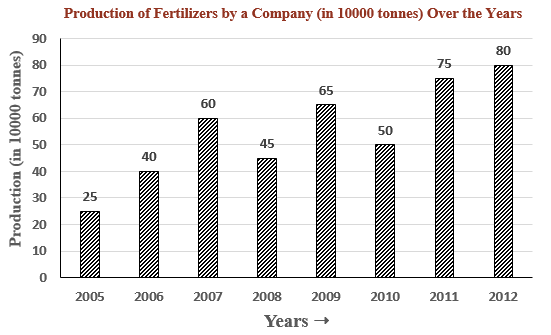
What was the percentage decline in the production of fertilizers from 2007 to 2008?
The average production of 2006 and 2007 was exactly equal to the average production of which of the following pairs of years?
In how many of the given years was the production of fertilizers more than the average production of the given years?
DIRECTION for the question: In the following question, five sentences are given, out of which four are incorrect and one is correct, choose the one which is correct
1. She is the better of the two girls.
2. She is better of the two girls.
3. She is the best of the two girls.
4. She is the better of two girls.
5. She is better of the two girl.
DIRECTION for the question: Fill in the blank with question tag:
I don't know a little about your plan, ________________ ?
DIRECTION for the question: In the following question, out of the alternatives given , choose the one which can be substituted. for the given words/sentence.
Music sung or played at night below a person's window.
DIRECTION for the question: In the following question, five sentences are given, out of which four are incorrect and one is correct, choose the one which is correct
1. Mohan is senior to Vijay.
2. Mohan is more senior to Vijay.
3. Mohan is senior than Vijay.
4. Mohan is less senior to Vijay.
5. Mohan is most senior to Vijay.
DIRECTION for the question: In the following question, a part of the sentence is italicized. Below ,each sentence are given some possible substitutions for the italicized part. If one of them is better than the italicized part, indicate your response against the corresponding letter. If none of the substitutions improve the sentence, indicate 'No improvement' as your answer.
All along the journey she remained silent.
DIRECTION for the question: Fill in the blank with correct option.
He was astonished _____________ the sad news.
DIRECTION for the question: In tile following question, an idiomatic expression / a proverb has been given, followed by some alternatives. Choose the one which best expresses the meaning of the given idiom/ proverb.
Something up one's sleeve
DIRECTION for the question: In the following question, out of the alternatives given , choose the one which can be substituted for the given words/sentence.
The study of physical phenomenon of lakes
DIRECTION for the question: In the following question, an idiomatic expression / a proverb has been given, followed by same alternatives. Choose the one which best expresses the meaning of the given idiom/ proverb.
To take with a grain of salt
DIRECTION for the question: In tile following question, a part of the sentence is italicized. Below each sentence are given some possible substitutions for the italicized part. If one of them is better than the italicized part, indicate your response against the corresponding letter. If none of the substitutions improve the sentence, indicate 'No improvement' as your answer.
He will never succeed however hard he will try.
DIRECTION for the question: In the following question, out of the given alternatives, choose the one which is nearest to the opposite in meaning of the given word.
NIGGARD
DIRECTION for the question: In the following question, out of the given alternatives, choose the one which is nearest to the opposite in meaning of the given word.
FETTER
DIRECTION for the question: In the following question, a part of the sentence is italicized. Below each sentence are given some possible substitutions for the italicized part. If one of them is better than the italicized part, indicate your response against the corresponding letter. If none of the substitutions improve the sentence, indicate 'No improvement' as your answer.
I was waiting until everybody will have left the meeting place
DIRECTION for the question: In the following question the sentence has a blank space, select most appropriate option for the blank space as your answer.
We must _____________ help to the people hit by cyclone.
DIRECTION for the question: In the following question, out of the given alternatives, choose the one which best expresses the meaning of the given word.
DAINTY
DIRECTION for the question: In the following question, out of the given alternatives, choose the one which best expresses the meaning of the given word.
OBFUSCATE
DIRECTION for the question: In the following question, a part of the sentence is italicized. Below each sentence are given some possible substitutions far the italicized part . If one of them is better than the italicized part, indicate your response against the corresponding letter. If none of the substitutions improve the sentence, indicate 'No improvement' as your answer.
Who do you think I was talking over the phone when you came to see me.
DIRECTION for the question: In the following question, out of the alternatives given , choose the one which can be substituted for the given words/sentence.
An unexpected stroke of good luck
DIRECTION for the question: In the following question, out of the alternatives given , choose the one which can be substituted for the given words/sentence.
Indifference to pleasure or pain
DIRECTION for the question: In the following question, out of the alternatives given , choose the one which can be substituted for the given words/sentence.
An admirer of art
DIRECTION for the question: In the following question the sentence has a blank space, select most appropriate option for the blank space as your answer.
He is ............ for his evil deeds.
DIRECTION for the question: Fill in the blank with question tag:
Nobody liked your activities, ............... ?
DIRECTION for the question: Fill in the blank with correct option
He died ____________ violence.
DIRECTION for the question: Fill in the blank with question tag:
Let us start the work, ____________ ?
DIRECTION for the question: In the following question, out of the given alternatives, choose the one which best expresses the meaning of the given word.
JAZZY
DIRECTION for the question: In the following question the sentence has a blank space, select most appropriate option for the blank space as your answer.
Reena ............. a taste for poetry in the company of her cousin.
DIRECTION for the question: In the following question, out of the given alternatives, choose the one which best expresses the meaning of the given word.
PESKY
DIRECTION for the question: In the following question, an idiomatic expression / a proverb has been given, followed by some alternatives. Choose the one which best expresses the meaning of the given idiom/ proverb.
To throw up the sponge
DIRECTION for the question: In the following question, out of the given alternatives, choose the one which is nearest to the opposite in meaning of the given word.
IMPEDE
DIRECTION for the question: In the following question , out of the given alternatives, choose the one which is nearest to the opposite in meaning of the given word.
OSTRACISE
DIRECTION for the question: In the following question, an idiomatic expression / a proverb has been given , followed by some alternatives. Choose the one which best expresses the meaning of the given idiom/ proverb.
To give up the ghost
DIRECTION for the question: Fill in the blanks with correct option _____________ accordance _____________ the law of India the president is the supreme head of the government
DIRECTION for the question: In the following question , out of the given alternatives, choose the one which best expresses the meaning of the given word.
DEIFY
DIRECTION for the question: In the following question , out of the alternatives given, choose the one which can be substituted for the given words/sentence.
Part of a church in which bells hang
DIRECTION for the question: Read the sentence given below to find out whether there is any grammatical or idiomatic error in it.
The error, if any, will be in one part of the sentence. That part of the sentence is the answer. If there is no error, the answer is 'No error'.
He is in the habit (A)/ of going out (B)/ on a morning walk (C)/regularly. (D)/ No error (E).
DIRECTION for the question: In the following question, five sentences are given, out of which four are incorrect and one is correct, choose the one which is correct
1. Everybody should love his country
2. Everybody should love their country
3. Everybody should love one's country
4. Everybody should love its country
5. Everybody should love country
DIRECTION for the question: In the following question , out of the alternatives given , choose the one which can be substituted for the given words/sentence.
Open rebellion of soldiers and sailors against lawful authority
DIRECTION for the question: In the following question, out of the given alternatives, choose the one which is nearest to the opposite in meaning of the given word.
EXCULPATE
DIRECTION for the questions: Read the passage given below and answer the questions that follow.
People very often complain that poverty is a great evil and that it is not
possible to be happy unless one has a lot of money. Actually, this is not
necessarily true. Even a poor man, living in a small hut with none of the
comforts and luxuries of life, may be quite contented with his lot and achieve
a measure of happiness. On the other hand, a very rich man, living in a
palace and enjoying everything that money can buy, may still be miserable,
if, for example, he does not enjoy good health or his only son has taken to
evil ways. Apart from this, he may have a lot of business worries which keep
him on tenterhooks most of the time. There is a limit to what money can buy
and there are many things which are necessary for a man's happiness and which money cannot procure.
Real happiness is a matter of the right attitude and the capacity of being contented with whatever you have is the most important ingredient of this attitude.
The phrase "on tenterhooks" means:
It is true that:
Which of the following is the most appropriate title to the passage?
A rich man's life may become miserable if he:
DIRECTION for the question: Read the passage given below and answer the questions that follow.
Even an ordinary everyday activity may lead to an insight into human nature. A picnic had been arranged by the department. Everyone was supposed to join it. I, being older than a good many, was ill at ease at he thought of joining a bunch of callow youngsters dreaming of some soft and sweet company on he way to the hill resort.
But the morning of the adventure found the boy in me climbing the first ascent-rather steep and hard, to the applause of all Adams and Eves in the troop.
Half way through we started finding snow all around us, but, the boy in me by then was once again lost into oblivion. I found myself lagging behind and often falling down on the soft snow due to soft foam rubber soles of my shoes.
A laughing stock I was. But soon I found strong, healthy arms supporting me. I pleaded, "Let me go, I'll not be able to make it," but they would not let me.
They were the arms of two hill folks who as people, had been described as withdrawn, selfish and aloof by my friends from the plains.
Even an ordinary everyday activity may lead to an insight into ................
The writer got tired soon because
The writer climbed the first ascent rath er fast because
The hill folk did not let him go because
The narrator in this passage felt ill at ease at the thought of joining the picnic party because there was an age gap between him and the, rest of the party.
Which one of the following do you think is right?
DIRECTION for the questions: Read the passage given below and answer the questions that follow.
We are tempted to assume that technological progress is real progress and that material success is the criterion of civilisation. If the Eastern people become fascinated by machines and techniques and use them, as western nations do, to build huge industrial organisations and large military establishments, they will get involved in power politics and drift into the danger of death. Scientific and technological civilisation brings great opportunities and great rewards but also great risks and temptations. Science and technology are neither good nor bad. They are not to be tabooed but tamed and assigned their proper place. They become dangerous only if they become idols.
Science and technology will bring benefits to
From the passage, one gathers that the Eastern people must
According to the author, science and technology should be
Start your IIM journey with the right preparation and crack CAT 2026.

Educational materials for CAT preparation