IIFT 2019 Question Paper

For the following questions answer them individually

You travel by Delhi Metro every day from Botanical Garden, Noida to Hauz Khas, Delhi. At Hauz Khas metro station, you use an escalator to get out of the station. The escalator takes 80 seconds to get you down. One day, the escalator was not working and you walk up the escalator in 50 seconds. How many minutes does it approximately take you to walk up the working escalator?

If $$x=8-\sqrt{32}$$ and $$y=2+\sqrt{2}$$, then $$\left(x+\frac{1}{y}\right)^2$$ is given by:

If the co-ordinates of orthocentre and the centroid of a triangle ABC are (—5, 7) and (5, 5), then the circumcentre of the triangle ABC is :

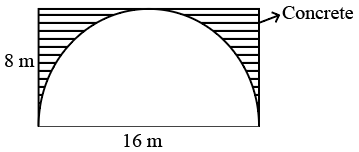
Consider a cuboidal underground tunnel of length 500 m whose cross-section is given in the figure. If $$1 m^3$$ of concrete costs 1000 rupees, find the amount of money needed to build the Tunnel.

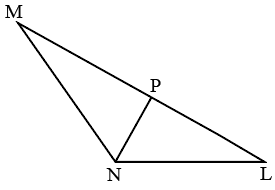
In $$\triangle MNL$$, line NP bisects the angle MNL. If NP : NL = 2 : 3 and angle MNL =  $$120^\circ$$. Then NP : NL : MN is:

Q5

A group of women in a society decided to execute interior and exterior decoration of the society in a week’s time. Since 11 women dropped out every day from the second day, the entire decoration was completed on $$12^{th}$$ day. How many women participated at the beginning ? (Answer to the nearest integer)

Joseph is in a dilemma. He has been offered a job which would pay him ₹ 80,000 per month for first three years and ₹ 1,20,000 per month for the next three years, and ₹ 1,50,000 per month for the remaining four years. He has also been offered an MBA at a prestigious place and he is considering whether to accept the job or go for the MBA. The first year tuition fee for the MBA program is ₹ 16,00,000 and the second year tuition fee for the MBA program is ₹ 20,00,000. After MBA, he'll get a salary of ₹ 2,00,000 per month for the first four years and then ₹ 2,50,000 per month for the remaining four years. What will be the approximate percentage gain for Joseph in opting for the MBA instead of the job in the 10 years horizon considering no discounting of money ?

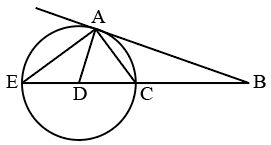
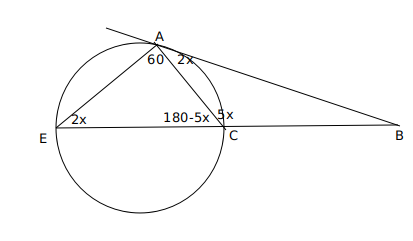
AB is the tangent on the circle at point A. The line BC meets the circle at points C and E. Line AD bisects the angle EAC. If angle EAC = $$60^\circ$$ and angle BAC : angle ACB = 2: 5. Find angle ABC :

KBC restaurant chain regularly conducts survey of its customers. The customers are asked to rate the food quality, service and price as Excellent, Good and Fair. Customers are also asked whether they would comeback. It was found that 76% of customers say that they will come back. Amongst those who say that they will come back, 57% rate the restaurant as Excellent, 36% rate it as Good and remainder rate it as Fair. Of those who say that they will not return, the respective values are 14%, 32% and 54%. What percentage of customers rated the restaurant as good ?

Four couples are to be seated in a circular table such that each couple sits together. In how many ways they can sit such that two males sit to the right of their female partners and the other two males sit to the left of their female partners ?

Nawab has two sons Saif and Amir who have export businesses. Nawab’s satisfaction/ utility level is given by adding twice of the satisfaction level of Saif with the satisfaction level of Amir. If Saif makes a profit of ₹ 100, his satisfaction level goes up by 10% and if he suffers a loss of ₹100, his satisfaction level goes down by 10%. If Amir makes profit of ₹ 100, his satisfaction level goes up by 5% and if he suffers a loss of ₹ 100, his satisfaction level goes down by 15%. Currently, Nawab’s satisfaction level is 24 and the satisfaction level of Saif is the same as the satisfaction level of Amir. If Saif makes a profit of 100 and Amir suffers a loss of ₹ 100, what is the approximate percentage change in Nawab’s satisfaction level?

A man standing on the line joining the two poles finds that the top of the poles make an angle of elevation of $$60^\circ$$ and $$45^\circ$$ respectively. After walking for sometime towards the other pole, the angles change to $$30^\circ$$ and $$60^\circ$$ respectively. The ratio of the height of the poles is :

An E-rickshaw owner makes 24 trips a month with 4 passengers per trip. If his interest cost for purchase of E-rickshaw is ₹ 120/month, he earns 15 percent profit a month (Profit is the difference between revenue and cost). What will be the approximate percentage profit for the same month if the owner undertakes 20 trips a month with 5 passengers and his interest cost is reduced by 10 percent for the month ?

Assume:
(a) Total cost to be proportional to the interest cost.
(b) Revenue per passenger is the same in both cases.

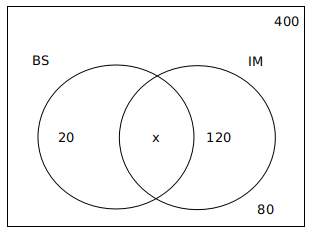
400 students were admitted to the 2018-19 MBA batch. 200 of them did not choose “Business Statistics”. 100 of them did not choose “International Management’. There were 80 students who did not choose any of the two subjects. Find the number of students who chose both Business Statistics and International Management.

At what time between 2.00 pm and 3.00 pm,the two arms of a watch are completely opposite to each other ?

A motorboat takes the passengers from Rishikesh to Haridwar and back. Both the cities, Rishikesh and Haridwar are located on the banks of River Ganga. During Kumbh Mela,to earn more money, the owner of the motorboat decided to have more trips from Rishikesh to Haridwar and back, so he increased the speed of the motorboat in still water, by 50%. By increasing the speed, he was able to cut down the travel time from Rishikesh to Haridwar and back, by 60%. What is the ratio of the speed of motorboating still water to that of the speed of river Ganga?

A cricket team has 11 players and each of them has played 20 matches till date. Virat, Rohit, Mahendra, Rahul and Shikhar have scored runs at an average of 60, 55, 50, 45 and 40 respectively. Rest of the players have scored at an average of 25 each. In the next 10 matches, Virat and Rohit each scored 900 runs whereas Mahendra scored twice that of Rahul. After 30 matches, if Virat’s new average score is twice that of Rahul, what is the approximate average score of Mahendra ?

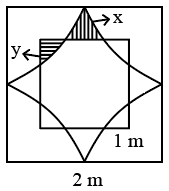
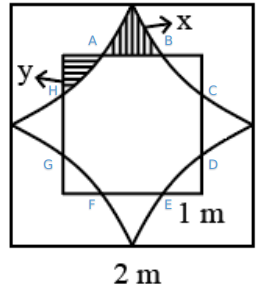
A square of length 1 m is inside a square of length 2 m and four quarter circles are joined as shown in the figure. The value of y —x is given by,

Rohit purchased a cistern which had a leakage. The cistern can be filled by two inlet pipes, which can individually fill the cistern in 12 min and 15 min respectively. Despite leakage, the two inlet pipes together can fill the cistern in 20 min. How long will it take to empty the completely full the cistern due to leakage?

In a triangle, the two longest sides are 13 cm and 12 cm. The angles of the triangle are in arithmetic progression. The radius of the circle inscribed in this triangle is :

According to birth registration data available with the South Delhi Municipal Corporation,7 babies were born in a particular week in a private hospital. What is the probability that three babies were born on the same day of the week?

Monika buys a Samsung’s 360 litre refrigerator from M/s Coldrush Agencies for ₹ 42,000. She makes a down payment of ₹ 12,000 and the remaining amount in 4 equal half yearly instalments. If M/s Coldrush Agencies charge an interest of 10% per annum, approximately what amount Monika has to pay every six month ?

Ms. Debjani after her MBA graduation wants to have start-up of her own. For this, she uses ₹ 8,00,000 of her own savings and borrows ₹ 12,00,000 from a public sector bank under MUDRA Scheme.As per the agreement with the bank,she is supposed to repay the principle of this loan equally over the period of the loan which is 25 years. Two years after taking the first loan, she borrowed an additional loan of ₹ 8,00,000 to finance expansion plan of her start-up. If Ms Debjani clears all her loans in 25 years from the date of taking the first loan, how much total interest she has to pay on her initial borrowing? Assume simple interest rate at 8 per cent per annum.

Read the passage and answer the questions.

Successful companies, no matter what the source of their capabilities, are pretty good at responding to evolutionary changes in their markets-what in The Innovator’s Dilemma (Harvard Business School, 1997), Clayton Christensen referred to as sustaining innovation. Where they run into trouble is in handing or initiating revolutionary changes in their markets, or dealing with disruptive innovation (DI).

Sustaining technologies are innovations that make a product or service perform better in ways that customers in the mainstream market already value. Compaq’s early adoption of Intel’s 32-bit 386 microprocessor instead of the 16-bit 286 chip was a sustaining innovation. So was Merrill Lynch's introduction of its Cash Management Account, which allowed customers to write checks against their equity accounts. Those were breakthrough innovations that sustained the best customers of these companies by providing something better than had previously been available.

Disruptive innovations create an entirely new market through the introduction of a new kind of product or service, one that’s actually worse, initially, as judged by the performance metrics that mainstream customers value. Charles Schwab's initial entry as a bare-bones discount broker was a disruptive innovation relative to the offering of full-service brokers like Merrill Lynch. Merrill Lynch’s best customers wanted more than Schwab-like services. Early personal computers were a disruptive innovation relative to mainframes and minicomputers. PCs were not powerful enough to run the computing applications that existed at the time they were introduced. These innovations were disruptive in that they didn’t address the next-generation needs of leading customers in existing markets. They had other attributes, of course, that enabled new market applications to emerge-and the disruptive innovations improved so rapidly that they ultimately could address the needs of customers in the mainstream of the market as well.

Sustaining innovations are nearly always developed and introduced by established industry leaders. But those same companies never introduce-or cope well with-disruptive innovations. Why? Our resources-processes-values framework holds the answer. Industry leaders are organized to develop and introduce sustaining technologies. Month after month, year after year, they launch new and improved products to gain an edge over the competition. They do so by developing processes for evaluating the technological potential of sustaining innovations and for assessing their customers’ needs for alternatives. Investment in sustaining technology also fits in with the values of leading companies in that they promise higher margins from better products sold to leading-edge customers.

Disruptive innovations occur so intermittently that no company has a routine process for handling them. Furthermore, because disruptive products nearly always promise lower profit margins per unit sold and are not attractive to the company’s best customers, they’ re inconsistent with the established company’s values. Merrill Lynch had the resources-the people, money and technology-required to succeed at the sustaining innovations (Cash Management Account) and the disruptive innovations (bare-bones discount brokering) that it has confronted in recent history. But its processes and values supported only the sustaining innovation: they became disabilities when the company needed to understand and confront the discount and on-line brokerage businesses.

The reason, therefore, that large companies often surrender emerging growth markets is that smaller, disruptive companies are actually more capable of pursuing them. Start-ups lack resources, but that doesn’t matter. Their values can embrace small markets, and their cost structures can accommodate low margins. Their market research and resource allocation processes allow managers to proceed intuitively; every decision need not be backed by careful research and analysis. All these advantages add up to the ability to embrace and even initiate disruptive change.

According to the passage, DI is more difficult for companies to adopt because :

The disadvantages of DI are that:

How does the author differentiate between Sustaining Innovation (SI) and Disruptive Innovation (DI) ?

According to the author, smaller companies are better suited to pursue DI because :

Read the passage and answer the questions.

A few years ago I was on my boat with one of my employees, a great guy named Keenon; I was supposed to be giving him a pep talk and performance review.
“When I think of what we do, I describe it as uncovering the riptide”, I said.
“Uncovering the riptide,” Keenon said.
“Yes, the idea is that we - you and I and everyone here - have the skills to identify the psychological forces that are pulling us away from shore and use them to get somewhere more productive.”
“Somewhere more productive,” Keenon said.
“Exactly,” I said. “To a place where we can...”
We had talked for about forty-five minutes when my son Brandon, who runs operations for the Black Swan Group, broke out laughing.
“I can’t take it anymore! Don’t you see? Really, Dad, don’t you see ?” I blinked. Did I see what? I asked him.
“All Keenonis doing is mirroring you. And he’s been doing it for almost an hour.”
“Oh,” I said, my face going red as Keenon began to laugh.

He was totally right. Keenon had been playing with me the entire time, using the psychological tool that works most effectively with assertive guys like me: the mirror. Your personal negotiation style - and that of your counterpart - is formed through childhood, schooling, family, culture and a million other factors; by recognizing it you can identify your negotiating strengths and weaknesses (and those of your counterpart) and adjust your mindset and strategies accordingly. Negotiation style is a crucial variable in bargaining. If you don’t know what instinct will tell you or the other side to do in various circumstances, you'll have massive trouble gaming out effective strategies and tactics. You and your counterpart have habits of mind and behaviour, and once you identify them you can leverage them in a strategic manner. Just like Keenon did.

There’s an entire library unto itself of research into the archetypes and behavioural profiles of all the possible people you're bound to meet at the negotiating table. It’s flat-out overwhelming, so much so that it loses its utility. Over the last few years, in an effort primarily led by my son Brandon, we've consolidated and simplified all that research, cross-referencing it with our experiences in the field and the case studies of our business school students, and found that people fall into three broad categories. Some people are Accommodators; others—like me—are basically Assertive; and the rest are data-loving Analysts.

Accommodators think that as long as there is a free-flowing continuous exchange of information, time is being well spent. They will yield a concession to appease or acquiesce and hope the other side reciprocates. The Assertive type believes time is money. For them, getting the solution perfect isn’t as important as getting it done. Assertives are fiery people who love winning above all else, often at the expense of others. Analysts are methodical and diligent. They are not in a big rush. Instead, they believe that as long as they are working toward the best result in a thorough and systematic way, time is of little consequence. Their self-image is linked to minimizing mistakes. Their motto is as much time as it takes to get it right.

A study of American lawyer-negotiators found that 65 percent of attorneys from two major U.S. cities used a cooperative style while only 24 percent were truly assertive. And when these lawyers were graded for effectiveness, more than 75 percent of the effective group came from the cooperative type; only 12 percent were Assertive. So if you’re not Assertive, don’t despair. Blunt assertion is actually counterproductive most of the time.

Remember, your personal negotiating style is not a straitjacket. No one is exclusively one style. Most of us have the capacity to throttle up our non-dominant styles should the situation call for it. But there is one basic truth about a successful bargaining style: To be good, you have to learn to be yourself at the bargaining table. To be great you have to add to your strengths, not replace them.

With respect to the passage, identify which of the following statement is correct:

Finishing the negotiation is more important than ‘getting it right’ for :

Select the most appropriatetitle for this passage:

‘Every wasted minute is a wasted dollar’ is best associated with :

Read the passage and answer the questions.


Much debate surrounds which kind of political system best achieves a functioning market economy with strong protection for property rights. People in the west tend to associate a representative democracy with a market economic system, strong property rights protection, and economic progress. Building on this, we tend to argue that democracy is good for growth.

However, some totalitarian regimes have fostered a market economy and strong property rights protection and have experienced rapid economic growth. Five of the fastest-growing economies of the past 30 years - China, South Korea, Taiwan, Singapore, and Hong Kong- had one thing in common at the start of their economic growth: undemocratic governments. At the same time, countries with stable democratic governments, such as India, experienced sluggish economic growth for long periods. In 1992, Lee Kuan Yew, Singapore’s leader for many years, told an audience, “I do not believe that democracy necessarily leads to development. I believe that a country needs to develop discipline more than democracy. The exuberance of democracy leads to undisciplined and disorderly conduct which is inimical to development.”

However, those who argue for the value of a totalitarian regime miss an important point: If dictators made countries rich, then much of Africa, Asia, and Latin America should have been growing rapidly during 1960 to 1990, and this was not the case. Only a totalitarian regime that is committed to a market system and strong protection of property rights is capable of promoting economic growth. Also, there is no guarantee that a dictatorship will continue to pursue such progressive policies. Dictators are rarely benevolent. Many are tempted to use the apparatus of the state to further their own private ends, violating property rights and stalling economic growth. Given this, it seems likely that democratic regimes are far more conducive to long-term economic growth than are dictatorships, even benevolent ones. Only in a well-functioning, mature democracy
are property rights truly secure. Nor should we forget Amartya Sen’s arguments where he says that states, by limiting human freedom, also suppress human development and therefore are detrimental to progress.

While it is possible to argue that democracy is not a necessary precondition for a free market economy in which property rights are protected, subsequent economic growth often leads to the establishment of a democratic regime. Several of the fastest-growing Asian economies adopted more democratic governments during the past three decades, including the East Asian economies of South Korea and Taiwan, Thus, although democracy may not always be the cause of initial economic progress, it seems to be one consequence of that progress.

The author believes that:

East Asian economic growth model exhibits the following sequence:

The necessary condition for economic growth is :

The argument in the passage is built on the premise :

Read the passage and answer the questions.
Japan presents an interesting case study of how culture can influence competitive advantage. Some scholars have argued that the culture of modern Japan lowers the costs of doing business relative to the costs in most Western nations. Japan’s emphasis on group affiliation, loyalty, reciprocal obligations, honesty, and education all boost the competitiveness of Japanese companies. The emphasis on group affiliation and loyalty encourage individuals to identify strongly with the companies in which they work. This tends to foster an ethic of hard work and cooperation between management and labour “for the good of the company.” Similarly, reciprocal obligation and honesty help foster an atmosphere of trust between companies and their suppliers. This encourages them to enter into long-term relationships with each other to work on inventory reduction, quality control, and design - all of which have been lacking in West, where the relationship between a company and its suppliers tends to be a short-term one structured around competitive bidding rather than one based on long-term mutual commitments. In addition, the availability of a pool of highly skilled labor, particularly engineers, has helped Japanese enterprises develop cost-reducing, process innovations that have boosted their productivity. Thus, cultural factors may help explain the success enjoyed by many Japanese businesses in the global market place. Most notably,it has been argued that the rise of Japan as an economic power during the second half of the twentieth century may be in part attributed to the economic consequences of its culture.

It also has been argued that the Japanese culture is less supportive of entrepreneurial activity than, say American society. In many ways entrepreneurial activity is a product of an individualistic mind-set, not a classic characteristic of the Japanese. This may explain why American enterprises, rather than Japanese corporations, dominate industries where entrepreneurship and innovation are highly valued, such as computer software and biotechnology. Of course, obvious and significant exceptions to this generalization exist. Masayoshi Son recognized the potential of software far faster than any of Japan’s corporate giants; set up his company, Soft bank, in 1981; and over the past 30 years has built it into Japan’s top software distributor. Similarly, dynamic entrepreneurial individuals established major Japanese companies such as Sony and  Matsushita. But these examples maybe the exceptions that prove the rule, for as yet there has been no surge in entrepreneurial high-technology enterprises in Japan equivalent to what has occurred in the United States.

Masayoshi Son represents :

In the passage the author mainly tries to:

Japanese business practices emphasize:

Use the table for answering the following questions :

Complete the crosswords using words from the above table. There are more words than required.
Hint :
(a) Across: Producing tears (b) Across : Mocking
(a) Down: Unpredictable (b) Down: Resembling a caveman

Below given (a) and (b) explain the meaning/synonym of two words from the above table. Identify the correct matching option from the choices given below :
(a) Idealistic but impractical
(b) Extremely thorough

Below given (a) and (b) explain the meaning /synonym of the two words from the above table. Identify the correct matching option from the choices given below :
(a) Change of fortune
(b) Unruly

Select the option which expresses a relationship similar to the one expressed in the italicized pair.

SAVAGE: BARBARIC: :

PERTINACIOUS: ASTUTE: :

DILATE : CONTRACT: :

SERENE: AGITATED: :

Direction : Fill in the blank with appropriate preposition given in the options:

The peasant refused to grovel ________ the feet of his master.

Only the blood-stained road was a witness ________ his assassination.

For the following questions answer them individually

Match each word in the left hand column with the description in the right hand column which best describes its meaning/synonym :

Identify the correct sentence from the given options :

Choose the option that best describes the meaning of each of the following idioms and phrases:

To flog a dead horse :

A pipe dream :

Ante meridiem :

Fill in the blanks with appropriate words given in the options :

Sunita’s _______ in athletics yielded rich _______ as she got a scholarship.

In _________ of international matters, there is always an element of risk in ________ one might do.

Each question comprises four sentences (A), (B), (C) and (D). Arrange the sentences in a correct and meaningful order.

(A) Particular finger positions or gestures of the hand, common to their age and civilization, delivered a message that was instantly recognized by those who understood the symbolism.
(B) Since ancient times hands have been used in cave paintings, drawings, sculpture and fine art as symbols of communication.
(C) European religious paintings represented the Holy Trinity by the extended thumb, index and middle fingers of a hand.
(D) Ancient Egyptian and Semitic art, for example, depicted celestial power by a hand painted in the sky.
Choose the correct option.

(A) Some people are born with greater possibilities or ‘potential intelligence’ than others.
(B) Intelligence is improved by learning.
(C) It is no longer thought that intelligence is a general quality, underlying all behaviour and inherited wholly from our parents.
(D) However, this potential may not develop unless it is encouraged and stimulated by influences surrounding the child from birth.
Choose the correct option :

(A) The commission also wants insurers to be legally bound to provide compulsory cover for pedestrians and cyclists involved in accidents with cars.
(B) A shake up of the law governing the industry across Europe will make it far easier for individuals to switch insurance companies.
(C) Plans were announced by the European Commission that should lead to greater competition in the vehicle insurance market.
(D) It should mean that companies are no longer able to restrict the length of time motorists may keep their vehicles in EU states other than the ones in which they are registered.
Choose the correct option : 

Answer the questions with the given information and the graph.
The analyst at a retail giant has modelled the consumer spending and consumer sentiment to prepare a strategy on product offers in the upcoming festive season. The data given in the figure are from last 10 years on 3 parameters namely, food spending (Food_Spend), style spending (Style_Spend), and sentiment index (Sentiment_Index). Study the figure below and answer the following questions :

From the years mentioned below, in which year total of Food_Spend and StyleSpend as a proportion of Sentiment_Index is lowest ?

From the years mentioned below, in which year Food_Spend as a proportion of Style_Spend is lowest ?

In which year, ratio of percentage annual change in Style_Spend to percentage annual change in Sentiment_Index is highest ?

In which year, highest annual percentage change in StyleSpend is recorded ?

Direction : Answer the questions with the given information and the data.

Given below are transactions of 17 customers who brought products available from a range of 5 products namely Product A, Product B, Product C, Product D and Product E, on a particular day. “1” means product was purchased and “0” means product was not purchased on that day. There tail manager wants to study the product purchase behaviour based on customer transactions. Example of Paired Product purchase, there are three paired product purchases made by customer with Customer_ID : 101 - (1) Product A and Product D, (2) Product A and Product E and (3) Product D and Product E.

Assuming profit margin of the products is as follows : Product A - ₹ 50, Product B - ₹ 45, Product C - ₹ 60, Product D - ₹ 40 and Product E - ₹ 70, which of the following paired product purchases generates highest profit margin given the existing buying frequency ?

Given the profit margins of the products as follows : Product A - ₹ 50, Product B - ₹ 45, Product C - ₹ 60, Product D - ₹ 40 and Product E - ₹ 70, and the retailer decides to offer discount in case customer buys more than two products. The discount is equal to 10% of the margin of higher margin product in the combination of products purchased, then how many customer in the sample data generate profit margin of ₹ 150 or more ?

Answer the questions with the given information and the data.

The figures given below show the amount of work distribution (in operational hours) for a toy manufacturing company having manufacturing plants in Chennai and Kanpur. Each plant carries out six activities. Planned operational cost per hour of Chennai and Kanpur plants are ₹ 250 and %₹300 respectively. However, the actual operational cost per hour is ₹ 270 in Chennai and ₹ 315 in Kanpur.

Cost Difference (in %)=Absolute ((Actual Cost —- Planned Cost) / Planned Cost) x 100

Overall Cost difference in Chennai plant is approximately :

In how many activities plant in Chennai could meet at least 50% shortfall in the actual operational hours compared to planned operational hours of plant in Kanpur ?

Whichof following activities has maximum cost difference in Kanpur Plant ?

In how manyactivities plant in Chennai has higher planned operational hours as compared to plant in Kanpur ?

Answer the questions with the given information and the data.

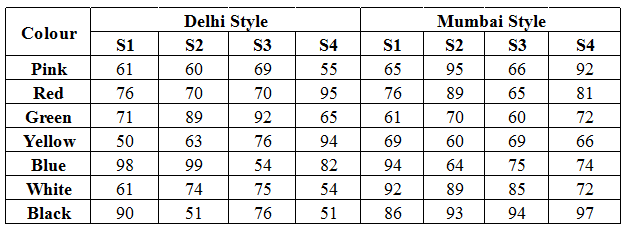
The following table gives number of T-Shirts sold (in thousand units) in Delhi and Mumbai. The T-Shirts are sold in different styles (S1, S2, S3, and S4) with different colours as shown in the table.

The average sales of which colour T-Shirt sold is same in both the cities ?

Which style T-Shirt has highest difference in numberof units sold between twocities of Delhi and Mumbai?

If the profit margin of T-Shirts of various styles S1, $2, S3 and S4 are = 100, ¥ 100, ¥ 120 and & 120 respectively, then among the colour an city combinations given below, which combination has the maximum profit ?

From the combinations given below, which one has minimum difference in units sold across cities of Delhi and Mumbai ?

Direction : Answer the questions based on the information provided.

In Gargi’s family there are 7 members A, B,C, D, E, F and G other than her consisting of Mother, Father, Brother, Sister, Uncle, Grandfather and Grandmother. They are Doctor, Professor, Director, Actor, Minister, Business Person and Artist by profession not necessarily in the same order. Gargi is a Manager of a leading restaurant and invites the family to her restaurant having round tables for seating to have dinner. The family members select a table for dinner while Gargi is on duty. Few other details are :

(a) The mother and father do not sit together.

(b) C is seated on the immediate left of Professor and A sits with B.

(c) The artist is either the sister or grandmother and sits to the immediate right of Father.

(d) The grandmother is seated on the immediate left of D who is an actor.

(e) G who is an artist sits with the Business person, F who is a female.

(f) E sits second to the left of Director.

(g) There is one family member between Grandmother and C, who is a Director.

(h) Father is a doctor and sits between Professor and Sister.

(i) Brother is not a Professor and sits with Grandmother.

Direction : Answer the questions based on the information provided.

A group of students A,B, C, D, E, F, G, H and I visit Sheesh Mahal in Jaipur and play a game of standing in a horizontal line in front of a mirror as per the directions seen in the reflection. The group consists of four girls and five boys and none of the boys are at the extreme end positions. All the boys stand together with no girl in between. A takes the lead and stands in the centre to give directions as per those seen in the reflection. Some other directions which A gives are :

(a) Gis on the extreme left while A is to the immediate left of D.

(b) C stands two places to the right of A and is not a girl.

(c) H is second to the left of B and to the immediate right of G.

(d) E is not on the extreme ends and is not a girl.

(e) B always stands between two boys.

Which of the following statementis always true ?

Whois three placesto the right of A considering A’s direction sense and not that of the reflection ?

If there are two students between F and D, then I as per reflection is :

Direction : Answer the questions based on the information provided.

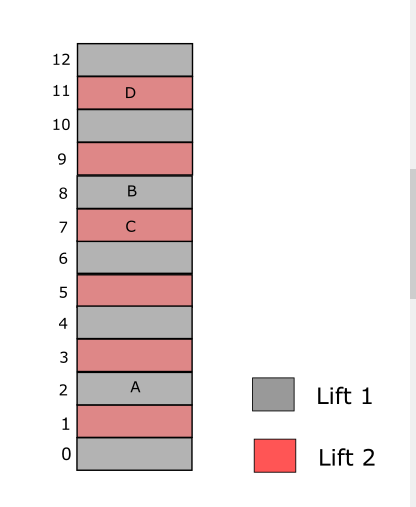
In a building with various offices on 12 floors there are two lifts. Lift 1 halts at even numbered floors and Lift 2 at odd numbered. A, B, C and D have their offices on 2, 8, 7 and 11 floors respectively. The office reaching time for A and C is 9:10 am while for B and D is 9:15 am and 9:20 am respectively. The attendance will be marked on the floor office. The lift takes 30 seconds to cross from one floor to another and halts on the selected floor for 30 seconds. The employees have to complete 8 hours and 30 minutes per day and are allowed to be late in the morning up to a maximum of 30 minutes which has to be compensated for in the evening. They have to enter the building from Ground i.e. ‘0’ floor and it is not necessary that the lift is always available.

D steps into Lift 1 by mistake with in it at 9:00 am at the ground floor and C is in Lift 2 at ground floor at the same time and realises only when the lift has started. Then approximately at what time will D reach office, if Lift 2 halts for additional 30 seconds after D boards it ?

If A reaches the building at 9:08 am and Lift 1 is at the $$6^{th}$$ floor with only B in it, at what time can at the earliest leave from office on that given day ?

Direction : Answer the questions based on the information provided.

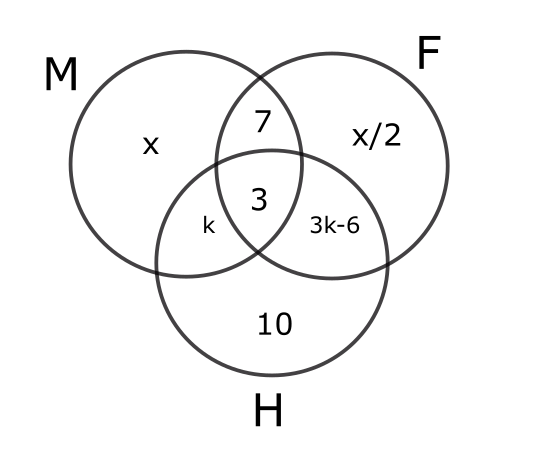
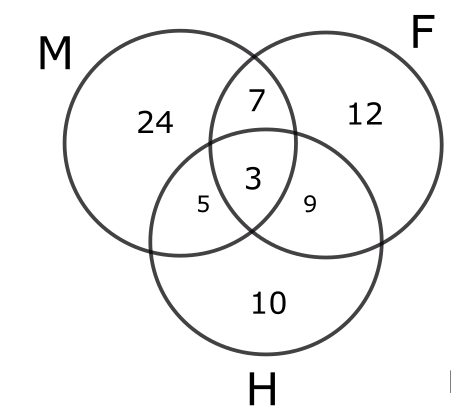
In an organisation with three departments i.e. Marketing, Finance and HR, it was decided to shuffle the 70 employees between departments. To make optimum use of resources, the management assesses their capability based on their qualification. 3 employees can work in every department. 7 employees can work in Finance and Marketing only. 10 can work only in HR while the number of employees only in Marketing is double of that in only Finance. Employees in only Finance cannot be less than 10 while employees in Finance and HR only are three times of two less than that of Marketing and HR only. The organisation has employees with all possible combinations of their capabilities.

How many employees are capable to work in Marketing and HR only ?

How many employees at the maximum are capable to work in Finance ?

For the following questions answer them individually

Direction : Answer the questions based on the information provided.

A word arrangement, when rearranged by given input follow a particular rule/logic in each step.

Following is an example of input and rearrangement. Study that rule/logic and apply on given problem.

INPUT one cannot but feel sorry for him

Steps /Results :

(I) but cannot one sorry feel him for

(II) cannot but feel sorry one for him

(III) but cannot sorry feel him for one

(IV) sorry cannot but him feel one for

If Step VI reads, ‘the best way of promoting our nation’, what will be the arrangement of the input ?

If Step V reads, ‘weeks of tepid slothful and weak performance’, what would step VI read ?

For the following questions answer them individually

2014 Hong Kong protest was termedas:

Match the Juice brands with their Company.

Which companylaunched India’sfirst ethanol based bike ?

The Gandhi Solar Park (GSP) wasrecently inaugurated at the headquarters of which international organisation ?

Adani Group wonthe bid to manage and develop which ofthe following airports in India ?

“83” is a biopic on which famous personality ?

The 2018 Winter Olympics games were heldin :

Match the Sea Port with the Country where it is located :

Heis a French Business magnate, investor and an art collector. He is the Chairman and Chief executive of LVMH,the world’s largest luxury goods company. Heis the second richest person in the world according to Forbes Magazine as on July 2019. Identify the Personality.

Which ministry launched the UDAAN Scheme?

According to latest UN International Migrant Stock 2019 report, which country is the leading country of origin of international migrants in 2019 ?

Scientist's plan to build an elevator between Earth and the Moon to cut down on the rocket fuel needed for a trip between the Earth and the Moon is known as:

Who is the co-founder of multi-brand sneaker store “Veg NonVeg” ?

Which of the following is not a recipient of Ramon Magsaysay Award ?

Which of the following country is not a member of BIMSTEC ?

With which of the following countries Afghanistan shares its border ?
(a) Turkmenistan
(b) Uzbekistan
(c) Tajikistan
(d) Iran
(e) Kyrgyztan
Select the correct option :

Name of which of the following shoe brandis derived from a ‘wild cat’ found in Americas ?

Match the festivals with the states in which they are celebrated :

The terms “Technical foul” and “Flagrant Foul” are most commonly associated with which of the following sport ?

Identify the name of ISRO Mission whoseobjective is to carry a three membercrew to low earth orbit and return them safely to a pre-defined destination on earth ?

Join CAT 2026 course by 5-Time CAT 100%iler

Crack CAT 2026 & Other Exams with Cracku!