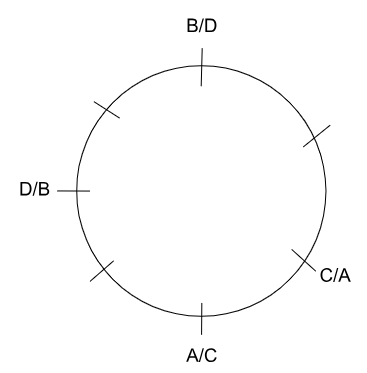
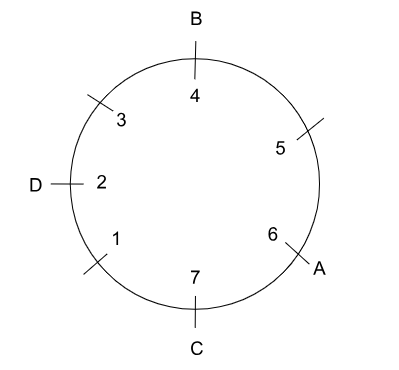
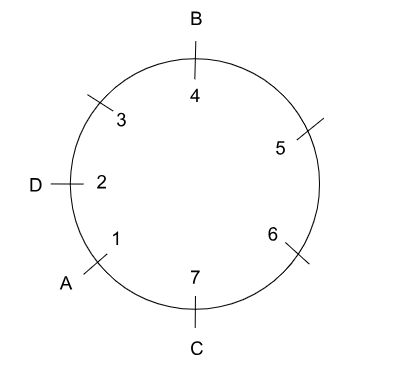
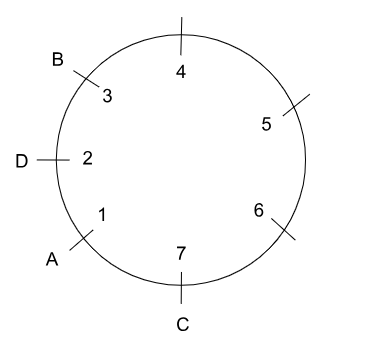
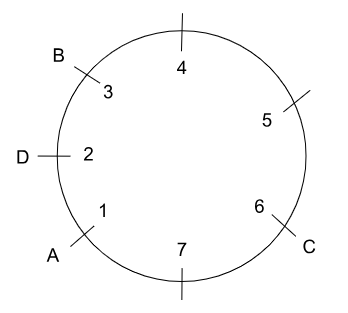
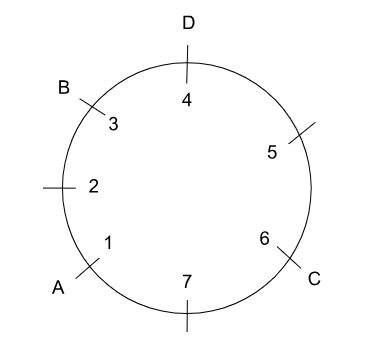
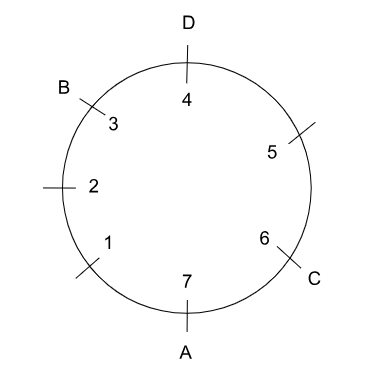
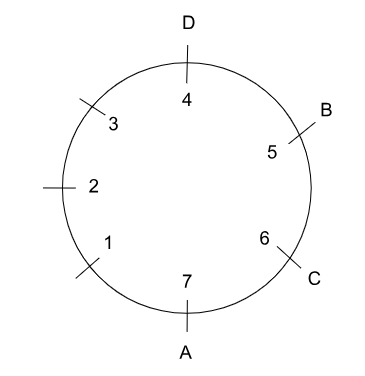
We are given that Alia tapped 6 times, Dilshan tapped 11 times, and Ehsan tapped 9 times. We also know that the total number of taps is 40. So, the sum of taps by Badal and Clive can be calculated as,
6 + Badal + Clive + 11 + 9 = 40
Badal + Clive = 14
We are given that taps by Clive are more than taps by Badal.
So, the possible pairs for taps by Clive and Badal such that the sum is 14 are (8, 6), (9, 5), (10, 4)...(14, 0).
We are given that no one gave more than two 'Yes' answers. We know that yes means one tap. So, the maximum number of 1 taps out of the 4 questions answered can be 2. The minimum possible number of taps for any person for the four questions would be 1 + 1 + 2 + 2 = 6. It is not possible for any person to have fewer than 6 taps as the maximum number of yes is 2.
So, out of all the possibilities, the only possible case for Badal is 6, and Clive is 8, as in all the other cases, the number by Badal was less than 6.
We are given that Alia answered Yes to Clive and Dilshan's questions. We know that the total number of taps by Alia is 6, and she tapped once for both those questions. The number of taps by Alia to the questions by Badal and Ehsan must be greater than 1, as we know that a person must have a maximum of two single taps. The sum of taps by Alia to Badal and Ehsan can be calculated as,
Badal + 1 + 1 + Ehsan = 6
Badal + Ehsan = 4
We know that both the values are greater than 1 and their sum is 4, so the only possibility is for both of them to be equal to 2.
So, Alia tapped twice for both Badal and Ehsan.
We are given that Dilshan answered no to Badal's question which means he tapped twice. The total number of taps by Dilshan is 11. So, the sum of taps from Alia, Clive and Ehsan's questions can be calculated as,
Alia + 2 + Clive + Ehsan = 11
Alia + Clive + Ehsan = 9
We know that the maximum possibility for each of the values is 3, and for the sum to be 9, all the values must be equal to 3.
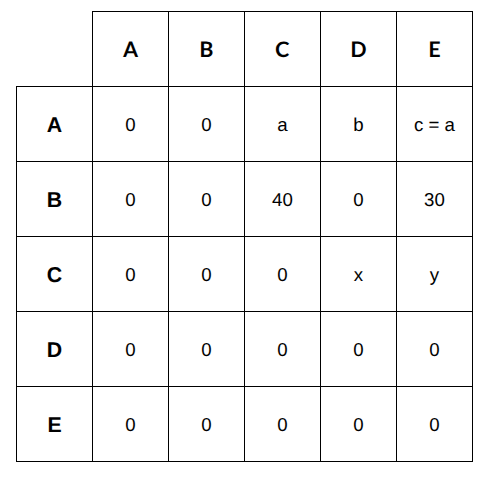
We are given that taps received for the questions by Badal, Dilshan and Ehsan are equal, so let us assume the value to be a.
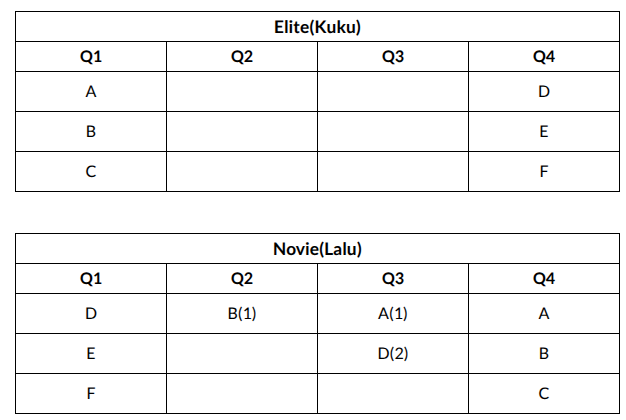
Putting all the calculated values in the table, we get,
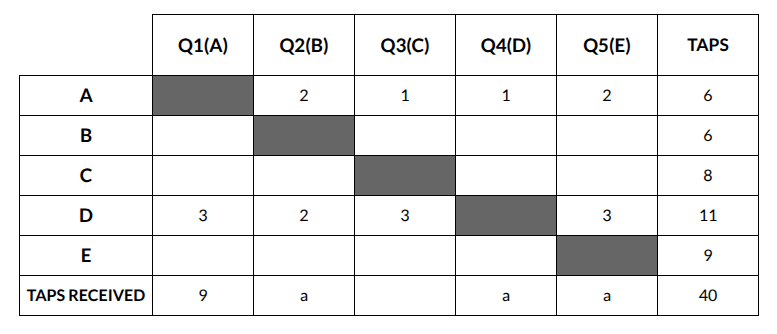
We know that each question received atleast one yes, one no and one maybe as an answer. If we examine the question asked by B, we already have two 'No's, so out of the other two, one must be 'Yes', and the other must be 'Maybe'. The taps received by B can be calculated as 2 + 2 + 1 + 3 = 8. We calculated the value of a to be 8, and the value of taps received by C can be calculated as,
9 + 8 + c + 8 + 8 = 40
c = 7
So, the number of taps received by Clive is 7.
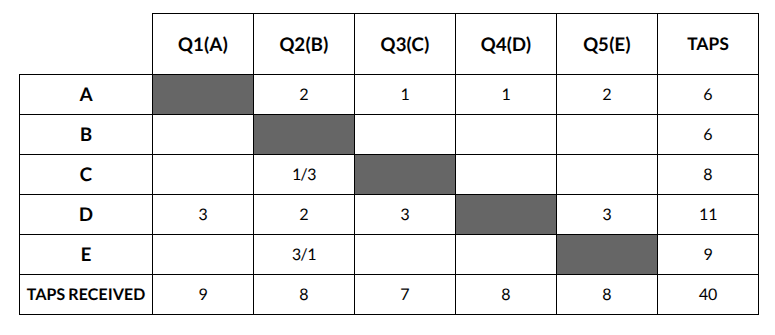
We are given that the answer by Alia does not match the answers people gave to her question. We know that the taps by Badal have to be 1, 1, 2 and 2 in some order. We know that Alia tapped twice to Badal's question, so Badal cannot tap twice to Alia's question, which means Badal tapped once for Alia's question. Now the sum of Clive and Ehsan's taps for Alia's question has to be 9 - 3 - 1 = 5. So, they have to be 2 and 3 in some order. We also know that Alia's answer to Ehsan's question is 2, so Ehsan has only one option to answer Alia, which is 3, and Clive's answer to Alia's question is 2.
Badal and Ehsan's answer to Clive's question has to be 1 and 2 in some order. Similarly, Badal and Clive's answers to Ehsan's question have to be 1 and 3 in some order.
We can also calculate the sum of taps by Badal, Clive and Ehsan to Dilshan's question is 8 - 1 = 7. So, their taps have to be 2, 2 and 3 in some order as this is the only possibility satisfying the condition of at least one Yes, one No and one Maybe for every question. We know that a tap Badal has to be either one or two, so the only possibility for Badal's answer to Dilshan's question is 2 and the other two has to be two and three in some order.
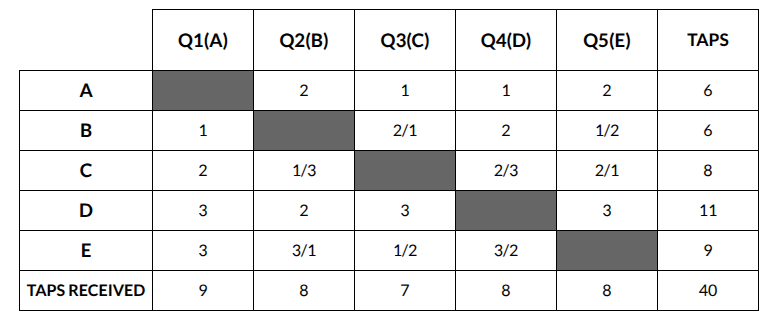
We are also given that the answer by Ehsan does not match the answers people gave to his question. Dilshan's answer to Ehsan's question is 3, so the answer by Ehsan to Dilshan's question has to be 2.
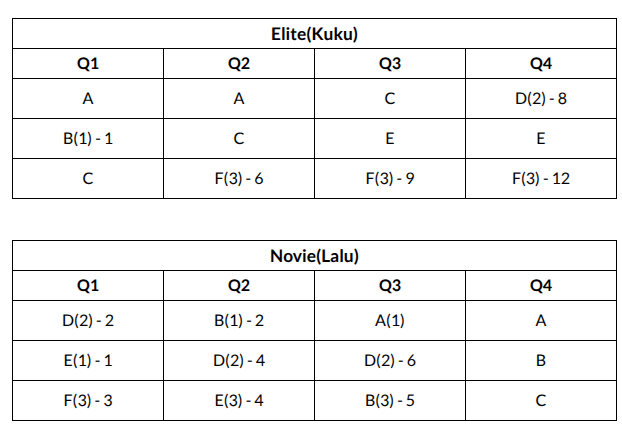
The answer by Clive to Badal's question has to be 1, as if it is 3, then the answer to Ehsan's question by Clive becomes 0, which is not possible. With that value, we can determine all the other values and putting the values in the table, we get,
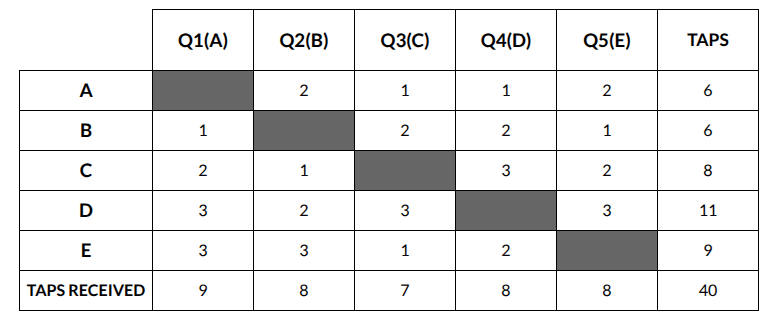
The total number of Yes responses is equal to the number of 1's in the table, which is 6.
Hence, the correct answer is 6.
 CAT WhatsApp Group
 Share
Share