Sign in
Please select an account to continue using cracku.in
↓ →
 CAT WhatsApp Group
A train travels from Station A to Station E, passing through stations B, C, and D, in that order. The train has a seating capacity of 200. A ticket may be booked from any station to any other station ahead on the route, but not to any earlier station.
A ticket from one station to another reserves one seat on every intermediate segment of the route. For example, a ticket from B to E reserves a seat in the intermediate segments B - C, C - D, and D - E.
The occupancy factor for a segment is the total number of seats reserved in the segment as a percentage of the seating capacity. The total number of seats reserved for any segment cannot exceed 200.
The following information is known.
1. Segment C - D had an occupancy factor of 95%. Only segment B - C had a higher occupancy factor.
2. Exactly 40 tickets were booked from B to C and 30 tickets were booked from B to E.
3. Among the seats reserved on segment D - E, exactly four-sevenths were from stations before C.
4. The number of tickets booked from A to C was equal to that booked from A to E, and it was higher than that from B to E.
5. No tickets were booked from A to B, from B to D and from D to E.
6. The number of tickets booked for any segment was a multiple of 10.
How many tickets were booked from Station A to Station E?
Correct Answer: 50

Assuming the tickets from A - C, A - D, and A - E to be $$a,b$$ and $$c$$, respectively. Also, assuming the tickets from C - D and C - E to be $$x$$ and $$y$$, respectively. We are also given that the number of tickets from A - C is equal to the number of tickets booked from A - E, so the value of $$a=c$$. We are also given that 40 tickets were booked from B to C, and 30 tickets were booked from B to E. Other information provided is that no tickets were booked from A to B, from B to D, or from D to E.
Putting all the given information in the table, we get,
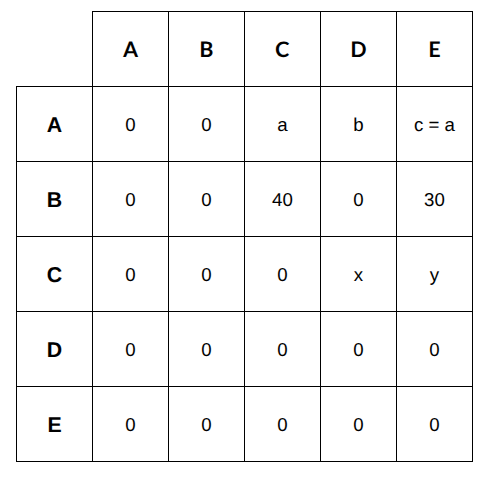
From the above table, the tickets in the segments A - B, B - C, C - D and D - E can be calculated as,
A - B $$=a+b+c=2a+b$$
B - C $$=a+b+c+30+40=2a+b+70$$
C - D $$=a+b+x+y+30$$
D - E $$=c+y+30=a+y+30$$
We are given that segment C - D had an occupancy factor of 95%. We can calculate the number of seats occupied in the segment C - D as,
Seats occupied in segment C - D $$=\dfrac{95}{100}\times\ 200\ =\ 190$$
We are given that the B - C segment had more occupancy than the C - D segment. We are also given that a, b, c, x and y are multiples of 10 as per clue 6.
We also know that the people on board in a segment cannot be more than 200. The only value greater than 190 that is a multiple of 10 is 200. So, B - C segment had 200 seats occupied.
Equating it with the above equation, we get,
$$2a+b+70=200$$
$$2a+b=130$$ --(1)
$$a+b+x+y+30 = 190$$
$$a+b+x+y=160$$ --(2)
We are also given that among the seats reserved on segment D - E, exactly four-sevenths were from stations before C. The seats reserved on segment D - E before station C are a + 30.
Equating the expressions, we get,
$$\dfrac{4}{7}\left(a\ +\ y\ +\ 30\right)\ =\ a\ +\ 30$$
$$a\ +\ y\ +\ 30\ =\ \dfrac{7}{4}\left(a\ +\ 30\right)$$ ---(3)
So, the seats occupied during D - E $$=a\ +\ y\ +\ 30\ =\ \dfrac{7}{4}\left(a\ +\ 30\right)$$
We know that this value has to be an integer.
We are given that the number of tickets booked from A to C was higher than that from B to E. This means that the value of a > 30.
We know that a and b are positive multiples of 10, so the possible values of a that are greater than 30 and satisfy the equation (1) are 40, 50 and 60.
The only value of a at which the equation (3) is an integer is when $$a+30$$ is a multiple of 4, and the only value out of the above values that satisfies the condition is when $$a=50$$, as at $$a=40$$ and 60, the value of $$a+30$$ is not a multiple of 4.
We can conclude that the value of $$a=50$$, and substituting in (1), we get the value of $$b=30$$.
Substituting in (3), we get,
$$50\ +\ y\ +\ 30\ =\ \frac{7}{4}\left(50\ +\ 30\right)$$
$$\ y\ +\ 80\ =\ 140$$
$$\ y\ =\ 60$$
Substituting all the values in (2), we get,
$$50\ +\ 30\ +\ x\ +\ 60\ =\ 160$$
$$x\ =\ 20$$
Putting all the values in the table, we get,
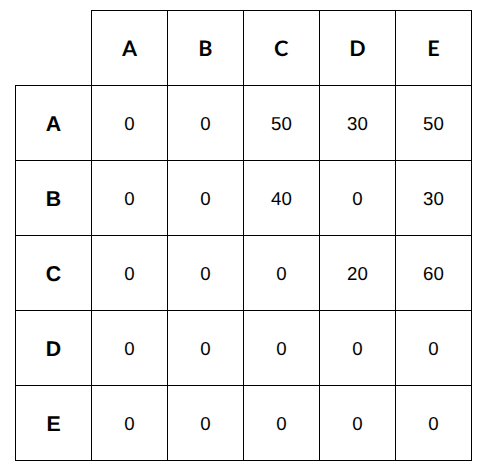
A - B $$=a+b+c=2a+b=130$$
B - C $$=a+b+c+30+40=2a+b+70=200$$
C - D $$=a+b+x+y+30=190$$
D - E $$=c+y+30=a+y+30=140$$
The number of tickets booked from station A to E from the above table is 50.
Hence, the correct answer is 50.
Was this solution helpful?
Click on the Email ☝️ to Watch the Video Solution
Create a FREE account and get:
Book Free CAT Mentorship
Get personalized CAT strategy from a 99%iler
500+ students mentored
OTP Verification
Enter the 6-digit code sent to your phone
Booking Summary
Enter OTP
Didn't receive the OTP?
Start your IIM journey with the right preparation and crack CAT 2026.

Educational materials for CAT preparation

Ask our AI anything

AI can make mistakes. Please verify important information.
AI can make mistakes. Please verify important information.
 91- 6303239042