Sign in
Please select an account to continue using cracku.in
↓ →
 CAT WhatsApp Group
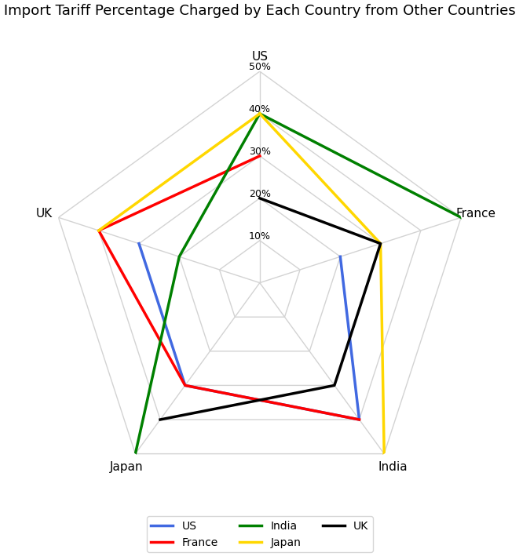
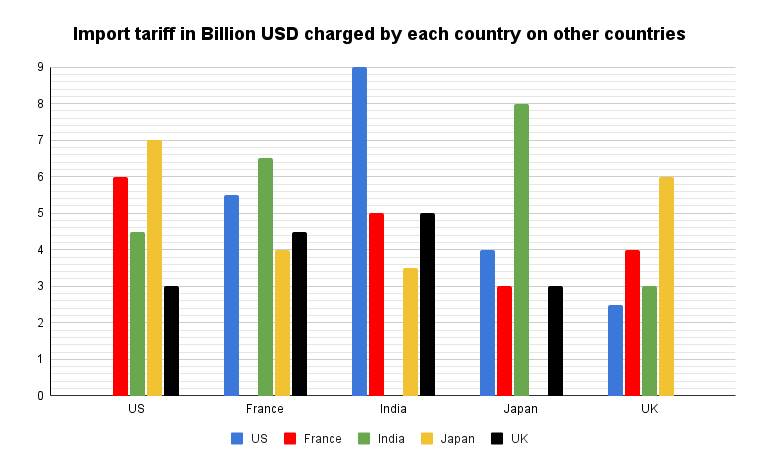
Five countries engage in trade with each other. Each country levies import tariffs on the other countries. The import tariff levied by Country X on Country Y is calculated by multiplying the corresponding tariff percentage with the total imports of Country X from Country Y.
The radar chart below depicts different import tariff percentages charged by each of the five countries on the others. For example, US (the blue line in the chart) charges 20%, 40%, 30%, and 30% import tariff percentages on imports from France, India, Japan, and UK, respectively. The bar chart depicts the import tariffs levied by each county on other countries. For example, US charged import tariff of 3 billion USD on UK.
Assume that imports from one country to another equals the exports from the latter to the former.
The trade surplus of Country X with Country Y is defined as follows.
Trade surplus = Exports from Country X to Country Y - Imports to Country X from Country Y.
A negative trade surplus is called trade deficit.
The values given in both charts together are represented in the table below, with the import tariff percentages charged by each of the five countries on the others represented as a percentage, and the import tariffs levied by each country on other countries are represented in brackets(in billion USD).

Japan's export to India would be the same as India's import from Japan.
India is charging a 50% tariff on Japan, and the tariff by India on Japan equals 3.5 billion USD.
So, 50% of the imports equals 3.5 billion USD.
$$\dfrac{50}{100}\ \times\ $$ Imports $$=\ 3.5$$
Imports $$=\ 3.5\ \times\ 2\ =\ 7$$ billion USD.
The value of imports by India from Japan = Japan's export to India = 7 billion USD.
Hence, the correct answer is option C.
Was this solution helpful?
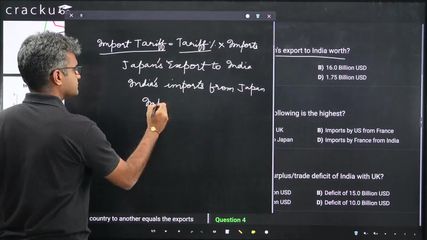
Click on the Email ☝️ to Watch the Video Solution
Create a FREE account and get:
Book Free CAT Mentorship
Get personalized CAT strategy from a 99%iler
500+ students mentored
OTP Verification
Enter the 6-digit code sent to your phone
Booking Summary
Enter OTP
Didn't receive the OTP?
Start your IIM journey with the right preparation and crack CAT 2026.

Educational materials for CAT preparation

Ask our AI anything

AI can make mistakes. Please verify important information.
AI can make mistakes. Please verify important information.
 91- 6303239042