Sign in
Please select an account to continue using cracku.in
↓ →
 CAT WhatsApp Group
A round table has seven chairs around it. The chairs are numbered 1 through 7 in a clockwise direction. Four friends, Aslam, Bashir, Chhavi, and Davies, sit on four of the chairs. In the starting position, Aslam and Chhavi are sitting next to each other, while for Bashir as well as Davies, there are empty chairs on either side of the chairs that are sitting on.
The friends take turns moving either clockwise or counterclockwise from their chair. The friend who has to move in a turn occupies the first empty chair in whichever direction (s)he chooses to move. Aslam moves first (Turn 1), followed by Bashir, Chhavi, and Davies (Turns 2, 3, and 4, respectively). Then Aslam moves again followed by Bashir, and Chhavi (Turns 5, 6, and 7, respectively).
The following information is known
1. The four friends occupy adjacent chairs only at the end of Turn 2 and Turn 6.
2. Davies occupies Chair 2 after Turn 1 and Chair 4 after Turn 5, and Chhavi occupies Chair 7 after Turn 2.
Which of the following BEST describes the friends sitting on chairs adjacent to the one occupied by Bashir at the end of Turn 7?

Based on the information about the initial positions of Aslam and Chhavi sitting next to each other, while Bashir and Davies have empty chairs on either side of their seats, the possible combinations are,
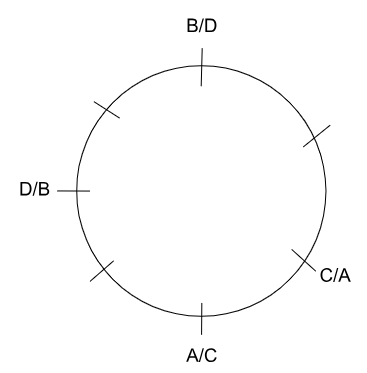
This has 4 possible combinations.
We are also given that Davies occupies Chair 2 after Turn 1 and Chhavi occupies Chair 7 after Turn 2. We know that the positions of Davies and Chhavi won't be changing after turn 2, as we know that in those turns, only the positions of Aslam and Bashir are being changed in the first 2 turns. Therefore, we can determine that Davies' initial position is chair 2, and Chhavi's initial position is chair 7.
Out of the 4 possible combinations, Davies on chair 2 and Chhavi on chair 7 are only possible in one case, which is,
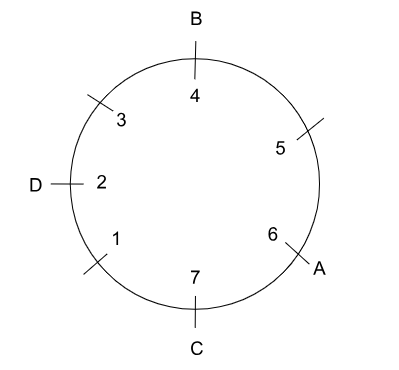
We now have the initial position, and we are told that all the members are adjacent only after turn 2 and turn 6.
We know that A changed his position in turn 1.
Turn 1: Aslam moves
If A changed his position anticlockwise, he would go to chair 5, and if he changed his position clockwise, he would go to chair 1.
If A ends in chair 5 after turn 1, then it is not possible for all of them to be adjacent to each other after B changes his position in turn 2.
So, A has to end in chair 1 after turn 1, so that B will have a chance in turn 2 for all of them to be adjacent.
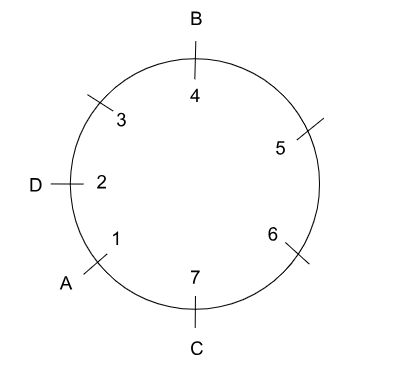
Turn 2: Bashir moves
For all of them to be adjacent after turn 2, B must change his position anticlockwise, and after turn 2, he would end up on chair 3.
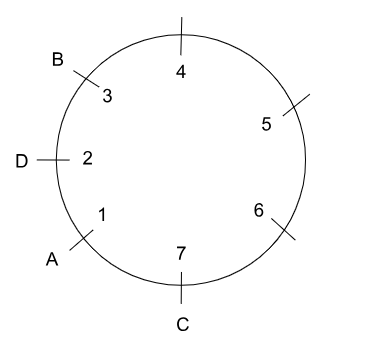
Turn 3: Chhavi moves
We are given that Davies occupies chair 4 after turn 5, and for this to happen, chair 4 must be empty and cannot be occupied by anyone who does not move before turn 5. So, in turn 3, C must go anticlockwise and occupy chair 6, as if he goes clockwise, he would occupy chair 4, which must be empty for Davies.
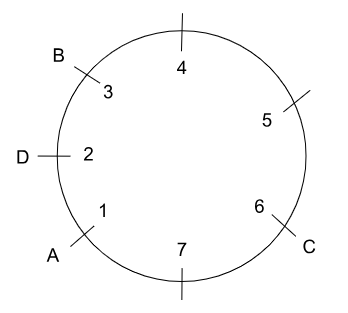
Turn 4: Davies moves
Davies will not move in turn 5, and for him to occupy chair 4 after turn 5, he must occupy it on turn 4. So, D has to go clockwise in turn 4 and must occupy chair 4.
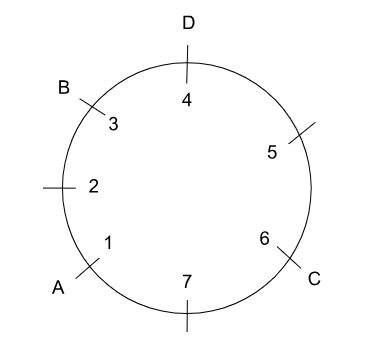
Turn 5: Aslam moves
We know that all of them are again adjacent after turn 6. If A goes clockwise in turn 5, then he will occupy the chair 2, and in that case, it is not possible for them to be adjacent after turn 6 in either of the cases of B going clockwise or anticlockwise.
So, A must go anticlockwise and occupy chair 7 for them to be adjacent after turn 6.
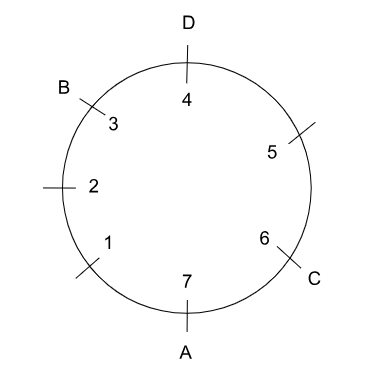
Turn 6: Bashir moves
Now, for them to be adjacent after turn 6, B must go clockwise and must occupy chair 5.
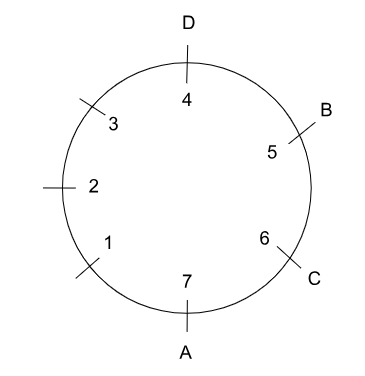
Turn 7: Chavvi moves
We do not have any information to determine whether C went clockwise or anticlockwise. So, both cases are possible after turn 7.
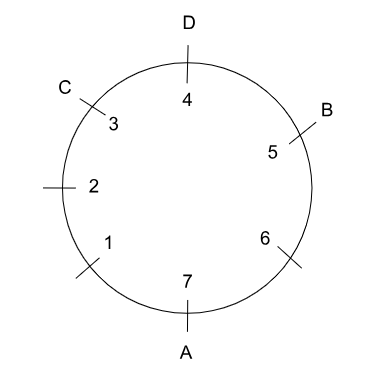
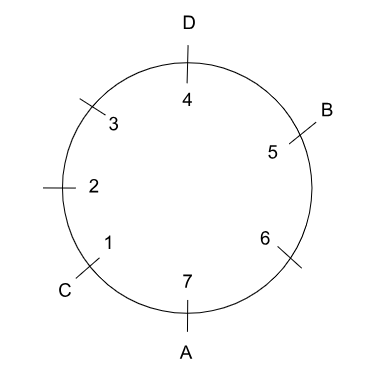
In either of the cases after turn 7, the seat adjacent to Bashir is occupied only by Davies, and the other one is empty.
Hence, the correct answer is option B.
Was this solution helpful?
Click on the Email ☝️ to Watch the Video Solution
Create a FREE account and get:
Book Free CAT Mentorship
Get personalized CAT strategy from a 99%iler
500+ students mentored
OTP Verification
Enter the 6-digit code sent to your phone
Booking Summary
Enter OTP
Didn't receive the OTP?
Start your IIM journey with the right preparation and crack CAT 2026.

Educational materials for CAT preparation

Ask our AI anything

AI can make mistakes. Please verify important information.
AI can make mistakes. Please verify important information.
 91- 6303239042