We can infer from the passage that medieval crafts guilds resembled mass production in that both
Sign in
Please select an account to continue using cracku.in
↓ →
The passage below is accompanied by four questions. Based on the passage, choose the best answer for each question.
. . . [T]he idea of craftsmanship is not simply nostalgic. . . . Crafts require distinct skills, an allround approach to work that involves the whole product, rather than individual parts, and an attitude that necessitates devotion to the job and a focus on the communal interest. The concept of craft emphasises the human touch and individual judgment.
Essentially, the crafts concept seems to run against the preponderant ethos of management studies which, as the academics note, have long prioritised efficiency and consistency. . . . Craft skills were portrayed as being primitive and traditionalist.
The contrast between artisanship and efficiency first came to the fore in the 19th century when British manufacturers suddenly faced competition from across the Atlantic as firms developed the “American system” using standardised parts. . . . the worldwide success of the Singer sewing machine showed the potential of a mass-produced device. This process created its own reaction, first in the form of the Arts and Crafts movement of the late 19th century, and then again in the “small is beautiful” movement of the 1970s. A third crafts movement is emerging as people become aware of the environmental impact of conventional industry.
There are two potential markets for those who practise crafts. The first stems from the existence of consumers who are willing to pay a premium price for goods that are deemed to be of extra quality. . . . The second market lies in those consumers who wish to use their purchases to support local workers, or to reduce their environmental impact by taking goods to craftspeople to be mended, or recycled.
For workers, the appeal of craftsmanship is that it allows them the autonomy to make creative choices, and thus makes a job far more satisfying. In that sense, it could offer hope for the overall labour market. Let the machines automate dull and repetitive tasks and let workers focus purely on their skills, judgment and imagination. As a current example, the academics cite the “agile” manifesto in the software sector, an industry at the heart of technological change. The pioneers behind the original agile manifesto promised to prioritise “individuals and interactions over processes and tools”. By bringing together experts from different teams, agile working is designed to improve creativity.
But the broader question is whether crafts can create a lot more jobs than they do today. Demand for crafted products may rise but will it be easy to retrain workers in sectors that might get automated (such as truck drivers) to take advantage? In a world where products and services often have to pass through regulatory hoops, large companies will usually have the advantage.
History also suggests that the link between crafts and creativity is not automatic. Medieval craft guilds were monopolies which resisted new entrants. They were also highly hierarchical with young men required to spend long periods as apprentices and journeymen before they could set up on their own; by that time the innovative spirit may have been knocked out of them. Craft workers can thrive in the modern era, but only if they don’t get too organised.
We can infer from the passage that medieval crafts guilds resembled mass production in that both
Option A is the correct answer.
The passage mentions that medieval craft guilds were monopolies that resisted new entrants and required long apprenticeship periods, which could stifle innovative spirit. Similarly, the ethos of mass production prioritizes efficiency and consistency, which often comes at the expense of creativity. Therefore, Option A could be inferred.
Option B: While it is true that medieval guilds restricted entry through strict rules, the passage does not suggest that mass production involves such restrictions.
Option C: The passage does not discuss whether mass production or medieval guilds employed egalitarian processes.
Option D: The passage does not mention that medieval guilds or mass production focused excessively on product quality.
Which one of the following statements is NOT inconsistent with the views stated in the passage?
Option B is the correct answer.
The passage mentions that medieval craft guilds were monopolistic and hierarchical, resisting new entrants and imposing long apprenticeships, which could stifle innovation. It also warns that modern craft workers “can thrive... only if they don’t get too organised,” supporting option B.
Option A: This is an extreme interpretation. The passage does not argue that supporting crafts is the only way to retain the creativity intrinsic to their production.
Option C: The Arts and Crafts movement is described as a reaction against the “American system” and the rise of mass production, not an inspiration drawn from it.
Option D: Agile movement is praised for prioritizing creativity and collaboration, whereas medieval craft guilds are described as hierarchical and restrictive, which stifled innovation. These are contrasting ideas. Therefore, agile movement cannot be a throwback to the tenets (principles) of medieval craft guilds)
The author questions the ability of crafts to create substantial employment opportunities presently because
Option B is the correct answer.
The author says "In a world where products and services often have to pass through regulatory hoops, large companies will usually have the advantage." From this, we can infer that the author doubts whether crafts can create substantial employment opportunities because smaller craft businesses may struggle to compete with larger companies due to regulatory barriers.
Option A: The passage does not focus on the low scale of crafts production as the primary obstacle. Instead, the author emphasizes regulatory challenges and not the scale.
Option C: The passage does not argue that workers wouldn’t want to pursue crafts-related work, just that retraining them for these roles might be difficult.
Option D: The passage mentions that craft guilds resisted new entrants, but it does not suggest that they are unlikely to accept large number of trainees. The passage suggests that craft workers can thrive in the modern era, but the challenge lies in how modern crafts are organized and their potential to scale up in a competitive market.
The most recent revival in interest in the crafts is a result of the emergence of all of the following EXCEPT:
Option A is the correct answer.
While the passage mentions the premium for high-quality crafted goods and the contrast between mass production and craftsmanship, it does not mention that there is support for "individual creations" as opposed to mass-produced goods. The focus is on quality and sustainability rather than explicitly advocating for individuality in products.
Option B: This is mentioned. The passage talks about consumers wanting to reduce environmental impact by supporting local workers or recycling goods, which reflects growing concerns over mass production.
Option C: This is mentioned. The passage describes a market of consumers who pay a premium for high-quality, hand-crafted goods.
Option D: This is mentioned. The passage highlights a market where consumers buy from local workers to support the community and reduce environmental impact.
The passage given below is followed by four alternate summaries. Choose the option that best captures the essence of the passage.
Scientific research shows that many animals are very intelligent and have sensory and motor abilities that dwarf ours. Dogs are able to detect diseases such as cancer and diabetes and warn humans of impending heart attacks and strokes. Elephants, whales, hippopotamuses, giraffes, and alligators use low-frequency sounds to communicate over long distances, often miles. Many animals also display wide-ranging emotions, including joy, happiness, empathy, compassion, grief, and even resentment and embarrassment. It’s not surprising that animals share many emotions with us because we also share brain structures, located in the limbic system, that are the seat of our emotions.
Option B is the correct answer.
The paragraph states that animals share many emotions with humans, such as joy, happiness, empathy, and grief, because of shared brain structures, particularly in the limbic system, which is responsible for emotions in both humans and animals. This is the key point that ties together animals' intelligence and emotional capacity, as discussed in the passage.
Option A: The passage does not attribute emotions to sensory and motor abilities. The emphasis is on brain structures, not sensory abilities.
Option C: While the passage states that animals share emotions with humans, this option fails to capture the reason behind this, i.e. shared brain structures. It misses the point that makes the emotional similarity possible, which is central to the passage's message.
Option D: The passage discusses animals' sensory abilities but does not suggest that their intelligence is superior to humans'.
The passage below is accompanied by four questions. Based on the passage, choose the best answer for each question.
Oftentimes, when economists cross borders, they are less interested in learning from others than in invading their garden plots. Gary Becker, for instance, pioneered the idea of human capital. To do so, he famously tackled topics like crime and domesticity, applying methods honed in the study of markets to domains of nonmarket life. He projected economics outward into new realms: for example, by revealing the extent to which humans calculate marginal utilities when choosing their spouses or stealing from neighbors. At the same time, he did not let other ways of thinking enter his own economic realm: for example, he did not borrow from anthropology or history or let observations of nonmarket economics inform his homo economicus. Becker was a picture of the imperial economist in the heyday of the discipline’s bravura.
Times have changed for the once almighty discipline. Economics has been taken to task, within and beyond its ramparts. Some economists have reached out, imported, borrowed, and collaborated—been less imperial, more open. Consider Thomas Piketty and his outreach to historians. The booming field of behavioral economics—the fusion of economics and social psychology—is another case. Having spawned active subfields, like judgment, decisionmaking and a turn to experimentation, the field aims to go beyond the caricature of Rational Man to explain how humans make decisions….
It is important to underscore how this flips the way we think about economics. For generations, economists have presumed that people have interests—“preferences,” in the neoclassical argot—that get revealed in the course of peoples’ choices. Interests come before actions and determine them. If you are hungry, you buy lunch; if you are cold, you get a sweater. If you only have so much money and can’t afford to deal with both your growling stomach and your shivering, which need you choose to meet using your scarce savings reveals your preference.
Psychologists take one look at this simple formulation and shake their heads. Increasingly, even some mainstream economists have to admit that homo economicus doesn’t always behave like the textbook maximizer; irrational behavior can’t simply be waved away as extraeconomic expressions of passions over interests, and thus the domain of other disciplines…. This is one place where the humanist can help the economist. If narrative economics is going to help us understand how rivals duke it out, who wins and who loses, we are going to need much more than lessons from epidemiological studies of viruses or intracranial stimuli.
Above all, we need politics and institutions. Shiller [the Nobel prize winning economist] connects perceptions of narratives to changes in behavior and thence to social outcomes. He completes a circle that was key to behavioral economics and brings in storytelling to make sense of how perceptions get framed. This cycle (perception to behavior to society) was once mediated or dominated by institutions: the political parties, lobby groups, and media organizations that played a vital role in legitimating, representing, and excluding interests. Yet institutions have been stripped from Shiller’s account, to reveal a bare dynamic of emotions and economics, without the intermediating place of politics.
We can infer from the passage that the term '‘homo economicus” refers to someone who
Option C is the correct answer.
The passage suggests that the idea of 'homo economicus' assumes that people have “preferences” that determine their choices. Deciding whether to spend limited money on food or warmth illustrates this rational decision-making based on individual preferences. This aligns with option C
Option A: The passage does not suggest that 'homo economicus' is not influenced by others’ preferences. It only states that this model assumes people have their own preferences that determine their actions.
Option B: This is wrong as the passage states that economists like Gary Becker, associated with the homo economicus model, did not borrow or collaborate with other disciplines.
Option D: The passage mentions applying economic reasoning to nonmarket domains but does not tie this specifically to homo economicus.
“Times have changed for the once almighty discipline.” We can infer from this statement and the associated paragraph that the author is being
Option A is the correct answer.
The tone of the phrase “almighty discipline” suggests mild sarcasm regarding economics' earlier dominance and self-containment. The statement reflects a shift in economics from being insular and self-assured to being more open to interdisciplinary borrowing. The author describes earlier economists, like Gary Becker, as imperialistic and unwilling to incorporate ideas from other disciplines. In contrast, contemporary economists like Thomas Piketty are portrayed as reaching out and collaborating.
Option B: The passage mentions that economists are now collaborating with other disciplines, but it does not suggest this is due to their inability to predict market behaviour. The focus is on how the discipline has shifted over time, not any predictive failures.
Option C: The author does not criticize economic tools for managing crises or say that economics as a discipline has fallen. The passage highlights a transformation toward openness, not a downfall.
Option D: The author is not critical of economists collaborating with other disciplines. Instead, the passage presents this shift as a positive change, contrasting it with the earlier insularity of the discipline.
The author critiques Schiller’s approach to behavioural economics for
Option C is the correct answer.
The author critiques Schiller for focusing on the direct relationship between emotions, perceptions, and behaviour while excluding the mediating role of institutions such as political parties, media organizations, and lobby groups. The passage states that these institutions historically played a vital role in framing perceptions and legitimizing interests, which Schiller’s narrative leaves out.
Option A: The passage suggests that media and politics are key intermediaries in shaping perceptions and behaviour and not a marginal role.
Option B: The passage does not suggest that Shiller actively denigrates or diminishes the role of institutions. The issue is his omission of institutions, not his critique of their importance.
Option D: The passage mentions that storytelling is part of Schiller’s approach but does not critique him for relying excessively on it. The critique is about the exclusion of institutions, not the use of storytelling.
In the first paragraph the author is making the point that economists like Becker
Option C is the correct answer.
The first paragraph describes how Becker projected economics into non-market domains like crime and domesticity, analyzing them with economic tools. It also states that he did not borrow ideas or perspectives from fields such as anthropology or history. Option C aligns with this.
Option A: The passage mentions that Becker applied economic principles to non-market phenomena like crime and domesticity, but it does not state or imply that he benefitted from this.
Option B: The passage explicitly contradicts this idea, stating: “At the same time, he did not let other ways of thinking enter his own economic realm: for example, he did not borrow from anthropology or history.” Becker did not borrow from other disciplines, so this option is incorrect.
Option D: The passage does not state that Becker actively guarded economics against outside influence. Instead, it focuses on Becker’s one-sided application of economics to other areas, without accepting external perspectives.
There is a sentence that is missing in the paragraph below. Look at the paragraph and decide where (option 1, 2, 3, or 4) the following sentence would best fit.
Sentence: Comprehending a wide range of emotions, Renaissance music nevertheless portrayed all emotions in a balanced and moderate fashion.
Paragraph: A volume of translated Italian madrigals were published in London during the year of 1588. This sudden public interest facilitated a surge of English Madrigal writing as well as a spurt of other secular music writing and publication. ___(1)___. This music boom lasted for thirty years and was as much a golden age of music as British literature was with Shakespeare and Queen Elizabeth I. ___(2)___. The rebirth in both literature and music originated in Italy and migrated to England; the English madrigal became more humorous and lighter in England as compared to Italy. Renaissance music was mostly polyphonic in texture. ___(3)___. Extreme use of and contrasts in dynamics, rhythm, and tone colour do not occur. ___(4)___. The rhythms in Renaissance music tend to have a smooth, soft flow instead of a sharp, well-defined pulse of accents.
The sentence would best fit in B) Option 3.
Option 3 is the most logical position because it continues the description of Renaissance music’s characteristics, which was mentioned in the sentence before blank 3. The missing sentence fits perfectly here, as it discusses how Renaissance music handles emotions in a balanced and moderate manner, aligning with the flow and tone of the preceding sentences.
The sentences around Option 1 and Option 2 discuss the historical context of English madrigals and their cultural significance, so adding the sentence there would disrupt the historical narrative.
Option 4 may appear plausible, but the sentence discussing the balanced and moderate nature of music after asserting that extremes do not occur would be redundant. The given sentence should precede the one addressing extremes to maintain logical flow.
There is a sentence that is missing in the paragraph below. Look at the paragraph and decide where (option 1, 2, 3, or 4) the following sentence would best fit.
Sentence: Understanding central Asia’s role helps developments make more sense not only across Asia but in Europe, the Americas and Africa.
Paragraph: The nations of the Silk Roads are sometimes called ‘developing countries’, but they are actually some of the world’s most highly developed countries, the very crossroads of civilization, in advanced states of disrepair. ___(1)___. These countries lie at the centre of global affairs: they have since the beginning of history. Running across the spine of Asia, they form a web of connections fanning out in every direction, routes along which pilgrims and warriors, nomads and merchants have travelled, goods and produce have been bought and sold, and ideas exchanged, adapted and refined. ___(2)___ .They have carried not only prosperity, but also death and violence, disease and disaster. ___(3)___. The Silk Roads are the world’s central nervous system, connecting otherwise far-flung peoples and places…. ___(4)___. It allows us to see patterns and links, causes and effects that remain invisible if one looks only at Europe, or North America.
We can observe that the only spot where the given sentence would fit is Blank 4. This sentence in question emphasises the broader, global significance of Central Asia's role; it reflects the idea that understanding the Silk Roads provides clarity on historical and global interconnectedness.
Since the given sentence shifts focus from describing the historical and cultural importance of the Silk Roads to their global implications, which is broader than the current discussion, placing it in any of Blanks 1, 2, or 3 interrupts the flow between the statements outlining certain features linked to the Silk Roads. For example, Blank 1 is a poor fit since the succeeding sentence mentions “These countries,” which refers to the “developing countries” mentioned in the sentence preceding the blank. Similarly, “They” in the sentence after Blank 2 refers to routes/Silk Roads described earlier. We can eliminate Blank 3 using a similar logic; the sentence after this blank establishes the metaphor of the Silk Roads as a central nervous system, emphasizing their global connectivity. The given sentence doesn’t align with the focus on the Silk Roads’ tangible impacts or the metaphorical depiction of their connectivity; therefore, placing it in Blank 3 would shift the focus prematurely to understanding their role globally.
Five jumbled up sentences (labelled 1, 2, 3, 4 and 5), related to a topic, are given below. Four of them can be put together to form a coherent paragraph. Identify the odd sentence and key in the number of that sentence as your answer.
1. Urbanites also have more and better options for getting around: Uber is ubiquitous; easy-to-rent dockless bicycles are spreading; battery-powered scooters will be next.
2. When more people use buses or trains the service usually improves because public-transport agencies run more buses and trains.
3. Worsening services on public transport, terrorist attacks in some urban metros and a rise in fares have been blamed for this trend.
4. It seems more likely that public transport is being squeezed structurally as people’s need to travel is diminishing as a result of smartphones, videoconferencing, online shopping and so on.
5. There has been a puzzling decline in the use of urban public transport in many countries in the west, despite the growth in urban populations and rising employment.
Sentence 2 is the odd one out.
The sequence 5-3-4-1 forms a coherent paragraph.
Sentence 5 introduces the issue of the puzzling decline in public transport despite growing urban populations and employment.
Sentence 3, then explains some of the reasons for the decline, like worsening services, terrorist attacks, and rising fares.
Sentence 4 adds a structural explanation, stating that public transport is being squeezed as people travel less due to technology.
Sentence 1 provides more details about the alternatives to public transport, which are contributing to the decline in usage.
Sentence 2 talks about how more people using buses or trains improves the service, but this idea is not directly relevant to the overall discussion in the passage, which focuses on the decline of public transport usage. It shifts the focus toward an increase in usage improving services, which contradicts the central theme of decline.
The passage below is accompanied by four questions. Based on the passage, choose the best answer for each question.
Landing in Australia, the British colonists weren’t much impressed with the small-bodied, slender-snooted marsupials called bandicoots. “Their muzzle, which is much too long, gives them an air exceedingly stupid,” one naturalist noted in 1805. They nicknamed one type the “zebra rat” because of its black-striped rump.
Silly-looking or not, though, the zebra rat—the smallest bandicoot, more commonly known today as the western barred bandicoot—exhibited a genius for survival in the harsh outback, where its ancestors had persisted for some 26 million years. Its births were triggered by rainfall in the bone-dry desert. It carried its breath-mint-size babies in a backward-facing pouch so mothers could forage for food and dig shallow, camouflaged shelters.
Still, these adaptations did not prepare the western barred bandicoot for the colonial-era transformation of its ecosystem, particularly the onslaught of imported British animals, from cattle and rabbits that damaged delicate desert vegetation to ravenous house cats that soon developed a taste for bandicoots. Several of the dozen-odd bandicoot species went extinct, and by the 1940s the western barred bandicoot, whose original range stretched across much of the continent, persisted only on two predator-free islands in Shark Bay, off Australia’s western coast.
“Our isolated fauna had simply not been exposed to these predators,” says Reece Pedler, an ecologist with the Wild Deserts conservation program.
Now Wild Deserts is using descendants of those few thousand island survivors, called Shark Bay bandicoots, in a new effort to seed a mainland bandicoot revival. They’ve imported 20 bandicoots to a preserve on the edge of the Strzelecki Desert, in the remote interior of New South Wales. This sanctuary is a challenging place, desolate much of the year, with one of the world’s most mercurial rainfall patterns—relentless droughts followed by sudden drenching floods.
The imported bandicoots occupy two fenced “exclosures,” cleared of invasive rabbits (courtesy of Pedler’s sheepdog) and of feral cats (which slunk off once the rabbits disappeared). A third fenced area contains the program’s Wild Training Zone, where two other rare marsupials (bilbies, a larger type of bandicoot, and mulgaras, a somewhat fearsome fuzzball known for sucking the brains out of prey) currently share terrain with controlled numbers of cats, learning to evade them. It’s unclear whether the Shark Bay bandicoots, which are perhaps even more predator-naive than their now-extinct mainland bandicoot kin, will be able to make that kind of breakthrough.
For now, though, a recent surge of rainfall has led to a bandicoot joey boom, raising the Wild Deserts population to about 100, with other sanctuaries adding to that number. There are also signs of rebirth in the landscape itself. With their constant digging, the bandicoots trap moisture and allow for seed germination so the cattle-damaged desert can restore itself.
They have a new nickname—a flattering one, this time. “We call them ecosystem engineers,” Pedler says.
According to the text, the western barred bandicoots now have a flattering name because they have
Option A is the correct answer.
The passage mentions how bandicoots contribute to the ecosystem by digging, which traps moisture and aids in seed germination. This activity helps restore the desert ecosystem damaged by cattle. Their role as "ecosystem engineers" stems from these positive environmental impacts.
Option B: Although efforts to preserve the bandicoot species are ongoing, the passage does not link their new nickname to these efforts. The name "ecosystem engineers" specifically reflects their environmental contributions rather than conservation measures.
Option C: While the passage mentions a population increase due to rainfall, the new nickname is unrelated to this growth. Instead, it is tied to their environmental engineering role.
Option D: This is a wrong interpretation because there is no mention in the passage of the bandicoots affecting rainfall.
Which one of the following options does NOT represent the characteristics of the western barred bandicoot?
Option B is the correct answer.
The passage does not mention the bandicoots' use of camouflage as a survival technique. While their shelters may be camouflaged (hidden), the bandicoots themselves are not described as using camouflage directly.
Option A: This is correct. The passage mentions their long, slender snouts and their digging behaviour, which allows them to create shallow shelters in the desert.
Option C: This is correct. The nickname "zebra rat" comes from their appearance, and their slender snout and backward-facing pouch for carrying joeys are described in the passage.
Option D: This is also correct. The passage mentions these features as characteristics of the western barred bandicoot.
The text uses the word ‘exclosures’ because Wild Deserts has adopted a measure of
Option D is the correct answer.
The 'exclosures' are mentioned as fenced areas cleared of invasive rabbits and feral cats. The term "exclosures" points to the intentional exclusion of these invasive species to create a safe environment for the bandicoots and other native animals.
Option A: While the bandicoots help in restoring the cattle damaged landscape, the term 'exclosure' does not relate to it.
Option B: The exclosures are cleared of feral cats, but the passage does not mention removing large bilbies, which are actually part of the controlled environment. The exclosures themselves are specifically to protect the bandicoots from cats and rabbits, not bilbies.
Option C: The exclosures are not about making an area entirely predator-free for all species. Instead, the purpose is to create controlled environments where invasive species like rabbits and feral cats are removed. Predators are still present in the Wild Training Zone, where bandicoots and other marsupials learn to coexist and evade predators.
Which one of the following statements provides a gist of this passage?
Option D is the correct answer.
Option D captures the main idea of the passage. It reflects the near-extinction of the western barred bandicoot due to invasive species and highlights the conservation efforts using survivors from Shark Bay islands.
Option A: This is not entirely true. The western barred bandicoot did not go extinct; instead, it survived in small numbers on two predator-free islands. This option incorrectly asserts total extinction and ignores the ongoing efforts to revive the species.
Option B: This is a distortion. While the colonists' negligence and the nicknames they gave reflect their disregard, the passage clearly attributes the near-extinction of bandicoots to ecological disruptions caused by invasive species, not merely the colonists' attitudes.
Option C: This generalizes the issue and does not focus specifically on the western barred bandicoot, the subject of the passage. Furthermore, it does not highlight the rescue efforts which are central to the passage.
The passage given below is followed by four alternate summaries. Choose the option that best captures the essence of the passage.
Cartographers design and create maps to communicate information about phenomena located somewhere on our planet. In the past, cartographers did not worry too much about who was going to read their maps. Although some simple “usability” research was done—like comparing whether circle or bar symbols worked best—cartographers knew how to make maps. This has changed now, however, due to all kinds of societal and technological developments. Today, map readers are more demanding—mostly because of the tools they use to read maps. Cartographers, who are also influenced by these trends, are now more interested in seeing if their products are efficient, effective, and appreciated.
Option A is the correct answer.
The passage emphasizes that cartographers now should pay attention to the usability of maps due to the evolving expectations of map readers. The key point is that technological developments have made users more demanding, leading cartographers to focus on how efficient, effective, and appreciated their maps are.
Option B: While it is true that cartographers are focused on usability, the passage does not mention specific experiments or evaluation methods.
Option C: This option suggests that maps are being used for a variety of reasons, which is not mentioned in the passage. The focus of the passage is on the demanding nature of modern map readers and not on the reasons for which maps are used.
Option D: While new technological developments are mentioned, the passage does not state that cartographers are experimenting with these innovations in their maps.
There is a sentence that is missing in the paragraph below. Look at the paragraph and decide where (option 1, 2, 3, or 4) the following sentence would best fit.
Sentence: The brain isn’t organized the way you might set up your home office or bathroom medicine cabinet.
Paragraph: ___(1)___. You can’t just put things anywhere you want to. The evolved architecture of the brain is haphazard and disjointed, and incorporates multiple systems, each of which has a mind of its own. ___(2)___. Evolution doesn’t design things and it doesn’t build systems—it settles on systems that, historically, conveyed a survival benefit. There is no overarching, grand planner engineering the systems so that they work harmoniously together. ___(3)___. The brain is more like a big, old house with piecemeal renovations done on every floor, and less like new construction. ___(4)___.
Let’s evaluate each option:
Option 1: The given sentence works well as an introduction. It sets the stage by comparing the brain’s organization to familiar spaces like a home office or medicine cabinet. This analogy smoothly transitions into the next sentence about the brain's "haphazard and disjointed" architecture, making it a natural fit here.
Option 2: Inserting the sentence here would disrupt the flow. This part focuses on the brain's evolved systems and how evolution works. The analogy to home offices feels out of place and does not connect coherently with the subsequent sentences.
Option 3: This gap already includes a metaphor—the brain as "a big, old house with piecemeal renovations." Adding the sentence here would be redundant, as it repeats the idea of disorganization without adding new insight.
Option 4: This section discusses how evolution doesn’t design harmonious systems. The sentence about the brain’s organization doesn’t align well with this abstract explanation, making it feel disjointed and out of context.
Option 1 is the best fit as it introduces the idea clearly, aligns with the paragraph's theme, and transitions seamlessly into the discussion of the brain's complexity.
The passage given below is followed by four alternate summaries. Choose the option that best captures the essence of the passage.
Certain codes may, of course, be so widely distributed in a specific language community or culture, and be learned at so early an age, that they appear not to be constructed - the effect of an articulation between sign and referent - but to be ‘naturally’ given. Simple visual signs appear to have achieved a ‘near-universality’ in this sense: though evidence remains that even apparently ‘natural’ visual codes are culture specific. However, this does not mean that no codes have intervened; rather, that the codes have been profoundly naturalized. The operation of naturalized codes reveals not the transparency and ‘naturalness’ of language but the depth, the habituation and the near-universality of the codes in use. They produce apparently ‘natural’ recognitions. This has the (ideological) effect of concealing the practices of coding which are present.
Option C is the correct answer.
This option captures the main idea of the passage that some codes, like language and visual signs, are so commonly used that they appear natural and conceal the process of how they were created.
Option A: The passage does not suggest that early learning is why codes appear natural. The cause-and-effect relationship is incorrectly stated here.
Option B: This option misinterprets two key aspects of the passage. First, the idea that certain codes are "made to appear universal" is somewhat misleading because the passage doesn't claim that codes are deliberately made universal; instead, it describes how codes, through habituation and widespread use, come to feel "natural". Second, the phrase "Ideology aims to hide the mechanism of coding" is not supported by the passage. The passage suggests that the naturalization of codes leads to the illusion of transparency and naturalness, which conceals the mechanisms of coding, but it doesn't explicitly discuss ideology as a force that intentionally hides these mechanisms
Option D: This option is incorrect because the passage doesn’t claim that all codes have a natural origin. It states that codes become naturalized through use, not that they were naturally originating from the start.
Five jumbled up sentences (labelled 1, 2, 3, 4 and 5), related to a topic, are given below. Four of them can be put together to form a coherent paragraph. Identify the odd sentence and key in the number of that sentence as your answer.
1. Animals have an interest in fulfilling their basic needs, but also in avoiding suffering, and thus we ought to extend moral consideration.
2. Singer viewed himself as a utilitarian, and presents a direct moral theory concerning animal rights, in contrast to indirect positions, such as welfarist views.
3. He argued for extending moral consideration to animals because, similar to humans, animals have certain significant interests.
4. The event that publicly announced animal rights as a legitimate issue within contemporary philosophy was Peter Singer’s Animal Liberation text in 1975.
5. As such, we ought to view their interests alongside and equal to human interests, which results in humans having direct moral duties towards animals.
Sentence 1 is the odd sentence.
The correct sequence is 4-2-3-5.
Sentence 4 introduces the historical significance of Peter Singer’s Animal Liberation, which set the stage for the discussion of animal rights in contemporary philosophy.
Sentence 2 expands on Singer’s philosophy, explaining his utilitarian view and how it contrasts with other indirect moral views on animal rights.
Sentence 3 then explains the core of Singer’s argument, that animals, like humans, have significant interests and deserve moral consideration.
Sentence 5 concludes Singer's argument by stating that humans should treat animal interests equally to human interests, leading to moral duties towards animals.
Sentence 1 is the odd one out because it does not focus on Peter Singer's views on animal rights and the moral obligations humans have towards animals, which is the main theme of the paragraph.
The passage below is accompanied by four questions. Based on the passage, choose the best answer for each question.
In the summer of 2022, subscribers to the US streaming service HBO MAX were alarmed to discover that dozens of the platform’s offerings - from the Covid-themed heist thriller Locked Down to the recent remake of The Witches - had been quietly removed from the service . . . The news seemed like vindication to those who had long warned that streaming was more about controlling access to the cultural commons than expanding it, as did reports (since denied by the show’s creators) that Netflix had begun editing old episodes of Stranger Things to retroactively improve their visual effects.
What’s less clear is whether the commonly prescribed cure for these cultural ills - a return to the material pleasures of physical media - is the right one. While the makers of Blu-ray discs claim they have a shelf life of 100 years, such statistics remain largely theoretical until they come to pass, and are dependent on storage conditions, not to mention the continued availability of playback equipment. The humble DVD has already proved far less resilient, with many early releases already beginning to deteriorate in quality Digital movie purchases provide even less security. Any film “bought” on iTunes could disappear if you move to another territory with a different rights agreement and try to redownload it. It’s a bold new frontier in the commodification of art: the birth of the product recall. After a man took to Twitter to bemoan losing access to Cars 2 after moving from Canada to Australia, Apple clarified that users who downloaded films to their devices would retain permanent access to those downloads, even if they relocated to a hemisphere where the [content was] subject to a different set of rights agreements. Thanks to the company’s ironclad digital rights management technology, however, such files cannot be moved or backed up, locking you into watching with your Apple account.
Anyone who does manage to acquire Digital Rights Management free (DRM-free) copies of their favourite films must nonetheless grapple with ever-changing file format standards, not to mention data decay - the gradual process by which electronic information slowly but surely corrupts. Only the regular migration of files from hard drive to hard drive can delay the inevitable, in a sisyphean battle against the ravages of digital time.
In a sense, none of this is new. Charlie Chaplin burned the negative of his 1926 film A Woman of the Sea as a tax write-off. Many more films have been lost through accident, negligence or plain indifference. During a heatwave in July 1937, a Fox film vault in New Jersey burned down, destroying a majority of the silent films produced by the studio.
Back then, at least, cinema was defined by its ephemerality: the sense that a film was as good as gone once it left your local cinema. Today, with film studios keen to stress the breadth of their back catalogues (or to put in Hollywood terms, the value of their IPs), audiences may start to wonder why those same studios seem happy to set the vault alight themselves if it’ll help next quarter’s numbers.
Which one of the following statements about art best captures the arguments made in the passage?
Option B is the correct answer.
The passage argues that, despite the advances in digital distribution and storage of films (via streaming services or digital purchases), access to art is becoming more fragile. It mentions how content can disappear from platforms, how digital files deteriorate over time, and how rights agreements can limit access based on geographical location. The idea that technology and platform control lead to difficulties in maintaining access captured in Option B
Option A: The passage does not advocate changing the understanding of art as immutable or easily available. Hence, this is wrong.
Option C: This is an overstatement of the passage’s argument. While the passage briefly touches on the idea of retroactive changes to works like Stranger Things, it does not present these changes as inherently "dangerous."
Option D: The passage does not argue for the availability of art in the cultural commons in perpetuity. Instead, it highlights how access is controlled by platforms and technological challenges rather than making a broader ideological statement about cultural commons.
Which one of the following statements, if true, would best invalidate the main argument of the passage?
Option B is the correct answer.
Option B would invalidate the main argument because it directly addresses the issue raised in the passage, i.e., the lack of permanent access to digital content. The passage highlights concerns about the temporary and restricted nature of digital ownership. If studios and streaming services committed to providing perpetual and platform-independent access, it would resolve the problem of content being removed or restricted, making the author's argument about the instability of digital media irrelevant.
Option A: This would not invalidate the argument because the passage mentions that Blu-ray discs have a theoretical shelf life but acknowledges that their durability depends on storage conditions and the availability of playback equipment.
Option C: This option doesn't directly invalidate the argument either. While VPNs might help users bypass geo-restrictions, it doesn't address the broader issue of digital ownership and the fragility of digital rights, especially the fear of losing access to content due to different rights agreements. The passage focuses on the unreliability and restrictions of digital ownership, not just geographical access.
Option D: While this option touches on the potential for preserving digital content, it doesn't directly address the problem raised in the passage: the lack of permanent, independent access to content.
Which of the following statements is suggested by the sentence “Back then, at least, cinema was defined by its ephemerality: the sense that a film was as good as gone once it left your local cinema”?
Option B is the correct answer.
The passage contrasts the past and present by mentioning that, in the past, films were considered “as good as gone” once they left the cinema, meaning they were ephemeral and not readily accessible afterwards. Whereas, today's audience expects ongoing access to films well beyond their initial cinema run, thanks to technological advancements like streaming services and digital media. This shift in expectations is what the passage implies when referencing the previous era's ephemerality versus today's more lasting availability.
Option A: This is not the main point. While it may be true that people accepted films as temporary, the passage emphasizes today's expectations rather than discussing past acceptance.
Option C: The passage does not mention technology improvements. It focuses more on audience expectations or belief that films should now be available beyond just the cinema.
Option D: While the passage suggests that audiences may expect films to remain accessible, it does not claim there is no reason for studios to remove access. The passage acknowledges that financial motives may lead to films being removed from platforms.
“Netflix had begun editing old episodes of Stranger Things to retroactively improve their visual effects.” What is the purpose of this example used in the passage?
Option C is the correct answer.
The passage highlights that the practice of streaming services, like Netflix, editing old episodes of Stranger Things retroactively raised concerns. Altering a popular show’s content without consent or transparency supports the concern that such platforms can tamper with or erase parts of culture at their discretion rather than preserve them as they were originally created.
Option A: This option doesn't fully address the specific concern raised by the Stranger Things editing example. The example focuses on altering the content, not controlling access.
Option B: The example concerns the possibility and practice of editing content on streaming platforms, not whether unsubstantiated reports cause distrust.
Option D: The example of Stranger Things is not necessarily about changing films to suit new tastes or technology. Rather, it’s about the platform’s ability to alter existing content without transparency or input from the original creators.
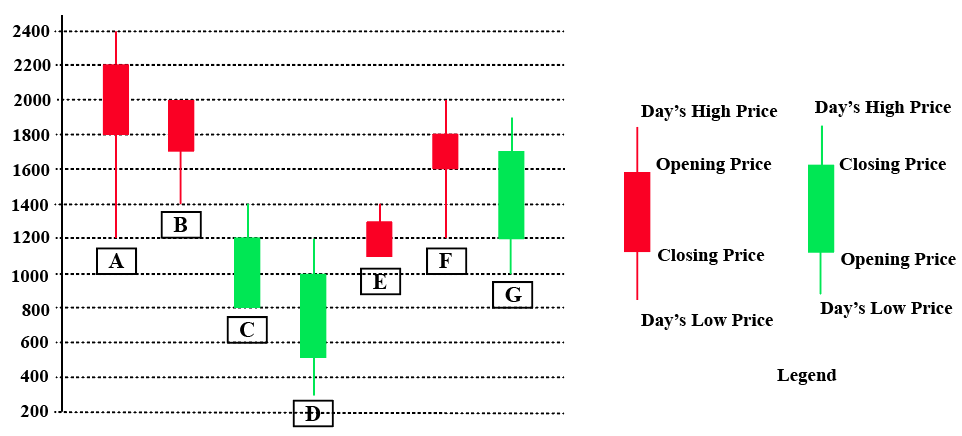
The chart below shows the price data for seven shares - A, B, C, D, E, F, and G as a candlestick plot for a particular day. The vertical axis shows the price of the share in rupees. A share whose closing price (price at the end of the day) is more than its opening price (price at the start of the day) is called a bullish share; otherwise, it is called a bearish share. All bullish and bearish shares are shown in green and red colour respectively.
Daily Share Price Variability (SPV) is defined as (Day’s high price - Day’s low price) / (Average of the opening and closing prices during the day). Which among the shares A, C, D and F had the highest SPV on that day?
Writing down the values given in the candlestick chart in the form of a table for ease of calculation,
We are given that, Daily Share Price Variability (SPV) is defined as (Day’s high price - Day’s low price) / (Average of the opening and closing prices during the day)
Calculating it for the four options,
Stock F: 800/1700=8/17
Stock A: 1200/2000=3/5
Stock D: 900/750=90/75=6/5
Stock C: 600/1000=3/5
Clearly Stock D has the highest SPV.
Daily Share Price Variability (SPV) is defined as (Day’s high price - Day’s low price) / (Average of the opening and closing prices during the day). How many shares had an SPV greater than 0.5 on that day?
Writing down the values given in the candlestick chart in the form of a table for ease of calculation,
We are given that, Daily Share Price Variability (SPV) is defined as (Day’s high price - Day’s low price) / (Average of the opening and closing prices during the day)
Calculating it for the stocks
Stock A: 1200/2000=3/5
Stock B: 600/1850=60/185
Stock C: 600/1000=3/5
Stock D: 900/750=90/75=6/5
Stock E: 300/1200=1/4
Stock F: 800/1700=8/17
Stock G: 900/1450=90/145
We need to check for stocks greater than 0.5 on that day,
Stock A, Stock C, Stock D, Stock G have SPV greater than 0.5 that day.
Hence, the answer is 4.
Daily loss for a share is defined as (Opening price - Closing price) / (Opening price). Which among the shares A, B, F and G had the highest daily loss on that day?
Writing down the values given in the candlestick chart in the form of a table for ease of calculation,
Daily loss for a share is defined as (Opening price - Closing price) / (Opening price)
Calculating this for the options:
Stock A: 400/2200=2/11
Stock B: 300/2000=3/20
Stock F: 200/1800=1/9
Stock G gained money that day
Hence Stock A has the highest Daily Loss.
What would have been the percentage wealth gain for a trader, who bought equal numbers of all bullish shares at opening price and sold them at their day’s high?
Writing down the values given in the candlestick chart in the form of a table for ease of calculation,
There are three bullish shares, C D and G
Lets say a trader buys one share of each of these stocks, and sells them at their day's high
One share of C at opening is 800, sells at 1400
One share of D at opening is 500, 1200
One share of G at opening is 1200, 1900
Total Investment is 2500, and total money after selling is 4500
That is an 80% return since, $$\dfrac{\left(4500-2500\right)}{2500}=0.8$$
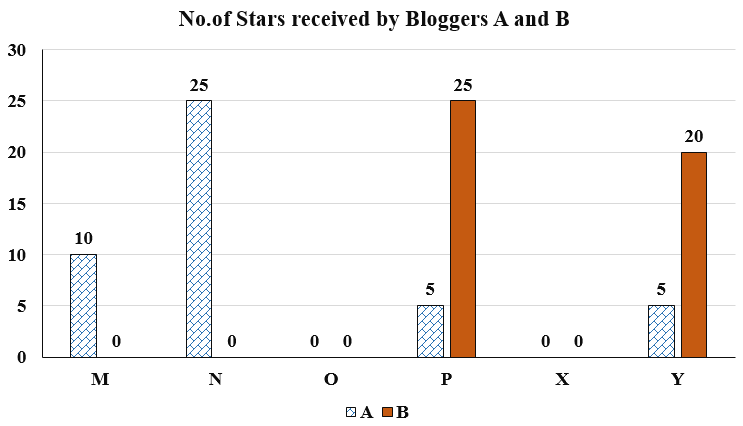
Six web surfers M, N, O, P, X, and Y each had 30 stars which they distributed among four bloggers A, B, C, and D. The number of stars received by A and B from the six web surfers is shown in the figure below.
The following additional facts are known regarding the number of stars received by the bloggers from the surfers.
1. The numbers of stars received by the bloggers from the surfers were all multiples of 5 (including 0).
2. The total numbers of stars received by the bloggers were the same.
3. Each blogger received a different number of stars from M.
4. Two surfers gave all their stars to a single blogger.
5. D received more stars than C from Y.
What was the total number of stars received by D?
We can note down the data from the chart into the form of a table, that gives us,
We are told that D receives more stars than C from Y. Considering Y has already given 25 stars, it will give 0 stars to C and 5 stars to D.
The only two surfers who have not given any stars to A or B is O and X, and these are the two surfers to give all of their stars to a single blogger.
We are also told that M gives different stars to the four bloggers,
Since he has already given 0 and 10, the remaining distinct stars should add up to 20. The only numbers that are remaining that add up to 20 are 5 and 15.
We know that X rewards one of C or D 30 stars and O rewards one of C or D 30 stars. Given that, M could not have rewarded D 15 stars, since Y rewarded D 5 stars, and D is also going to rewarded 30 stars by O or X, and since the total is same for all, which is 45. This is not possible.
This means that, M rewarded C 15 stars and D 5 stars.
This gives us two cases,
Case-1
Case-2
We can use these two cases to answer the questions,
D was rewarded 45 stars in total.
What was the number of stars received by D from Y?
We can note down the data from the chart into the form of a table, that gives us,
We are told that D receives more stars than C from Y. Considering Y has already given 25 stars, it will give 0 stars to C and 5 stars to D.
The only two surfers who have not given any stars to A or B is O and X, and these are the two surfers to give all of their stars to a single blogger.
We are also told that M gives different stars to the four bloggers,
Since he has already given 0 and 10, the remaining distinct stars should add up to 20. The only numbers that are remaining that add up to 20 are 5 and 15.
We know that X rewards one of C or D 30 stars and O rewards one of C or D 30 stars. Given that, M could not have rewarded D 15 stars, since Y rewarded D 5 stars, and D is also going to rewarded 30 stars by O or X, and since the total is same for all, which is 45. This is not possible.
This means that, M rewarded C 15 stars and D 5 stars.
This gives us two cases,
Case-1
Case-2
We can use these two cases to answer the questions,
D received 5 stars from Y.
How many surfers distributed their stars among exactly 2 bloggers?
We can note down the data from the chart into the form of a table, that gives us,
We are told that D receives more stars than C from Y. Considering Y has already given 25 stars, it will give 0 stars to C and 5 stars to D.
The only two surfers who have not given any stars to A or B is O and X, and these are the two surfers to give all of their stars to a single blogger.
We are also told that M gives different stars to the four bloggers,
Since he has already given 0 and 10, the remaining distinct stars should add up to 20. The only numbers that are remaining that add up to 20 are 5 and 15.
We know that X rewards one of C or D 30 stars and O rewards one of C or D 30 stars. Given that, M could not have rewarded D 15 stars, since Y rewarded D 5 stars, and D is also going to rewarded 30 stars by O or X, and since the total is same for all, which is 45. This is not possible.
This means that, M rewarded C 15 stars and D 5 stars.
This gives us two cases,
Case-1
Case-2
We can use these two cases to answer the questions,
M distributed among 3 bloggers, N among 2 bloggers, O among 1, P among 2, X among 1, Y among 3
Hence 2 surfers distribute their stars among 2 bloggers.
Which of the following can be determined with certainty?
I. The number of stars received by C from M
II. The number of stars received by D from O
We can note down the data from the chart into the form of a table, that gives us,
We are told that D receives more stars than C from Y. Considering Y has already given 25 stars, it will give 0 stars to C and 5 stars to D.
The only two surfers who have not given any stars to A or B is O and X, and these are the two surfers to give all of their stars to a single blogger.
We are also told that M gives different stars to the four bloggers,
Since he has already given 0 and 10, the remaining distinct stars should add up to 20. The only numbers that are remaining that add up to 20 are 5 and 15.
We know that X rewards one of C or D 30 stars and O rewards one of C or D 30 stars. Given that, M could not have rewarded D 15 stars, since Y rewarded D 5 stars, and D is also going to rewarded 30 stars by O or X, and since the total is same for all, which is 45. This is not possible.
This means that, M rewarded C 15 stars and D 5 stars.
This gives us two cases,
Case-1
Case-2
We can use these two cases to answer the questions,
There are two cases formed since we cannot identify for certain two whom did O reward the stars to,
We can identify the number of stars rewarded by M to C.
Hence only statement 1 can be identified uniquely.
The game of QUIET is played between two teams. Six teams, numbered 1, 2, 3, 4, 5, and 6, play in a QUIET tournament. These teams are divided equally into two groups. In the tournament, each team plays every other team in the same group only once, and each team in the other group exactly twice. The tournament has several rounds, each of which consists of a few games. Every team plays exactly one game in each round.
The following additional facts are known about the schedule of games in the tournament.
1. Each team played against a team from the other group in Round 8.
2. In Round 4 and Round 7, the match-ups, that is the pair of teams playing against each other, were identical. In Round 5 and Round 8, the match-ups were identical.
3. Team 4 played Team 6 in both Round 1 and Round 2.
4. Team 1 played Team 5 ONLY once and that was in Round 2.
5. Team 3 played Team 4 in Round 3. Team 1 played Team 6 in Round 6.
6. In Round 8, Team 3 played Team 6, while Team 2 played Team 5.
How many rounds were there in the tournament?
We are told that there are six teams, that are divided into two groups.
Teams in the same group will play each other only once, and teams in different group will play each other twice.
Calculating the combinations, there is going to be $$^3C_2$$ games among teams in the same group among them, and since there is two groups, total such games will be 6.
Now, teams in different group play each other twice. Calculating the combinations for this,
From the first group, a team can be chosen in three ways, and from the second group, a team can be chosen in three ways. Total ways two teams from different groups can play each other is 3x3 which is 9. And since they play each other twice, that is 9+9 games of this combination.
Total number of games is 18+6=24
It is given that each team plays one game in each round, that means there is going to be 3 matchups in each round. And given, there is 24 games to played in this format, the number of rounds will be 24/3=8
The tournament will have 8 rounds.
Now that we know there are going to be 8 rounds in the tournament, let us identify the teams in a particular group, that will help us build the matchups.
We are told that Round 8 teams from different groups play each other, and Teams 1 and 5 play only once. This means, 1 and 5 have to be on the same group. It is also told that 4 and 6 play each other twice, that means 4 and 6 have to be in different groups. Looking at the matches from Round 8 that is given to us, 3 played 6 and 2 played 5. We already know 1 and 5 are in the same group, so 2 must be in the other group. Among 3 and 6, if we were to place 3 in the group with 1 and 5, 4 and 6 would have to be in the same group, which is not possible, hence 6 is with 1 and 5, giving us the final combination of groups.
Now, using the given information to build the matchups for the 8 rounds.
Rounds marked with the same colour represent the fact that the matchups are identical. Now we know that each team plays a game in each round, we know 2 out of the 3 matches for Round 2 and 8, and we can identify the third matchups as well. Giving us this resulting table.
We are told that Round 4 and 7 are identical, that means they are the matchups between teams from two different groups,
We look at the matchups that are remaining among the 6 teams where both the games are left to play.
Right away we identify that 6 is yet to play 2 twice and 5 once. We are looking for teams playing twice, so both Round 4 and 7 has a matchups between 2 and 6. This means 6 will play 5 in Round 3 and using that we can identify the third matchup in Round 3 as well.
Now, we can identify that 1 is yet to play 3 both the times, 2 once. And we are looking for teams playing each other twice, so we can fill in the remaining values in the table as well.
. This is the final table.
The tournament will have 8 rounds.
What is the number of the team that played Team 1 in Round 5?
We are told that there are six teams, that are divided into two groups.
Teams in the same group will play each other only once, and teams in different group will play each other twice.
Calculating the combinations, there is going to be $$^3C_2$$ games among teams in the same group among them, and since there is two groups, total such games will be 6.
Now, teams in different group play each other twice. Calculating the combinations for this,
From the first group, a team can be chosen in three ways, and from the second group, a team can be chosen in three ways. Total ways two teams from different groups can play each other is 3x3 which is 9. And since they play each other twice, that is 9+9 games of this combination.
Total number of games is 18+6=24
It is given that each team plays one game in each round, that means there is going to be 3 matchups in each round. And given, there is 24 games to played in this format, the number of rounds will be 24/3=8
The tournament will have 8 rounds.
Now that we know there are going to be 8 rounds in the tournament, let us identify the teams in a particular group, that will help us build the matchups.
We are told that Round 8 teams from different groups play each other, and Teams 1 and 5 play only once. This means, 1 and 5 have to be on the same group. It is also told that 4 and 6 play each other twice, that means 4 and 6 have to be in different groups. Looking at the matches from Round 8 that is given to us, 3 played 6 and 2 played 5. We already know 1 and 5 are in the same group, so 2 must be in the other group. Among 3 and 6, if we were to place 3 in the group with 1 and 5, 4 and 6 would have to be in the same group, which is not possible, hence 6 is with 1 and 5, giving us the final combination of groups.
Now, using the given information to build the matchups for the 8 rounds.
Rounds marked with the same colour represent the fact that the matchups are identical. Now we know that each team plays a game in each round, we know 2 out of the 3 matches for Round 2 and 8, and we can identify the third matchups as well. Giving us this resulting table.
We are told that Round 4 and 7 are identical, that means they are the matchups between teams from two different groups,
We look at the matchups that are remaining among the 6 teams where both the games are left to play.
Right away we identify that 6 is yet to play 2 twice and 5 once. We are looking for teams playing twice, so both Round 4 and 7 has a matchups between 2 and 6. This means 6 will play 5 in Round 3 and using that we can identify the third matchup in Round 3 as well.
Now, we can identify that 1 is yet to play 3 both the times, 2 once. And we are looking for teams playing each other twice, so we can fill in the remaining values in the table as well.
. This is the final table.
The team that played Team 1 in Round 5 is 4.
Which team among the teams numbered 2, 3, 4, and 5 was not part of the same group?
We are told that there are six teams, that are divided into two groups.
Teams in the same group will play each other only once, and teams in different group will play each other twice.
Calculating the combinations, there is going to be $$^3C_2$$ games among teams in the same group among them, and since there is two groups, total such games will be 6.
Now, teams in different group play each other twice. Calculating the combinations for this,
From the first group, a team can be chosen in three ways, and from the second group, a team can be chosen in three ways. Total ways two teams from different groups can play each other is 3x3 which is 9. And since they play each other twice, that is 9+9 games of this combination.
Total number of games is 18+6=24
It is given that each team plays one game in each round, that means there is going to be 3 matchups in each round. And given, there is 24 games to played in this format, the number of rounds will be 24/3=8
The tournament will have 8 rounds.
Now that we know there are going to be 8 rounds in the tournament, let us identify the teams in a particular group, that will help us build the matchups.
We are told that Round 8 teams from different groups play each other, and Teams 1 and 5 play only once. This means, 1 and 5 have to be on the same group. It is also told that 4 and 6 play each other twice, that means 4 and 6 have to be in different groups. Looking at the matches from Round 8 that is given to us, 3 played 6 and 2 played 5. We already know 1 and 5 are in the same group, so 2 must be in the other group. Among 3 and 6, if we were to place 3 in the group with 1 and 5, 4 and 6 would have to be in the same group, which is not possible, hence 6 is with 1 and 5, giving us the final combination of groups.
Now, using the given information to build the matchups for the 8 rounds.
Rounds marked with the same colour represent the fact that the matchups are identical. Now we know that each team plays a game in each round, we know 2 out of the 3 matches for Round 2 and 8, and we can identify the third matchups as well. Giving us this resulting table.
We are told that Round 4 and 7 are identical, that means they are the matchups between teams from two different groups,
We look at the matchups that are remaining among the 6 teams where both the games are left to play.
Right away we identify that 6 is yet to play 2 twice and 5 once. We are looking for teams playing twice, so both Round 4 and 7 has a matchups between 2 and 6. This means 6 will play 5 in Round 3 and using that we can identify the third matchup in Round 3 as well.
Now, we can identify that 1 is yet to play 3 both the times, 2 once. And we are looking for teams playing each other twice, so we can fill in the remaining values in the table as well.
. This is the final table.
2, 3 and 4 were part of the same group. 5 is the answer.
What is the number of the team that played Team 1 in Round 7?
We are told that there are six teams, that are divided into two groups.
Teams in the same group will play each other only once, and teams in different group will play each other twice.
Calculating the combinations, there is going to be $$^3C_2$$ games among teams in the same group among them, and since there is two groups, total such games will be 6.
Now, teams in different group play each other twice. Calculating the combinations for this,
From the first group, a team can be chosen in three ways, and from the second group, a team can be chosen in three ways. Total ways two teams from different groups can play each other is 3x3 which is 9. And since they play each other twice, that is 9+9 games of this combination.
Total number of games is 18+6=24
It is given that each team plays one game in each round, that means there is going to be 3 matchups in each round. And given, there is 24 games to played in this format, the number of rounds will be 24/3=8
The tournament will have 8 rounds.
Now that we know there are going to be 8 rounds in the tournament, let us identify the teams in a particular group, that will help us build the matchups.
We are told that Round 8 teams from different groups play each other, and Teams 1 and 5 play only once. This means, 1 and 5 have to be on the same group. It is also told that 4 and 6 play each other twice, that means 4 and 6 have to be in different groups. Looking at the matches from Round 8 that is given to us, 3 played 6 and 2 played 5. We already know 1 and 5 are in the same group, so 2 must be in the other group. Among 3 and 6, if we were to place 3 in the group with 1 and 5, 4 and 6 would have to be in the same group, which is not possible, hence 6 is with 1 and 5, giving us the final combination of groups.
Now, using the given information to build the matchups for the 8 rounds.
Rounds marked with the same colour represent the fact that the matchups are identical. Now we know that each team plays a game in each round, we know 2 out of the 3 matches for Round 2 and 8, and we can identify the third matchups as well. Giving us this resulting table.
We are told that Round 4 and 7 are identical, that means they are the matchups between teams from two different groups,
We look at the matchups that are remaining among the 6 teams where both the games are left to play.
Right away we identify that 6 is yet to play 2 twice and 5 once. We are looking for teams playing twice, so both Round 4 and 7 has a matchups between 2 and 6. This means 6 will play 5 in Round 3 and using that we can identify the third matchup in Round 3 as well.
Now, we can identify that 1 is yet to play 3 both the times, 2 once. And we are looking for teams playing each other twice, so we can fill in the remaining values in the table as well.
. This is the final table.
The team that played Team 1 in Round 7 is 3.
What is the number of the team that played Team 6 in Round 3?
We are told that there are six teams, that are divided into two groups.
Teams in the same group will play each other only once, and teams in different group will play each other twice.
Calculating the combinations, there is going to be $$^3C_2$$ games among teams in the same group among them, and since there is two groups, total such games will be 6.
Now, teams in different group play each other twice. Calculating the combinations for this,
From the first group, a team can be chosen in three ways, and from the second group, a team can be chosen in three ways. Total ways two teams from different groups can play each other is 3x3 which is 9. And since they play each other twice, that is 9+9 games of this combination.
Total number of games is 18+6=24
It is given that each team plays one game in each round, that means there is going to be 3 matchups in each round. And given, there is 24 games to played in this format, the number of rounds will be 24/3=8
The tournament will have 8 rounds.
Now that we know there are going to be 8 rounds in the tournament, let us identify the teams in a particular group, that will help us build the matchups.
We are told that Round 8 teams from different groups play each other, and Teams 1 and 5 play only once. This means, 1 and 5 have to be on the same group. It is also told that 4 and 6 play each other twice, that means 4 and 6 have to be in different groups. Looking at the matches from Round 8 that is given to us, 3 played 6 and 2 played 5. We already know 1 and 5 are in the same group, so 2 must be in the other group. Among 3 and 6, if we were to place 3 in the group with 1 and 5, 4 and 6 would have to be in the same group, which is not possible, hence 6 is with 1 and 5, giving us the final combination of groups.
Now, using the given information to build the matchups for the 8 rounds.
Rounds marked with the same colour represent the fact that the matchups are identical. Now we know that each team plays a game in each round, we know 2 out of the 3 matches for Round 2 and 8, and we can identify the third matchups as well. Giving us this resulting table.
We are told that Round 4 and 7 are identical, that means they are the matchups between teams from two different groups,
We look at the matchups that are remaining among the 6 teams where both the games are left to play.
Right away we identify that 6 is yet to play 2 twice and 5 once. We are looking for teams playing twice, so both Round 4 and 7 has a matchups between 2 and 6. This means 6 will play 5 in Round 3 and using that we can identify the third matchup in Round 3 as well.
Now, we can identify that 1 is yet to play 3 both the times, 2 once. And we are looking for teams playing each other twice, so we can fill in the remaining values in the table as well.
. This is the final table.
Team that played Team 6 in Round 3 was Team 5.
Two students, Amiya and Ramya are the only candidates in an election for the position of class representative. Students will vote based on the intensity level of Amiya’s and Ramya’s campaigns and the type of campaigns they run. Each campaign is said to have a level of 1 if it is a staid campaign and a level of 2 if it is a vigorous campaign. Campaigns can be of two types, they can either focus on issues, or on attacking the other candidate.
If Amiya and Ramya both run campaigns focusing on issues, then
• The percentage of students voting in the election will be 20 times the sum of the levels of campaigning of the two students. For example, if Amiya and Ramya both run vigorous campaigns, then 20 × (2+2)%, that is, 80% of the students will vote in the election.
• Among voting students, the percentage of votes for each candidate will be proportional to the levels of their campaigns. For example, if Amiya runs a staid (i.e., level 1) campaign while Ramya runs a vigorous (i.e., level 2) campaign, then Amiya will receive 1/3 of the votes cast, and Ramya will receive the other 2/3. The above-mentioned percentages change as follows if at least one of them runs a campaign attacking their opponent.
• If Amiya runs a campaign attacking Ramya and Ramya runs a campaign focusing on issues, then 10% of the students who would have otherwise voted for Amiya will vote for Ramya, and another 10% who would have otherwise voted for Amiya, will not vote at all.
• If Ramya runs a campaign attacking Amiya and Amiya runs a campaign focusing on issues, then 20% of the students who would have otherwise voted for Ramya will vote for Amiya, and another 5% who would have otherwise voted for Ramya, will not vote at all.
• If both run campaigns attacking each other, then 10% of the students who would have otherwise voted for them had they run campaigns focusing on issues, will not vote at all.
If both of them run staid campaigns attacking the other, then what percentage of students will vote in the election?
If both Ramya and Amiya run staid campaigns, the intensity of each staid campaign is 1
So total number of voters that would vote for them if they focused on issues will be 20x(1+1)%=40%
This means if they had both ran regarding issues, then they would get 20% of votes each.
We are told that both of them run attacking campaigns,
And the rule for mutual attacking campaign is 10% of voters who would have voted for each candidate will not vote.
That means 10% of 20% of each candidate will not vote, now that it is a mutually attacking campaign.
That means, each candidate receives 18% of the votes.
Total votes received is 36%.
What is the minimum percentage of students who will vote in the election?
We want the minimum vote share, that means both the candidates run staid campaigns.
And, both the campaigns should be attacking, since we see that if one candidate runs an attacking campaign whereas the other candidate runs an issues campaign, a fair number of voters get transferred to the other candidate's vote share.
This points to us to a scenario where both the campaigns are staid and attacking, which is nothing but the scenario described in the previous question.
If both Ramya and Amiya run staid campaigns, the intensity of each staid campaign is 1
So total number of voters that would vote for them if they focused on issues will be 20x(1+1)%=40%
This means if they had both ran regarding issues, then they would get 20% of votes each.
We are told that both of them run attacking campaigns,
And the rule for mutual attacking campaign is 10% of voters who would have voted for each candidate will not vote.
That means 10% of 20% of each candidate will not vote, now that it is a mutually attacking campaign.
That means, each candidate receives 18% of the votes.
Total votes received is 36%, which is the minimum possible.
If Amiya runs a campaign focusing on issues, then what is the maximum percentage of votes that she can get?
Amiya runs a campaign on issues, and we need to find the maximum vote share that she can get.
We are trying to maximise the number of voters for Amiya, that means Amiya needs to run a vigorous campaign.
Since, we are trying to increase the vote share for Amiya, we want as many voters as possible transferred from Ramya's share to Amiya's votes.
As the number of votes a candidate receives is proportional to the intensity level of the campaign, we want Ramya also to run a vigorous AND attacking campaign, so that her votes are transferred to Amiya.
In this scenario we have 20x(2+2)% of the people voting, 80% of the people. Of that, if both had ran issues campaign, they would have each received 40% of the votes.
Now, we want Ramya to run an attacking campaign, where 20% of the people that would have voted for her vote for Amiya.
So 20% of 40% of the votes are transferred to Amiya. That is 8% of the votes. And we are also told that, 5% that would have voted for her dont vote, so 5% of 40% dont vote, that is 2% of the voters.
Final Tally is Amiya gets 48% of the votes, and Ramya gets 30% of the votes.
If Ramya runs a campaign attacking Amiya, then what is the minimum percentage of votes that she is guaranteed to get?
We are looking for the minimum possible number of votes that Ramya can get when she runs an attacking campaign.
To minimise the number of votes, we can have Ramya run a staid campaign to minimise the votes, so minimum intensity, which will get her 20% of the votes if she ran with issues. Now that she is running with attacking, she will loose 20% of the votes to Amiya and 5% of the votes will not vote anymore.
That is a total 25% loss. Remaining votes she will get is 75% of the 20% which will leave her with 15% of the votes.
What is the maximum possible voting margin with which one of the candidates can win?
We are looking for the minimum possible number of votes that Ramya can get and maximise the number of votes that Amiya can get.
We can borrow the scenario from the previous question where Ramya runs an attacking campaign, and we minimised the number of votes she can get.
To minimise the number of votes, we can have Ramya run a staid campaign to minimise the votes, so minimum intensity, which will get her 20% of the votes if she ran with issues. Now that she is running with attacking, she will loose 20% of the votes to Amiya and 5% of the votes will not vote anymore.
That is a total 25% loss. Remaining votes she will get is 75% of the 20% which will leave her with 15% of the votes.
And to maximise the number of votes Amiya can get, we will have her run an vigorous issues campaign, which will give her 2x20% of the votes, that is 40% of the votes. And since Ramya has been running an attacking campaign, 20% of her votes are transferred to Amiya. 20% of the 20% of the votes which is 4% that were going to Ramya will now go to Amiya. That will bring up Amiya's tally up to 44% leaving Ramya's tally at 15%.
The difference in the votes will be 44-15=29%.
This is the maximum possible vote difference between the two candidates that is possible.
The chart below provides complete information about the number of countries visited by Dheeraj, Samantha and Nitesh, in Asia, Europe and the rest of the world (ROW).
The following additional facts are known about the countries visited by them.
1. 32 countries were visited by at least one of them.
2. USA (in ROW) is the only country that was visited by all three of them.
3. China (in Asia) is the only country that was visited by both Dheeraj and Nitesh, but not by Samantha.
4. France (in Europe) is the only country outside Asia, which was visited by both Dheeraj and Samantha, but not by Nitesh.
5. Half of the countries visited by both Samantha and Nitesh are in Europe.
How many countries in Asia were visited by at least one of Dheeraj, Samantha and Nitesh?
Writing down the data with us in a table form.
But this includes countries which have been visited by one person, two people and three people. Essentially, there is an overlap of countries.
It is given to us that 32 distinct countries were visited among the three people,
Using that we can write down the equations,
$$I+II+III=32$$...(1)
$$I+2II+3III=43$$...(2)
Where I, II, and III denote the number of countries visited exactly by 1 of them, 2 of them and all of them.
We are told that USA(ROW) is the only country which was visited by all three people, that means $$III=1$$
Subtracting Equation 1 from 2 we get, $$II+2III=11$$
And since III=1 we get $$II=9$$
So, we are looking for 9 countries visited by exactly 2 people, and 22 countries visited by exactly 1 person.
Using the information from the problem set, we can note down the following,
We can see that Dheeraj visited only 1 country in ROW so every other value in that column has to be zero for wherever Dinesh is present. And Samantha has not visited any country in Asia so every value with Samantha present in Asia should be zero as well.
We have the following distribution, we are looking for 9 countries visited by exactly 2 people. And we have identified 2 countries, that means, 7 were countries were visited by both Samantha and Nitesh only. And given that half the countries visited by both of them are in Europe, and total number of countries visited by both of them is 7(only two of them)+1(USA)=8, they visited 4 countries in Europe together and 3 countries in ROW together. And using that information, we can fill in the rest of the table as well. Since we know the number of countries visited by each of them in a particular continent.
How many countries in Asia were visited by at least one of Dheeraj, Samantha and Nitesh is 3.
How many countries in Europe were visited only by Nitesh?
Writing down the data with us in a table form.
But this includes countries which have been visited by one person, two people and three people. Essentially, there is an overlap of countries.
It is given to us that 32 distinct countries were visited among the three people,
Using that we can write down the equations,
$$I+II+III=32$$...(1)
$$I+2II+3III=43$$...(2)
Where I, II, and III denote the number of countries visited exactly by 1 of them, 2 of them and all of them.
We are told that USA(ROW) is the only country which was visited by all three people, that means $$III=1$$
Subtracting Equation 1 from 2 we get, $$II+2III=11$$
And since III=1 we get $$II=9$$
So, we are looking for 9 countries visited by exactly 2 people, and 22 countries visited by exactly 1 person.
Using the information from the problem set, we can note down the following,
We can see that Dheeraj visited only 1 country in ROW so every other value in that column has to be zero for wherever Dinesh is present. And Samantha has not visited any country in Asia so every value with Samantha present in Asia should be zero as well.
We have the following distribution, we are looking for 9 countries visited by exactly 2 people. And we have identified 2 countries, that means, 7 were countries were visited by both Samantha and Nitesh only. And given that half the countries visited by both of them are in Europe, and total number of countries visited by both of them is 7(only two of them)+1(USA)=8, they visited 4 countries in Europe together and 3 countries in ROW together. And using that information, we can fill in the rest of the table as well. Since we know the number of countries visited by each of them in a particular continent.
Number of countries visited by only Nitesh is 2.
How many countries in the ROW were visited by both Nitesh and Samantha?
Writing down the data with us in a table form.
But this includes countries which have been visited by one person, two people and three people. Essentially, there is an overlap of countries.
It is given to us that 32 distinct countries were visited among the three people,
Using that we can write down the equations,
$$I+II+III=32$$...(1)
$$I+2II+3III=43$$...(2)
Where I, II, and III denote the number of countries visited exactly by 1 of them, 2 of them and all of them.
We are told that USA(ROW) is the only country which was visited by all three people, that means $$III=1$$
Subtracting Equation 1 from 2 we get, $$II+2III=11$$
And since III=1 we get $$II=9$$
So, we are looking for 9 countries visited by exactly 2 people, and 22 countries visited by exactly 1 person.
Using the information from the problem set, we can note down the following,
We can see that Dheeraj visited only 1 country in ROW so every other value in that column has to be zero for wherever Dinesh is present. And Samantha has not visited any country in Asia so every value with Samantha present in Asia should be zero as well.
We have the following distribution, we are looking for 9 countries visited by exactly 2 people. And we have identified 2 countries, that means, 7 were countries were visited by both Samantha and Nitesh only. And given that half the countries visited by both of them are in Europe, and total number of countries visited by both of them is 7(only two of them)+1(USA)=8, they visited 4 countries in Europe together and 3 countries in ROW together. And using that information, we can fill in the rest of the table as well. Since we know the number of countries visited by each of them in a particular continent.
Number of countries in ROW visited by both Nitesh and Samantha is 3+1=4.
How many countries in Europe were visited by exactly one of Dheeraj, Samantha and Nitesh?
Writing down the data with us in a table form.
But this includes countries which have been visited by one person, two people and three people. Essentially, there is an overlap of countries.
It is given to us that 32 distinct countries were visited among the three people,
Using that we can write down the equations,
$$I+II+III=32$$...(1)
$$I+2II+3III=43$$...(2)
Where I, II, and III denote the number of countries visited exactly by 1 of them, 2 of them and all of them.
We are told that USA(ROW) is the only country which was visited by all three people, that means $$III=1$$
Subtracting Equation 1 from 2 we get, $$II+2III=11$$
And since III=1 we get $$II=9$$
So, we are looking for 9 countries visited by exactly 2 people, and 22 countries visited by exactly 1 person.
Using the information from the problem set, we can note down the following,
We can see that Dheeraj visited only 1 country in ROW so every other value in that column has to be zero for wherever Dinesh is present. And Samantha has not visited any country in Asia so every value with Samantha present in Asia should be zero as well.
We have the following distribution, we are looking for 9 countries visited by exactly 2 people. And we have identified 2 countries, that means, 7 were countries were visited by both Samantha and Nitesh only. And given that half the countries visited by both of them are in Europe, and total number of countries visited by both of them is 7(only two of them)+1(USA)=8, they visited 4 countries in Europe together and 3 countries in ROW together. And using that information, we can fill in the rest of the table as well. Since we know the number of countries visited by each of them in a particular continent.
Number of countries in EU visited by exactly 1 person is 12.
Consider two sets $$A = \left\{2, 3, 5, 7, 11, 13 \right\}$$ and $$B = \left\{1, 8, 27 \right\}$$. Let f be a function from A to B such that for every element in B, there is at least one element a in A such that $$f(a) = b$$. Then, the total number of such functions f is
Set A={2,3,5,7,11,13} so |A|=6
Set B={1, 8, 27} so |B|=3
Without any restrictions, each element in A can map to any of the 3 elements in B. Thus, the total number of functions is: $$3^6=729$$
Excluding Functions That Miss One Element in B: If a function does not map to an element in B, there are 2 elements in B left for mapping. The total number of such functions (for each specific element not mapped) is: $$2^6=64$$
Since there are 3 elements in B, the total number of such functions is:3x64=192
Adding Back Functions That Miss Two Elements in B:
If a function misses two elements in B, there is only 1 element left for mapping. The total number of such functions is: 1^6=1.
Since there are $$^3C_2$$ ways to choose which two elements are missed, the total number of such functions is: 3
Using the inclusion-exclusion principle, the number of functions where all elements of B are mapped by at least one element of A is:
729-192+3=540.
Let $$x, y,$$ and $$z$$ be real numbers satisfying
$$4(x^{2}+y^{2}+z^{2})=a,$$
$$4(x-y-z)=3+a$$
The a equals
We have two equations,
$$4(x^{2}+y^{2}+z^{2}) = a$$ ---(1)
$$4(x - y - z) = 3 + a$$ ---(2)
Substituting the value of a from equation 1 in equation 2, we get,
$$4\left(x\ -\ y\ -\ z\right)\ =\ 3\ +\ 4(x^2\ +\ y^2\ +\ z^2)$$
$$\ 3\ +\ 4(x^2\ +\ y^2\ +\ z^2)\ -4\left(x\ -\ y\ -\ z\right)\ =\ 0$$
$$\ 3\ +\ 4x^2\ +\ 4y^2\ +\ 4z^2\ -4x\ \ +\ 4y\ +\ 4z\ =\ 0$$
It can be written as,
$$4x^2\ -4x\ +\ 1+\ 4y^2\ +\ 4y\ +\ 1\ +\ 4z^2\ +\ 4z\ +\ 1\ =\ 0$$
$$\left(2x\ -\ 1\right)^2\ +\ \left(2y\ +\ 1\right)^2\ +\ \left(2z\ +\ 1\right)^2\ \ =0$$
We know that if the sum of the squares of terms is 0, then all the terms must be equal to 0
2x - 1 = 0
x = $$\dfrac{1}{2}$$
2y + 1 = 0
y = $$-\dfrac{1}{2}$$
2z + 1 = 0
z = $$-\dfrac{1}{2}$$
Substituting the values in equation 2, we get,
$$4\left(\dfrac{1}{2}\ -\ \left(-\dfrac{1}{2}\right)\ -\ \left(-\dfrac{1}{2}\right)\right)\ =\ 3\ +\ a$$
$$4\left(\dfrac{3}{2}\right)\ =\ 3\ +\ a$$
$$6\ =\ 3\ +\ a$$
$$\ a\ =\ 3$$
Therefore, the correct answer is option A.
lf the equations $$x^{2}+mx+9=0, x^{2}+nx+17=0$$ and $$x^{2}+(m+n)x+35=0$$ have a common negative root, then the value of $$(2m+3n)$$ is
When given more than one equations, stating the fact that there is a common root,
We need to equate the two equations to get discernible values for $$x$$
Here, we are given three equations with the values of $$m$$, $$n$$
$$x^2+mx+9=x^2+\left(m+n\right)x+35$$
$$mx+9=mx+nx+35$$
$$nx=-26$$
Similarly, we can do it for the other equation as well,
$$x^2+nx+17=x^2+\left(m+n\right)x+35$$
$$mx=-18$$
Substituting the value of either $$mx$$ or $$nx$$ in the original equations, we get
$$x^2-18+9=0$$
$$x^2=9$$
$$x=\pm\ 3$$
Since we are given that the root is negative, $$x=-3$$
$$n=-\dfrac{26}{-3}$$
$$m=-\dfrac{18}{-3}$$
$$3n=26$$
$$2m=12$$
$$2m+3n=38$$
Suppose $$x_{1},x_{2},x_{3},...,x_{100}$$ are in arithmetic progression such that $$x_{5}=-4$$ and $$2x_{6}+2x_{9}=x_{11}+x_{13}$$, Then,$$x_{100}$$ equals
Using the arithmetic progression formula for the nth term, where
$$x_n=a+\left(n-1\right)d$$
Substituting the value for n and using that in the equation that is given,
$$2x_{6}+2x_{9}=x_{11}+x_{13}$$, Then,$$x_{100}$$ equals
We get, $$2\left(a+5d\right)+2\left(a+8d\right)=a+10d+a+12d$$
$$4a+26d=2a+22d$$
$$2a=-4d$$
$$a=-2d$$
We are given, $$x_5=-4$$
$$a+4d=-4$$
Substituting the value for a in terms of d,
$$2d=-4$$
$$d=-2$$
$$a=4$$
$$x_{100}=a+99d$$
$$x_{100}=4-198=-194$$
Renu would take 15 days working 4 hours per day to complete a certain task whereas Seema would take 8 days working 5 hours per day to complete the same task. They decide to work together to complete this task. Seema agrees to work for double the number of hours per day as Renu, while Renu agrees to work for double the number of days as Seema. If Renu works 2 hours per day, then the number of days Seema will work, is
Let us assign the amount of work done by Renu in one hour is R
And the amount of work done by Seema in one hour is S
We are told that a certain task with different time durations for Seema and Renu
Renu=15 days with 4 hours each day, that is total work done by Renu is $$15\times\ 4\times\ R=60R$$
Similarly for Seema, 8 days and 5 hours each day, total work done by Seema is $$40S$$
We know that $$60R=40S$$ or $$S=1.5R$$
For this task, let us assume that the amount of days that Seema decides to work is X and the hours per day that Renu decides to work is Y
We are then told that, Seema works for 2Y hours per day and Renu works for 2X days,
Work done by them will be $$2XYR$$ and $$2XYS$$
We are told that Y=2, Making this $$4XR$$ and $$4XS$$
$$S=1.5R$$
Total work will be, $$4XR$$+$$6XR$$=$$60R$$
We get the value of $$X=6$$
X is the number of days Seema will work, which is 6.
When $$10^{100}$$is divided by 7, the remainder is
To find the value of $$10^{100}mod\left(7\right)$$
When 10 is divided by 7, it leaves a remainder 3, so the above equation can be written as,
$$3^{100}mod\left(7\right)$$
Now looking at the cyclicality of powers of 3 when divided by 7,
$$3^1mod 7=3$$
$$3^2mod 7=2$$
$$3^3mod 7=6$$
$$3^4mod 7=4$$
$$3^5mod 7=5$$
$$3^6mod 7=1$$
From this calculation, it is evident that the powers of 3 modulo 7 repeat every 6 steps. This forms a cycle: 3, 2, 6, 4, 5, 1
$$3^{100}=\left(3^6\right)^{16}\times\ \left(3^4\right)$$
Since $$3^6mod 7=1$$
We just need to consider $$3^4mod 7$$ which equals 4
Hence the answer is 4.
The sum of all real values of k for which $$\left(\cfrac{1}{8}\right)^{k}\times \left(\cfrac{1}{32768}\right)^{\cfrac{1}{3}}=\cfrac{1}{8}\times \left(\cfrac{1}{32768}\right)^{\cfrac{1}{k}}$$, is
To solve this question, we need to immediately recognise the fact that, $$32768=8^5$$
Substituting this in the above given equation,
$$\left(\dfrac{1}{8}\right)^k\times\ \left(\dfrac{1}{8}\right)^{5\times\ \dfrac{1}{3}}=\left(\dfrac{1}{8}\right)\times\ \left(\dfrac{1}{8}\right)^{5\times\ \dfrac{1}{k}}$$
Since the bases are equal, we can equate the powers on either side of the equation,
$$k+\frac{5}{3}=1+\frac{5}{k}$$
$$\frac{\left(3k+5\right)}{3}=\frac{\left(k+5\right)}{k}$$
$$3k^2+5k=3k+15$$
$$3k^2+2k-15=0$$
Here in the given quadratic equation, the Discriminant is greater than 0, $$2^2-\left(4\right)\left(3\right)\left(-15\right)>0$$
That means both the roots are real, hence we can simply take the sum of the roots of the quadratic equation in k,
Which in a standard quadratic equation of the form $$ax^2+bx+c$$ is $$-\frac{b}{a}$$
Here, the sum of the real values of k is $$-\frac{2}{3}$$
For any natural number $$n$$ let $$a_{n}$$ be the largest integer not exceeding $$\sqrt{n}$$. Then the value of $$a_{1}+a_{2}+.....+a_{50}$$ is
We are told that, for any natural number $$n_{1}$$ let $$a_{n}$$ be the largest integer not exceeding $$\sqrt{n}$$
So for n=1, the largest integer not exceeding $$\sqrt{1}$$ will be 1
For n=2, the largest integer not exceeding $$\sqrt{2}$$ will be 1
For n=3, the largest integer not exceeding $$\sqrt{3}$$ will be 1
For n=4, the largest integer not exceeding $$\sqrt{4}$$ will be 2
We see a pattern here regarding the squares of the numbers,
Listing down all the perfect squares,
1, 4, 9, 16, 25, 36, 49, 64, ...
We see that the difference between 4 and 1 is 3 and there were three natural numbers in the given pattern with the value as 1,
So we can write for the rest of the numbers as well,
3 numbers will have value 1, giving a total value of 3
5 numbers will have value 2, giving a total value of 10
7 numbers will have value 3, giving a total value of 21
9 numbers will have value 4, giving a total value of 36
11 numbers will have value 5, giving a total value of 55
13 numbers will have value 6, giving a total value of 78
Now, only the values of $$a_{49},\ a_{50}$$ will have the value of 7, total value of 14.
Adding these values, we get the total sum as 217, which is the answer.
In September, the incomes of Kamal, Amal and Vimal are in the ratio 8 ∶ 6 ∶ 5. They rent a house together, and Kamal pays 15%, Amal pays 12% and Vimal pays 18% of their respective incomes to cover the total house rent in that month. In October, the house rent remains unchanged while their incomes increase by 10%, 12% and 15%, respectively. In October, the percentage of their total income that will be paid as house rent, is nearest to
We are told that, the incomes of Kamal, Amal and Vimal are in the ratio 8 ∶ 6 ∶ 5
Lets assume them to be 80X, 60X, 50X respectively.
Money that each one of them pays towards rent,
Kamal 15% which comes to 12X
Amal 12% which comes to 7.2X
Vimal 18% which comes to 9X
Total Rental expenditure will be, 28.2X
Their incomes increase by 10%, 12% and 15% respectively,
Kamal 10% which comes to 88X
Amal 12% which comes to 67.2X
Vimal 15% which comes to 57.5X
Total income will be 212.7X
We are told the rent is the same, so it will be 28.2X
Percentage of income going towards rent in October will be, $$\frac{28.2X}{212.7X}=0.13258$$
Hence, the answer is 13.26%
The sum of all four-digit numbers that can be formed with the distinct non-zero digits a, b, c, and d, with each digit appearing exactly once in every number, is 153310 + n, where n is a single digit natural number. Then, the value of (a + b + c + d + n) is
When gives n distinct numbers, and asked to find the sum of the possible n distinct numbers that can be formed,
We use the formula, $$(10^{n-1}+10^{n-2}+10^{n-3}+...) \times ((n-1)!)\times(Sum\ of\ numbers)$$
Inserting n=4, $$\left(1000+100+10+1\right)\left(3!\right)\left(a+b+c+d\right)$$
$$\left(6666\right)\left(a+b+c+d\right)$$
We are told that this value equals, $$153310+n$$
Since we are told that n is a single digit natural number, the total value cannot be that much greater and 6666 should perfectly divide $$153310+n$$
Upon dividing 153310 by 6666 we get the quotient as 22.99
Nearest value being 23, We take 6666x23 giving us the value 153318
Hence the value of n=8 and the value of a+b+c+d=23
Value of a+b+c+d+n=31.
ABCD is a rectangle with sides AB = 56 cm and BC = 45 cm, and E is the midpoint of side CD. Then, the length, in cm, of radius of incircle of $$\triangle ADE$$ is
Drawing the figure described in the question, we get the following representation,
Since E is the midpoint of CD, the length of each half will be 28cm.
We need to find the incircle of the triangle ADE, which is a right angled triangle, we can do that with the formula,
$$\dfrac{\left(a+b-h\right)}{2}$$
$$h^2=28^2+45^2$$
$$h^2=784+2025=2809$$
$$h=53$$
$$r=\dfrac{\left(28+45-53\right)}{2}=10$$
In the XY-plane, the area, in sq. units, of the region defined by the inequalities
$$y \geq x + 4$$ and $$-4 \leq x^2 + y^2 + 4(x - y) \leq 0$$ is
We have two inequalities,
$$y\ \ge\ x\ +\ 4$$
$$-4\ \le\ x^2\ +\ y^2\ +\ 4\left(x\ -\ y\right)\ \le\ 0$$
The second inequality can be written as two separate inequalities,
$$-4\ \le\ x^2\ +\ y^2\ +\ 4\left(x\ -\ y\right)$$ and $$\ x^2\ +\ y^2\ +\ 4\left(x\ -\ y\right)\ \le\ 0$$
The first inequality can be written as,
$$\ x^2\ +\ y^2\ +\ 4x\ -\ 4y\ +4\ \ge\ 0$$
$$\ x^2+\ 4x\ +4\ +\ y^2-\ 4y\ +4\ -4\ge\ 0$$
$$\left(x\ +\ 2\right)^2\ +\ \left(y\ -\ 2\right)^2\ \ge\ 4$$
The second inequality can be written as,
$$\ x^2\ +\ y^2\ +\ 4x\ -\ 4y\ \ \le\ \ 0$$
$$\ x^2+\ 4x\ +4\ +\ y^2-\ 4y\ +4\ -8\ \le\ \ 0$$
$$\left(x\ +\ 2\right)^2\ +\ \left(y\ -\ 2\right)^2\ \le\ \ 8$$
Representing all three inequalities in the graph, we get the graph as shown above, and we must calculate the intersection of all three inequalities,
We can see that the line passes through the centre of both circles (-2, 2), and the area obtained from the second inequality is the area between the two circles. So, the area of intersection of all three graphs is half of the area between both the circles as the line divides the circle in half, and we must only consider the area above the line as per the given inequality. We know that the area of the bigger circle is $$\sqrt{\ 8}$$ and the area of the smaller circle is $$\sqrt{\ 4}$$ from the equations of the circles as we know that equation of circle as $$\left(x\ -\ a\right)^2\ +\ \left(y\ -\ b\right)^2\ =\ \left(radius\right)^2$$ where (a,b) is the centre of the circle.
The area of intersection
= $$\dfrac{1}{2}$$ (Area of bigger circle - Area of smaller circle)
= $$\dfrac{1}{2}\left(\pi\ \left(\sqrt{\ 8}\right)^2\ -\pi\ \left(\sqrt{\ 4}\right)^2\right)$$
= $$\dfrac{1}{2}\left(8\pi\ \ -4\pi\right)$$
= $$\dfrac{1}{2}\left(4\pi\ \right)$$
= $$2\pi\ $$
Therefore, the correct answer is option A.
If x is a positive real number such that $$4 \log_{10} x + 4 \log_{100} x + 8 \log_{1000} x = 13$$, then the greatest integer not exceeding x, is
Using the logarithmic property that $$\log_{a^p}b=\frac{1}{p}\log_ab$$
$$4 \log_{10} x + 4 \log_{100} x + 8 \log_{1000} x = 13$$
Can be written as
$$4\log_{10}x+2\log_{10}x+\frac{8}{3}\log_{10}x=13$$
$$\frac{26}{3}\log_{10}x=13$$
$$\log_{10}x=1.5$$
$$x=10^{1.5}$$
$$x=\sqrt{1000}$$
$$\left[\sqrt{1000}\right]=31$$
Where [.] is Greatest Integer Function since that is what is asked in the question,
31 is the greatest integer that does not exceed x.
The selling price of a product is fixed to ensure 40% profit. If the product had cost 40% less and had been sold for 5 rupees less, then the resulting profit would have been 50%. The original selling price, in rupees, of the product is
Let us fix the Cost Price of the product to be X, and the Selling Price of the product to be 1.4X, since it is given that it is fixed to have a profit of 40%.
If the CP has been 40% less, making the CP 0.6X,
And the selling price is 5 rupees less, making it 1.4X-5
Profit will be 50%,
So, $$1.5\left(0.6X\right)=1.4X-5$$
$$0.9X=1.4X-5$$
$$0.5X=5$$
$$X=10$$
Original selling price will be 14.
A glass is filled with milk. Two-thirds of its content is poured out and replaced with water. If this process of pouring out two-thirds the content and replacing with water is repeated three more times, then the final ratio of milk to water in the glass, is
Let us say the capacity of the glass is X, and it is completely filled with milk,
If two-thirds of its content is poured out and replaced with water, the remaining fraction of the milk will be one third.
And this is said to be done three more times, that means a total of 4 times.
So the contents of Milk initially being X,
And after 4 times the contents will be, $$X\left(1-\frac{2}{3}\right)^4=\frac{X}{81}$$
Since the total contents is X, and the milk contents is X/81, the water contents will be 80X/81.
Ratio of milk to water will be $$\frac{X}{81}:\ \frac{80X}{81}$$
Answer is $$1:80$$
A fruit seller has a total of 187 fruits consisting of apples, mangoes and oranges. The number of apples and mangoes are in the ratio 5 : 2. After she sells 75 apples, 26 mangoes and half of the oranges, the ratio of number of unsold apples to number of unsold oranges becomes 3 : 2. The total number of unsold fruits is
The number of apples and mangoes are in the ratio 5 : 2.
Let us write the number of apples as 5X and number of mangoes as 2X
This means oranges will be 187-7X.
After selling the remaining fruits,
Apples: 5X-75
Mangoes: 2X-26
Oranges: (187-7X)/2
Unsold Apples to Unsold oranges is 3:2
$$\frac{2\left(5x-75\right)}{187-7x}=\frac{3}{2}$$
$$20x-300=561-21x$$
$$41x=861$$
$$x=21$$
Total number of unsold fruits will be,
Apples: 30
Mangoes: 16
Oranges: 20
Total is 66.
Two places A and B are 45 kms apart and connected by a straight road. Anil goes from A to B while Sunil goes from B to A. Starting at the same time, they cross each other in exactly 1 hour 30 minutes. If Anil reaches B exactly 1 hour 15 minutes after Sunil reaches A, the speed of Anil, in km per hour, is
We can use the formula for when two people moving towards each other and meeting in a straight line. $$t^2=t_1\times\ t_2$$
Where $$t$$ is time taken for them to meet each other. $$t_1$$ is the time taken by person 1 to reach the destination after meeting and
$$t_2$$ is the time taken by person 2 to reach the destination after meeting
We are told they meet each other in 1 and a half hours, that is 90 minutes.
And if Sunil takes X minutes to reach A, Anil will take X+75 minutes
Since it is given that, Anil reaches B exactly 1 hour 15 minutes after Sunil reaches A
$$90^2=x\left(x+75\right)$$
$$8100=x^2+75x$$
$$x^2+75x-8100=0$$
$$\dfrac{\left(-75\pm\sqrt{5625+32400}\right)}{2}$$
$$\dfrac{\left(-75+195\right)}{2}$$
$$x=60$$
Total time of travel of Anil is, $$90\ \min\ +60\ \min\ +75\ \min$$
Total of 225 minutes.
Time in hours will be 3.75 hours.
Speed is $$\dfrac{45}{3.75}=12\ \dfrac{km}{hr}$$
There are four numbers such that average of first two numbers is 1 more than the first number, average of first three numbers is 2 more than average of first two numbers, and average of first four numbers is 3 more than average of first three numbers. Then, the difference between the largest and the smallest numbers, is
Let us assume the four numbers to be a, b, c and d in ascending order.
Average of first two numbers is 1 more than the first number
$$\frac{\left(a+b\right)}{2}=a+1$$
$$b-a=2$$
$$b=a+2$$
Average of first three numbers is 2 more than average of first two numbers
$$\frac{\left(a+b+c\right)}{3}=\frac{\left(a+b\right)}{2}+2$$
$$2c=a+b+12$$
Substituting the value for b
$$2c=a+a+2+12$$
$$2c=2a+14$$
$$c=a+7$$
Average of first four numbers is 3 more than average of first three numbers.
$$\frac{\left(a+b+c+d\right)}{4}=\frac{\left(a+b+c\right)}{3}+3$$
$$3d=a+b+c+36$$
Substituting the value of b and c
$$3d=a+a+2+a+7+36$$
$$3d=3a+45$$
$$d=a+15$$
d is the largest and a is the smallest and we know that d=a+15
Hence the difference between the smallest and the largest values is 15.
An amount of Rs 10000 is deposited in bank A for a certain number of years at a simple interest of 5% per annum. On maturity, the total amount received is deposited in bank B for another 5 years at a simple interest of 6% per annum. If the interests received from bank A and bank B are in the ratio 10 : 13, then the investment period, in years, in bank A is
We are told that, 10000 is deposited in bank A for a certain number of years at a simple interest of 5% per annum.
Let us say that the number of years is x
Total value of the deposit after x years is, $$10000\left(1+x\left(0.05\right)\right)$$
On maturity, the total amount received is deposited in bank B for another 5 years at a simple interest of 6% per annum
Here we know the years and the interest rate,
$$10000\left(1+x\left(0.05\right)\right)\left(1+5\left(0.06\right)\right)$$
$$10000\left(1+\left(0.05\right)x\right)\left(1.3\right)$$
Interest received from Bank A is $$\left(x\left(0.05\right)\right)10000$$
Interest received from Bank B is $$0.3\left(10000\left(1+x\left(0.05\right)\right)\right)$$
This ratio is given to be 10:13.
$$\dfrac{x\left(0.05\right)}{0.3\left(1+x\left(0.05\right)\right)}=\dfrac{10}{13}$$
$$0.65x=3+0.15x$$
$$0.5x=3$$
$$x=6$$
Hence the number of years the money was invested in Bank A is 6 years.
A shop wants to sell a certain quantity (in kg) of grains. It sells half the quantity and an additional 3 kg of these grains to the first customer. Then, it sells half of the remaining quantity and an additional 3 kg of these grains to the second customer. Finally, when the shop sells half of the remaining quantity and an additional 3 kg of these grains to the third customer, there are no grains left. The initial quantity, in kg, of grains is
Let us say the quantity of grains is X
For the first customer he sells $$\frac{X}{2}+3$$
Remaining is $$\frac{X}{2}-3$$
Second customer he sells: $$\frac{X}{4}-\frac{3}{2}+3=\frac{X}{4}+\frac{3}{2}$$
Remaining will be $$\frac{X}{4}-\frac{9}{2}$$
Third customer he sells: $$\frac{X}{8}-\frac{9}{4}+3$$ = $$\frac{X}{8}+\frac{3}{4}$$
Remaining will be $$\frac{X}{8}-\frac{21}{4}$$
Now, this is said to be 0,
$$\frac{X}{8}-\frac{21}{4}=0$$
X=42
If $$(a + b \sqrt{n})$$ is the positive square root of $$(29 - 12\sqrt{5})$$, where a and b are integers, and n is a natural number, then the maximum possible value of $$(a + b + n)$$ is
$$(a + b \sqrt{n})$$ is the positive square root of $$(29 - 12\sqrt{5})$$
So $$29-12\sqrt{5}=\left(a+b\sqrt{n}\right)^2$$
$$29-12\sqrt{5}=a^2+b^2n+2ab\sqrt{n}$$
$$a^2+b^2n=29$$ and
$$ab\sqrt{n}=-6\sqrt{5}$$
$$a^2b^2n=180$$
$$b^2n=\frac{180}{a^2}$$
Substituting this in the above equation,
$$a^2+\frac{180}{a^2}=29$$
$$a^4-29a^2+180=0$$
$$a^2=\frac{\left(29\pm\sqrt{29^2-4\left(180\right)}\right)}{2}$$
$$a^2=\frac{\left(29+\sqrt{841-720}\right)}{2}$$
$$a^2=9\ or\ 20$$
That means, one of $$a^2\ or\ b^2n$$ is 9 and 20.
We also have, $$ab\sqrt{n}=-6\sqrt{5}$$ that means one of a or b should be negative
And also the fact that this is a positive square root,
And we need to maximise the value of a, b and n.
We can have a=-3, b=1 and n=20.
This satisfies all the above equations, and the value of a+b+n=18.
The surface area of a closed rectangular box, which is inscribed in a sphere, is 846 sq cm, and the sum of the lengths of all its edges is 144 cm. The volume, in cubic cm, of the sphere is
Given that, The surface area of a closed rectangular box, which is inscribed in a sphere, is 846 sq cm
So, $$2(lb+bh+hl)=846$$.
And $$4(l+b+h)=144$$
$$(l+b+h)=36$$
$$\left(l+b+h\right)^2=l^2+b^2+h^2+2\left(lb+bh+hl\right)$$
$$1296=\left(l^2+b^2+h^2\right)+846$$
$$450=l^2+b^2+h^2$$
We are told that this cuboid is inscribed in a sphere, the body diagonal of the cuboid equals the diameter of the sphere, this can be visualised as:
This is nothing but, $$\sqrt{l^2+b^2+h^2}=2R$$
$$l^2+b^2+h^2=4R^2$$
$$450=4R^2$$
$$R^2=\frac{225}{2}$$
$$R=\frac{15}{\sqrt{2}}$$
Volume of sphere will be $$\dfrac{4}{3}\times\ \pi\ \times\ \left(\dfrac{15}{\sqrt{2}}\right)^3$$
$$\dfrac{4}{3}\pi\ \left(\dfrac{3375}{2\sqrt{\ 2}}\right)$$
$$\pi\ \times\ 1125\sqrt{\ 2}$$
Educational materials for CAT preparation