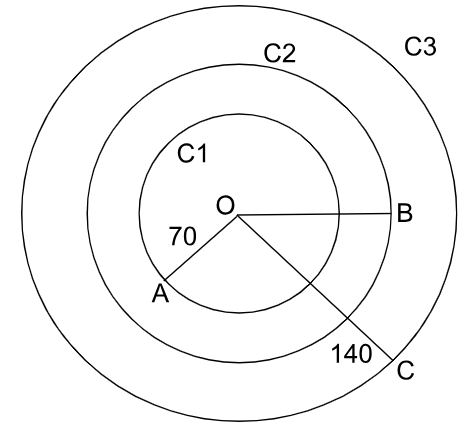
In a battle, the commander-in-chief arranges his soldiers in a formation of three concentric circles. The radii of the circles are in an arithmetic progression: the smallest radius is 70m (meters) and the largest is 140m.
If each soldier is to be separated from the adjacent soldiers standing on the same circle by 1m, how many soldiers are required to complete the formation? (Consider π = 22/7.)
XAT Geometry Questions
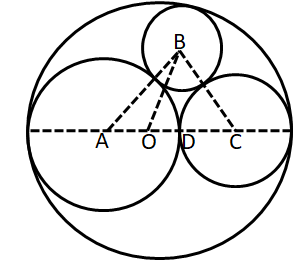
Three concentric circles C1, C2 and C3 with the radius OA, OB and OC are drawn.
OA, OB and OC are in AP (given).
OA = 70m, OB = (70 + d)m, OC = (70 + 2d)m , where, d is the common difference.
OC = 70+2d = 140 (given)
d = 35m
OB = 70 + 35 = 105m
The soldiers are standing on the circumference of these three circles at a distance of 1m. Hence, to find the total number of soldiers, we have the find the length of the circumference of all three circles.
Total circumference = $$2\pi\ \left(r1+r2+r3\right)$$
= 2 $$\times\ $$ $$\ \frac{\ 22}{7}\times\ \left(70+105+140\right)$$ = 1980
Hence, the total number of soldiers are 1980.
$$\therefore\ $$ The required answer is D.
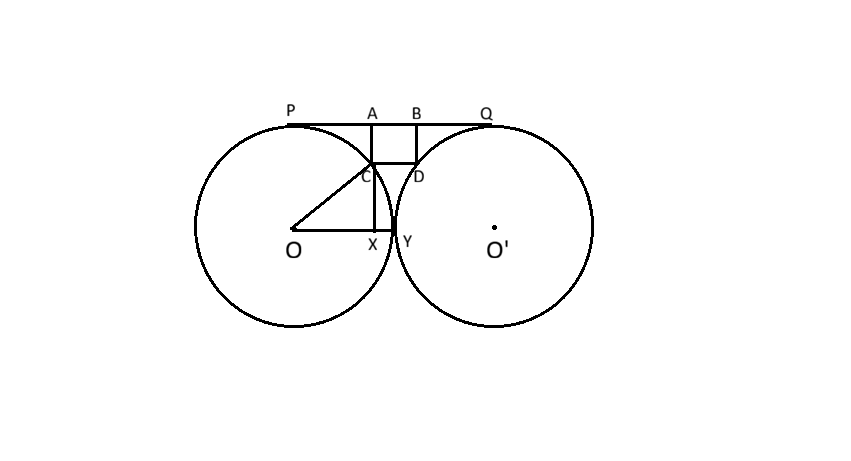
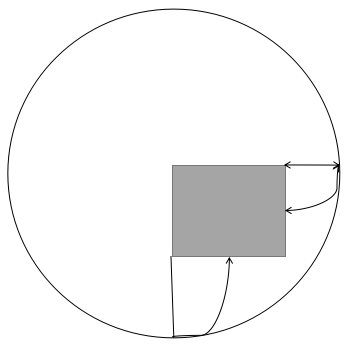
Consider two circles, each having radius of 5cm (centimeters), touching each other at a point P. A direct tangent QR is drawn touching one circle at a point Q and the other circle at a point R. Inside the region PQR inscribed by the two circles and the tangent, a square ABCD is inscribed with its base AB on the tangent and the other side touching the two circles at points D and C, respectively.
Find the area of the square ABCD.
The image will be drawn as:
We will assume the side of the square to be 2a. XY will be half of CD i.e. 2a/2 = a. This means that OX = radius - XY ==> 5 - a.
Similarly, CX = radius - AC ==> 5 - 2a and OC = radius.
Now, we can use pythagoras theorem in triangle OCX:
$$\left(5-a\right)^2+\left(5-2a\right)^2=5^2$$ ==> $$25\ +\ a^2-10a\ +\ 25\ +\ 4a^2\ -20a=25$$
==> $$5a^2-30a+25\ =\ 0$$ ==> $$a^2\ -\ 6a\ +\ 5\ =\ 0\ $$.
This gives a = 5 or 1.
a can not be 5 as that will make CX i.e. 5 - 2a to be of negative length.
This means that side of the square is 2*1 = 2 cm and Area of the square is 2*2 = 4 sq. cm.
A triangular plot is such that two of its sides, of lengths 90m (meter) and 60m, are perpendicular to each other. There is a housing complex in a rectangular region within the plot. The area of the rectangular region is 4/9th of the area of the triangular plot. Additionally, two sides of the rectangular region lie on the two perpendicular sides of the triangle, and one vertex is on the hypotenuse. The members of the housing complex want to construct a wall along the perimeter of the rectangular region.
If the cost of construction is Rs. 5000/m, what is the MINIMUM possible cost of building the wall?
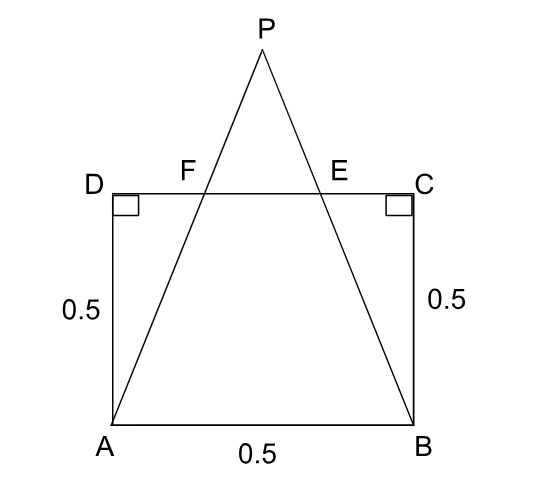
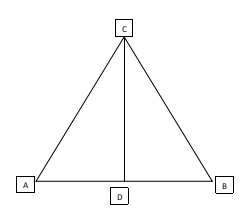
During Durga Puja, for the purpose of lighting, one puja pandal in Kolkata used many identical structures made of wooden sticks. The design of the structures was as follows: each structure was constructed with the help of six wooden sticks by combining an isosceles triangular structure, and a square structure, with the bases of both structures being the same. Let us take one such structure. Call the triangle PAB, with PA = PB, and the square ABCD, with AB being the same wooden stick as a common base for the triangle and the square. To make the structure strong, the two equal sides of the triangular structure were tied with the opposite side of square’s base, i.e., CD, at points E and F, in such a way that CE = EF = FD. The structure was hung from P.
If AB = 0.5m (meter), the total length of wooden sticks required for twenty such structures is:
The figure of one of the structure is given above.
Since, ABCD is a square, AB = CD = 0.5 m
Now, CE=EF=DF= (Given) = CD/3 = $$\ \ \ \frac{\ 0.5}{3}=\ \frac{\ 1}{6}m$$
Let PE = x m and EB = y m respectively.
In $$\triangle\ $$PFE and $$\triangle\ $$PAB,
$$\angle\ P=\angle\ P$$ (common angle)
$$\angle\ PFE=\angle\ PAB$$ (since FE is parallel to AB)
Hence, $$\triangle\ $$PFE and $$\triangle\ $$PAB are similar.
$$\ \frac{\ PE}{PB}=\ \frac{\ FE}{AB}$$
$$\ \frac{\ PE}{PE+EB}=\ \frac{\ FE}{AB}$$
$$\ \ \ \frac{\ x}{x+y}=\ \frac{\ \ \frac{\ 1}{6}}{0.5}$$
y = 2x i.e. EB = 2 $$\times\ $$PE
Now, in $$\triangle\ $$ECB,
$$EB^2=EC^2+CB^2$$
$$\left(2x\right)^2=\ \left(\frac{1\ }{6}\right)^2+\ \left(\frac{1\ }{2}\right)^2$$
$$x=\ \frac{\ \sqrt{10\ }}{12}m$$
PB = PE + EB = x + 2x = 3x = $$\ \frac{\ \sqrt{10}}{4}\ $$m
Length of the structure = PA + PB + AB + BC + CD + DA
= $$\ \frac{\ \sqrt{10}}{4}\ $$ + $$\ \frac{\ \sqrt{10}}{4}\ $$ + $$\ \frac{\ 1}{2}$$ + $$\ \frac{\ 1}{2}$$ + $$\ \frac{\ 1}{2}$$ + $$\ \frac{\ 1}{2}$$
= $$\left(2+\ \frac{\ \sqrt{10\ }}{2}\right)$$m
Length of 20 such structures =$$\left(2+\ \frac{\ \sqrt{10\ }}{2}\right)\times\ 20$$
= $$10\left(4+\sqrt{10\ }\right)m$$
$$\therefore\ $$ The required answer is C.
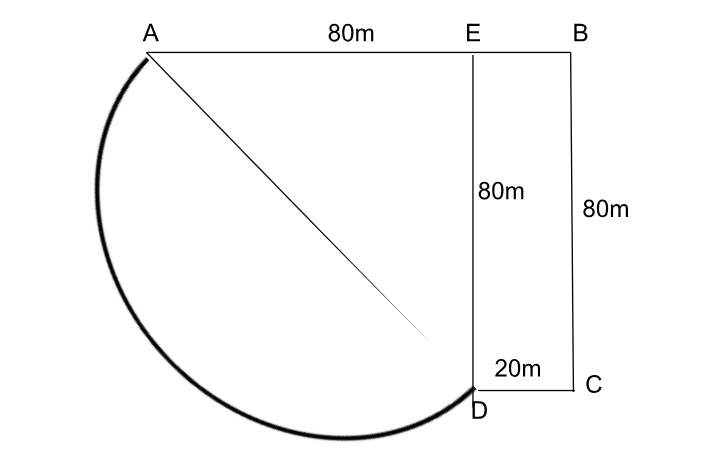
A park has two gates, Gate 1 and Gate 2. These two gates are connected via two alternate paths. If one takes the first path from Gate 1, they need to walk 80m (meters) towards east, then 80m towards south, and finally 20m towards west to arrive at Gate 2. The second path is a semi-circle connecting the two gates, where the diameter of the semi-circle is the straight-line distance between the two gates.
A person walking at a constant speed of 5 kilometers/hour enters the park through Gate 1, walks along the first path to reach Gate 2 and then takes the second path to come back to Gate 1.
Which of the following is the CLOSEST to the time the person takes, from entering the park to coming back to Gate 1, if she never stops in between?
The figure of the path is given below. Gate 1 and Gate 2 is situated at A and B respectively.
We have drawn ED which is perpendicular to AB in order to get a right angled triangle AED where AE = 60m and ED = 80m.
From pythagoras theorem, $$AD^2=AE^2+ED^2$$
$$AD^2=60^2+80^2$$
AD = 100m
Length of the semi circular path AD = $$\pi\ r=\pi\ \left(\frac{AD\ }{2}\right)\ $$ = $$50\pi\ \ $$ = 157 m
Length of path ABCD = 80+80+20 = 180 m
A person entered through gate 1 and travelled along path 1 and path 2 and exited from gate 1.
Total distance covered = 180+157 = 337m
Speed of the person = 5 kmph = $$\ \frac{\ 5\times\ 1000}{60}=\ \frac{\ 250}{3}\ \frac{\ m}{\min}$$
Total time taken = $$\ \frac{\ 337}{\ \frac{\ 250}{3}}\min$$ = 4 min (approx)
So the total time taken for the person to travel across the park is 4 min.
$$\therefore\ $$ The required answer is A.
There are three rectangular tanks in a building. The length, width and height of the first tank are m meters each, and the length, width and height of the second tank are n meters each. However, the length, width and height of the third tank are m meters, n meters and 1 meter, respectively.Initially, the first tank is full of water, while the second and the third are empty. When the second and the third tanks are completely filled with water transferred from the first tank, 85,000 liters of water is still left in the first tank.
If both m and n are positive integers, what is the value of m? (1 meter$$^{3}$$ =1000 liters)
The length, width and height of Tank 1 is m meters each.
Volume of Tank 1 = $$m^{3\ }$$ cubic meters
The length, width and height of Tank 2 is n meters each.
Volume of Tank 2 = $$n^{3\ }$$ cubic meters
The length, width and height of Tank 3 is m, n and 1 m respectively.
Volume of Tank 3 = mn cubic meters
Since, Tank 1 is filled first and after Tank 1 is full, water is flowing into Tank 2 and Tank 3,
Volume of water left in Tank 1 after Tank 2 and Tank 3 are filled = $$\left(m^{3\ }-n^3-mn\right)$$ cubic meters
Volume of water left in Tank 1 = 85000 L (given) = 85$$m^3$$
Hence, $$\left(m^{3\ }-n^3-mn\right)$$ = 85 , where, m and n are integers.
$$n^3+mn=m^3-85$$
From option B, we get $$n^3+7n=258$$ $$\longrightarrow\ $$ n=6
From option C, we get $$n^3+5n=40$$ $$\longrightarrow\ $$ No integer solution
From option D, we get $$n^3+6n=131$$ $$\longrightarrow\ $$ No integer solution
From option E, we get $$n^3+10n=915$$ $$\longrightarrow\ $$ No integer solution
Hence, we got m = 7 and n = 6.
$$\therefore\ $$ The required answer is B.
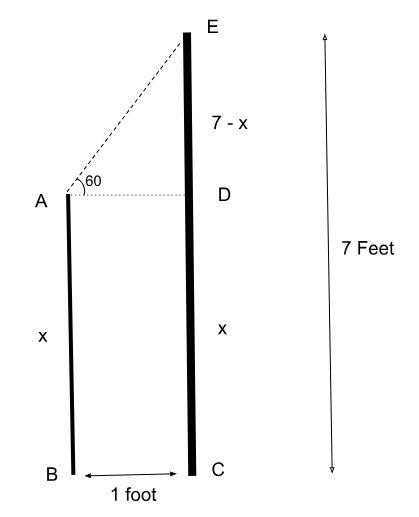
An industrial robot manufacturing company is tasked to design humanoid robots to be used in warehouses where the robots need to pick items from a stack of shelves. The height of the topmost shelf from the ground is 7 feet. To operate, the robot has to move on a track, running parallel to the stack of shelves. The track is fixed 1 foot away from the base of the stack of shelves. Further, the robot cannot raise its arms by more than 60° from the horizontal plane.
If the robot’s arms are attached to its shoulder, what should be the minimum height of the robot from the ground to the shoulder for its arms to reach the topmost shelf?
According to the question, we can draw the following table:
Here, EC refers to the shelf which is 7 feet and AB refers to the height of the robot. Here, AE reflects the hand of the robot. Since we need to find the minimum possible height, we need to maximize the length of the hands of the robot. The hands of the robot can be tilted to the maximum angle of 60, hence, we will assume that the hands of the robot tilt to exactly $$60^{\circ\ }$$.
Let the height of the robot i.e. AB be $$x$$ feet.
Now, we need to find the value of x.
Since, BC = 1 foot, AD is also 1 foot.
In triangle ADE, $$\tan\ 60^{\circ\ }=\dfrac{ED}{AD}$$
$$\tan\ 60^{\circ\ }=\dfrac{7-x}{1}$$
$$\sqrt{3}=\dfrac{7-x}{1}$$
$$x=7-\sqrt{3}$$
Hence, the minimum height of the robot from the ground to the shoulder for its arms to reach the topmost shelf is $$7-\sqrt{3}$$ feet.
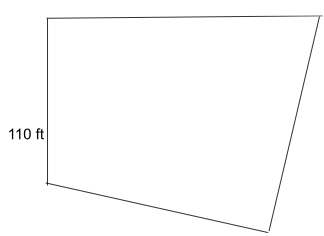
A farmer has a quadrilateral parcel of land with a perimeter of 700 feet. Two opposite angles of that parcel of land are right angles, while the remaining two are not. The farmer wants to do organic farming on that parcel of land. The cost of organic farming is Rs. 400 per square foot.
Consider the following two additional pieces of information:
I. The length of one of the sides of that parcel of land is 110 feet.
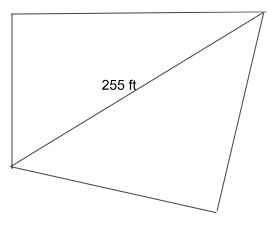
II. The distance between the two corner points where the non-perpendicular sides of that parcel of land intersect is 255 feet.
To determine the amount of money the farmer needs to spend to do organic farming on the entire parcel of land, which of the above additional pieces of information is/are MINIMALLY SUFFICIENT?
Considering statement 1: We can only get the length of one of the sides of the land. But that is not sufficient to get the area.
Considering statement 2:
We are given the diagonal length.
With this information and the perimeter, it is not possible to find the area of land.
Considering both 1 and 2 statements.
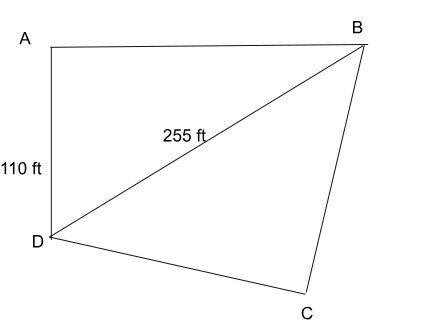
Now, we have two right-angle triangles. We know the hypotenuse of both triangles.
$$AB^2+AD^2=BD^2$$
$$110^2+AB^2= 255^2$$
AB$$\approx\ $$230
Let DC = x, BC = 700 - 110-230-x = 360-x.
$$x^2+(360-x)^2 = 255^2$$
Upon solving this we get x = 180$$\pm\frac{15}{\sqrt{2}}$$
360-x = 180$$\pm\frac{15}{\sqrt{2}}$$
Area of triangle ABD = $$\frac{1}{2}\cdot110\cdot230\ =\ 12650$$
Area of triangle BDC = $$\frac{1}{2}\left(180+\frac{15}{\sqrt{2}}\right)\left(180-\frac{15}{\sqrt{2}}\right)=16143.75$$
So, total area = 12650+16143.75 = 28793.75
Cost = 28793.75*400 = Rs. 11517500.
So, option C is the answer, as both statements 1 and 2 are required and sufficient to answer the question.
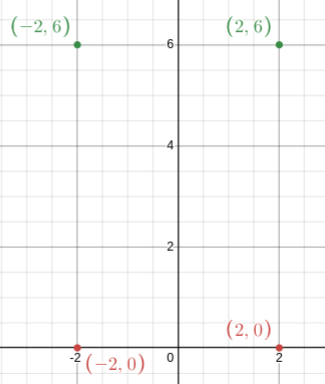
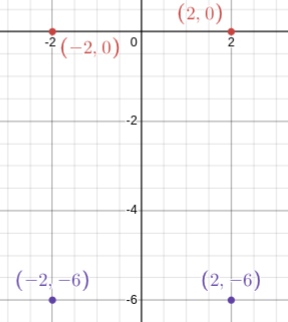
ABCD is a rectangle, where the coordinates of C and D are (- 2,0) and (2,0), respectively.
If the area of the rectangle is 24, which of the following is a possible equation representing the line $$\overleftrightarrow{AB}$$?
CD is on of the side of the rectangle. So, two of the remaining 3 sides will be perpendicular to CD.
Length of CD is 4. We are told that area is 24.
We know area of rectangle is lb. 4*l = 24
l = 6
So, the other two points should be such that when jined with C and D respectively, should be perpendicular to CD and lie at a distance of 6.
There will be two pair of such points. One pair is (-2,6), (2,6) and the other pair is (-2,-6), (2,-6)
So, there are two possible equations of AB. One is y = 6 and the other is y = -6.
Adu and Amu have bought two pieces of land on the Moon from an e-store. Both the pieces of land have the same perimeters, but Adu’s piece of land is in the shape of a square, while Amu’s piece of land is in the shape of a circle.
The ratio of the areas of Adu’s piece of land to Amu’s piece of land is:
It is given that the perimeters of areas are equal for both of them. Let the equal perimeter be P.
Adu's piece is a square, and the perimeter of the square = 4s = P
Side of the square $$s=\ \dfrac{P}{4}$$
Amu's piece is a circle, and the perimeter of the circle = $$2\pi\ r=\ P$$
The radius of the circle $$r=\ \dfrac{P}{2\pi\ }$$
The ratio of areas is,
$$s^2\ :\ \pi\ r^2$$ $$=\left(\dfrac{P}{4}\right)^{^2}:\ \pi\ \left(\dfrac{P}{2\pi\ }\right)^{^2}$$ $$=\ \dfrac{P^2}{16}\ :\ \pi\times\dfrac{P^2}{4\pi^2\ }$$ $$=\ \dfrac{1}{4}\ :\ \dfrac{1}{\ \pi\ }\ =\ $$ $$\pi\ \ :\ \ 4$$
Hence, the correct answer is option D.
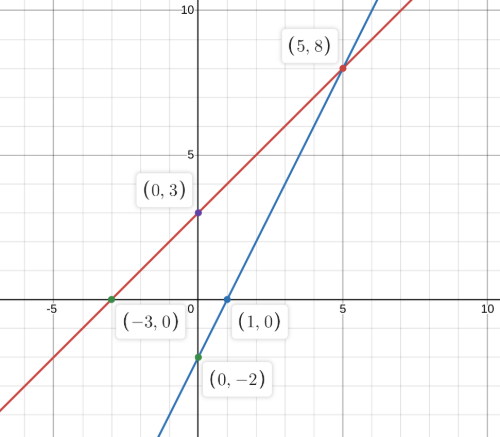
A straight line $$L_1$$ has the equation $$y = k(x - 1)$$, where k is some real number. The straight line $$L_1$$ intersects another straight line $$L_2$$ at the point (5, 8).
If $$L_2$$ has a slope of 1, which of the following is definitely FALSE?
Given that the equation of line $$L_1$$ is $$y = k(x - 1)$$ and it intersects line $$L_2$$ at (5, 8).
So, the point (5, 8) must satisfy the equation of line $$L_1$$
We get $$8=k\left(5-1\right)$$
or $$k=2$$
Hence, the equation of line $$L_1$$ is $$y = 2(x - 1)$$ . . . (1)
Now, $$L_2$$ has a slope of 1
Using slope form, the equation of line is $$y=mx+c$$, where $$m$$ is the slope and $$c$$ is the y-intercept
So, the equation of line $$L_2$$ is $$y=x+c$$
Now, as it passes through the point (5, 8), the equation must satisfy
Hence, $$8=5+c$$
or, $$c=3$$
Hence, the equation of line $$L_2$$ is $$y=x+3$$ . . . (2)
Plotting both lines on the graph, we get
From the graph we can clearly see that the distance between the y-intercepts of the two lines is 5 not 6.
Hence, the statement the distance between the y-intercepts of the two lines is 6 is definitely false.
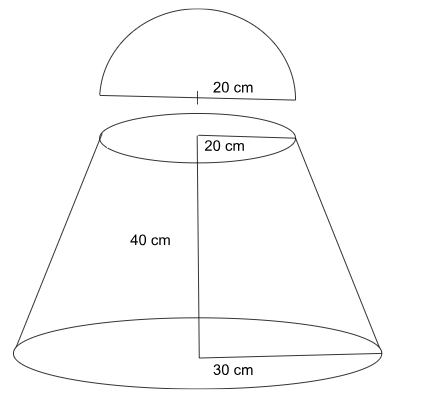
A soild trophy, consisting of two parts, has been designed in the following manner: the bottom part is a frustum of a cone with the bottom radius 30 cm, the top radius 20 cm, and height 40 cm, while the top part is a hemisphere with radius 20 cm. Moreover, the flat surface of the hemisphere is the same as the top surface of the frustum.
If the entire trophy is to be gold-plated at the cost of Rs. 40 per square cm, what would the cost for gold-plating be closest to?
According to the question, we have the following figure:
According to the question, we have a frustum and a semisphere with a flat surface, and we need to find the curved surface area of the frustum along with the curved surface area of the hemisphere and the bottom flat area of the frustum.
Curved surface area of the Frustrum = $$\pi\ \times\left(r_1+r_2\right)\times l$$
Here, r1 and r2 refer to the two different radii, and l refers to the slant height.
$$l=\sqrt{h^2+\left(r_1-r_2\right)^2}$$
$$l=\sqrt{1600+100}=\sqrt{1700}=10\sqrt{17}$$
Hence, curved surface area of the frustrum = $$\pi\ \times\left(20+30\right)\times10\sqrt{17}$$ = $$\pi\ \times50\times10\sqrt{17}$$ = $$500\sqrt{17}\pi\ $$
Now, curved surface area of the hemisphere = $$2\pi r^2=2\times\pi\ \times\ \left(20\right)^2\ =\ 800\pi\ $$
And the flat bottom area of the frustrum = $$\pi r^2=\pi\ \times\left(30\right)^2=900\pi\ $$
Hence, the total surface area of the trophy =$$500\sqrt{17}\pi\ +\ 800\pi\ +\ 900\pi\ =500\sqrt{17}\pi\ +\ 1700\pi\ $$
The cost of gold coating is Rs. 40 per square cm.
Hence, the total cost of coating = $$40\times\ \left(500\sqrt{17}\pi\ +\ 1700\pi\ \right)$$
$$40\times\ \dfrac{22}{7}\times\ \left(500\sqrt{17}\ +\ 1700\ \right)$$
$$40\times\ \dfrac{22}{7}\times\ \left(2061.55\ +\ 1700\ \right)$$
$$40\times\ \dfrac{22}{7}\times\ 3761.55=Rs.\ 4,72,880.571\ \approx\ Rs.\ 4,73,000$$
Consider a right-angled triangle ABC, right angled at B. Two circles, each of radius r, are drawn inside the triangle in such a way that one of them touches AB and BC, while the other one touches AC and BC. The two circles also touch each other (see the image below).
If AB = 18 cm and BC = 24 cm, then find the value of r.
It is given that ABC is a right-angled triangle, where $$\angle\ B\ =\ 90^{\circ\ }$$
Now, we can use Pythagoras theorem to calculate the value of AC, which is equal to $$\sqrt{\ 18^2+24^2}=\sqrt{\ 324+576}=\sqrt{\ 900}\ =\ 30$$ cm.
Here, we have drawn a common tangent MN, which is perpendicular to BC => Triangle MNC is a right-angled triangle.
It is also be concluded that traingle MNC is similar to traingle ABC
Hence, the ratio of the sides of triangle MNC is the same as the ratio of the sides of triangle ABC.
Thus, AB: BC: AC = MN: NC: MC = 18:24:30 = 3: 4: 5
Let the length of side MN be 3x => the length of NC = 4x, and the length of MC = 5x.
In triangle MNC, the circle inside it is the in circle of triangle MNC.
Thus, the in radius (r) of the circle in triangle MNC = (3x+4x-5x)/2 = x.
We know that BC = BN+NC, where BN is the diameter of the first circle, which is equal to 2r = 2x (since, r = x), and NC = 4x
=> 24 = 2x+4x
=> 6x = 24 => x = 4 cm.
Hence, the radius of the circle (x = r) is 4 cm.
The correct option is B
A farmer has a triangular plot of land. One side of the plot, henceforth called the base, is 300 feet long and the other two sides are equal. The perpendicular distance, from the corner of the plot, where the two equal sides meet, to the base, is 200 feet. To counter the adverse effect of climate change, the farmer wants to dig a circular pond. He plans that half of the circular area will be inside the triangular plot and the other half will be outside, which he will purchase at the market rate from his neighbour. The diameter of the circular plot is entirely contained in the base and the circumference of the pond touches the two equal sides of the triangle from inside.
If the market rate per square feet of land is Rs. 1400, how much does the farmer must pay to buy the land from his neighbour for the pond? (Choose the closest option.)
The line AC is tangent to the circle. So, the line DE is perpendicular to AC and is radius to the circle.
Look at the $$\triangle\ $$ADC and $$\triangle\ $$DEC. $$\angle\ $$DAC = $$\angle\ $$EDC, $$\angle\ $$C=$$\angle\ $$C. And both D and E are right angle triangles.
So, both the triangles are similar.
$$\triangle\ $$ ADC is a right-angled triangle.
$$AC^2$$=$$AD^2$$+$$DC^2$$
$$AC^2$$=$$200^2+150^2=250^2$$
AC=250, AD=200, DE=r, DC=150
$$\frac{AD}{DE}=\frac{AC}{DC}$$
$$\frac{200}{r}=\frac{250}{150}$$
$$\Rightarrow$$ r=120.
Given half pond is inside the triangle, so he has to only buy half the area of the circle.
Cost for buying area of semi circle =$$\pi\ \frac{r^2}{2}$$*1400=$$\pi\ \frac{120^2}{2}$$*1400= 3,16,80,000
A group of boys is practising football in a rectangular ground. Raju and Ratan are standing at the two opposite mid-points of the two shorter sides. Raju has the ball, who passes it to Rivu, who is standing somewhere on one of the longer sides. Rivu holds the ball for 3 seconds and passes it to Ratan. Ratan holds the ball for 2 seconds and passes it back to Raju. The path of the ball from Raju to Rivu makes a right angle with the path of the ball from Rivu to Ratan. The speed of the ball, whenever passed, is always 10 metre per second, and the ball always moves on straight lines along the ground.
Consider the following two additional pieces of information:
I. The dimension of the ground is 80 metres × 50 metres.
II. The area of the triangle formed by Raju, Rivu and Ratan is 1000 square metres.
Consider the problem of computing the following: how many seconds does it take for Raju to get the ball back since he passed it to Rivu? Choose the correct option.
The question states that the path forms a right-angle triangle at Rivu. So, let's consider the distance from Raju to Rivu as x and that from Rivu to Ratan as y.
i)
Now, $$\triangle\ ABC$$ form a right-angled triangle. Using Pythagoras theorem
$$AB^2+BC^2=AC^2$$
=>$$x^2+y^2=80^2=6400$$ --->1
The area of $$\triangle\ ABC$$ is $$\frac{1}{2}\cdot b\cdot h$$=$$\frac{1}{2}\cdot x\cdot y$$ ---->2
If we consider the base of the triangle as AC of length 80(side of rectangle) and height as altitude from B of length 25 (half the breadth of rectangle), we can get the area as $$\frac{1}{2}\cdot b\cdot h$$=$$\frac{1}{2}\cdot 80\cdot 25=1000$$.
Now, use this in equation 2.
$$\frac{1}{2}\cdot x\cdot y$$=1000
xy=2000--->3
$$\left(x+y\right)^2=x^2+y^2+2xy$$=6400+4000=10400
x+y=20$$\sqrt{\ 26}$$
This is the distance the ball travels at 10m/s. The time taken is 2$$\sqrt{\ 26}$$+5 sec for holding.
So, 1 alone is sufficient.
ii) Given the area of the triangle is 1000
$$\frac{1}{2}\cdot x\cdot y$$=1000
=> xy=2000
With this alone, we can't find the travel time.
Find the value of
$$\frac{\sin^{6}15^{\circ} + \sin^{6}75^{\circ} + 6\sin^{2}15^{\circ}\sin^{2}75^{\circ}}{\sin^{4}15^{\circ} + \sin^{4}75^{\circ} + 5\sin^{2}15^{\circ}\sin^{2}75^{\circ}}$$
$$Let\ \sin^215^{\circ}\ =a\ and\ \sin^275^{\circ}\ =\ b\ $$
Then the given equation becomes,
$$\ \frac{\ a^3+b^3+6ab}{a^2+b^2+5ab}$$
=$$\ \frac{\ \left(a+b\right)^3-3ab\left(a+b\right)+6ab}{\left(a+b\right)^2-2ab+5ab}$$ $$\ \therefore\ \ a^3+b^3=\left(a+b\right)^3-3ab\left(a+b\right)$$ , $$\ \therefore\ \ a^2+b^2=\left(a+b\right)^2-2ab$$
Using $$\sin\left(\theta\right)\ =\cos\left(90-\theta\ \ \right)$$
we get, $$\sin^275^{\circ\ }=\cos^215^{\circ\ }$$
now, a+b = $$\sin^215^{\circ\ }+\sin^275^{\circ\ }$$ = $$\sin^215^{\circ\ }+\cos^215^{\circ\ }$$ = 1.
The equation becomes, $$=\ \frac{\ 1-3ab+6ab}{1-2ab+5ab}\ =\ \frac{\ 1+3ab}{1+3ab}\ =1\ $$
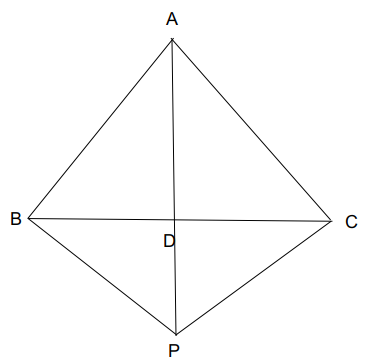
ABC is a triangle with BC=5. D is the foot of the perpendicular from A on BC.
E is a point on CD such that BE=3. The value of $$AB^2 - AE^2 + 6CD$$ is:
Given that, $$AD\bot\ BC$$
$$BE=3$$
$$BC=5$$
Using Pythagoras' theorem,
$$AD^2+BD^2=AB^2$$ .....(1)
$$AD^2+DE^2=AE^2$$......(2)
$$AD^2+DC^2=AC^2$$......(3)
(1) - (2) gives
$$BD^2+DE^2=AB^2-AE^2$$
$$x^2-\left(3-x\right)^2=AB^2-AE^2$$
$$AB^2-AE^2=6x-9$$
$$AB^2-AE^2+6CD=6x-9+6\left(5-x\right)$$ ($$CD=\left(5-x\right)$$)
$$AB^2-AE^2+6CD=6x-9+30-6x$$
$$AB^2-AE^2+6CD=21$$
ABC is a triangle and the coordinates of A, B and C are (a, b-2c), (a, b+4c) and (-2a,3c) respectively where a, b and c are positive numbers.
The area of the triangle ABC is:
The length of AB = $$\left(b+4c\right)-\left(b-2c\right)=6c$$ (X-coordinates of A&B are same).
The altitude of triangle ABC, CD = $$a-(-2a)=3a$$.
Area of triangle ABC = $$\ \dfrac{\ AB\ \times\ CD}{2}$$ = $$\ \dfrac{6c\ \times\ 3a\ }{2}=9ac$$
Option (D) is correct.
A non-flying ant wants to travel from the bottom corner to the diagonally opposite top corner of a cubical room. The side of the room is 2 meters. What will be the minimum distance that the ant needs to travel?
The shortest route ant takes to travel from the bottom corner to the diagonally opposite top corner is shown below.
The route goes through lateral faces (vertical faces) of the cubical room.
The length of route, r = $$\sqrt{\ \left(2+2\right)^2+2^2}$$ = $$\sqrt{\ 20}$$ = $$2\sqrt{5}$$
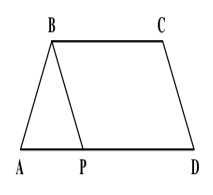
ABCD is a trapezoid where BC is parallel to AD and perpendicular to AB. Kindly note that BC< AD. P is a point on AD such that CPD is an equilateral triangle. Q is a point on BC such that AQ is parallel to PC. If the area of the triangle CPD is $$4\sqrt{\ 3}$$, find the area of the triangle ABQ.
Given that, CPD is an equilateral triangle
$$\angle\ CPD=\angle\ PDC=\angle\ DCP=60^{\circ\ }$$
As AQ is parallel to PC $$\angle\ CPD=\angle\ QAP=60^{\circ\ }$$
As BC is parallel to AD $$\angle\ QAP=\angle\ AQB=60^{\circ\ }$$ ( alternate interior angles).
Given, Area of equilateral triangle CPD is $$4\sqrt{\ 3}$$
This implies, $$\ \frac{\ \sqrt{3}a^2}{4}=4\sqrt{3}$$
Solving, we get $$a=\ 4$$.
From figure, length of $$AB$$ = Height of $$\triangle\ CPD=\frac{\sqrt{\ 3}a}{2}=2\sqrt{\ 3}$$.
From $$\triangle\ ABQ,\ BQ=\ \frac{\ AB}{\tan\ 60^{\circ\ }}=\frac{2\sqrt{\ 3}}{\sqrt{\ 3}}=2$$
Area of $$\triangle\ ABQ=\frac{1}{2}\times\ AB\times\ BQ=\ \ \frac{\ 2\times\ 2\sqrt{\ 3}}{2}=2\sqrt{\ 3}\ $$
Option A is correct.
Ramesh and Reena are playing with triangle ABC. Ramesh draws a line that bisects $$\angle BAC$$; this line cuts BC at D. Reena then extends AD to a point P. In response, Ramesh joins B and P. Reena then announces that BD bisects $$\angle PBA$$, hat a surprise! Together, Ramesh and Reena find that BD= 6 cm, AC= 9 cm, DC= 5 cm, BP=8 cm, and DP = 5 cm.
How long is AP?
Given:
BD= 6 cm, AC= 9 cm, DC= 5 cm, BP=8 cm, and DP = 5 cm.
Since AD is the angular bisector applying the angular bisector theorem we have :
$$\frac{AB}{BD}=\ \frac{AC}{CD}$$
Hence : Considering AB = x cm.
$$\frac{9}{5}=\ \frac{x}{6}$$
x = 10.8 cm.
Now since BD is the angular bisector for angle PBA we have :
Applyinh the internal angle bisector theorem :
$$\frac{PB}{PD}=\ \frac{BA}{AD}$$
Considering AD = y cm.
$$\frac{8}{5}\ =\ \frac{10.8}{y}$$
y = 6.75 cm.
AP = AD + DP.
= 6.75 + 5 = 11.75 cm
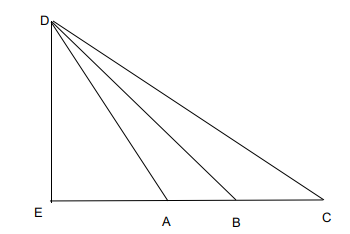
A tall tower has its base at point K. Three points A, B and C are located at distances of 4 metres, 8 metres and 16 metres respectively from K. The angles of elevation of the top of the tower from A and C are complementary.
What is the angle of elevation (in degrees) of the tower’s top from B?
Given the distances are :
AE = 4 meters , EB = 8 meters and EC = 16 meters.
Considering the length of ED = K.
Given the angles DAE and angle DCE are complementary.
Hence the angles are A and 90 - A.
Tan(90-A) = Cot A
$$\ \tan\ DAE\ =\frac{k}{4}$$ and $$\ \tan\ DCE\ =\frac{1}{\tan\ DAE}=\ \frac{k}{16}$$
Hence $$\frac{k}{16}=\ \frac{4}{k}$$
k = 8 meters.
The angle DBE is given by
$$Tan\ DBE\ =\ \frac{k}{8}=\ 1$$
Hence the angle is equal to 45 degrees.
The six faces of a wooden cube of side 6 cm are labelled A, B, C, D, E and F respectively. Three of these faces A, B, and C are each adjacent to the other two, and are painted red. The other three faces are not painted. Then, the wooden cube is neatly cut into 216 little cubes of equal size. How many of the little cubes have no sides painted?
Since A, B and C are adjacent faces. If we remove them, the resultant solid will also be a cube with side 5.
Hence total number of cubes unpainted = $$5^3$$ = 125
ABC is a triangle with integer-valued sides AB = 1, BC >1, and CA >1. If D is the mid-point of AB, then, which of the following options is the closest to the maximum possible value of the angle ACD (in degrees)?
We will try to maximize the value of the angle ACD:

For a fixed triangle ABC, the angle ACD can be maximized when we take the median CD to be perpendicular to AB and the value of AC is as small as possible, so that the sine of angle ACD, and hence, the angle ACD itself if maximized, as the value of AD is fixed at half of AB at 0.5.
Now, the least possible value of AC is 2. The triangle will be of sides (1,2,2).
Value of sin(ACD)=$$\frac{0.5}{2}=0.25$$
$$\angle\ ACD=\sin^{-1}\left(0,25\right)=14.78\approx\ 15.$$
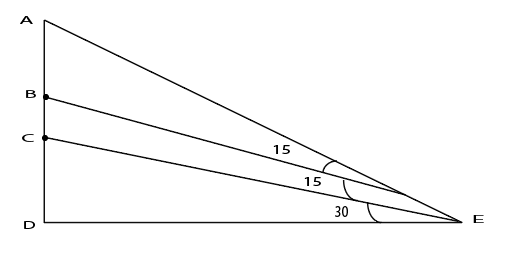
The topmost point of a perfectly vertical pole is marked A. The pole stands on a flat ground at point D. The points B and C are somewhere between A and D on the pole. From a point E, located on the ground at a certain distance from D, the points A, B and C are at angles of 60, 45 and 30 degrees respectively. What is AB : BC : CD?
Let ED = $$\sqrt{\ 3}x$$
In triangle CDE, $$\tan\ 30\ =\ \frac{CD}{\sqrt{\ 3}x}$$ => CD = x
In triangle BDE, $$\tan\ 45\ =\ \frac{BD}{\sqrt{\ 3}x}$$ => BD = $$\sqrt{\ 3}x$$ => BC = $$\sqrt{\ 3}x\ -x$$
In triangle ADE, $$\tan\ 60\ =\ \frac{AD}{\sqrt{\ 3}x}$$ => AD = 3x => AB = $$3x\ -\ \sqrt{\ 3}x$$
AB : BC : CD = $$(3 - \sqrt 3) : (\sqrt 3 - 1) : 1$$
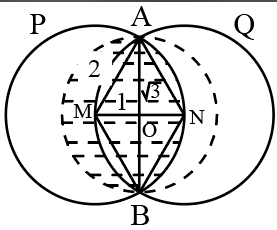
Two circles P and Q, each of radius 2 cm, pass through each other’s centres. They intersect at points A and B. A circle R is drawn with diameter AB. What is the area of overlap (in square cm) between the circles R and P?
We know that radius of circle P is 2 cm
Length of MO = 1 cm
radius of circle R = AO = $$\sqrt{\ 2^2-1^2}$$ = $$\sqrt{\ 3}$$
Area of overlap between the circle R and P(shaded region) = semi circle area of R + area of segment ANBOA
Area of segment ANBOA = area of sector ANBM - area of triangle AMB
= $$\frac{120}{360}\pi\ \left(2\right)^2$$ - $$\frac{1}{2}\left(1\right)\left(2\sqrt{\ 3}\right)$$
= $$\frac{4\pi}{3}-\sqrt{\ 3}$$
Area of overlap between circle R and P = $$\frac{\pi\ \left(\sqrt{\ 3}\right)^2}{2}$$+ $$\frac{4\pi}{3}-\sqrt{\ 3}$$
= $$\ \frac{\ 17\pi\ }{6}-\sqrt{\ 3}$$
Answer is option E.
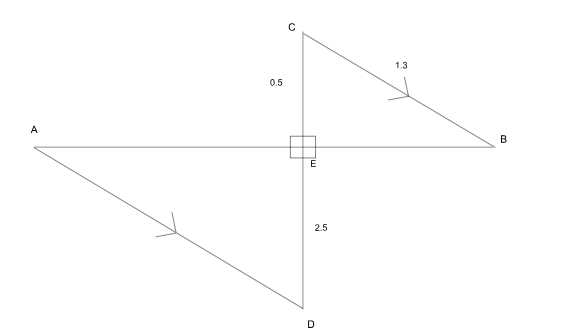
Rajesh, a courier delivery agent, starts at point A and makes a delivery each at points B, C and D, in that order. He travels in a straight line between any two consecutive points. The following are known: (i) AB and CD intersect at a right angle at E, and (ii) BC, CE and ED are respectively 1.3 km, 0.5 km and 2.5 km long. If AD is parallel to BC, then what is the total distance (in km) that Rajesh covers in travelling from A to D?
Based on the information, the following figure can be obtained.
Given, CE=0.5, BC = 1.3 and ED=2.5
Triangle CEB is a right-angled triangle => EB = 1.2
$$\triangle\ $$ ECB is similar to $$\triangle\ $$ EDA
EB/EC = AE/ED => AE = 6
Hence total distance travelled = AB + BC + CD = 7.2 + 1.3 + 3 = 11.5km
Two lighthouses, located at points A and B on the earth, are 60 feet and 40 feet tall respectively. Each lighthouse is perfectly vertical and the land connecting A and B is perfectly flat. The topmost point of the lighthouse at A is A’ and of the lighthouse at B is B’. Draw line segments A’B and B’A, and let them intersect at point C’. Drop a perpendicular from C’ to touch the earth at point C. What is the length of CC’ in feet?
Triangle ACC' is similar to triangle ABB'
Considering AC = a, BC = b, CC' = h, AA' is given as 60, BB' is given to be 40.
AC/AB = CC'/BB' = h/40.
$$\left(\frac{a}{a+b}\right)\ =\ \frac{h}{40}$$ (1)
Similarly triangle BCC' is similar to BAA'.
BC/AB = CC'/AA' = h/60.
$$\left(\frac{b}{a+b}\right)\ =\ \frac{h}{60}$$ (2)
Adding (1) and (2).
$$\frac{h}{40}+\frac{h}{60\ }=\ 1$$
1/h = $$\left(\frac{1}{40}+\frac{1}{60}\right)$$
h = 24
Using crossed ladder theorem
$$\frac{1}{CC'}=\frac{1}{AA'}+\frac{1}{BB'}$$=1/60 +1/40 =5/120 =24.
A rectangular swimming pool is 50 meters long and 25 meters wide. Its depth is always the same along its width but linearly increases along its length from 1 meter at one end to 4 meters at the other end. How much water (in cubic meters) is needed to completely fill the pool?
The volume of cuboid will be 50*25*1=1250
The volume of the portion below cuboid will be Area of triangle*width =$$\frac{1}{2}\cdot3\cdot50\cdot25=1875$$
.'. Total volume = 1875+1250= 3125.
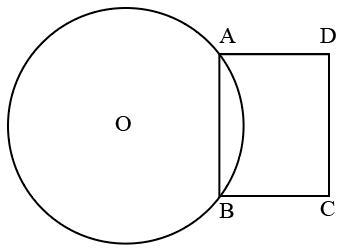
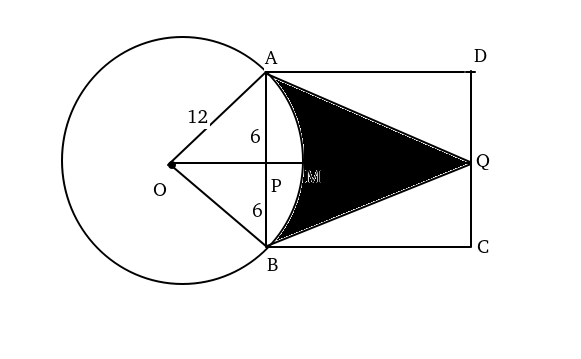
In the figure given below, the circle has a chord AB of length 12 cm, which makes an angle of $$60^\circ$$ at the center of the circle, O. ABCD, as shown in the diagram, is a rectangle. OQ is the perpendicular bisector of AB, intersecting the chord AB at P, the arc AB at M and CD at Q. OM = MQ. The area of the region enclosed by the line segments AQ and QB,and the arc BMA, is closest to (in cm$$^2$$):
In triangle OAP, since AP=6, OA will be 12.
Area of AQBMA=Area of Triangle ABQ- (Area of minor arc AMB-Area of OAB)
Length of PQ=MQ+PM = 12+(12-$$6\sqrt{\ 3}$$)=24-$$6\sqrt{\ 3}$$
Area of Triangle ABQ=$$\frac{1}{2}\cdot12.\left(24-6\sqrt{\ 3}\right)=6\left(24-6\sqrt{\ 3}\right)$$.=81.64
Area of minor arc AMB-Area of OAB=$$\frac{60}{360}\cdot\pi\ \cdot144-\frac{1}{2}\cdot12\cdot6\sqrt{\ 3}$$ = $$24\pi\ -36\sqrt{\ 3}$$.=13.07
.'.Area of AQBMA=68.57$$\approx\ 69$$
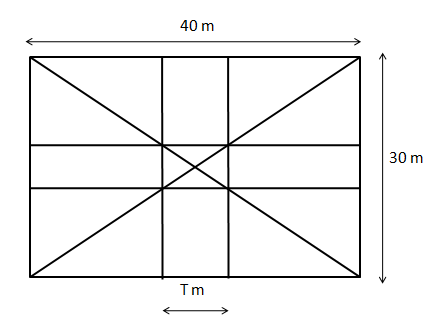
A rectangular field is 40 meters long and 30 meters wide. Draw diagonals on this field and then draw circles of radius 1.25 meters, with centers only on the diagonals. Each circle must fall completely within the field. Any two circles can touch each other but should not overlap. What is the maximum number of such circles that can be drawn in the field?
Each circle on the end of the diagonal will touch sides of the rectangular field
Using Pythagoras' theorem, the distance between the vertex of the rectangle and center of the first circle drawn on the diagonal = $$1.25\sqrt{\ 2}$$
Distance between the vertex of the rectangle and circumference of the first circle drawn on the diagonal = $$1.25\sqrt{\ 2}$$ - 1.25 = 0.51 meters
Space that cannot be used to draw circle otherwise they will go outside rectangle on every diagonal = 0.51 * 2 = 1.02 meters
Space that can be used to draw circles = length of diagonal - unused space = 50 - 1.02 = 48.98 meters
On every diagonal, maximum number of such circles = usable length/diameter of each circle = 48.98/2.5 = 19
Or, on every diagonal, one circle will be at the center (intersection of diagonals) and 9 circles will be on each half of the diagonal
Therefore the circle in center will be common for both diagonals, and 9 circles can be drawn on each half of the diagonal. So total circles = 9*4 + 1 = 37
XYZ is an equilateral triangle, inscribed in a circle. P is a point on the arc YZ such that X and P are on opposite sides of the chord YZ. Which of the following MUST always be true?
If we join YP and PZ, XYPZ will become a cyclic quadrilateral. YZ and XP will be diagonals of this quadrilateral.
Ptolemy's theorem states that the product of the length of the diagonals is equal to the sum of products of measures of the pairs of opposite sides.
As per this theorem for the quadrilateral :
XY*PZ +XZ*PY = YZ*XP.
For the equilateral triangle.
Now, in equilateral triangle XYZ, YZ = XZ = XY.
Hence equation 1 becomes, XP = YP + PZ.
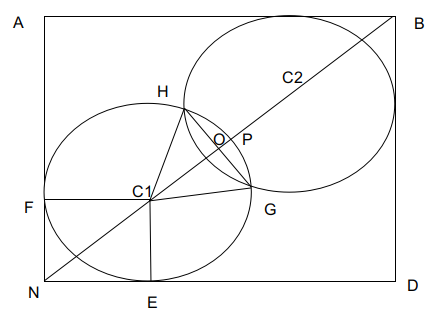
Mohanlal, a prosperous farmer, has a square land of side 2 km. For the current season, he decides to have some fun. He marks two distinct points on one of the diagonals of the land. Using these points as centers, he constructs two circles. Each of these circles falls completely within the land, and touches at least two sides of the land. To his surprise, the radii of both the circles are exactly equal to $$\frac{2}{3}$$ km. Mohanlal plants potatoes on the overlapping portion of these circles. Calculate the area on which Mohanlal planted potatoes (in sq. km).
The two circles are symmetric about the diagonal.
NC1=$$\frac{2\sqrt{\ 2}}{3}$$ = $$\sqrt{\ \left(\frac{2}{3}\right)^{^2}+\left(\frac{2}{3}\right)^2}=\ \frac{\left(2\sqrt{\ 2}\right)}{3}$$
The lengths FC1, EC1 are the radius of the circle which is 2km/3.
The length C1P is the radius of the circle.
Because of symmetry C1O = C2O and C1N = C2B.
2*(C1N+ C1O) = $$2\sqrt{\ 2}$$ the length of the diagonal of the square.
C1N+C1O = $$\sqrt{\ 2}$$
C1O = $$\sqrt{\ 2}-\frac{2\sqrt{\ 2}}{3}=\ \frac{\sqrt{\ 2}}{3}$$
OP = $$\frac{\left(2-\sqrt{\ 2}\right)}{3}$$
The diagonal perpendicularly bisects the line GH. Hence C1OH is 90 degrees.$$C1H^2\ =\ C1O^2+OH^2$$
OH = $$\frac{\sqrt{\ 2}}{3}$$. Similarly OG = $$\frac{\sqrt{\ 2}}{3}$$
HC1, C1G both are equal to $$\frac{2}{3}$$ each. H1G is $$\frac{2\sqrt{\ 2}}{3}$$. HC1G is a raight angled traingle with angle HC1G is 90 degrees.
Area of the region required is 2*(Area of segment OGH)
.'. Area of required region=$$2\left(\frac{90}{360}\cdot\frac{4\pi\ }{9}-\frac{1}{2}\cdot\frac{2\sqrt{\ 2}}{3}\cdot\frac{\sqrt{\ 2}}{3}\right)$$=$$\frac{2(\pi - 2)}{9}$$
A gold ingot in the shape of a cylinder is melted and the resulting molten metal molded into a few identical conical ingots. If the height of each cone is half the height of the original cylinder and the area of the circular base of each cone is one fifth that of the circular base of the cylinder, then how many conical ingots can be made?
Let the radius of the cylinder be $$r$$ and height be $$h$$ (as shown).
Let the dimensions of the cone be $$r_c$$ and $$h_c$$ (as shown).
It is given that $$h_c = \frac{h}{2}$$
Area of base of cone $$A_{c}=\pi \times r_{c}^{2}$$
Area of base of cylinder $$A=\pi \times r^{2}$$
Given, $$A_{c}=\frac{1}{5} \times A $$
$$ \Rightarrow \pi \times r_{c}^{2} =\frac{1}{5} \times \pi \times r^{2} $$
$$ \Rightarrow r_{c}^{2} = \frac{1}{5} \times r^{2} $$
$$ \Rightarrow \frac{r^{2}}{r_{c}^{2}} = 5 $$
Now we know that the volume of cylinder = total volume of cones
Let the number of cones be n.
So, volume of cylinder = n x volume of each cone
$$ \Rightarrow V = n \times V_{c} $$
$$ \Rightarrow \pi \times r^{2} \times h = n \times \frac{1}{3} \times \pi \times r_{c}^{2} \times h_c $$
$$ \Rightarrow r^{2} \times h = n \times \frac{1}{3} \times r_{c}^{2} \times h_c $$
$$ \Rightarrow \frac{r^{2}}{r_{c}^{2}} \times \frac{h}{h_c} \times 3 = n $$
$$ \Rightarrow 5 \times 2 \times 3 = n $$
$$ \Rightarrow 30 = n $$
Thus, 30 conical ingots can be made.
Let P be the point of intersection of the lines
3x + 4y = 2a and 7x + 2y = 2018
and Q the point of intersection of the lines
3x + 4y = 2018 and 5x + 3y = 1
If the line through P and Q has slope 2, the value of a is:
On solving for x and y from the equations
3x + 4y = 2018 and 5x + 3y = 1
we get Q(-550,917)
Let, P(x,y)
So, $$\frac{y - 917}{x + 550}$$ = 2
=> y - 2x = 2017 ....(1)
Considering the equations
3x + 4y = 2a ........(2)
7x + 2y = 2018 .....(3)
On subtracting equation (2) from (3) we have,
4x - 2y = 2018 - 2a
=> 2x - y = 1009 - a
=> y - 2x = a -1009 .....(4)
From equation (1) and (4)
2017 = a - 1009
=> a = 3026
Hence, option C.
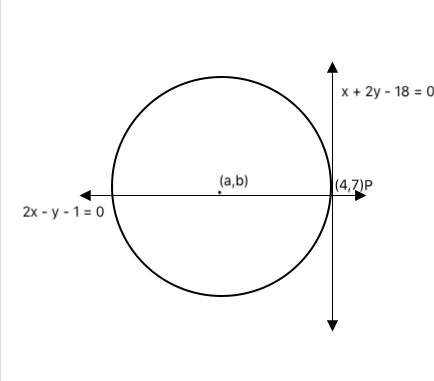
Let C be a circle of radius $$\sqrt{20}$$ cm. Let L1, L2 be the lines given by 2x − y −1 = 0 and x + 2y−18 = 0, respectively. Suppose that L1 passes through the center of C and that L2 is tangent to C at the point of intersection of L1 and L2. If (a,b) is the center of C, which of the following is a possible value of a + b?

As mentioned in the question,
Lines L1 and L2 intersect at point P as shown in the figure.
On solving for x and y from equations
x + 2y - 18 = 0
2x - y - 1 = 0
We get x = 4 and y =7.
Given, radius = $$\sqrt{20}$$
Using the equation of a circle, we have
$$(4-a)^{2}$$ + $$(7-b)^{2}$$ = 20....(1)
The center of the circle will lie on the line: 2x - y - 1 = 0
a,b will satisfy this equation.
So 2a-b-1=0
b=2a-1
From equation 1...
$$(4-a)^{2}$$ + $$(7-b)^{2}$$ = 20
$$(4-a)^{2}$$ + $$(8-2a)^{2}$$ = 20
5$$(4-a)^{2}$$ = 20
a=6 or a=2
b=11 or b=3
The sum of the coordinates possible=6+11 or 2+3
i.e. 17 or 5
Option B is one of the solution.
In the trapezium ABCD the sides AB and CD are parallel. The value of $$\frac{sin \angle{BAC}}{sin \angle{BAD}}$$ is
Construct a perpendicular in the trapezium. Let its height be 'h'
Now, $$sin\angle BAC = \dfrac{h}{AC}$$
and $$sin\angle BAD = \dfrac{h}{AD}$$
Thus, $$\dfrac{sin\angle BAC}{sin\angle BAD} = \dfrac{\frac{h}{AC}}{\frac{h}{AD}} = \dfrac{AD}{AC}$$
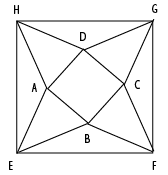
In the picture below, EFGH, ABCD are squares, and ABE, BCF, CDG, DAH are equilateral triangles. What is the ratio of the area of the square EFGH to that of ABCD?
Let the sides of the smaller square be $$x$$ units and the sides of the larger square be $$y$$ units.
Construct diagonal HF on the larger square. Let the point of intersection of AD and diagonal be I and point of intersection of BC and diagonal be J.
We know that since EFGH is a square, the diagonal will bisect the angle. Therefore $$\angle EHF=45^{o}$$
Observe $$\triangle AEH$$ and $$\triangle DHG$$ :
AE=AH=DH=DG = $$x$$ units and EH=HG=$$y$$ units.
Thus by SSS property, $$\triangle AEH \cong \triangle DHG$$
Thus, we know that $$\angle$$AHE=$$\angle$$DHG
Also, $$\angle$$AHE+$$\angle$$DHG+$$\angle$$AHD= $$90^{o}$$ (angle of a square)
$$ \Rightarrow (2 \times \angle AHE)+ 60^{o} = 90^{o}$$ (angle of an equilateral triangle)
$$ \Rightarrow (2 \times \angle AHE) = 30^{o}$$
$$ \Rightarrow \angle AHE = 15^{o}$$
Since $$\angle AHE = 15^{o}, \angle AHI = 45^{o}-15^{o} = 30^{o} $$
Since $$30^{o}= \dfrac{60^{o}}{2}$$ we can say that HF is the angle bisector of $$\angle$$AHD
Since $$\triangle$$AHD is an equilateral triangle, we know that the angle bisector, median and altitude will all be the same line ie HI in this case.
By symmetry, we know that JF will also be the angle bisector, median and altitude.
Also, length of altitude of equilateral triangle ie HI and JF = $$\dfrac{\sqrt{3} \times x}{2} $$
Length of diagonal HF = $$\sqrt{2} \times y$$
From the figure, we can express the length of diagonal HF as given :
$$ \sqrt{2} \times y = \dfrac{\sqrt{3} \times x}{2} + x + \dfrac{\sqrt{3} \times x}{2} $$
$$ \Rightarrow \sqrt{2} \times y = (\sqrt{3} \times x) + x $$
$$ \Rightarrow \sqrt{2} \times y = x \times (\sqrt{3} + 1) $$
$$ \Rightarrow y = x \times (\dfrac{\sqrt{3} + 1}{\sqrt{2}}) $$
Ratio of areas asked = $$(\dfrac{y}{x})^{2} = (\dfrac{\sqrt{3} + 1}{\sqrt{2}})^{2} = \dfrac{4+2\sqrt{3}}{2} = 2+\sqrt{3}$$
Alternate Explanation:
Let AB=BC=CD=DA=x, then the area the area of square ABCD will be $$x^2$$
Since AHD, DGC, CFB, and BAE are equilateral triangles with side x, the sum of area of these traingles will be $$4\times\ \frac{\sqrt{\ 3}}{4}\times\ x^2=\sqrt{\ 3}x^2$$
We know that angle HAD=60, angle DAB=90, and angle BAE=60, thus angle HAE=360-(60+90+60)=150
Area of triangles HAE+HDG+GCF+FBE=4* area of triangle HAE
In HAE, AH=AE=x, and angle HAE=150, thus area will be $$\frac{1}{2}\times\ x\times\ x\times\ \sin\ 150$$
sin 150=sin(180-150)=sin 30=0.5
Thus area of 4 triangles will be 4*0.5*x*x*0.5=$$x^2$$
Thus, total area= $$x^2+\sqrt{\ 3\ }\ x^2+x^2$$=$$x^2\left(2+\sqrt{\ 3}\right)$$
Thus area of EFGH/area of ABCD=$$2+\sqrt{\ 3}$$
What is the maximum number of points that can be placed on a circular disk of radius 1 metre (some of the points could be placed on the bounding circle of the disk) such that no two points are at a distance of less than 1 metre from each other?
In order to accommodate maximum number of points on the circular disk, all the points should be placed on the boundary of the disk as any point if placed inside the boundary would be less than 1 metre apart from the centre of the disk. Also, all the points have to be exactly 1 metre apart from each other to place maximum number of points. Hence, a maximum of 6 points can be placed on the boundary of the disk (each adjacent points placed 60 degrees apart) and 1 point at the centre.
Hence, a total of 7 points can be placed on the disk.
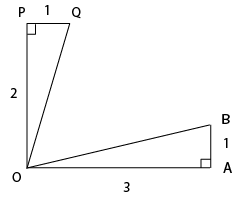
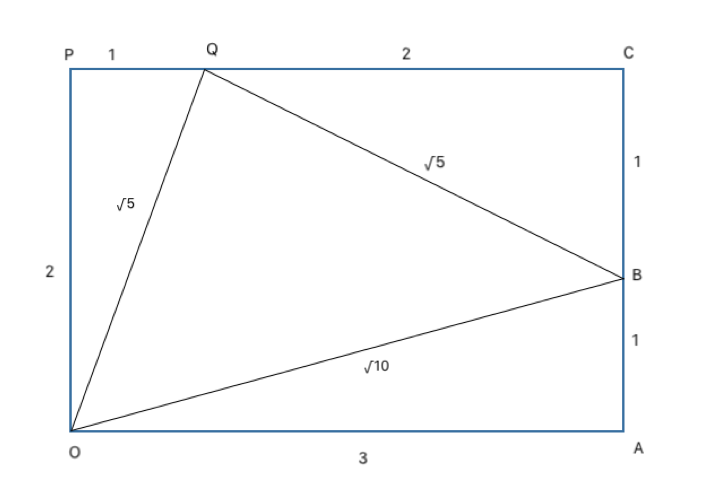
The figure below shows two right angled triangles ∆OAB and ∆OQP with right angles at vertex A and P, respectively, having the common vertex O, The lengths of some of the sides are indicated in the figure. (Note that the figure is not drawn to scale.) AB and OP are parallel.
What is ∠QOB?


The figure can be redrawn as shown above.
$$\because $$ AB and OP are parallel, POAC is a rectangle.
In right $$\triangle$$QCB, QB = $$\sqrt{5}$$
$$\triangle$$QBO is an isosceles right angled triangle with $$\angle $$OQB = $$ 90°$$ (By Pythagoras theorem)
$$\therefore $$ $$\angle $$QOB = $$45°$$
Let ABC be an isosceles triangle. Suppose that the sides AB and AC are equal and let the length of AB be x cm. Let b denote the angle ∠ABC and sin b = 3/5. If the area of the triangle ABC is M square cm, then which of the following is true about M?
$$\triangle$$ ABC can be represented as shown above where AD $$\bot$$ BC
Given, Sin b = $$\frac{3}{5}$$
Hence, AD = $$\frac{3x}{5}$$ and BD = $$\frac{4x}{5}$$
Now, BC = 2 BD = $$\frac{8x}{5}$$
$$\therefore$$ area of $$\triangle$$ ABC = $$\frac{1}{2}$$ * BC * AD = $$\frac{1}{2}$$ * $$\frac{8x}{5}$$ * $$\frac{3x}{5}$$ = $$\frac{12x^{2}}{25}$$
Only option E satisfies.
Hence, option E.
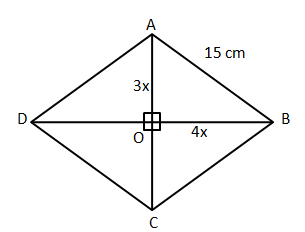
If the diagonals of a rhombus of side 15 cm are in the ratio 3:4, find the area of the rhombus.
It is given that the length of the diagonals are in 3:4. Let '3x', and '4x' be the lengths of semi-diagonals as shown in the figure. We know that diagonals of a rhombus intersect each other perpendicularly.
In right angle triangle AOB,
$$AB^2=AO^2+BO^2$$
$$\Rightarrow$$ $$AB= \sqrt{AO^2+BO^2}$$
$$\Rightarrow$$ $$AB= \sqrt{(3x)^2+(4x)^2}$$
$$\Rightarrow$$ $$15= 5x$$
$$\Rightarrow$$ $$x= 3$$cm.
Therefore, we can say that the length of diagonals = 6x and 8x or 18 and 24 cm.
Hence, the area of the rhombus = $$\dfrac{1}{2}*18*24$$ = 216 cm$$^2$$. Therefore, option E is the correct answer.
It takes 2 liters to paint the surface of a solid sphere. If this solid sphere is sliced into 4 identical pieces, how many liters will be required to paint all the surfaces of these 4 pieces.
2 litres are required to paint the surface of a solid sphere.
Surface area of the solid sphere = $$4\pi*r^2$$
Now, the solid sphere is cut into 4 identical parts. This is possible only when the sphere is cut into 4 quarter spheres.
After making the first cut, 2 hemispheres will be formed. 2 circles of area $$\pi*r^2$$ will get exposed in addition to the surface area of the sphere (the base surface of the bottom hemisphere and the base of the top hemisphere).
Now, another perpendicular cut will be made along the diameter of the sphere. 2 additional surfaces will get exposed again (one on left hemisphere and the another on the right hemisphere).
Area exposed after making 4 identical pieces = $$4*\pi*r^2$$ + $$2*\pi*r^2$$ + $$2*\pi*r^2$$
= $$8*\pi*r^2$$
2 litres of paint is required to paint an area of $$4\pi*r^2$$
=> 4 litres of paint will be required to paint an area of $$8*\pi*r^2$$.
Therefore, option D is the right answer.
A cone of radius 4 cm with a slant height of 12 cm was sliced horizontally, resulting into a smaller cone (upper portion) and a frustum (lower portion). If the ratio of the curved surface area of the upper smaller cone and the lower frustum is 1:2, what will be the slant height of the frustum?
The ratio of the curved surface area of the upper cone to the lower frustum is 1:2.
=> the ratio of the curved surface area of the upper cone to the total cone = 1:3.
Curved surface area (CSA) of a cone = $$\pi*r*l$$
For the given cone, the slant height, $$l=12$$cm
CSA of the cone = $$48*\pi$$
CSA of the smaller cone = $$16*\pi$$
Both the slant height and the radius would have been reduced by the same ratio. Let that ratio be $$x$$.
$$x^2*48*\pi$$=$$16\pi$$
=>$$x^2=\frac{1}{3}$$
$$x=\frac{1}{\sqrt{3}}$$
Slant height of the smaller cone = $$\frac{12}{\sqrt{3}}$$
Slant height of the frustum = $$12-\frac{12}{\sqrt{3}}$$
= $$12*\frac{\sqrt{3}-1}{\sqrt{3}}$$
=$$12*\frac{(3-\sqrt{3})}{3}$$
=$$12-4\sqrt{3}$$
Therefore, option D is the right answer.
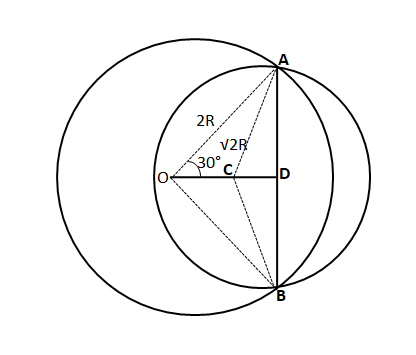
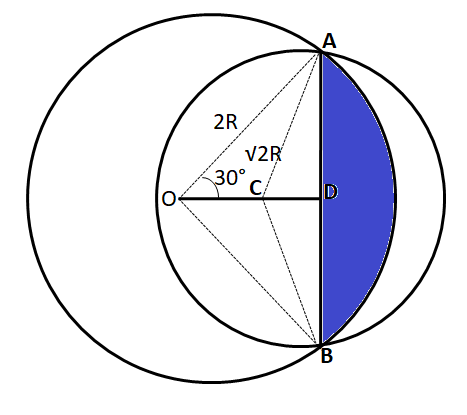
Two circles with radius 2R and R$$\sqrt{2}$$ intersect each other at points A and B. The centers of both the circles are on the same side of AB. O is the center of the bigger circle and ∠AOB is 60°. Find the area of the common region between two circles.
Let us draw the diagram according to the given info,
We can see that AD = AO*cos60° = 2R*$$\dfrac{1}{2}$$ = R
In triangle, ACD
$$\Rightarrow$$ $$sinACD=\dfrac{AC}{AC}$$
$$\Rightarrow$$ $$sinACD=\dfrac{R}{\sqrt{2}*R}$$ = $$\dfrac{1}{\sqrt{2}}$$
$$\Rightarrow$$ $$\angle$$ ACD = 45°
By symmetry we can say that $$\angle$$ BCD = 45°
Therefore we can say that $$\angle$$ ACB = 90°
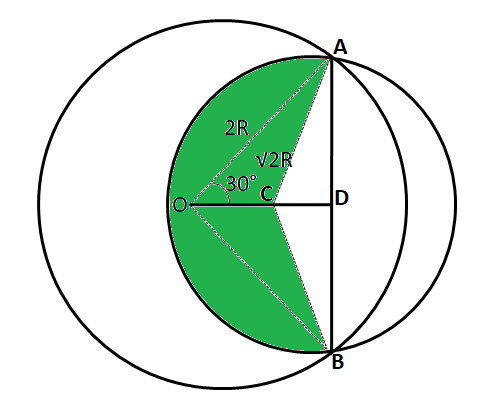
Hence, the area colored by green color = $$\dfrac{270°}{360°}*\pi*(\sqrt{2}R)^2$$ = $$\dfrac{3}{2}*\pi*R^2$$ ... (1)
Area of triangle ACB = $$\dfrac{1}{2}*R*2R$$ = $$R^2$$ ... (2)
Area shown in blue color = $$\dfrac{60°}{360°}*\pi*(2R)^2-\dfrac{\sqrt{3}}{4}*(2R)^2$$ = $$\dfrac{2}{3}*\pi*R^2-\sqrt{3}*R^2$$ ... (3)
By adding (1) + (2) + (3)
Therefore, the area of the common region between two circles = $$\dfrac{3}{2}*\pi*R^2$$ + $$R^2$$ + $$\dfrac{2}{3}*\pi*R^2-\sqrt{3}*R^2$$
$$\Rightarrow$$ $$(\dfrac{13\pi}{6}+1-\sqrt{3})R^2$$
Hence, option C is the correct answer.
AB is a chord of a circle. The length of AB is 24 cm. P is the midpoint of AB. Perpendiculars from P on either side of the chord meets the circle at M and N respectively. If PM < PN and PM = 8 cm. then what will be the length of PN?
Let us draw the diagram using the given conditions.
AB = 24 cm and P is the mid-point of AB. Therefore, AP=PB=12 cm.
MN is perpendicular to AB and passes through P.
PM < PN. Therefore, M should be closer to A and B than N.
MN and AB are 2 perpendicular chords intersecting at P.
Therefore, according to the intersecting chords theorem, AP*PB = PM*PN
12*12=8*PN
=> PN = 18 cm.
Therefore, option B is the right answer.
If 5° $$\leq$$ x° $$\leq$$ 15°, then the value of sin 30° + cos x° - sin x° will be :
For smaller values of 'x', cos 'x' will be close to 1 and sin x will be close to 0.
Sin 30° = 1/2 = 0.5
As we move closer to 0, the value of cos x increases and sin x decreases. Therefore, when we move from a larger value of x to a smaller value, the value of the expression cos x - sin x will increase.
Let us evaluate the value of the expression at x= 30° (since we know the values of cos x° and sin x° at this point) and then logically deduce the range of the value of the expression.
At x = 30°, cos x = $$\frac{\sqrt{3}}{2}$$ and sin x = $$\frac{1}{2}$$
Therefore, cos x° - sin x° would have been 1.732/2 - 0.5 = 0.866 - 0.5 = 0.366
sin 30° + cos x - sin x will be 0.866
At x = 0, sin 30 + cos x - sin x will be 0.5 + 1 - 0 = 1.5.
At x = 5°, the value of the expression sin 30 + cos x - sin x will be slightly less than 1.5.
Therefore, we can infer that the upper limit of the expression will be greater than 1. None of the given limits include values greater than 1. Therefore, option E is the right answer.
Alternate solution:
The value of sin 15° and cos 15° can be found out using the identities sin (A-B) = sin A cos B - cos A sin B and cos (A-B) = cos A cos B + sin A sin B.
Substituting A = 45° and B = 15° in these expressions, we get,
sin 15° = 0.2588
cos 15° = 0.9659
sin 30° + cos 15° - sin 15° = 0.5 + 0.9659 - 0.2588 = 1.2071.
None of the given options capture this value in the range. Therefore, option E is the right answer.
The Volume of a pyramid with a square base is 200 cubic cm. The height of the pyramid is 13cm. What will be the length of the slant edges (i.e. the distance between the apex and any other vertex), rounded to the nearest integer?
Volume of the pyramid = $$200$$ cubic cm.
The volume of a pyramid is usually a third of the volume of a cuboid of the same height.
Therefore, a square cuboid of the height of the pyramid will have a volume of $$600$$ cubic cm.
We know that the height is $$13$$ cm.
Area of the base square* height = $$600$$ cm.
=> Area of the base square = $$\frac{600}{13}$$ cm$$^2$$.
Side of the base square = $$\sqrt{\frac{600}{13}}$$ cm.
Length of diagonal of the base square = $$\sqrt{\frac{600}{13}}*\sqrt{2}$$
Now, the height of slant edge of the pyramid can be found out by using the Pythagoras theorem.
Length of half the diagonal of the base square will form one of the sides and the height of the pyramid will form the other side. The slant height of the pyramid will be the hypotenuse of the right-angled triangle.
Height of slant edge = $$\sqrt{13^2 + \frac{1}{4}*2*\frac{600}{13}}$$
= $$\sqrt{169 + \frac{600}{26}}$$
= $$\sqrt{\frac{4394+600}{26}}$$
= $$\sqrt{ \frac{4994}{26}}$$
=$$\sqrt{192.07}$$
=$$13.85$$ cm
The nearest integer is $$14$$. Therefore, option C is the right answer.
AB, CD and EF are three parallel lines, in that order. Let d1 and d2 be the distances from CD to AB and EF respectively. d1 and d2 are integers, where d1 : d2 = 2 : 1. P is a point on AB, Q and S are points on CD and R is a point on EF. If the area of the quadrilateral PQRS is 30 square units, what is the value of QR when value of SR is the least?
There are 3 parallel lines AB, CD, and EF, in that order.
Let the distance between CD and AB be 2x.
It has been given that the distance between CD and EF is x.
A quadrilateral PQRS is formed such that P is on AB, Q and S are on CD, and R is on EF.
Also, the length of SR is the least possible value it can take. Therefore, SR must be perpendicular to the parallel lines.
Area of quadrilateral PQRS = Area of triangle PQS + Area of triangle SRQ = 30 square cm.
Area of triangle PQS = 2*area of triangle SRQ (Since they rest on the same base and height of SRQ is half the height of PQS)
=> Area of triangle SRQ = 10 square cm.
Let the length of SQ be $$b$$. We know that SR= $$x$$
$$0.5*x*s = 10$$
=> $$xs=20$$
$$s=20/x$$
We do not have any other detail to evaluate the value of the expression. But, we have been given that d1 and d2 are integers. Therefore, the least value that 'x' can take is 1.
The least value that S can take is 1.
By Pythagoras theorem, $$QR =\sqrt{s^2 + x^2}$$
$$QR=\sqrt{20^2+1}$$
$$QR=\sqrt{401}$$
Therefore, the value of QR will be slightly greater than 20. Therefore, option E is the right answer.
ABCD is a rectangle. P, Q and R are the midpoint of BC, CD and DA. The point S lies on the line QR in such a way that SR: QS = 1:3. The ratio of the area of triangle APS to area of rectangle ABCD is
First, let us construct the rectangle using the given information.
Let the length of the rectangle be 'l' and the breadth of the rectangle be 'b'.
Area of rectangle ABCD = lb.
We have to find the area of the triangle APS.
We consider length as 4cm and breadth as 2cm. ( Answer is irrespective of length and breadth)

In triangle QRD
RS/RQ=XS/DQ
1/4=XS/2cm
XS= 0.5 cm
SY= 4cm-0.5cm= 3.5cm
We can now find the areas of all the sections.
area (RDQ)= 1/2 x 1cm x 2cm= $$1cm^2$$
area (ABP) =1/2 x 1cm x 4cm = $$2cm^2$$
area (ARS) =1/2 x 1cm x 0.5cm = $$0.25cm^2$$
area (PSQC) = Area (PSZ)-Area(QCZ)= 1/2 x 2cm x 3.5cm - 1/2 x 1cm x 2cm =
= $$2.5cm^2$$
Area (ABCD)= 4cm x 2cm = $$8cm^2$$
Area (APS) = 8 -1 -2 - 0.25 - 2.5 = $$2.25cm^2$$
Area (APS) / Area (ABCD) = 9/32 = 36/128
Hence answer (A).
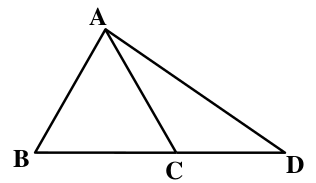
In the figure below, AB = AC = CD. If ADB = 20°, what is the value of BAD?
AB = AC = CD, => $$\angle CAD = \angle CDA = 20^{\circ}$$
and $$\angle ABC = \angle ACB$$
In $$\triangle$$ ACD
=> $$\angle ACD + \angle CAD + \angle CDA = 180^{\circ}$$
=> $$\angle ACD = 180^{\circ} - 20^{\circ} - 20^{\circ} = 140^{\circ}$$
=> $$\angle ACB = 180^{\circ} - 140^{\circ} = 40^{\circ} = \angle ABC$$
Similarly, In $$\triangle$$ ABC
=> $$\angle BAC = 180^{\circ} - 40^{\circ} - 40^{\circ} = 100^{\circ}$$
$$\therefore \angle BAD = 100^{\circ} + 20^{\circ} = 120^{\circ}$$
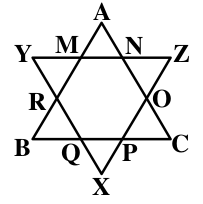
$$\triangle$$ABC and $$\triangle$$XYZ are equilateral triangles of 54 cm sides. All smaller triangles like $$\triangle$$ANM, $$\triangle$$OCP, $$\triangle$$QPX etc. are also equilateral triangles. Find the area of the shape MNOPQRM.
AB = 54 cm and $$\triangle$$ANM , $$\triangle$$OCP , $$\triangle$$OPX are equilateral triangles.
=> MN = MR = NO = OP = PQ = QR = $$\frac{54}{3} = 18$$ cm
Thus, MNOPQRM is a regular hexagon with side 18 cm
$$\therefore$$ Area of MNOPQRM = $$\frac{3 \sqrt{3}}{2} (side)^2$$
= $$\frac{3 \sqrt{3}}{2} \times 18^2 = 486 \sqrt{3} cm^2$$
Akhtar plans to cover a rectangular floor of dimensions 9.5 meters and 11.5 meters using tiles. Two types of square shaped tiles are available in the market. A tile with side 1 meter costs Rs. 100 and a tile with side 0.5 meters costs Rs. 30. The tiles can be cut if required. What will be the minimum cost of covering the entire floor with tiles?
Area of rectangular floor = $$9.5 \times 11.5$$
= $$109.25 m^2$$
Now, cost of covering $$109 m^2$$ (with 1x1 tiles) = $$109 \times 100$$ = Rs. 10,900
Cost of covering $$0.25 m^2$$ (with 0.5 m square tile) = Rs. 30
$$\therefore$$ Total cost = $$10,900 + 30 = Rs. 10,930$$
A square piece of paper is folded three times along its diagonal to get an isosceles triangle whose equal sides are 10 cm. What is the area of the unfolded original piece of paper?
When a square sheet is folded in half, its area is also halved. Now, an isosceles right triangle is formed after folded. For 2nd & 3rd folds, again areas halved each time and isosceles right triangle is formed
Equal sides = 10 cm
Area of last such triangle = $$\frac{1}{2} \times 10 \times 10 = 50 cm^2$$
$$\therefore$$ Area of original square = $$50 \times 2 \times 2 \times 2$$
= $$400 cm^2$$
The difference between the area of the circumscribed circle and the area of the inscribed circle of an equilateral triangle is 2156 sq. cm. What is the area of the equilateral triangle?
Assume that $$\pi=\frac{22}{7}$$
Let radius of incircle = $$r$$, => Radius of circumcircle = $$2r$$
Difference in area = $$\pi [(2r)^2 - (r)^2] = 2156$$
=> $$3 \times \frac{22}{7} \times r^2 = 2156$$
=> $$r^2 = \frac{2156 \times 7}{66}$$
=> $$r = \sqrt{\frac{686}{3}}$$
Now, height of equilateral triangle = $$3 r = \frac{\sqrt{3}}{2} a$$ (where $$a$$ is side of triangle)
=> $$3 \times \sqrt{\frac{686}{3}} = \frac{\sqrt{3}}{2} a$$
=> $$a = 2 \sqrt{686}$$
$$\therefore$$ Area of triangle = $$\frac{\sqrt{3}}{4} a^2$$
= $$\frac{\sqrt{3}}{4} \times 4 \times 686 = 686 \sqrt{3} cm^2$$
In the figure below, two circular curves y and x create 60° and 90° angles with their respective centres. If the length of the bottom curve Y is 10$$\pi\ $$, find the length of the other curve.
Let P and Q be the centres of the circles with arcs x and y respectively.
Thus, $$\angle APB = 90$$ and $$\angle AQB = 60$$
Also, length of arc $$y = 10 \pi$$ cm
=> $$\frac{\theta}{360} \times 2 \pi r = 10 \pi$$
=> $$\frac{1}{6} \times 2 \times r = 10$$
=> $$r = AQ = 10 \times 3 = 30$$ cm
=> AB = 30 ($$\because \triangle$$ AQB is equilateral triangle)
Also, $$\triangle$$ APB is right isosceles triangle, => $$AP = \frac{30}{\sqrt{2}}$$
$$\therefore$$ Arc length = $$x = \frac{90}{360} \times 2 \pi \times \frac{30}{\sqrt{2}}$$
= $$\frac{15 \pi}{\sqrt{2}}$$
ABCD is a quadrilateral such that AD = 9 cm, BC = 13 cm and $$\angle$$DAB = $$\angle$$BCD = 90°. P and Q are two points on AB and CD respectively, such that DQ : BP = 1 : 2 and DQ is an integer. How many values can DQ take, for which the maximum possible area of the quadrilateral PBQD is 150 sq.cm?
Let $$DQ = x$$, => $$BP = 2x$$
Acc. to ques,
=> $$ar (\triangle BPD) + ar (\triangle BQD) \leq ar (PBQD)$$
=> $$(\frac{1}{2} \times AD \times BP) + (\frac{1}{2} \times BC \times QD) \leq 150$$
=> $$(\frac{1}{2} \times 9 \times 2x) + (\frac{1}{2} \times 13 \times x) \leq 150$$
=> $$31x \leq 300$$ => $$x \leq \frac{300}{31}$$
=> $$x \leq 9.68$$
Thus, for $$x$$ to be an integer and positive, 9 different values (1 to 9) are possible.
A solid metal cylinder of 10 cm height and 14 cm diameter is melted and re - cast into two cones in the proportion of 3 : 4 (volume), keeping the height 10 cm. What would be the percentage change in the flat surface area before and after?
Volume of Cylinder = $$\pi r^2 h = \pi \times 7^2 \times 10 = 490\pi$$
Now, The solid metal cylinder is re-cast into two cones in the proportion 3 : 4 i.e. the volumes of cone 1 and cone 2 is
$$210 \pi$$ and $$280 \pi$$ respectively.
So, flat Surface area of cylinder before melting = $$2 \pi r^2 = 2 \pi \times 7^2 = 98 \pi$$
Volume of cone 1 = $$\frac{1}{3} \pi r_1^2 h = 210 \pi$$
=> $$r_1^2 = \frac{210 \times 3}{10} = 63$$
Volume of cone 2 = $$\frac{1}{3} \pi r_2^2 h = 280 \pi$$
=> $$r_2^2 = \frac{280 \times 3}{10} = 84$$
Flat surface area of cones = $$\pi r_1^2 + \pi r_2^2$$
= $$\pi (63 + 84) = 147 \pi$$
$$\therefore$$ Percentage change in surface area = $$\frac{147 \pi - 98 \pi}{98 \pi} \times 100$$
= $$\frac{1}{2} \times 100 = 50 \%$$
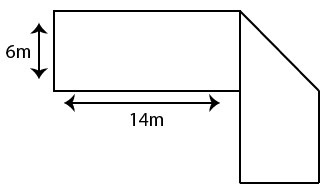
The figure below has been obtained by folding a rectangle. The total area of the figure (as visible) is 144 square meters. Had the rectangle not been folded, the current overlapping part would have been a square. What would have been the total area of the original unfolded rectangle?

Area of given figure = 144 sq meter
It is given that BCE becomes square when we will unfold it, so to find the complete area of the figure shown as dotted after unfolding we need to add the area of triangle BCE.
Thus, BC = CE = 6 m
=> Area of $$\triangle$$ BCE = $$\frac{1}{2} \times 6 \times 6 = 18$$ sq meter
$$\therefore$$ Final area of whole figure = 144 + 18 = 162 square meter.
A circular road is constructed outside a square field. The perimeter of the square field is 200 ft. If the width of the road is 7√2 ft. and cost of construction is Rs. 100 per sq.ft. Find the lowest possible cost to construct 50% of the total road.
Perimeter of square ABCD = 200 ft
=> AB = $$\frac{200}{4} = 50$$ ft
=> $$DB = \sqrt{50^2 + 50^2} = 50 \sqrt{2}$$ ft
=> $$BO = r = \frac{50 \sqrt{2}}{2} = 25 \sqrt{2}$$ ft
Width of the road = BX = $$7 \sqrt{2}$$ ft
=> $$BX = R = 25 \sqrt{2} + 7 \sqrt{2} = 32 \sqrt{2}$$
Area of bigger circle = $$\pi R^2 = \pi (32 \sqrt{2})^2 = 2048 \pi$$ sq. ft
Area of smaller circle = $$\pi r^2 = \pi (25 \sqrt{2})^2 = 1250 \pi$$ sq. ft
=> Area of road = $$2048 \pi - 1250 \pi = 798 \times \frac{22}{7} = 2508$$ sq. ft
But we have to calculate cost of construction of 50% road.
Required Construction = $$\frac{2508}{2} = 1254$$ sq. ft
$$\therefore$$ Cost of 1254 ft = $$1254 \times 100 = Rs. 1,25,400$$
In the diagram below, CD = BF = 10 units and ∠CED = ∠BAF = 30°. What would be the area of triangle AED? (Note: Diagram below may not be proportional to scale.)
In $$\triangle$$ ABF
=> $$tan 30 = \frac{BF}{AB}$$
=> $$\frac{1}{\sqrt{3}} = \frac{10}{AB}$$
=> $$AB = 10 \sqrt{3}$$
Similarly, $$ED = 10 \sqrt{3}$$
Also, $$\angle ECD = \angle BCF = 60$$ (Vertically opposite angles)
In $$\triangle$$ BCF
=> $$tan 60 = \frac{BF}{BC}$$
=> $$\sqrt{3} = \frac{10}{BC}$$
=> $$BC = \frac{10}{\sqrt{3}}$$
=> Height = $$AD = AB + BC + CD = 10 \sqrt{3} + \frac{10}{\sqrt{3}} + 10 = \frac{40 + 10 \sqrt{3}}{\sqrt{3}}$$
$$\therefore area (\triangle AED) = \frac{1}{2} \times AD \times ED$$
= $$\frac{1}{2} \times \frac{40 + 10 \sqrt{3}}{\sqrt{3}} \times 10 \sqrt{3}$$
= $$50 (\sqrt{3} + 4)$$
Two diagonals of a parallelogram intersect each other at coordinates (17.5, 23.5). Two adjacent points of the parallelogram are (5.5, 7.5) and (13.5, 16). Find the lengths of the diagonals.
Using distance formula,
$$CX = \sqrt{(17.5 - 5.5)^2 + (23.5 - 7.5)^2} = \sqrt{12^2 + 16^2}$$
= $$\sqrt{144 + 256} = \sqrt{400} = 20$$
=> $$AC = 2 \times CX = 40$$
$$BX = \sqrt{(17.5 - 13.5)^2 + (23.5 - 16)^2} = \sqrt{4^2 + 7.5^2}$$
= $$\sqrt{16 + 56.25} = \sqrt{72.25} = 8.5$$
=> $$BD = 2 \times BX = 17$$
The parallel sides of a trapezoid ABCD are in the ratio of 4 : 5. ABCD is divided into an isosceles triangle ABP and a parallelogram PBCD (as shown below). ABCD has a perimeter equal to 1120 meters and PBCD has a perimeter equal to 1000 meters. Find Sin$$\angle$$ABC, given 2$$\angle$$DAB = $$\angle$$BCD.
AB + BC + CD + AD = 1120 ------------Eqn(I)
PB + BC + CD + PD = 1000 -------------Eqn(II)
Subtracting eqn(II) from (I), we get :
=> AB - PB + (AD - PD) = 120
=> AB - PB + AP = 120
=> AB + AP = 120 + PB
Now, if AB = PB, => AP = 120
=> AD = 600 and BC = 480, then AB + PB + CD = 40, which is not possible (We know that BC = PD. If BC = PD = 480, then BC+PD = 960. PB + BC + CD + PD = 1000.
=> PB+CD = 40. Therefore, AB + PB+CD should be greater than 40).
Similarly, AB = AP is also not possible. Thus $$AP = BP$$
=> $$\angle ABC = x + (180 - 2x) = (180 - x)$$
=> $$sin \angle ABC = sin (180 - x) = sin x$$
Also, perimeter of PBCD = $$10y = 1000$$ => $$y = 100$$
and perimeter of ABCD = $$AB + 10y = 1120$$ => $$AB = 120$$
Applying cosine rule in $$\triangle$$ ABP
=> $$cos x = \frac{(AB)^2 + (AP)^2 - (BP)^2}{2 AB AP}$$
=> $$cos x = \frac{(120)^2 + (100)^2 - (100)^2}{2 \times 120 \times 100}$$
=> $$cos x = \frac{120}{200} = \frac{3}{5}$$
$$\therefore sin x = \sqrt{1 - (\frac{3}{5})^2} = \sqrt{1 - \frac{9}{25}}$$
= $$\sqrt{\frac{16}{25}} = \frac{4}{5}$$
The centre of a circle inside a triangle is at a distance of 625 cm from each of the vertices of the triangle. If the diameter of the circle is 350 cm and the circle is touching only two sides of the triangle, find the area of the triangle.
If a point is equidistant from all 3 vertices, it has to be the circumcentre. The given circle with centre S is concentric and touches two sides.
As S is equidistant from 2 of the sides (say AB and AC), => It lies on angle bisector of $$\angle A$$.
=> $$\triangle ABC$$ is isosceles with AB = AC
Radius of the circle = RS = SQ = 175 cm and SA = SB = SC = 625 cm
=> $$AR = \sqrt{625^2 - 175^2} = 600$$
Let SP = x
=> $$(BP)^2 = (BA)^2 - (AP)^2 = (BS)^2 - (SP)^2$$
=> $$1200^2 - (625 + x)^2 = 625^2 - x^2$$
=>$$1200^2 - 625^2 - x^2 - 2*625x = 625^2 - x^2$$
=> $$1200^2 - 2 * 625^2 = 1250x$$
=> $$x = \frac{658750}{1250} = 527$$
=> $$BP = \sqrt{625^2 - 527^2} = 336$$
$$\therefore$$ ar $$(\triangle ABC)$$ = $$\triangle ASB + \triangle ASC + \triangle SBC$$
= $$(600 \times 175) + (600 \times 175) + (527 \times 336)$$
= $$105000 + 105000 + 177072 = 387072$$
A person is standing at a distance of 1800 meters facing a giant clock at the top of a tower. At 5.00 p.m., he can see the tip of the minute hand of the clock at 30 degree elevation from his eye - level. Immediately, the person starts walking towards the tower. At 5.10 pm., the person noticed that the tip of the minute hand made an angle of 60 degrees with respect to his eye - level. Using three - dimensional vision, find the speed at which the person is walking. The length of the minutes hand is 200√3 meters (√3 = 1.732).
Let O be the centre of the clock. Let the person's eye be at A and the tip of minute hand at 5.00 p.m. is at P and at 5.10 p.m. at Q
AM = 1800 m and OP = OQ = $$200\sqrt{3}$$ m
In $$\triangle$$ APM
=> $$tan 30 = \frac{PM}{AM}$$
=> $$\frac{1}{\sqrt{3}} = \frac{PM}{1800}$$
=> $$PM = \frac{1800}{\sqrt{3}} = 600 \sqrt{3}$$
=> $$OM = PM - OP = 600 \sqrt{3} - 200 \sqrt{3} = 400 \sqrt{3}$$
In $$\triangle$$ OBM
=> $$tan 60 = \frac{OM}{BM}$$
=> $$\sqrt{3} = \frac{400 \sqrt{3}}{BM}$$
=> $$BM = 400$$ m
=> $$AB = AM - BM = 1800 - 400 = 1400$$ m
Time taken to reach B from A = 10 minutes = 600 sec
$$\therefore$$ Speed of the person = $$\frac{1400}{600} = \frac{7}{3}$$ m/s
= $$(\frac{7}{3} \times \frac{18}{5})$$ km/hr = $$8.4$$ km/hr
In quadrilateral PQRS, PQ = 5 units, QR = 17 units, RS = 5 units, and PS = 9 units. The length of the diagonal QS can be:
In a triangle , sum of two sides is greater than the third side and difference of two sides is less than third side.
In $$\triangle$$ PQS
=> $$QS < 9 + 5$$ => $$QS < 14$$ ------Eqn(I)
In $$\triangle$$ QRS
=> $$QS > 17 - 5$$ => $$QS > 12$$ ------Eqn(II)
From eqn(I) & (II)
=> $$12 < QS < 14$$
There are two windows on the wall of a building that need repairs. A ladder 30 m long is placed
against a wall such that it just reaches the first window which is 26 m high. The foot of the
ladder is at point A. After the first window is fixed, the foot of the ladder is pushed backwards
to point B so that the ladder can reach the second window. The angle made by the ladder with the
ground is reduced by half, as a result of pushing the ladder. The distance between points A and B is
Given : Length of ladder = PA = P'B = 30 m and PQ = 26 m
$$\angle$$ PAQ = 2 $$\angle$$ P'BQ
To find : AB = ?
Solution : In $$\triangle$$ PAQ
=> $$(QA)^2 = (PA)^2 - (PQ)^2$$
=> $$(QA)^2 = 30^2 - 26^2 = 900 - 676$$
=> $$QA = \sqrt{224} \approx 15$$
Also, $$cos 2 \theta = \frac{QA}{PA}$$
=> $$2 \theta = cos^{-1}(\frac{15}{30})$$
=> $$2 \theta = 60$$ => $$\theta = \frac{60}{2} = 30$$
In $$\triangle$$ P'QB
=> $$cos 30 = \frac{QB}{P'B}$$
=> $$QB = \frac{\sqrt{3}}{2} \times 30$$
=> $$QB = 15 \times 1.732 = 25.98$$
$$\therefore$$ AB = QB - QA = 25.98 - 15 = 10.98 m
Triangle ABC is a right angled triangle. D and E are mid points of AB and BC respectively. Read
the following statements.
I. AE = 19
II. CD = 22
III. Angle B is a right angle.
Which of the following statements would be sufficient to determine the length of AC?
ABC is right angled triangle. D and E are mid points of AB and BC respectively.
As it is not given that which angle is 90°. So we need statement (III) to find the value of AC.
Whereas using statement (I) & (II) alone, we cannot find the value of AC.
But using all the three statements. We can find value of $$(AB)^2 + (BC)^2$$.
Hence, the value of $$AC = \sqrt{(AB)^2 + (BC)^2}$$ using Pythagoras Theorem.
=> Ans - (E) : All statements are required.
There are two circles $$C_{1}$$ and $$C_{2}$$ of radii 3 and 8 units respectively. The common internal tangent, T, touches the circles at points $$P_{1}$$ and $$P_{2}$$ respectively. The line joining the centers of the circles intersects T at X. The distance of X from the center of the smaller circle is 5 units. What is the length of the line segment $$P_{1} P_{2}$$ ?
Given : $$OP_1 = 3 , O'P_2 = 8 , OX = 5$$ units
To find : $$P_1P_2 = ?$$
Solution : In $$\triangle OP_1X$$
=> $$(P_1X)^2 = (OP_1)^2 - (OX)^2$$
=> $$(P_1X)^2 = 5^2 - 3^2 = 25 - 9$$
=> $$P_1X = \sqrt{16} = 4$$
In $$\triangle OP_1X$$ and $$\triangle O'P_2X$$
$$\angle OXP_1 = O'XP_2$$ (Vertically opposite angles)
$$\angle OP_1X = O'P_2X = 90$$
=> $$\triangle OP_1X \sim \triangle O'P_2X$$
=> $$\frac{XP_1}{XP_2} = \frac{OP_1}{O'P_2}$$
=> $$XP_2 = 4 \times \frac{8}{3} = 10.66$$
$$\therefore P_1P_2 = P_1X + XP_2 = 4 + 10.66 = 14.66$$ units
Circle $$C_{1}$$ has a radius of 3 units. The line segment PQ is the only diameter of the circle which is parallel to the X axis. P and Q are points on curves given by the equations $$y = a^{x}$$ and $$y = 2a^{x}$$ respectively, where a < 1. The value of a is:
Radius = 3 units, => Diameter = PQ = 6 units
y-coordinates of P and Q are same as PQ is parallel to x-axis
x-coordinates of P and Q will have a difference of 6 units.
Equating y-coordinate of P and Q
=> $$a^x = 2 a^{x + 6}$$
=> $$\frac{1}{2} = \frac{a^{x + 6}}{a^x}$$
=> $$a^{x + 6 - x} = \frac{1}{2}$$
=> $$a = \frac{1}{\sqrt[6]{2}}$$
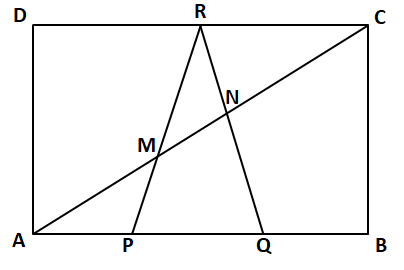
Consider a rectangle ABCD of area 90 units. The points P and Q trisect AB, and R bisects CD. The
diagonal AC intersects the line segments PR and QR at M and N respectively. What is the area of the quadrilateral PQNM?
Let us draw the figure according to the available information,
In $$\triangle$$ AMP and $$\triangle$$ CMR
$$\angle$$ MAP = $$\angle$$ MCR
$$\angle$$ AMP = $$\angle$$ CMR
Therefore, we can say that $$\triangle$$ AMP $$\sim$$ $$\triangle$$ CMR
Hence, we can say that $$\dfrac{AP}{CR}=\dfrac{MP}{MR}$$
$$\Rightarrow$$ $$\dfrac{AB/3}{AB/2}=\dfrac{MP}{MR}$$
$$\Rightarrow$$ $$MR=\dfrac{3}{2}*MP$$
Therefore, we can say that $$\Rightarrow$$ $$MR=\dfrac{3}{5}*RP$$ ... (1)
Similarly, in $$\triangle$$ ANQ and $$\triangle$$ CNR
$$\angle$$ NAQ = $$\angle$$ NCR
$$\angle$$ ANQ = $$\angle$$ CNR
Therefore, we can say that $$\triangle$$ ANQ $$\sim$$ $$\triangle$$ CNR
Hence, we can say that $$\dfrac{AQ}{CR}=\dfrac{NQ}{NR}$$
$$\Rightarrow$$ $$\dfrac{2AB/3}{AB/2}=\dfrac{NQ}{NR}$$
$$\Rightarrow$$ $$NR=\dfrac{3}{4}*NQ$$
Therefore, we can say that $$\Rightarrow$$ $$NR=\dfrac{3}{7}*RQ$$ ... (2)
In $$\triangle$$ RMN and $$\triangle$$ RPQ
$$\dfrac{\text{Area of triangle RMN}}{\text{Area of triangle RPQ}} = \dfrac{0.5*RM*RN*sinMRN}{0.5*RP*RQ*sinPRQ}$$
$$\text{Area of triangle RMN}=\dfrac{3}{5}*\dfrac{3}{7}*\text{Area of triangle RPQ}$$
We know that, Area of triangle RPQ = 1/6*Area of rectangle ABCD = 1/6*90 = 15 sq. units
$$\Rightarrow$$ $$\text{Area of triangle RMN}=\dfrac{3}{5}*\dfrac{3}{7}*15$$ = $$\dfrac{27}{7}$$ sq. units
Hence, the area of the quadrilateral PQNM = 15 - $$\dfrac{27}{7}$$ = $$\dfrac{78}{7}=11\dfrac{1}{7}$$ sq. units. Therefore, option D is the correct answer.
A rectangular swimming pool is 48 m long and 20 m wide. The shallow edge of the pool is 1 m deep.
For every 2.6 m that one walks up the inclined base of the swimming pool, one gains an elevation of 1 m. What is the volume of water (in cubic meters), in the swimming pool? Assume that the pool is filled up to the brim.v
For every 2.6 m that one walks along the slanting part of the pool, there is a height of 1 m that is gained.
=> $$\frac{AC}{BC} = \frac{2.6}{1}$$
=> $$AC = 2.6 \times BC$$
Also, dimensions of cuboidal part = $$48 \times 20 \times 1$$
In $$\triangle$$ ABC
=> $$(AC)^2 = (AB)^2 + (BC)^2$$
=> $$(2.6 \times BC)^2 = (48)^2 + (BC)^2$$
=> $$6.76 (BC)^2 - (BC)^2 = 2304$$
=> $$(BC)^2 = \frac{2304}{5.76} = 400$$
=> $$BC = \sqrt{400} = 20$$ m
$$\therefore$$ Volume of water in the pool = Volume of cuboid + Volume of triangle
= $$(l \times b \times h) + (\frac{1}{2} \times AB \times BC) \times height$$
= $$(48 \times 20 \times 1) + (\frac{1}{2} \times 48 \times 20 \times 20)$$
= $$960 + 9600 = 10560 m^3$$
There are two squares S 1 and S 2 with areas 8 and 9 units, respectively. S 1 is inscribed within S 2 , with one corner of S 1 on each side of S 2 . The corners of the smaller square divides the sides of
the bigger square into two segments, one of length ‘a’ and the other of length ‘b’, where, b > a. A possible value of ‘b/a’, is:
Area of $$S_1 = 8$$ sq. units
=> Side of $$S_1 = PS = \sqrt{8} = 2 \sqrt{2}$$ units
Similarly, Side of $$S_2 = CD = \sqrt{9} = 3$$ units
=> $$a + b = 3$$
In $$\triangle$$ PDS
=> $$b^2 + a^2 = 8$$
=> $$b^2 + (3 - b)^2 = 8$$
=> $$b^2 + 9 + b^2 - 6b = 8$$
=> $$2b^2 - 6b + 1 = 0$$
=> $$b = \frac{6 \pm \sqrt{36 - 8}}{4} = \frac{6 \pm \sqrt{28}}{4}$$
=> $$b = \frac{3 + \sqrt{7}}{2}$$ $$(\because b > a)$$
=> $$a = 3 - \frac{3 + \sqrt{7}}{2} = \frac{3 - \sqrt{7}}{2}$$
$$\therefore \frac{b}{a} = \frac{\frac{3 + \sqrt{7}}{2}}{\frac{3 - \sqrt{7}}{2}}$$
= $$\frac{3 + \sqrt{7}}{3 - \sqrt{7}} \approx 15.9$$
Diameter of the base of a water - filled inverted right circular cone is 26 cm. A cylindrical pipe, 5 mm in radius, is attached to the surface of the cone at a point. The perpendicular distance
between the point and the base (the top) is 15 cm. The distance from the edge of the base to the
point is 17 cm, along the surface. If water flows at the rate of 10 meters per minute through the
pipe, how much time would elapse before water stops coming out of the pipe?
Radius of cone = $$BP = 13$$ cm
In $$\triangle$$ ABC
=> $$(AB)^2 = (BC)^2 - (AC)^2$$
=> $$(AB)^2 = 17^2 - 15^2 = 289 - 225$$
=> $$AB = \sqrt{64} = 8$$ cm
=> AP = OC = $$BP - AB = 13 - 8 = 5$$ cm
Let time elapsed before water stops coming out of the pipe = $$T$$ min
Volume of frustum = Volume discharged
=> $$\frac{1}{3} \pi h (R^2 + r^2 + R r) = \pi (0.5)^2 \times f \times T$$ (where f is the flowrate given by 10m/s = 1000cm/s)
(Total volume = Cross sectional area of pipe $$\times$$ flowrate $$\times$$ Total time)
=> $$\frac{1}{3} \times 15 \times (13^2 + 5^2 + 13 * 5) = 0.25 \times 1000 \times T$$
=> $$5 \times 259 = 250 \times T$$
=> $$T = \frac{259}{50} = 5.18$$ mi
At the centre of a city's municipal park there is a large circular pool. A fish is released in the water at the edge of the pool. The fish swims north for 300 feet before it hits the edge of the pool. It then turns east and swims for 400 feet before hitting the edge again. What is the area of the pool?
The fish travels North for 300 m and on hitting the edge, travels East for 400 m. The directions North and East are perpendicular to each other. On connecting the initial and final positions of the fish in the tank, we get a right-angled triangle.
The line AC subtends an angle of 90 degree on the circumference. Therefore, AC must be the diameter of the pond.
Applying Pythagoras theorem, we get,
$$AB^2 + BC^2$$ = $$AC^2$$
$$AC^2 = 300^2 + 400^2$$
$$AC = 500$$ m.
=> Radius of the pond = $$250$$ m.
Area of the pond = $$\pi*r^2$$
=> Area = $$62500\pi m^2$$.
Therefore, option A is the right answer.
In a square PQRS, A and B are two points on PS and SR such that PA =2AS, and RB = 2BS If PQ = 6, the area of the triangle ABQ is (in sq. cm)
PQ = QR = RS = SP = 6 cm
PA = 2AS and PA + AS = 6cm
=> PA = 4 cm and AS = 2 cm
Similarly, RB = 2BS and RB + BS = 6 cm
=> RB = 4 cm and BS = 2cm
Area of △ ABQ = area of PQRS - area of △APQ - area of △RBQ - area of △ASB
= (36 - 12 - 12 - 2) sq. cm
= 10 sq. cm
Hence, option C is the correct answer.
The central park of the city is 40 metres long and 30 metres wide. The mayor wants to construct two roads of equal width in the park such that the roads intersect each other at right angles and the center of the rectangle co-incides with the center of the rectangle formed by the intersection of the two roads . Further, the mayor wants that the area of the two roads to be equal to the remaining area of the park. What should be the width of the roads?
Let us draw the diagram according to the information given in the questions.
Let us assume that 'T' is the width of the road as shown in the diagram.
Total area covered by road = $$30*T+40*T-T^2$$
Also it is given that the mayor wants that the area of the two roads to be equal to the remaining area of the park.
$$\Rightarrow$$ $$30*T+40*T-T^2$$ = $$\dfrac{30*40}{2}$$
$$\Rightarrow$$ $$T^2-70T+600$$ = $$0$$
$$\Rightarrow$$ $$(T-10)(T-60)$$ = $$0$$
$$\Rightarrow$$ $$T$$ = $$10$$ or $$60$$ m. T $$\neq$$ 60 m as the width of park is 30 m only.
Therefore, we can say that T = 10 meters. Hence, option A is the correct answer.
The radius of a circle with centre O is $$\sqrt{50}$$cm. A and C are two points on the circle, and B is a point inside the circle. The length of AB is 6 cm, and the length of BC is 2 cm. The angle ABC is a right angle. Find the square of the distance OB.
We know that ABC is a right angled triangle.
=> $$AC=\sqrt{6^2+2^2}$$
$$AC=\sqrt{40}$$
$$AC=2*\sqrt{10}$$
Let the coordinates of A be (0,0)
We know that the radius of the circle, OA = $$\sqrt{50}$$cm
Let OD be the height of the triangle AOC.
$$AC/2=*\sqrt{10}$$
By applying Pythagoras theorem, we get,
=>The height(y) of the point O $$= \sqrt{50-10}$$
The height(y) of the point O$$=\sqrt{40}$$cm
=> Coordinates of point O = $$(\sqrt{10},\sqrt{40})$$
Area of triangle ABC = $$0.5*6*2$$ = $$6$$ square units.
Let the height of triangle ABC be h.
0.5*h*AC=6
h*AC = 12
h*$$2*\sqrt{10}$$ = $$12$$
h = $$\frac{6}{\sqrt{10}}$$
X-coordinate of point B =$$\sqrt{6^2-\frac{36}{10}}$$
= $$\sqrt{32.4}$$ cm
Distance between points O and B = $$\sqrt{(\sqrt{10}-\sqrt{32.4})^2+({\sqrt{40}-\frac{6}{\sqrt{10}})^2}}$$
Expanding, we get,
Square of the distance between points O and B = $$26$$ cm.
Therefore, option A is the right answer.
In the country of Four, there are four cities, A, B, C and D. B is to the East of A, C is to the South of B, D is to the West of C, and A is to the North of D. The Government of Four is planning to connect these four cities by road such that it is possible for a person to go from a city to any of the other three cities. At the same time, the Government wants to ensure that the total road length is minimum. The distances between A to B, B to C, C to D and D to A are all equal to 10 km. What should be the total length of the road?
We can draw the towns as shown in the diagram below.
For the minimum length the Government should diagonal roads. The length of road will be same as the length of a diagonal of a square whose side length is 10 km.
Length of one diagonal = $$\sqrt{2}*10$$ = 1.414*10 = 14.14 km
Therefore, total length of both the roads = 2*14.14 $$\approx$$ 28.30 km.
Ram, a farmer, managed to grow shaped- watermelons inside glass cases of different shapes. The shapes he used were: a perfect cube, hemi-spherical, cuboid, cylindrical along with the normal spherical shaped watermelons. Thickness of the skin was same for all the shapes. Each of the glass cases was so designed that the total volume and the weight of the all the water- melons would be equal irrespective of the shape.
A customer wants to but water-melons for making juice, for which the skin of the water- melon has to be peeled off, and therefore is a waste. Which shape should the customer buy?
Let the volume of watermelon = $$V$$
Total surface area = $$S$$
Thickness of the skin = $$t$$
=> Volume usable for juice = $$V - S t$$
Hence, if total surface area is minimum then usable volume of the watermelon will be max.
For equal volume, sphere has the least surface area.
Ans - (E)
A spherical metal of radius 10 cm is molten and made into 1000 smaller spheres of equal sizes. In this process the surface area of the metal is increased by:
Radius of larger sphere = $$R = 10$$ cm
Let radius of each of the smaller spheres = $$r$$ cm
=> $$\frac{4}{3} \pi R^3 = 1000 \times \frac{4}{3} \pi r^3$$
=> $$10^3 = 1000 r^3$$
=> $$r = \sqrt[3]{1} = 1$$ cm
Initial surface area of sphere = $$4 \pi R^2 = 4 \pi \times 100 = 400 \pi$$
Final surface area of 1000 spheres = $$1000 \times 4 \pi r^2 = 1000 \times 4 \pi = 4000 \pi$$
$$\therefore$$ Increase in surface area = $$4000 \pi - 400 \pi = 3600 \pi$$
=> $$\frac{3600 \pi}{400 \pi} = 9$$ times
A city has a park shaped as a right angled triangle. The length of the longest side of this park is 80 m. The Mayor of the city wants to construct three paths from the corner point opposite to the longest side such that these three paths divide the longest side into four equal segments. Determine the sum of the squares of the lengths of the three paths.
To find : $$(BD)^2 + (BE)^2 + (BF)^2 = ?$$
AC = 80 m
AD = DE = EF = FC = 20
Let $$AB = a$$ and $$BC = b$$
In $$\triangle$$ ABC
$$(a)^2 + (b)^2 = (80)^2$$
Also, $$(BE) = 1/2 (AC) = 40 $$
=> $$BE = 40$$
Using Apollonius theorem in $$\triangle$$ ABE, as AD = DE
=> $$(AB)^2 + (BE)^2 = 2 [(BD)^2 + (AD)^2]$$
=> $$(BD)^2 + 20^2 = \frac{1}{2} (a^2 + 40^2)$$ --------Eqn(I)
Similarly, for $$\triangle$$ BEC, as EF = FC
=> $$(BE)^2 + (BC)^2 = 2 [(BF)^2 + (FC)^2]$$
=> $$(BF)^2 + 20^2 = \frac{1}{2} (b^2 + 40^2)$$ --------Eqn(II)
Adding eqns (I) & (II), we get :
=> $$(BD)^2 + (BF)^2 + 20^2 + 20^2$$ $$= \frac{1}{2} (a^2 + 40^2 + b^2 + 40^2)$$
=> $$(BD)^2 + (BF)^2 + 20^2 + 20^2$$ $$= \frac{1}{2} (80^2 + 40^2 + 40^2)$$
=> $$(BD)^2 + (BF)^2 = 4800 - 800 = 4000$$
$$\therefore$$ $$(BD)^2 + (BE)^2 + (BF)^2 = 4000 + 40^2$$
= $$4000 + 1600 = 5600$$
Suresh, who runs a bakery, uses a conical shaped equipment to write decorative labels (e.g., Happy
Birthday etc.) using cream. The height of this equipment is 7 cm and the diameter of the base is 5 mm. A full charge of the equipment will write 330 words on an average. How many words can be written using three fifth of a litre of cream?
Height = 7 cm and Radius = 0.25 cm
Volume of cone = $$\frac{1}{3} \pi r^2 h$$
= $$\frac{1}{3} \times \frac{22}{7} \times (0.25)^2 \times 7 = 0.458 cm^3$$
$$\because$$ $$0.458 cm^3$$ can write $$330$$ words
=> $$1 cm^3$$ can write = $$\frac{330}{0.458} = 720.05$$ words
Now, $$1$$ litre = $$1000 cm^3$$
=> $$\frac{3}{5}$$ litre = $$\frac{3}{5} \times 1000 = 600 cm^3$$
$$\therefore$$ $$600 cm^3$$ can write = $$600 \times 720.05$$
$$\approx 4,32,000$$ words
Carpenter Rajesh has a circular piece of plywood of diameter 30 feet. He has cut out two disks of diameter 20 feet and 10 feet. What is the diameter of the largest disk that can be cut out from the remaining portion of the plywood piece?
It is given that the 3rd disk also has the maximum diameter. This is possible only when all 3 discs touch each other externally.
Also the sum of the diameter of the two disks is 10+20 = 30 feets. Hence, we can say that centres of these two disk lie on a diameter of original plywood.The figure can be drawn as shown below,
Here, in the diagram O is the centre of original disk. A and C are the centres of disks having radius 10 feet and 5 feet respectively. D is the touching point of circles with centre A and C.
Let 'x' be the radius of the disk that is to be cut out from the remaining part.
We can say that AO = OD = CD = 5 feet. Also, AB = 10+x, BC = 5+X, OB = 15-x and AC = 15 feet.
Also, let 'y' be the length of BD.
By applying apollonius theorem in triangle ABD,
$$AB^2+BD^2=2(OB^2+OD^2)$$
$$(10+x)^2+y^2=2((15-x)^2+5^2)$$
$$x^2+20x+100+y^2=500-60x+2x^2$$
$$y^2 - x^2+80x=400$$ ... (1)
Similarly, by applying apollonius theorem in triangle OBC,
$$OB^2 + BC^2 = 2(BD^2+DC^2)$$
$$(15-x)^2 + (5+x)^2 = 2(y^2+5^2)$$
$$2x^2-20x+250=2y^2+50$$
$$2x^2-2y^2-20x+200=0$$ ... (2)
By equation (1) and (2) we can say that,
$$160x-20x+200=800$$
$$x=600/140 = 30/7$$
Therefore, the diameter of the largest disk that can be cut out from the remaining portion of the plywood piece = 2*30/7 = 8.57 feet. Hence, option C is the correct answer.
A property dealer bought a rectangular piece of land at 1000/sq. ft. The length of the plot is less than twice its breadth. Due to its size, there were no buyers for the full plot. Hence he decided to sell it in smaller sized pieces as given below. The largest square from one end was sold at 1200/sq. ft. From the remaining rectangle the largest square was sold at 1150/sq. ft. Due to crash in the property prices, the dealer found it difficult to make profit from the sale of the remaining part of the land. If the ratio of the perimeter of the remaining land to the perimeter of the original land is 3 : 8, at what price (in ) the remaining part of the land is to be sold such that the dealer makes an overall profit of 10%?
Let length = $$l$$ ft and breadth = $$b$$ ft
ABCD is original plot. First square AEFD is sold of side = DF = $$b$$, => FC = $$(l - b)$$
After that square EBHG is sold of side GH = $$(l - b)$$
=> HC = $$b - (l - b) = (2b - l)$$
Perimeter of remaining land GHCF = $$2 \times [(l - b) + (2b - l)]$$
= $$2b$$
Perimeter of original land ABCD = $$2 (l + b)$$
Acc to ques
=> $$\frac{2b}{2 (l + b)} = \frac{3}{8}$$
=> $$8b = 3l + 3b$$
=> $$5b = 3l$$
Only one combination is possible, i.e. $$l = 5$$ and $$b = 3$$ ($$\because$$ It is given that : $$l < 2b$$)
=> Area of land = $$5 \times 3 = 15$$ sq. ft
=> Cost of land = $$15 \times 1000 = Rs. 15,000$$
For overall profit to be 10 %, S.P. = $$15,000 \times \frac{110}{100}$$
= $$Rs. 16,500$$
Side of AEFD = $$b = 3$$
=> S.P. of AEFD = $$3^2 \times 1200 = Rs. 10,800$$
Side of EBHG = $$(l - b) = 5 - 3 = 2$$
S.P. of EBHG = $$2^2 \times 1150 = Rs. 4,600$$
Length of remaining rectangular land GHCF = $$(l - b) = 5 - 3 = 2$$
Breadth = $$(2b - l) = 6 - 5 = 1$$
Let selling price per sq. ft of GHCF = $$Rs. x$$
S.P. of GHCF = $$2 \times 1 \times = Rs. 2x$$
$$\therefore$$ Total S.P.
=> $$10,800 + 4,600 + 2x = 16,500$$
=> $$2x = 16,500 - 15,400$$
=> $$x = \frac{1100}{2} = Rs. 550$$
A straight line through point P of a triangle PQR intersects the side QR at the point S and the circumcircle of the triangle PQR at the point T. lf S is not the centre of the circumcircle, then which of the following is true?
Using properties of secant, $$PS \times ST = QS \times SR$$ -------------Eqn(I)
Also, for two numbers, $$PS$$ and $$ST$$, we know that harmonic mean is less than geometric mean.
=> $$\frac{2}{\frac{1}{PS} + \frac{1}{ST}} < \sqrt{PS \times ST}$$
=> $$\frac{1}{PS} + \frac{1}{ST} > \frac{2}{\sqrt{PS \times ST}}$$
Using Eqn(I)
=> $$\frac{1}{PS} + \frac{1}{ST} > \frac{2}{\sqrt{QS \times SR}}$$ ------Eqn(II)
Also, for two numbers, $$QS$$ and $$SR$$, geometric mean is less than arithmetic mean.
=> $$\sqrt{QS \times SR} < \frac{QS + SR}{2}$$
=> $$\frac{1}{\sqrt{QS \times SR}} > \frac{2}{QR}$$ $$(\because QS + SR = QR)$$
Multiplying both sides by $$2$$
=> $$\frac{2}{\sqrt{QS \times SR}} > \frac{4}{QR}$$ ----------Eqn(III)
From eqn(II) and (III)
$$\therefore \frac{1}{PS} + \frac{1}{ST} > \frac{4}{QR}$$
What is the maximum possible value of (21 Sin X + 72 Cos X)?
To find the minimum or maximum value, we need to find first derivative and put it equal to zero
Expression : $$f(x) = 21 sin x + 72 cos x$$
=> $$f'(x) = 21 cos x - 72 sin x = 0$$
=> $$21 cos x = 72 sin x$$
=> $$\frac{sin x}{cos x} = tan x = \frac{21}{72} = \frac{7}{24}$$
=> $$sin x = \frac{7}{\sqrt{7^2 + 24^2}} = \frac{7}{\sqrt{49 + 576}}$$
=> $$sin x = \frac{7}{\sqrt{625}} = \frac{7}{25}$$
Similarly, $$ cos x = \frac{24}{25}$$
Putting it in the original expression, we get :
=> $$f(x) = (21 \times \frac{7}{25}) + (72 \times \frac{24}{25})$$
= $$\frac{147}{25} + \frac{1728}{25} = \frac{1728 + 147}{25}$$
= $$\frac{1875}{25} = 75$$
Shortcut Method : Maximum value of $$a sin x + b cos x = \sqrt{a^2 + b^2}$$
and minimum value = $$- \sqrt{a^2 + b^2}$$
=> Max value of $$21 sin x + 72 cos x = \sqrt{(21)^2 + (72)^2}$$
= $$\sqrt{441 + 5184} = \sqrt{5625}$$
= $$75$$
A 25 ft long ladder is placed against the wall with its base 7 ft from the wall. The base of the ladder is drawn out so that the top comes down by half the distance that the base is drawn out. This distance is in the range:
Original position of the ladder = AC = $$25$$ ft
Base = BC = $$7$$ ft
=> In $$\triangle$$ ABC, using Pythagoras theorem
=> $$(AB)^2 = (AC)^2 - (BC)^2$$
=> $$(AB)^2 = (25)^2 - (7)^2$$
=> $$AB = \sqrt{625 - 49} = \sqrt{576}$$
=> $$AB = 24$$ ft
After drawing out the base, the new position of ladder = ED = $$25$$ ft
and $$AD = x$$ and $$CE = 2x$$
To find : CE = ?
Solution : In $$\triangle$$ DBE
$$DB = (24 - x)$$ and $$BE = (7 + 2x)$$
=> $$(DB)^2 + (BE)^2 = (ED)^2$$
=> $$(24 - x)^2 + (7 + 2x)^2 = (25)^2$$
=> $$(576 - 48x + x^2) + (49 + 28x + 4x^2) = 625$$
=> $$625 - 20x + 5x^2 = 625$$
=> $$5x^2 = 20x$$
=> $$x = \frac{20}{5} = 4$$
$$\therefore$$ $$CE = 2 \times 4 = 8$$ ft
None of the options include 8 in the interval.
In a city, there is a circular park. There are four points of entry into the park, namely - P, Q, R and S. Three paths were constructed which connected the points PQ, RS, and PS. The length of the path PQ is 10 units, and the length of the path RS is 7 units. Later, the municipal corporation extended the paths PQ and RS past Q and R respectively, and they meet at a point T on the main road outside the park. The path from Q to T measures 8 units, and it was found that the angle PTS is 60.
Find the area (in square units) enclosed by the paths PT, TS, and PS.
Given : PQ = 10 , QT = 8 , RS = 7
Now, TQ*TP=TR*TS (Secant from same external point)
8(PQ+QT)=TR(TR+RS)
8*18=TR(TR+7)
TR=9
TS=9+7=16
$$\therefore ar (\triangle PTS) = \frac{1}{2} \times PT \times TS \times sin60 $$
= $$\frac{1}{4} \times (16 \sqrt{3}) \times 18$$
= $$72 \sqrt{3}$$
Consider a square ABCD of side 60 cm. lt contains arcs BD and AC drawn with centres at A and D respectively. A circle is drawn such that it is tangent to side AB, and the arcs BD and AC. What is the radius of the circle?
Given : Side of square = CD = 60 cm
=> AB = CD = 60 cm , => Radius of circles centered at A and D have equal radius of 60 cm
To find : OP = $$r = ?$$
Solution : $$AO = 60 - r$$ and $$AQ = OP = r$$
In $$\triangle$$ AOQ
=> $$(OQ)^2 = (AO)^2 - (AQ)^2$$
=> $$(OQ)^2 = (60 - r)^2 - (r)^2$$
=> $$(OQ)^2 = 3600 - 120r + r^2 - r^2$$
=> $$(OQ)^2 = 3600 - 120r$$
Now, $$OD = 60 + r$$ and $$QD = 60 - r$$
In $$\triangle$$ DOQ
=> $$(OD)^2 = (QD)^2 + (OQ)^2$$
=> $$(60 + r)^2 = (60 - r)^2 + (3600 - 120r)$$
=> $$(3600 + 120r + r^2)$$ = $$(3600 - 120r + r^2) + (3600 - 120r)$$
=> $$120r + 120r + 120r = 3600$$
=> $$r = \frac{3600}{360} = 10 cm$$
ln a plane rectangular coordinate system, points L, M, N and O are represented by the coordinates (-5, 0), (1,-1), (0, 5), and (-1, 5) respectively. Consider a variable point P in the same plane. The minimum value of PL + PM + PN + PO is
$$(PL + PN)$$ will be minimum if P lies on LN, and $$(PM + PO)$$ will be minimum if P lies on OM.
=> P must be the intersection point of the diagonals of the quadrilateral.
$$\therefore$$ Min (PL + PM + PN + PO)
= $$LN + OM$$
= $$(\sqrt{(0 + 5)^2 + (5 - 0)^2}) + (\sqrt{(1 + 1)^2 + (-1 - 5)^2})$$
= $$(\sqrt{25 + 25}) + (\sqrt{4 + 36})$$
= $$\sqrt{50} + \sqrt{40} = 5 \sqrt{2} + 2 \sqrt{10}$$
Rakhal is looking for a field where he can graze his cow. He finds a local farmer, Gopal, who agrees to rent his field to Rakhal for Rs. 1000 a year. Rakhal finds a post in the field and ties his cow to the post with a 25 feet rope. After some months, Gopal tells Rakhal that he will build a shed with four walls on the field with the post as one of the corner posts. The shed would be 15 feet by 10 feet. Rakhal agrees but he realizes that this arrangement would reduce the available area for grazing. What should be the modified rent to compensate for this loss of grazing area if Rakhal has to keep the cow tied to the same post with the same rope?
Original area for grazing = $$\pi \times (25)^2$$
= $$625 \pi$$ sq. feet
After the shed (15 $$\times$$ 10 feet) is built, quarter of the area will be reduced.
=> New area = $$\frac{3}{4} \pi \times (25)^2 + \frac{1}{4}[\pi (10)^2 + \pi (15)^2]$$
= $$\frac{1875 \pi}{4} + \frac{325 \pi}{4}$$
= $$\frac{2200 \pi}{4} = 550 \pi$$
Now, original area corresponds to Rs. 1,000
=> $$625 \pi \equiv 1000$$
$$\therefore 550 \pi \equiv 1000 \times \frac{550}{625}$$
= $$Rs. 880$$
Based on the following information
A man standing on a boat south of a light house observes his shadow to be 24 meters long, as measured at the sea level. On sailing 300 meters eastwards, he finds his shadow as 30 meters long, measured in a similar manner. The height of the man is 6 meters above sea level.
The height of the light house above the sea level is:
KL = lighthouse
BA = initial position man of man and BC = shadow
After moving 300 m east, DE = new position of man and EF = shadow
Given : AB = DE = 6 m
BC = 24 m and EF = 30 m and BE = 300 m
$$\triangle$$ LBE is right angled triangle (sea level).
To find : KL = ?
Solution : In $$\triangle$$ KLF and $$\triangle$$ DEF
=> $$\angle KLF = \angle DEF = 90$$
$$\angle KFL = \angle DFE$$ (common angle)
=> $$\triangle KLF \sim \triangle DEF$$
=> $$\frac{KL}{DE} = \frac{LF}{EF}$$ -----------Eqn(I)
Similarly, $$\triangle KLC \sim \triangle ABC$$
=> $$\frac{KL}{AB} = \frac{LC}{BC}$$ ----------Eqn(II)
From eqn (I) and (II), and using AB = DE
=> $$\frac{LC}{BC} = \frac{LF}{EF}$$
=> $$\frac{LC}{24} = \frac{LF}{30}$$
=> $$\frac{LC}{LF} = \frac{24}{30} = \frac{4}{5}$$
If, LC is 4 part $$\equiv$$ LF is 5 part
=> $$LB = 4x$$ and $$LE = 5x$$
$$\because$$ $$\triangle$$ LBE is right angled triangle
=> $$(LE)^2 - (LB)^2 = (BE)^2$$
=> $$25X^2 - 16X^2 = 90000$$
=> $$x^2 = \frac{90000}{9} = 10000$$
=> $$x = \sqrt{10000} = 100$$
=> $$LB = 400$$ and $$LE = 500$$
=> $$LC = LB + BC = 400 + 24 = 424$$
Now, using Eqn (II), we get :
=> $$KL = \frac{LC}{BC} \times AB$$
= $$\frac{424}{24} \times 6 = \frac{424}{4}$$
= $$106 m$$
Based on the following information
A man standing on a boat south of a light house observes his shadow to be 24 meters long, as measured at the sea level. On sailing 300 meters eastwards, he finds his shadow as 30 meters long, measured in a similar manner. The height of the man is 6 meters above sea level.
What is the horizontal distance of the man from the lighthouse in the second position?
KL = lighthouse
BA = initial position man of man and BC = shadow
After moving 300 m east, DE = new position of man and EF = shadow
Given : AB = DE = 6 m
BC = 24 m and EF = 30 m and BE = 300 m
$$\triangle$$ LBE is right angled triangle (sea level).
To find : LE = ?
Solution : In $$\triangle$$ KLF and $$\triangle$$ DEF
=> $$\angle KLF = \angle DEF = 90$$
$$\angle KFL = \angle DFE$$ (common angle)
=> $$\triangle KLF \sim \triangle DEF$$
=> $$\frac{KL}{DE} = \frac{LF}{EF}$$ -----------Eqn(I)
Similarly, $$\triangle KLC \sim \triangle ABC$$
=> $$\frac{KL}{AB} = \frac{LC}{BC}$$ ----------Eqn(II)
From eqn (I) and (II), and using AB = DE
=> $$\frac{LC}{BC} = \frac{LF}{EF}$$
=> $$\frac{LC}{24} = \frac{LF}{30}$$
=> $$\frac{LC}{LF} = \frac{24}{30} = \frac{4}{5}$$
If, LC is 4 part $$\equiv$$ LF is 5 part
=> $$LB = 4x$$ and $$LE = 5x$$
$$\because$$ $$\triangle$$ LBE is right angled triangle
=> $$(LE)^2 - (LB)^2 = (BE)^2$$
=> $$25^2 - 16X^2 = 90000$$
=> $$x^2 = \frac{90000}{9} = 10000$$
=> $$x = \sqrt{10000} = 100$$
$$\therefore LE = 5 \times 100 = 500 m$$

In a circular field, AOB and COD are two mutually perpendicular diameters having length of 4 meters. X is the mid - point of OA. Y is the point on the circumference such that ∠YOD = 30°. Which of the following correctly gives the relation among the three alternate paths from X to Y?
XADY = XA + AD + DY = 2/2 + (2 * 3.14 * 2)/4 + (30/360) * (2 * 3.14 * 2) = 5.19
XOBY = XO + OB + BY = 2/2 + 2 + (60/360) * (2 * 3.14 * 2) = 5.09
XODY = XO + OD + DY = 2/2 + 2 + (30/360) * (2 * 3.14 * 2) = 4.04
Hence, option D is the correct answer.
In an equilateral triangle ABC, whose length of each side is 3 cm, D is the point on BC such that BD = ½ CD. What is the length of AD?
Given : AB = AC = BC = 3 cm and BD = $$\frac{1}{2}$$ CD
AE is median.
To find : $$AD = ?$$
Solution : BD + CD = 3
=> $$BD + 2BD = 3BD = 3$$
=> $$BD = \frac{3}{3} = 1$$ cm
Also, since AE is media => $$BE = CE = \frac{3}{2}$$ cm
=> $$DE = BE - DE = \frac{3}{2} - 1 = \frac{1}{2}$$ cm
Also, AE = $$\frac{\sqrt{3}}{2} a = \frac{3 \sqrt{3}}{2}$$ cm
In $$\triangle$$ ADE
=> $$(AD)^2 = (AE)^2 + (DE)^2$$
=> $$(AD)^2 = (\frac{3 \sqrt{3}}{2})^2 + (\frac{1}{2})^2$$
=> $$(AD)^2 = \frac{27}{4} + \frac{1}{4} = \frac{28}{4}$$
=> $$AD = \sqrt{7}$$ cm
Two poles of height 2 meters and 3 meters are 5 meters apart. The height of the point of intersection of the lines joining the top of each poles to the foot of the opposite pole is,
To find : $$EF = x = ?$$
Solution : In $$\triangle$$ ABC and $$\triangle$$ EFC
$$\angle ACB = \angle ECF$$ (common)
$$\angle ABC = \angle EFC = 90$$
=> $$\triangle ABC \sim \triangle EFC$$
=> $$\frac{x}{2} = \frac{5 - d}{5}$$ ----------Eqn(I)
Similarly, $$\triangle BCD \sim \triangle BFE$$
=> $$\frac{x}{3} = \frac{d}{5}$$ --------Eqn(II)
Adding Eqns (I) & (II), we get :
=> $$\frac{x}{2} + \frac{x}{3} = \frac{5 - d}{5} + \frac{d}{5}$$
=> $$\frac{3x + 2x}{6} = \frac{5}{5}$$
=> $$5x = 6 \times 1 = 6$$
=> $$x = \frac{6}{5} = 1.2 m$$
ABCD is a parallelogram with $$\angle$$ ABC = 60°. If the longer diagonal is of length 7 cm and the area of the parallelogram ABCD is $$15\frac{\sqrt{3}}{2}$$ sq.cm, then the perimeter of the parallelogram (in cm) is
Area of parallelogram = $$ab sin 60 = 15\frac{\sqrt{3}}{2}$$
=> $$\frac{\sqrt{3}}{2} ab = 15 \frac{\sqrt{3}}{2}$$
=> $$ab = 15$$
Using cosine rule in $$\triangle$$ ABD
=> $$cos 120 = \frac{a^2 + b^2 - 7^2}{2 ab}$$
=> $$\frac{-1}{2} = \frac{a^2 + b^2 - 49}{30}$$
=> $$a^2 + b^2 = 49 - 15 = 34$$
Also, $$(a + b)^2 = a^2 + b^2 + 2ab$$
=> $$(a + b)^2 = 34 + 2(15) = 64$$
=> $$(a + b) = \sqrt{64} = 8$$
$$\therefore$$ Perimeter of parallelogram = $$2 (a + b) = 2 \times 8 = 16$$ cm
A tank internally measuring 150cm × 120cm × 100cm has $$1281600cm^{3}$$ water in it. Porous bricks are placed in the water until the tank is full up to its brim. Each brick absorbs one tenth of its volume of water. How many bricks, of 20cm × 6cm × 4cm, can be put in the tank without spilling over the water?
Volume of tank = $$150 \times 120 \times 100 = 18,00,000 cm^3$$
Volume of water in the tank = $$12,81,600 cm^3$$
Volume to be filled in the tank = $$18,00,000 - 12,81,600 = 5,18,400 cm^3$$
Let the number of bricks to be placed in the tank = $$x$$
Volume of $$x$$ bricks = $$x \times 20 \times 6 \times 4 = 480x cm^3$$
Each brick absorbs $$(\frac{1}{10})^{th}$$ of its volume in water
=> $$x$$ bricks will absorb = $$\frac{480 x}{10} = 48x cm^3$$
$$\therefore$$ $$5,18,400 + 48x = 480x$$
=> $$480x - 48x = 432x = 5,18,400$$
=> $$x = \frac{518400}{432} = 1200$$
Frequently Asked Questions
Yes, geometry is one of the important topics in XAT Quantitative Ability. Questions may be asked from triangles, circles or polygons.
XAT geometry questions can cover triangles, circles, polygons, coordinate geometry and mensuration. Some questions may also combine geometry with algebraic concepts.
There is no fixed number of geometry questions in XAT. However, geometry and mensuration regularly contribute a few questions to the Quantitative Ability section.
Start by learning important geometry formulas, theorems, and properties. Practice topic-wise questions, revise concepts regularly, and solve mock tests to improve speed and accuracy.
The difficulty level varies each year. While some questions are formula-based and straightforward, others require thinking and application of multiple geometry concepts.
Cracku's XAT Geometry Questions are curated according to the latest XAT exam pattern and difficulty level. They provide topic-wise practice questions with detailed solutions to help aspirants strengthen concepts, improve accuracy, and build confidence for the XAT Quantitative Ability section.