NTA JEE Main 8th April 2017 Online
For the following questions answer them individually
NTA JEE Main 8th April 2017 Online - Question 21
A small circular loop of wire of radius $$a$$ is located at the centre of a much larger circular wire loop of radius $$b$$. The two loops are in the same plane. The outer loop of radius $$b$$ carries an alternating current $$I = I_0 \cos(\omega t)$$. The emf induced in the smaller inner loop is nearly:
NTA JEE Main 8th April 2017 Online - Question 22
Magnetic field in a plane electromagnetic wave is given by, $$\vec{B} = B_0 \sin(kx + \omega t)\hat{j}$$ T. Expression for corresponding electric field will be: (Where $$c$$ is speed of light)
NTA JEE Main 8th April 2017 Online - Question 23
Let the refractive index of a denser medium with respect to a rarer medium be $$n_{12}$$ and its critical angle be $$\theta_C$$. At an angle of incidence $$A$$ when light is travelling from denser medium to rarer medium, a part of the light is reflected and the rest is refracted and the angle between reflected and refracted rays is 90°. Angle $$A$$ is given by:

NTA JEE Main 8th April 2017 Online - Question 24
A single slit of width $$b$$ is illuminated by a coherent monochromatic light of wavelength $$\lambda$$. If the second and fourth minima in the diffraction pattern at a distance 1 cm from the slit are at 3 cm and 6 cm respectively from the central maximum, what is the width of the central maximum? (i.e. distance between first minimum on either side of the central maximum)
NTA JEE Main 8th April 2017 Online - Question 25
The maximum velocity of the photoelectrons emitted from the surface is $$v$$ when light of frequency $$n$$ falls on a metal surface. If the incident frequency is increased to $$3n$$, the maximum velocity of the ejected photoelectrons will be:
NTA JEE Main 8th April 2017 Online - Question 26
According to Bohr's theory, the time averaged magnetic field at the centre (i.e., nucleus) of a hydrogen atom due to the motion of electrons in the $$n^{th}$$ orbit is proportional to: ($$n$$ = principal quantum number)
NTA JEE Main 8th April 2017 Online - Question 27
Two deuterons undergo nuclear fusion to form a Helium nucleus. The energy released in this process is (given binding energy per nucleon for deuteron = 1.1 MeV and for helium = 7.0 MeV):
NTA JEE Main 8th April 2017 Online - Question 28
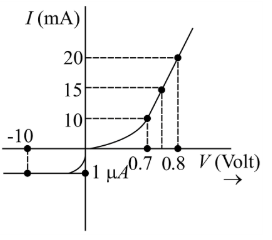
The $$V - I$$ characteristic of a diode is shown in the figure. The ratio of forward to reverse bias resistance is:
NTA JEE Main 8th April 2017 Online - Question 29
The conductivity of a semiconductor sample having electron concentration of $$5 \times 10^{18}$$ electrons m$$^{-3}$$, hole concentration of $$5 \times 10^{19}$$ holes m$$^{-3}$$, electron mobility of 2.0 m$$^2$$ V$$^{-1}$$ s$$^{-1}$$ and hole mobility of 0.01 m$$^2$$ V$$^{-1}$$ s$$^{-1}$$ is: (Take charge of an electron as $$1.6 \times 10^{-19}$$ C)
NTA JEE Main 8th April 2017 Online - Question 30
A signal of frequency 20 kHz and peak voltage of 5 Volt is used to modulate a carrier wave of frequency 1.2 MHz and peak voltage 25 Volts. Choose the correct statement.