
Join Our JEE Preparation Group
Prep with like-minded aspirants; Get access to free daily tests and study material.
Sign in
Please select an account to continue using cracku.in
↓ →
Join Our JEE Preparation Group
Prep with like-minded aspirants; Get access to free daily tests and study material.
First, let us recall the basic definition of partition chromatography. In this technique the separation of the components of a mixture takes place because each component distributes (or partitions) itself differently between two immiscible phases:
$$\text{solute (in mobile phase)} \rightleftharpoons \text{solute (in stationary phase)}$$
Here the mobile phase is a liquid that flows through the column or along the sheet, while the stationary phase is also a liquid but it is held in or on a finely divided inert solid support. The classical examples are paper chromatography and liquid-liquid column chromatography; in both cases the two phases are liquids.
Now we examine every given statement one by one.
Option A says, “Stationary phase is a finely divided solid adsorbent.” What really happens is that the stationary phase is liquid, yet this liquid is spread over (or trapped in) a finely divided solid matrix. So the wording may sound as if the solid itself were the stationary phase, but in fact the solid only plays the role of a support. Because the liquid is actually present on that solid, the overall description is considered acceptable in elementary discussions of partition chromatography. Therefore the essence of Option A is regarded as true for the purpose of this question.
Option B states, “Separation depends upon equilibration of solute between a mobile and a stationary phase.” This is exactly the defining principle of partition chromatography. Hence Option B is certainly true.
Option C claims, “Mobile phase can be a gas.” Let us note carefully that as soon as the mobile phase is a gas and the stationary phase is a liquid, the technique is specifically called gas-liquid chromatography (GLC). Although the mechanism behind GLC is still partition, in standard nomenclature GLC is treated as a separate category called “gas chromatography.” For the classical category named “partition chromatography,” both phases are taken to be liquids. Therefore saying that the mobile phase can be a gas is not accepted as a correct statement for ordinary partition chromatography.
Option D says, “Paper chromatography is an example of partition chromatography.” In paper chromatography water tightly held in the cellulose fibres acts as the stationary liquid, while another solvent such as ethanol-water mixture travels as the mobile liquid. So Option D is indeed true.
Summarising the truth values we have obtained:
$$ \begin{aligned} \text{Option A}& : \text{true},\\ \text{Option B}& : \text{true},\\ \text{Option C}& : \color{red}{\text{not true}},\\ \text{Option D}& : \text{true}. \end{aligned} $$
Only Option C fails to conform to the characteristic features of partition chromatography.
Hence, the correct answer is Option C.
Was this solution helpful?
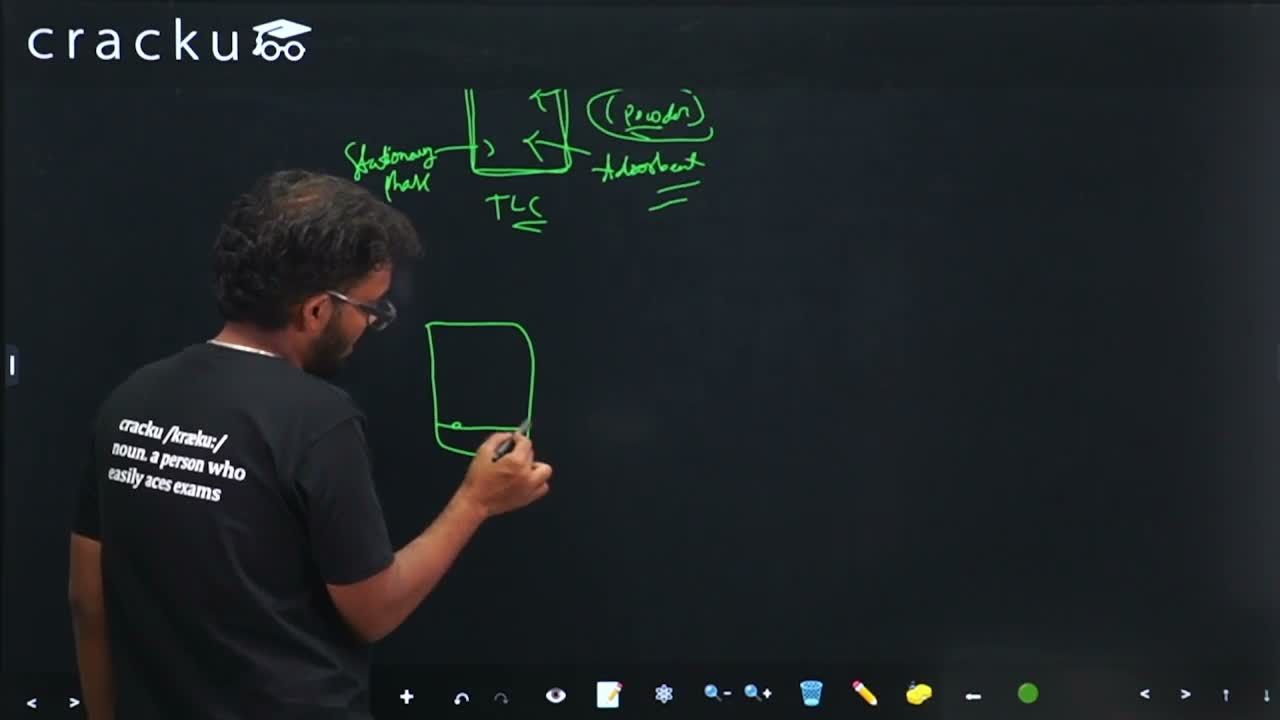
Click on the Email ☝️ to Watch the Video Solution
Create a FREE account and get:
_1.webp)

Educational materials for JEE preparation

Ask our AI anything

AI can make mistakes. Please verify important information.
AI can make mistakes. Please verify important information.


