
Join Our JEE Preparation Group
Prep with like-minded aspirants; Get access to free daily tests and study material.
Sign in
Please select an account to continue using cracku.in
↓ →
Join Our JEE Preparation Group
Prep with like-minded aspirants; Get access to free daily tests and study material.
If the sum of the first $$n$$ terms of the series $$\sqrt{3} + \sqrt{75} + \sqrt{243} + \sqrt{507} + \ldots$$ is $$435\sqrt{3}$$, then $$n$$ equals:
We begin by examining the individual terms of the given series.
The first term is $$\sqrt{3}=1\sqrt{3}$$.
The second term is $$\sqrt{75}=\sqrt{3\times 25}=5\sqrt{3}$$.
The third term is $$\sqrt{243}=\sqrt{3\times 81}=9\sqrt{3}$$.
The fourth term is $$\sqrt{507}=\sqrt{3\times 169}=13\sqrt{3}$$.
From the coefficients $$1, 5, 9, 13,\ldots$$ we notice an arithmetic progression where the first coefficient is $$1$$ and the common difference is $$4$$. Hence, the coefficient of $$\sqrt{3}$$ in the $$k^{\text{th}}$$ term equals
$$a_k = 1 + (k-1)\times 4 = 4k-3.$$
Therefore, the general (or $$k^{\text{th}}$$) term of the series is
$$T_k = (4k-3)\sqrt{3}.$$
Now we need the sum of the first $$n$$ terms. So we write
$$S_n = \sum_{k=1}^{n} T_k = \sum_{k=1}^{n} (4k-3)\sqrt{3}.$$
Because $$\sqrt{3}$$ is common to every term, we can factor it out:
$$S_n = \sqrt{3}\,\sum_{k=1}^{n} (4k-3).$$
We split the summation into two separate sums:
$$\sum_{k=1}^{n} (4k-3)=4\sum_{k=1}^{n}k - 3\sum_{k=1}^{n}1.$$
First, recall the standard formulas:
1. Sum of the first $$n$$ natural numbers: $$\displaystyle\sum_{k=1}^{n}k = \frac{n(n+1)}{2}.$$
2. Sum of $$n$$ ones: $$\displaystyle\sum_{k=1}^{n}1 = n.$$
Using these formulas we have
$$4\sum_{k=1}^{n}k = 4\left(\frac{n(n+1)}{2}\right) = 2n(n+1)=2n^2+2n,$$
and
$$3\sum_{k=1}^{n}1 = 3n.$$
Substituting back, we obtain
$$\sum_{k=1}^{n}(4k-3)= (2n^2+2n) - 3n = 2n^2 - n.$$
Therefore, the required partial sum is
$$S_n = \sqrt{3}\,(2n^2 - n).$$
According to the question, this sum equals $$435\sqrt{3}$$. Hence, we set
$$\sqrt{3}\,(2n^2 - n)=435\sqrt{3}.$$
Both sides contain the common factor $$\sqrt{3}$$, so we cancel it to obtain a purely quadratic equation in $$n$$:
$$2n^2 - n = 435.$$
Rearranging all terms to one side gives
$$2n^2 - n - 435 = 0.$$
Now we solve this quadratic equation. For a quadratic $$ax^2+bx+c=0$$, the roots are found by the quadratic formula
$$x = \frac{-b \pm \sqrt{b^2 - 4ac}}{2a}.$$
Here, $$a = 2$$, $$b = -1$$, and $$c = -435$$. First we calculate the discriminant:
$$\Delta = b^2 - 4ac = (-1)^2 - 4(2)(-435) = 1 + 3480 = 3481.$$
We notice that $$3481 = 59^2$$, so $$\sqrt{\Delta} = 59.$$
Substituting into the quadratic formula, we get
$$n = \frac{-(-1) \pm 59}{2\times 2} = \frac{1 \pm 59}{4}.$$
This yields two possible values:
1. $$n = \dfrac{1+59}{4} = \dfrac{60}{4} = 15,$$
2. $$n = \dfrac{1-59}{4} = \dfrac{-58}{4} = -14.5.$$
The second root is negative, and since the number of terms $$n$$ must be a positive integer, we discard it. Therefore, we are left with
$$n = 15.$$
Hence, the correct answer is Option B.
Was this solution helpful?
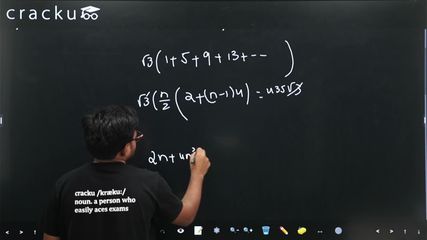
Click on the Email ☝️ to Watch the Video Solution
Create a FREE account and get:
_1.webp)

Educational materials for JEE preparation

Ask our AI anything

AI can make mistakes. Please verify important information.
AI can make mistakes. Please verify important information.


