
Join Our JEE Preparation Group
Prep with like-minded aspirants; Get access to free daily tests and study material.
Sign in
Please select an account to continue using cracku.in
↓ →
Join Our JEE Preparation Group
Prep with like-minded aspirants; Get access to free daily tests and study material.
Moment of inertia of an equilateral triangular lamina $$ABC$$, about the axis passing through its centre $$O$$ and perpendicular to its plane is $$I_0$$ as shown in the figure. A cavity $$DEF$$ is cut out from the lamina, where $$D$$, $$E$$, $$F$$ are the mid points of the sides. Moment of inertia of the remaining part of lamina about the same axis is:
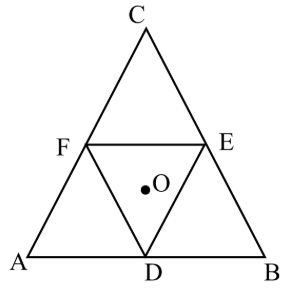
We consider the equilateral triangular lamina $$ABC$$ made of a material of uniform surface mass density $$\sigma\;(\text{mass/area})$$. About the axis that passes through its centroid $$O$$ and is perpendicular to the plane, its moment of inertia is given to be $$I_0$$.
Inside this triangle the points $$D,\;E,\;F$$ are the mid-points of the three sides, so joining them produces another equilateral triangle $$DEF$$. Because each side of $$DEF$$ joins mid-points, its length is exactly one-half of the length of $$ABC$$. Hence $$DEF$$ is similar to $$ABC$$ with a linear scale factor
$$k=\dfrac{\text{side of }DEF}{\text{side of }ABC}=\dfrac12.$$
First recall a standard result: for two geometrically similar laminae made of the same material,
mass $$\propto$$ (length)$$^2$$ and moment of inertia about corresponding central axes $$I \propto$$ (length)$$^4$$.
Stating this explicitly, if the scale factor is $$k$$, then
$$I_{\text{small}} = k^4\,I_{\text{large}}.$$
Applying this to our triangles, the moment of inertia of the inner triangle $$DEF$$ about the same central axis through $$O$$ is
$$I_{\text{DEF}} = k^4 I_0 = \left(\dfrac12\right)^4 I_0 = \dfrac1{16}\,I_0.$$
When the inner triangle is cut out, its mass and its moment of inertia are removed from the original lamina. Therefore the moment of inertia of the remaining portion is obtained by simple subtraction:
$$I_{\text{remaining}} = I_0 - I_{\text{DEF}} = I_0 - \dfrac1{16}I_0 = \left(1 - \dfrac1{16}\right)I_0 = \dfrac{15}{16}I_0.$$
Hence, the correct answer is Option B.
Was this solution helpful?
Create a FREE account and get:
_1.webp)

Educational materials for JEE preparation

Ask our AI anything

AI can make mistakes. Please verify important information.
AI can make mistakes. Please verify important information.


