JEE WhatsApp Group


JEE Organic Compounds with Halogens PYQ
JEE Organic Compounds with Halogens PYQs help you understand the preparation, properties, and reactions of haloalkanes and haloarenes. Questions from this chapter are commonly based on nucleophilic substitution, elimination reactions, the nature of the carbon-halogen bond, preparation methods, and named reactions.
The chapter becomes easier when you understand how the structure of a compound affects its reactivity. For example, haloalkanes can undergo nucleophilic substitution reactions, while haloarenes are generally less reactive because their carbon-halogen bond has partial double-bond character.
While preparing this chapter, focus on reaction conditions, the order of reactivity, and the difference between substitution and elimination. Regularly solving JEE Organic Compounds with Halogens Questions will help you recognise common reaction patterns and select the correct product.
In this blog, you can download important PYQs, revise key formulas and reactions, learn about common mistakes, and attempt selected questions as a chapter-wise test.
JEE Organic Compounds with Halogens Important PYQ PDF
The JEE Organic Compounds with Halogens Important PYQ PDF includes selected previous-year questions from haloalkanes, haloarenes, preparation methods, nucleophilic substitution, elimination, Grignard reagents, and important named reactions.
Practising these questions will help you understand which concepts are repeatedly tested in JEE. First, try to identify the substrate, reagent, solvent, and reaction conditions. These details will help you decide whether the reaction follows substitution, elimination, or another reaction pathway.
After completing the PDF, check your answers and revise weak concepts using reliable JEE Study Material. Do not memorise only the final product. Try to understand why a particular product is formed and how the reagent affects the reaction.
Important Formulas for Organic Compounds with Halogens PYQ
Organic Compounds with Halogens is mainly reaction-based. Therefore, your JEE Mains Formula Sheet should include important reaction equations, reactivity orders, and basic relations rather than only numerical formulas.
| Concept or Reaction | Formula or General Reaction |
|---|---|
| General formula of a monohaloalkane | CnH2n+1X |
| Hydrolysis of a haloalkane | R−X+KOH(aq)→R−OH+KX |
| Dehydrohalogenation | R−CH2−CH2X+KOH(alc)→Alkene+KX+H2O |
| Wurtz reaction | 2R−X+2Nadry etherR−R+2NaX |
| Finkelstein reaction | R−Cl/R−Br+NaIacetoneR−I+NaCl/NaBr |
| Swarts reaction | R−Cl/R−Br+AgF→R−F+AgCl/AgBr |
| Formation of Grignard reagent | R−X+Mgdry etherR−MgX |
| Reaction with ammonia | R−X+2NH3→R−NH2+NH4X |
| Reaction with KCN | R−X+KCN→R−CN+KX |
| Reaction with AgCN | R−X+AgCN→R−NC+AgX |
| Relative leaving-group ability | I−>Br−>Cl−>F− |
| Reactivity in an SN1 reaction | 3∘>2∘>1∘>CH3 |
| Reactivity in an SN2 reaction | CH3>1∘>2∘≫3∘ |
Remember that SN1 reactions depend mainly on carbocation stability, while SN2 reactions are affected by steric hindrance. Haloarenes are less reactive towards nucleophilic substitution than haloalkanes under ordinary conditions.
Top 5 Common Mistakes to Avoid in JEE Organic Compounds with Halogens PYQs
1. Confusing aqueous and alcoholic KOH
Aqueous KOH generally gives an alcohol through substitution, while alcoholic KOH generally produces an alkene through elimination.
2. Using the wrong reactivity order
The SN1 and SN2 mechanisms have different reactivity orders. Always identify the mechanism before comparing the substrates.
3. Ignoring the effect of the solvent
Polar protic solvents usually support SN1 reactions, while polar aprotic solvents generally favour SN2 reactions.
4. Treating haloarenes like haloalkanes
The carbon-halogen bond in haloarenes has partial double-bond character. Therefore, it is shorter, stronger, and more difficult to break.
5. Confusing KCN with AgCN
KCN usually forms a nitrile, while AgCN mainly forms an isocyanide. This difference is commonly tested in JEE questions.
List of JEE Organic Compounds with Halogens PYQs
Below, you can attempt selected JEE Organic Compounds with Halogens PYQs as a short chapter-wise test.
Question 1
Which of the following potential energy (P.E.) diagrams represents the S$$_N$$1 reaction?
correct answer:- 1
Question 2
The major product of the following reaction is:
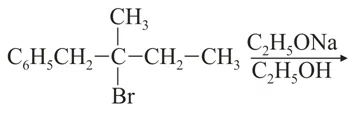
correct answer:- 1
Question 3
The major product in the given reaction is
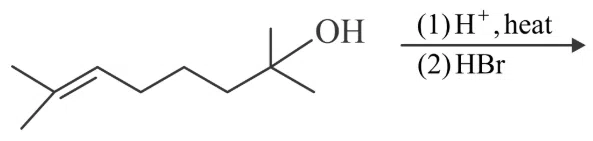
correct answer:- 3
Question 4
Identify the correct set of reagents or reaction conditions 'X' and 'Y' in the following set of transformation:

correct answer:- 4
Question 5
Among the following compounds, which one has the shortest C-Cl bond?
correct answer:- 4

Question 6
Consider the following compounds
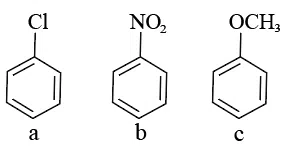
Arrange these compounds in the increasing order of reactivity with nitrating mixture.
correct answer:- 1
Question 7
The increasing order of the boiling points of the major products A, B and C of the following reactions will be:
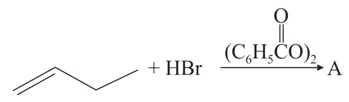
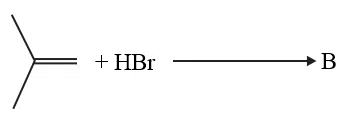
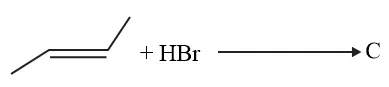
correct answer:- 1
Question 8
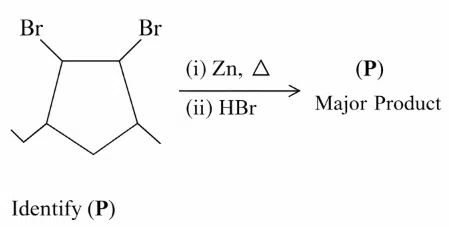
correct answer:- 3
Question 9
2-Methyl propyl bromide reacts with C$$_2$$H$$_5$$O$$^-$$ and gives 'A' whereas on reaction with C$$_2$$H$$_5$$OH it gives 'B'. The mechanism followed in these reactions and the products 'A' and 'B' respectively are:
correct answer:- 1
Question 10
Arrange the following compounds in the decreasing order of their reactivity towards $$S_N1$$ substitution (rate of solvolysis in aqueous ethanol):
I.
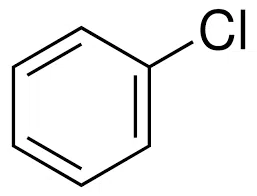
II.
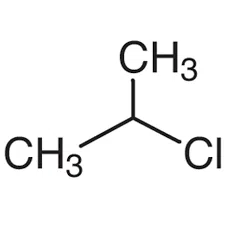
III.
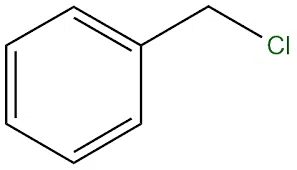
IV.
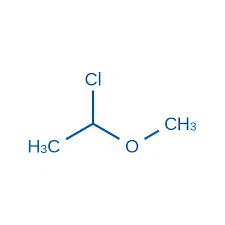
correct answer:- 2

Question 11
What is DDT among the following:
correct answer:- 4
Question 12
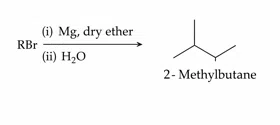
The maximum number of RBr producing 2-methylbutane by above sequence of reactions is ________ -
(Consider the structural isomers only)
correct answer:- 2
Question 13
Consider the following multi-step chemical transformation:
$$\text{Chlorobenzene}\xrightarrow{\text{Mg\ /\ Dry\ Ether}}P\xrightarrow{\text{(i)\ Dry\ Ice\ (CO}_{2}\text{),\ (ii)\ H}_{3}\text{O}^{+}}Q\xrightarrow{\text{PCl}_{5}}R$$
What is the final organic product $$R$$?
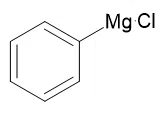
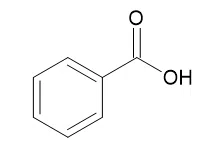
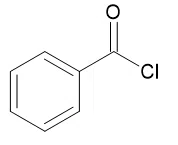
correct answer:- 1
Question 14
Reaction of trans-2-phenyl-1-bromocyclopentane on reaction with alcoholic KOH produces
correct answer:- 4
Question 15
The major product formed in the following reaction is:
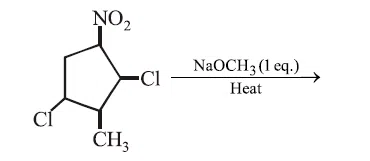
correct answer:- 1

Question 16
Which of the following will most readily give the dehydrohalogenation product?
correct answer:- 1
Question 17
Which of the following compounds will form the precipitate with aq. AgNO$$_3$$ solution most readily?
correct answer:- 4
Question 18
Consider the following reaction sequence involving a haloalkane:
$$\text{CH}_{3}-\text{CH}_{2}-\text{CH}_{2}-\text{Br}\xrightarrow{\text{alc.\ KOH,\ }\Delta }X\xrightarrow{\text{HBr\ (gas),\ no\ peroxides}}Y\xrightarrow{\text{aq.\ KOH}}Z$$
Identify the correct IUPAC name of the final organic product $$Z$$:
correct answer:- 2
Question 19
Which of the following reaction combinations will yield a pair of enantiomers (a racemic mixture) as the major organic product?
correct answer:- 4
Question 20
The correct order of reactivity of the following benzyl halides towards reaction with KCN is:
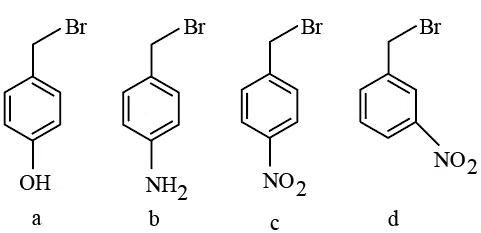
correct answer:- 1

Question 21
The major product obtained in the following reaction is,
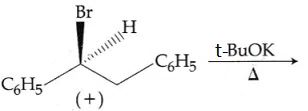
correct answer:- 1
Question 22
The increasing order of the reactivity of the following halides for the S$$_{N}$$1 reaction is
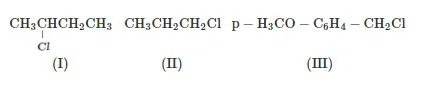
correct answer:- 1
Question 23
Identify the products [A] and [B], respectively in the following reaction :
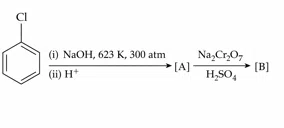
correct answer:- 2
Question 24
An 'Assertion' and a 'Reason' is given below. Choose the correct answer from the following options:
Assertion (A): Vinyl halides do not undergo nucleophilic substitution easily.
Reason (R): Even though the intermediate carbocation is stabilized by loosely held $$\pi$$-electrons, the cleavage is difficult because of the strong bonding.
correct answer:- 4
Question 25
Two isomers (A) and (B) with Molar mass 184 g/mol and elemental composition C, 52.2%; H, 49% and Br 42.9% gave benzoic acid and p-bromobenzoic acid, respectively on oxidation with KMnO$$_4$$. Isomer 'A' is optically active and gives a pale yellow precipitate when warmed with alcoholic AgNO$$_3$$. Isomer 'A' and 'B' are, respectively:
correct answer:- 3

Question 26
The decreasing order of reactivity of the following organic molecules towards AgNO$$_3$$ solution is:
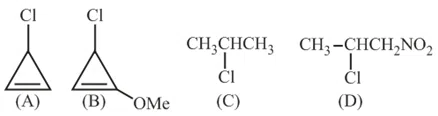
correct answer:- 4
Question 27
Given below are two statements:
Statement I: The dipole moment of R-CN is greater than R-NC and R-NC can undergo hydrolysis under acidic medium to produce $$O\\||\\R-C-OH$$.
Statement II: R-CN hydrolyses under acidic medium to produce a compound which on treatment with $$SOCl_{2}$$, followed by the addition of $$NH_{3}$$ gives another compound(x). This compound (x) on treatment with NaOCl/NaOH gives a product, that on treatment with $$CHCl_{3}/KOH/ \Delta$$ produces R-NC
In the Light of the above statements, choose the correct answer from the options given below
correct answer:- 1
Question 28
Identify $$A$$ and $$B$$ in the given chemical reaction sequence
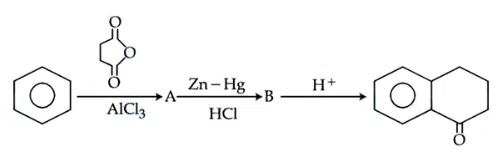
correct answer:- 3
Question 29
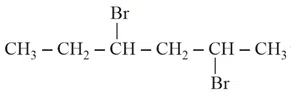
The product formed in the first step of the reaction with excess Mg / Et$$_2$$O / Et = $$C_2H_5$$ is
correct answer:- 1
Question 30
Compound from the following that will not produce precipitate on reaction with AgNO$$_3$$ is
correct answer:- 4
.webp)