
Join Our JEE Preparation Group
Prep with like-minded aspirants; Get access to free daily tests and study material.
Sign in
Please select an account to continue using cracku.in
↓ →
Join Our JEE Preparation Group
Prep with like-minded aspirants; Get access to free daily tests and study material.
The increasing order of the boiling points of the major products A, B and C of the following reactions will be:
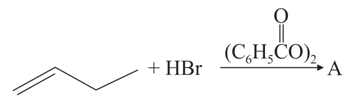
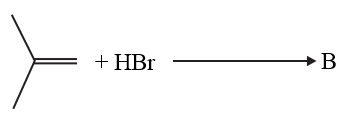
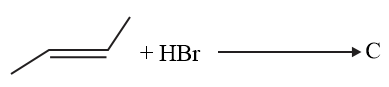
To determine the order of boiling points, we first predict the major products A, B, and C formed in the given addition reactions. All three products have the molecular formula $$C_4H_9Br$$ and are structural isomers.
Reaction A (Anti-Markovnikov Addition)
But-1-ene reacts with $$HBr$$ in the presence of benzoyl peroxide. The peroxide initiates a free-radical mechanism, leading to the anti-Markovnikov product in which bromine adds to the less substituted carbon.
Product A: 1-bromobutane (a straight-chain primary alkyl halide).
Reaction B (Markovnikov Addition)
2-Methylprop-1-ene reacts with $$HBr$$ through the normal electrophilic addition mechanism. Protonation forms the most stable tertiary carbocation, followed by bromide attack.
Product B: 2-bromo-2-methylpropane (tert-butyl bromide), a highly branched tertiary alkyl halide.
Reaction C (Markovnikov Addition)
But-2-ene reacts with $$HBr.$$ Since the alkene is symmetrical, addition from either side produces the same secondary carbocation.
Product C: 2-bromobutane (a branched secondary alkyl halide).
For these isomeric compounds, the boiling point depends primarily on the strength of intermolecular van der Waals (dispersion) forces, which in turn depend on the molecular surface area.
Straight-chain molecules such as Product A possess a larger surface area, allowing stronger intermolecular attractions and, therefore, a higher boiling point.
Branching makes molecules more compact and spherical, reducing the effective surface area and weakening dispersion forces. Product B is more highly branched than Product C and consequently has the lowest boiling point.
Hence, the boiling point order is:
Therefore, the increasing order of boiling points is
$$
B<C<A.
$$
This matches option A.
Was this solution helpful?
Create a FREE account and get:
_1.webp)

Educational materials for JEE preparation

Ask our AI anything

AI can make mistakes. Please verify important information.
AI can make mistakes. Please verify important information.


