
Join Our JEE Preparation Group
Prep with like-minded aspirants; Get access to free daily tests and study material.
Sign in
Please select an account to continue using cracku.in
↓ →
Join Our JEE Preparation Group
Prep with like-minded aspirants; Get access to free daily tests and study material.
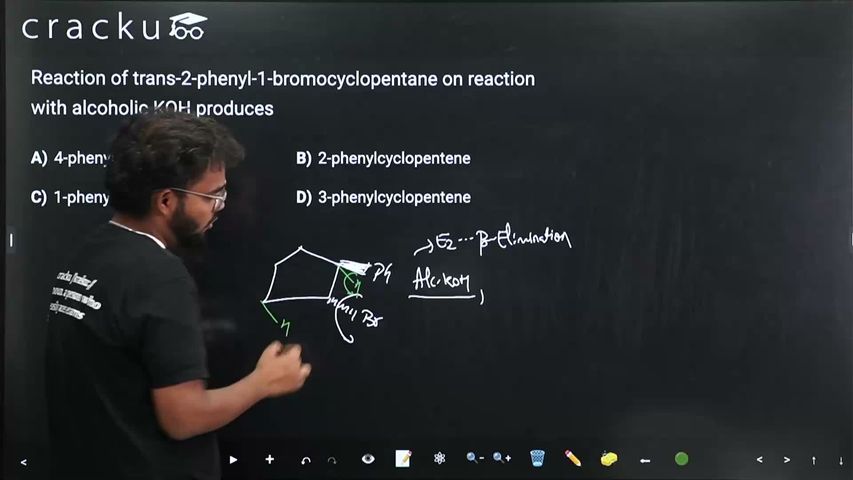
Reaction of trans-2-phenyl-1-bromocyclopentane on reaction with alcoholic KOH produces
trans-2-Phenyl-1-bromocyclopentane is a five-membered ring in which C-1 carries $$Br$$ and the adjacent C-2 carries a $$Ph$$ group. “trans’’ means the two substituents are on opposite faces of the ring (one above, one below the mean plane).
Alcoholic $$KOH$$ promotes an E2 (bimolecular β-elimination) reaction. In a concerted E2 step:
• the base abstracts a β-hydrogen that is anti-periplanar (180° dihedral angle) to the leaving group,
• the C-H and C-Br σ-bonds break while the C=C π-bond forms simultaneously.
For the present substrate the β-carbons relative to C-1 are C-2 and C-5. Therefore two eliminations are
formally possible:
$$\begin{array}{ll} \text{Path-I:}& C\!-\!1\,-\,C\!-\!2 \text{ double bond} \\[2pt] \text{Path-II:}& C\!-\!1\,-\,C\!-\!5 \text{ double bond} \end{array}$$
Case 1: Elimination across $$C_1\!-\!C_2$$
The required H on C-2 has to be anti-periplanar to $$Br$$. In the trans isomer, when $$Br$$ is oriented “up”, the phenyl group on C-2 is “down”. To make $$Br$$ anti to any H on C-2 we would need the $$Ph$$ group and that H to eclipse each other, which is sterically impossible in a stable conformer of cyclopentane. Hence no suitable anti β-H exists on C-2, so Path-I is ruled out.
Case 2: Elimination across $$C_1\!-\!C_5$$
C-5 possesses hydrogens on the face opposite to the phenyl group. One of these H atoms can adopt an anti-periplanar arrangement with the C-1 $$Br$$ in an accessible conformer of the flexible cyclopentane ring. Therefore Path-II satisfies the E2 geometric requirement and proceeds rapidly.
The immediate product of Path-II contains the double bond between C-1 and C-5. On renumbering the ring to give the double bond the lowest possible locants (IUPAC rule), this alkene is named 3-phenylcyclopent-1-ene, commonly written as 3-phenylcyclopentene.
Thus alcoholic $$KOH$$ converts trans-2-phenyl-1-bromocyclopentane to 3-phenylcyclopentene.
Option D which is: 3-phenylcyclopentene
Was this solution helpful?
Click on the Email ☝️ to Watch the Video Solution
Create a FREE account and get:
_1.webp)

Educational materials for JEE preparation

Ask our AI anything

AI can make mistakes. Please verify important information.
AI can make mistakes. Please verify important information.


